Learn · April 3, 2026
Building High-Performing Field Teams: Top 5 Secrets
Discover strategies for building high-performing field teams: recruitment, onboarding, territory design, culture, and tech for home services excellence.
By The Catalyst Editorial Team Operator education · 10 min read · Updated July 24, 2026

Why Building High-Performing Field Teams Is the Highest-Leverage Move You Can Make

Building high-performing field teams is one of the most impactful investments a home services business owner can make — and one of the easiest to get wrong.
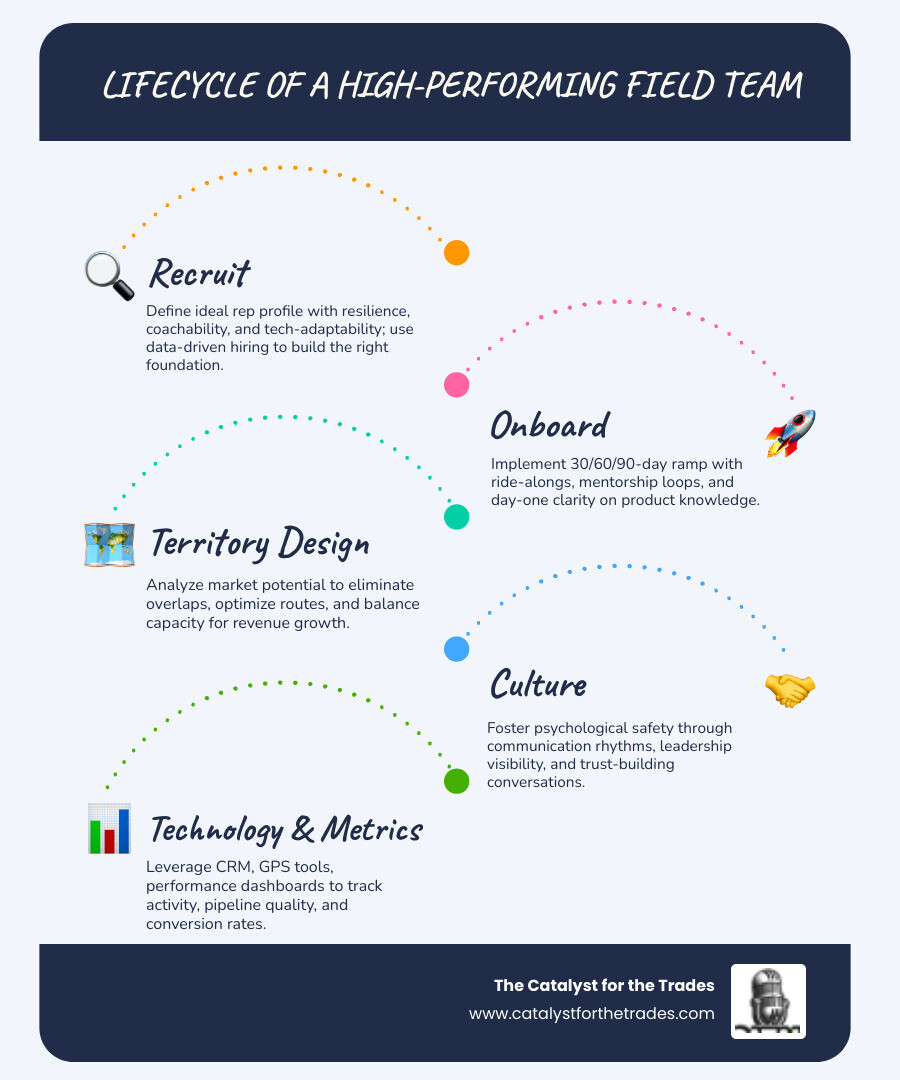
Here’s a quick breakdown of what it actually takes:
- Recruit the right profile — Hire for resilience, coachability, and tech-adaptability, not just experience.
- Onboard with structure — Use ride-alongs, mentorship, and a clear 30/60/90-day ramp plan.
- Design territories strategically — Start with market potential, not a map. Poor territory management can cost up to 7% in annual revenue.
- Build culture across distance — Consistent communication rhythms and visible leadership matter more than office proximity.
- Track the right metrics — Activity, pipeline quality, and conversion rates tell you far more than revenue alone.
- Use the right tools — CRM, GPS optimization, and performance dashboards reduce admin drag and keep reps selling.
Most home services businesses don’t fail because of bad technicians or weak demand. They fail because they never built the system around their people.
Consider this: only 15% of employees know their organization’s most important goals. In a field environment — where your team is spread across neighborhoods, job sites, and service routes — that number can feel even smaller. When your reps don’t know what winning looks like, they can’t consistently deliver it.
And the stakes are real. Enterprise-style field deals often involve multiple decision-makers and extended sales cycles. Even in residential home services, closing a job isn’t just a transaction — it’s a relationship. Research consistently shows that 87% of salespeople say in-person connections remain critical for building trust and closing deals. Your field team is your brand, every single day.
The good news? High performance in the field isn’t about hiring superstars and hoping for the best. It’s about building a repeatable system — one where the right people, clear territories, strong culture, and smart technology work together.
This guide walks you through every layer of that system.
Defining the High-Performing Field Sales Team
What exactly makes a field team “high-performing”? It’s not just about hitting a revenue target. In the trades, a high-performing team is a group of individuals who operate with a high degree of autonomy while remaining deeply connected to a shared mission. Unlike an office-based team where you can peek over a shoulder or have a quick water-cooler chat, field teams operate in the “wild.”
Their work is defined by physical presence and intense customer-centricity. When a rep or technician walks into a home, they aren’t just selling a repair; they are managing a complex environment involving homeowners, family members, and sometimes even other contractors. This requires a unique blend of relationship-building skills and technical expertise.
We often see that the most successful organizations prioritize Workforce Planning to ensure they have the right capacity to meet demand without burning out their best people. High performance also relies on interdependent work. While a tech might be alone in a van, their success depends on the dispatcher, the warehouse manager, and the sales lead. When these roles align, you create a “Public Victory” where the whole is greater than the sum of its parts. For a deeper dive into these dynamics, check out our guide on Team Building Strategies.
Strategies for Building High-Performing Field Teams through Recruitment
If you want to build a powerhouse, you have to stop hiring based on “gut feeling” and start using a Strategic Recruiting engine. The foundation of building high-performing field teams is defining the ideal profile.
In the home services industry, we look for three non-negotiables:
- Resilience: Can they handle the “no” at the doorstep or the difficult customer without losing their drive?
- Tech-Adaptability: As we integrate more AI and mobile CRM tools, your team must be comfortable navigating digital stacks.
- Coachability: Are they willing to drop old habits to adopt your company’s proven system?
We recommend a data-driven approach to Talent Acquisition. This means sourcing candidates where top performers actually hang out — LinkedIn, industry-specific events, and through internal referrals — rather than just spraying and praying on generic job boards. Your Employer Branding should scream that you are a place where winners want to work.
Mitigating the Too-Much-Talent Effect in Field Sales
It sounds counterintuitive, but you can have too much of a good thing. Research shows that when more than approximately one-third of a team are “star performers,” results often start to diminish. This is known as the “too-much-talent” effect.
Why does this happen? In a field environment, stars often have big egos. If everyone is trying to be the “alpha,” collaboration stalls, and internal competition turns toxic. To drive collective outcomes, you need a balance. You want stars to lead the way, but you also need a strong supporting cast that excels at execution and consistency.
Effective Talent Management involves positioning your stars at the center of your workflow where they can mentor others, while ensuring the team culture rewards collective wins over individual glory. 10% of your workforce often accounts for 30% of productivity, but they can’t carry the whole company if the other 90% isn’t aligned.
Onboarding for Building High-Performing Field Teams
You’ve found a great candidate. Now, don’t just throw them the keys to a van and wish them luck. That is the fastest way to contribute to the 35% turnover rate seen in sales roles.
A world-class onboarding program provides “Day-One Clarity.” This includes:
- Mentorship Loops: Pairing the new hire with a veteran for ride-alongs. There is no substitute for seeing how a pro handles a real-world customer objection.
- 30/60/90-Day Ramp: Set clear, measurable goals for the first three months. This might include time-to-first-meeting or lead conversion benchmarks.
- Product Knowledge: They need to be experts in what they are offering. If they don’t believe in the value, the customer won’t either.
By focusing on Hiring Process Optimization, you ensure that every new hire feels supported, leading to long-term Employee Growth and loyalty.
Scaling Operations: Territory Design and Onboarding
As you grow, how you divide your “turf” becomes critical. Many owners make the mistake of drawing lines on a map based on zip codes that “look right.” High-performing teams do it differently. They focus on market potential and Operational Efficiency.
| Feature | Geographic Mapping | Market Potential Design |
|---|---|---|
| Primary Focus | Physical boundaries/Zip codes | Customer density and lead quality |
| Travel Time | Often high and unpredictable | Optimized for maximum “wrench time” |
| Balance | Some reps get “gold mines,” others get “deserts” | Equitable distribution of opportunity |
| Revenue Impact | Can cost up to 7% in annual loss | Can increase revenue by 2% to 7% |
Strategic territory design ensures that you aren’t leaving “orphaned accounts” — customers who haven’t been contacted in 60+ days — just because they fall between two reps’ zones. For more on streamlining these back-office functions, consult our HVAC Business Operations Guide. Constant Process Improvement is the only way to ensure your scaling doesn’t lead to chaos.
Strategic Territory Management for Building High-Performing Field Teams
Territory management isn’t a “set it and forget it” task. We recommend rebalancing territories at least twice a year. Use data to see where your reps are spending their time. If a rep is spending 30% or more of their day driving, your territory is too large or poorly mapped.
By using System Integration to link your CRM with mapping tools, you can maintain “coverage warmth” during transitions. If a rep leaves, the system should immediately flag their high-value accounts so a manager or another rep can step in before the relationship goes cold.
Cultivating Culture and Trust in Distributed Teams
Building a culture when your team is rarely in the same room is a unique challenge. It requires intentionality and a focus on psychological safety.
One of the most powerful concepts we’ve encountered is the “Last 8%.” Research shows that team members often hold back the last 8% of what they really think during difficult conversations — the part that contains the most critical growth insights. High-performing teams normalize these hard truths. They have the courage to speak up and the connection to listen.
As Mike Disney discusses in his episode on Building Trust, trust is the bedrock of performance. Without it, your “visibility” tools just feel like surveillance.
To keep your team engaged:
- Establish Rhythms: Weekly all-hands calls, monthly regional check-ins, and quarterly face-to-face meetings.
- Visibility: Leadership must be accessible. If the only time a tech hears from the boss is when they mess up, you’ve already lost their heart.
- Retention: Use your Employee Retention Strategies Guide 2026 to create clear career paths. People stay where they see a future.
Leveraging Technology and Metrics for Field Excellence
You cannot manage what you do not measure. In the modern home services landscape, your tech stack is your competitive advantage.
A high-performing field organization needs a “Performance Intelligence” stack:
- CRM as System of Record: Every interaction, from the first call to the final invoice, must be logged.
- GPS and Route Optimization: This isn’t about “spying”; it’s about reducing drive time so your team can get home to their families earlier while hitting their numbers.
- Field Service Management Software: To handle dispatching, invoicing, and real-time communication.
When it comes to Performance Management, stop looking only at trailing indicators like total revenue. By the time you see a revenue drop, it’s too late to fix the cause. Instead, track:
- Activity Metrics: Number of visits, calls made, and proposals sent.
- Conversion Rates: Are they closing the leads they are given?
- Secondary Sales: Tracking product movement through the supply chain to predict future demand.
As Mike Abramowitz shares in his episode on Building Predictable Freedom, systems are what allow you to scale without losing your mind. When you have data-driven visibility, you can coach your team based on facts rather than feelings.
Frequently Asked Questions about Field Team Management
What are the key KPIs for field team performance?
While revenue is the ultimate goal, high-performing teams focus on leading indicators. These include customer satisfaction scores (NPS), lead-to-appointment conversion rates, average deal size, and “wrench time” (the percentage of the day spent actually performing service versus driving or doing admin).
How does territory design impact revenue?
Poorly managed territories lead to “turf burning” and high travel costs. Strategic design balances the workload so reps spend more time in front of customers. Research indicates that optimized territory mapping can unlock a 2% to 7% increase in annual revenue simply by improving coverage and reducing waste.
How can leaders foster trust in geographically distributed teams?
Trust is built through transparency and consistency. Leaders should share company goals openly and use “closed-loop communication” (repeating back what was heard to ensure clarity). Most importantly, frame technology and data as coaching tools meant to help the team succeed, rather than sticks to punish them.
Conclusion
Building high-performing field teams is a journey, not a destination. It requires a commitment to workforce development and a willingness to invest in the systems that support your people. When you combine the right recruiting strategy with data-driven territory design and a culture of high trust, you create an organization that can weather any disruption.
At The Catalyst for the Trades, we are dedicated to helping home service leaders bridge the gap between where they are and where they want to be. By leveraging modern technology and timeless leadership principles, you can build a team that doesn’t just work for you, but wins with you.
Learn more about our mission and start building your high-performance system today.
For more insights on scaling your trade business, listen to the Think Fast, Talk Smart communication series on Apple Podcasts or Spotify.


