Learn · March 31, 2026
Entrepreneurship in the Trades: Top 7 Steps
Master entrepreneurship in the trades: Scale your business, solve labor shortages, and lead with proven strategies for growth.
By The Catalyst Editorial Team Operator education · 9 min read · Updated July 24, 2026

Why Entrepreneurship in the Trades Is One of the Most Powerful Business Opportunities Right Now

Entrepreneurship in the trades is the path of building and owning a skilled trades business — think plumbing, electrical, HVAC, or construction — rather than working for someone else. Here’s what you need to know upfront:
- Demand stays consistent — essential home and property services are needed year-round
- Growth potential is real — you can expand from a small operation into a multi-crew business with strong systems
- Many owners start in the field and eventually build a company that serves their community at scale
- Common challenges include hiring, leadership, and building repeatable processes
- The biggest rewards are independence, community impact, and the ability to build a business you can eventually sell
The skilled trades have always been the backbone of the economy. Homes need to be built. Pipes need to flow. Wiring needs to work.
But here’s what most “start your own business” advice gets wrong: owning a trades business is not just about being great at the craft. It’s about leading people, managing systems, solving problems at scale, and making smart decisions under pressure.
Whether you’re already running a small shop and wondering how to grow without burning out, the path forward requires more than technical skill. It takes a real business strategy.
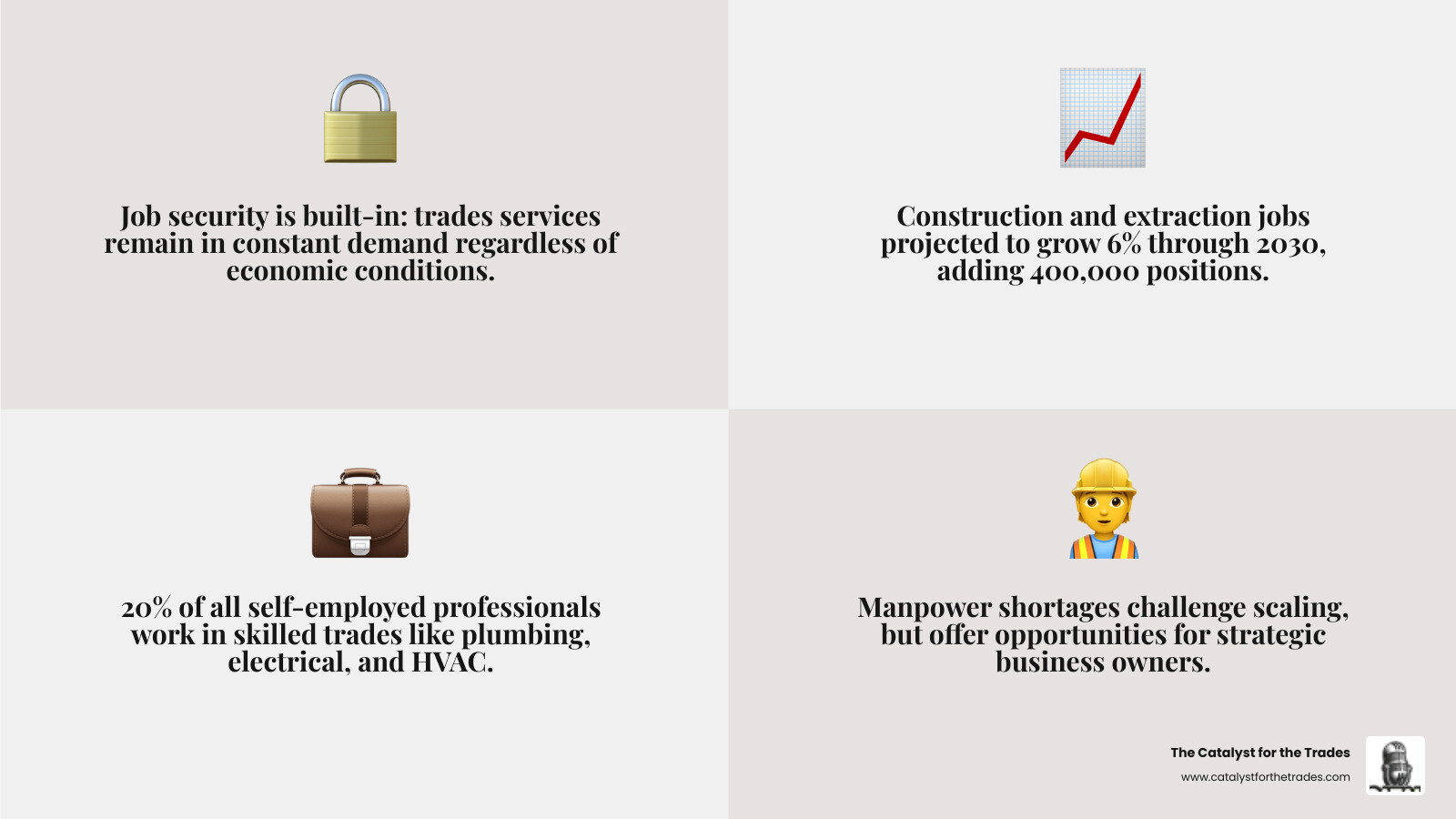
Entrepreneurship in the trades terms simplified:
The Reality of Entrepreneurship in the Trades
When we talk about entrepreneurship in the trades, it’s easy to get swept up in the romance of being your own boss. No more punching a clock for someone else, right? While that’s true, we have to be honest about the trade-offs. Transitioning from a technician to an owner means your tools change from wrenches and multimeters to spreadsheets and Contractor Leadership skills.
The biggest reality check is the time commitment. As an employee, you might work a hard eight or nine hours and go home. As a business owner, you are “on” 24/7. We’ve seen owners who handle calls at 2:00 AM because a pipe burst or a server went down for a major client. It’s a high-stress environment where you’re responsible for payroll, vendor relationships, equipment maintenance, and insurance.
However, the benefits often outweigh the sleepless nights. You aren’t just earning a paycheck; you’re building an asset. Successful trades businesses offer incredible scalability. You can start as a “man in a van” and grow into a fleet of 14 or 20 trucks serving an 80-mile radius. This level of growth allows you to have a massive community impact, providing stable, high-paying jobs to others in your area. To get there, you must master Organizational Leadership, moving from doing the work to managing the people who do the work.
Transitioning from Skilled Employee to Strategic Owner
Making the jump from employee to owner is a psychological and operational shift. We recommend starting with a clear niche identification. The “jack of all trades” often ends up being the master of none—and usually the most exhausted. Are you going to focus on new residential construction? High-end retrofits? Emergency plumbing? Specializing helps you streamline your team, tools, and processes.
Before you buy your first truck, you need a plan. This isn’t just a piece of paper for the bank; it’s your roadmap. You need to look at Business Valuation Contractors to understand what makes a business actually worth something in the long run. If the business can’t run without you being on every job site, you don’t have a business—you have a job that you can’t quit.
Risk mitigation is another huge factor. You need to account for the “emotional valleys” that come with starting out. Projections should be conservative. We often see new owners underestimate the day-to-day operational load—dispatch, scheduling, inventory, fleet readiness, and customer communication. By implementing solid Business Growth Strategies, you can prepare for the lean months and scale during the busy ones.
Essential Steps for Entrepreneurship in the Trades
- Legal and Licensing: Ensure all certifications and local permits are in place to build client trust.
- Branding: Your brand is more than a logo. It’s the promise of quality. Professional uniforms and clean trucks reinforce a consistent customer experience.
- Sales and Team Building: You can’t do it all. Focus on Sales Team Development early so you aren’t the only one closing deals.
- Online Presence: In today’s market, your website is your storefront. Reviews and local SEO support long-term visibility.
- Vendor Relationships: Build strong ties with your suppliers. When parts are scarce, those relationships help keep jobs moving.
Streamlining Operations in Trades Entrepreneurship
Efficiency is the difference between profit and loss. We’ve seen how adopting the latest tools—like cordless equipment that saves setup time—can add up to hours of saved labor every week. But it’s not just about physical tools.
Using technology for Home Service Business Growth means embracing troubleshooting apps and digital timecards. Imagine your team being able to pull up a spec sheet or a code requirement on an iPad in the middle of a crawlspace. This reduces mistakes and keeps projects moving.
Leveraging Technology and Systems for Scalable Growth
One of the most exciting aspects of modern entrepreneurship in the trades is how technology levels the playing field. Gone are the days of paper invoices getting lost in the truck. Today, we use integrated software to manage the entire customer lifecycle.
FaceTime has become a secret weapon for many trade owners. If a junior technician is stuck on a complex repair, they can hop on a video call with a senior lead to troubleshoot in real-time. This provides instant mentorship and ensures the job is done right the first time without needing to send a second truck.
Scheduling software and GPS navigation are no longer optional. They allow us to optimize routes, saving on fuel and vehicle wear and tear. Automated invoicing ensures that as soon as a job is finished, the bill is in the customer’s inbox, significantly improving cash flow.
To truly scale without losing your mind, we often point owners toward systems like the Entrepreneurial Operating System (EOS). Understanding How EOS Helps You Scale Without the Chaos is vital. It helps you define clear roles, set measurable goals, and ensure everyone in the company is pulling in the same direction.
Solving the Manpower Crisis through Leadership and Culture
The labor shortage is the “elephant in the room” for every trades business. We know that construction and extraction roles are growing, but there aren’t enough people entering the field to keep up. This is where your role as a leader becomes critical.
If you want to grow, you have to be a place where people want to work. This starts with Recruitment Marketing. You aren’t just selling your services to customers; you’re selling your company to potential employees. Your Employer Branding should highlight your culture, your benefits, and your vision.
We’ve found that Employee Loyalty isn’t just about the hourly wage. It’s about treatment. Do you offer health insurance? A 401k? Do you provide the best tools and latest technology so their jobs are easier and safer?
Mentorship programs are another way to beat the shortage. Instead of looking for the “perfect” tech who doesn’t exist, hire for character and train for skill. By creating a pipeline where apprentices can see a clear path to becoming leads or even partners, you solve your manpower problem while building a legacy.
Case Study: Lessons from High-Growth Trade Leaders
When we look at real-world examples of success in entrepreneurship in the trades, a few names stand out. Take the story of Mike Corsillo. He represents the “unconventional journey”—rebuilding from a point of total loss to creating a thriving plumbing business with 22 employees and 14 trucks. His success wasn’t just about knowing pipes; it was about his “fierce entrepreneurial spirit” and his dedication to the trades talent pipeline.
Then there’s the blueprint provided by Vince Heuser. You can learn exactly how he scaled in the episode From Zero to 22 Million: Vince Heuser’s Blueprint for Explosive Home Service Growth. His journey emphasizes that explosive growth is possible when you combine technical excellence with rigorous business systems.
We also look to leaders like Mark Evans, who discusses the broader picture of Mastering the Trades: Mark Evans on Building Wealth, Legacy, and Financial Freedom. These leaders teach us that the biggest hurdle isn’t usually the competition—it’s self-doubt.
The most successful owners are those who learn to “fail fast,” set firm boundaries to maintain work-life balance, and realize that they are artists in their own right. Whether you’re sanding a floor or wiring a smart home, there is a level of craftsmanship and pride that fuels the best businesses.
Frequently Asked Questions about Trades Ownership
Is starting a business better than advancing within an established company?
Not necessarily. Owning a business involves 24/7 stress and significant financial risk. For many, advancing to a senior leadership role in an established, large-scale company offers higher wages and better work-life balance without the headache of payroll and taxes. However, if you have a burning desire for independence and want to build a sellable asset, entrepreneurship is the way to go.
How does technology impact efficiency in the field?
Technology is a massive force multiplier. Between digital timecards that prevent “time theft,” GPS that optimizes routes, and iPads that allow for on-site troubleshooting via video, technology can easily save a business 10-20% in wasted labor costs every single month.
Why is employee retention critical to measuring success?
In the trades, your people are your product. High turnover leads to inconsistent quality, lost customer trust, and massive recruitment costs. A business that retains its employees is one that has mastered its culture, its leadership, and its long-term profitability.
Conclusion
At The Catalyst for the Trades, we believe that the skilled trades offer a path to freedom and wealth that few other industries can match. But to get there, you have to move beyond the “technician” mindset and embrace the role of a strategic owner. By focusing on innovation, leveraging modern technology, and leading your team with heart, you can turn a small shop into a local powerhouse.
Ready to take your business to the next level? Entrepreneurship in the trades is a journey, and you don’t have to walk it alone. Listen to the latest episodes for more growth strategies and join a community of owners who are redefining what it means to be a modern tradesperson. Let’s build something great together.


