Learn · May 14, 2026
Executive Leadership in Service Businesses: 2026 Guide
Master executive leadership in service businesses: Boost retention, drive growth, and lead like industry pros with proven strategies.
By The Catalyst Editorial Team Operator education · 9 min read · Updated July 24, 2026

Why Executive Leadership in Service Businesses Makes or Breaks Your Growth
Executive leadership in service businesses is the single biggest factor separating companies that scale from those that stall.
Here is a quick breakdown of what it means and why it matters:
What is executive leadership in service businesses?
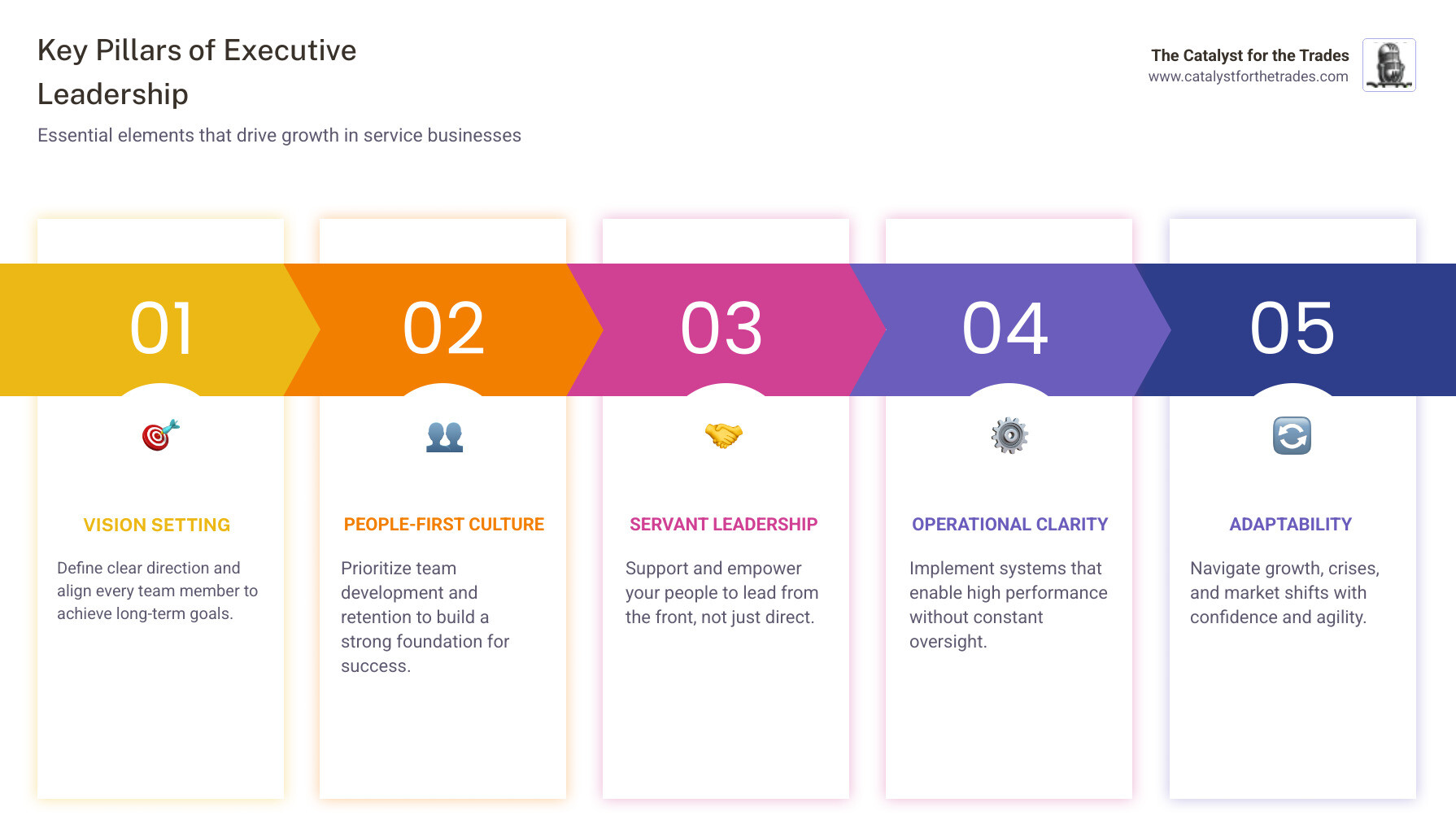
| Element | What It Means for Service Companies |
|---|---|
| Vision Setting | Defining where the business is headed and how every team member fits |
| People-First Culture | Prioritizing team development and retention over pure operational output |
| Servant Leadership | Leading by supporting your people, not just directing them |
| Operational Clarity | Building systems so teams perform well without constant oversight |
| Adaptability | Responding to growth, crises, and market shifts with confidence |
If you run a home services business — plumbing, HVAC, electrical, or any trade — you already know that your team is your product. Customers do not experience your brand through a website or a storefront. They experience it through your technicians, your dispatchers, and every person who picks up the phone.
That is exactly why leadership at the top has an outsized impact here. According to research on workforce retention, 17.4% of employees leave because of a lack of career development, and nearly 10% leave because of poor management. In a labor-tight industry like home services, those numbers are not abstract — they represent trucks sitting idle and jobs left unfinished.
The leaders who get this right do not just manage. They build cultures, develop people, and create businesses that grow without depending entirely on the owner.
Basic executive leadership in service businesses terms:
Defining Executive Leadership in Service Businesses
In home services, executive leadership isn’t just about sitting in a corner office reviewing spreadsheets. It is the high-level steering of an organization toward its primary mission. For a plumbing or HVAC company, this means balancing three critical pillars: mission accomplishment, resource acquisition, and external affairs.
Unlike manufacturing, where a leader oversees a production line, executive leadership in service businesses involves managing the “human element.” You aren’t selling a widget; you are selling a promise of comfort, safety, and reliability delivered by a human being. This requires a deep understanding of Organizational Leadership that prioritizes the technician just as much as the customer.
What makes this industry different? In other sectors, the product is static. In ours, the “product” (the service) happens in real-time, often in a customer’s basement or attic. This creates a unique need for Industry Leadership that empowers employees to make autonomous, high-quality decisions on the fly. Effective executives ensure that the company’s values aren’t just posters on the wall; they are lived out at every service call.
Essential Skills for Executive Leadership in Service Businesses
To lead a service business effectively in April 2026, an executive needs more than just technical trade knowledge. They need a toolkit of “soft” skills that drive “hard” results. Strategic thinking is at the top of the list—the ability to look at the horizon and see where the market is going before the competition does.
Key skills include:
- Decision-Making Under Pressure: Whether it’s a sudden heatwave or a supply chain disruption, leaders must stay calm and decisive.
- Emotional Regulation: Service businesses are high-stress. Leaders must manage their own emotions to help their teams navigate difficult customer interactions.
- Prioritization: Knowing which “fires” to put out first is vital when you have fifty technicians in the field and a hundred ringing phones.
- Executive Presence: The ability to project confidence and inspire trust, even when things are chaotic.
Mastering these Leadership and Management Keywords is essential for anyone looking to move from a “boss” to a true executive. This often requires ongoing Management Development to sharpen cognitive skills like planning and organizing.
Core Qualities of High-Impact Service Leaders
What does a “pro” leader actually look like in the trades? It starts with superior communication. We aren’t just talking about giving orders; we mean two-way communication where the leader listens as much as they speak. High-impact leaders foster a collaborative mindset, ensuring that the sales team, the dispatchers, and the field technicians are all pulling in the same direction.
Contractor Leadership also demands a high level of accountability. If a job goes wrong, the executive doesn’t look for someone to blame—they look for the system failure that allowed the mistake to happen. This requires flexibility; the home services industry changes fast, and leaders must be willing to pivot their strategies when the old ways stop working.
Many successful executives participate in a Leadership Circles Guide to gain outside perspectives. This helps them develop emotional intelligence (EQ) and “grit.” In the service world, grit is the ability to out-run a fear of failure through sheer hard work and resilience. It’s about being present on the floor, not hiding in the office, and showing the team that you are willing to do whatever it takes to help them succeed.
Servant Leadership: Lessons from Industry Giants
Servant leadership is a term that gets tossed around a lot, but in the service industry, it is a survival strategy. It is the belief that a leader’s primary job is to serve their employees so that the employees can better serve the customers.
We can learn a lot from leaders in the restaurant and hospitality sectors—industries that share our “people-as-the-product” DNA. For instance, top executives at major chains like Denny’s or Jack in the Box have long emphasized that a culture grounded in servant leadership creates organizational resilience. When employees feel cared for, they stay longer and work harder.
Consider these servant leadership traits:
- Inverting the Pyramid: The CEO works for the managers, who work for the technicians, who work for the customers.
- Empathy: Understanding the physical and mental toll of trade work.
- Investment in Growth: Providing clear pathways for a helper to become a lead technician, and a lead to become a manager.
- Community Integration: Building a brand that the local community respects and trusts.
Whether it’s the story of a franchisee turning around failing stores through team support or a CEO in the home services space like those at Stellar Service Brands, the lesson is the same: People-First Leadership in Construction and trades is the most direct path to growth. These leaders don’t see training as an expense; they see it as “protection” for their brand’s reputation. If you’re looking to implement this, exploring Leadership Development Programs can provide the framework you need to start leading with purpose.
Balancing Operational Efficiency with Team Culture
One of the hardest parts of executive leadership in service businesses is finding the “sweet spot” between running a tight ship and maintaining a happy crew. If you focus only on efficiency (doing things right), you might burn out your team. If you focus only on effectiveness (doing the right things), you might go broke.
| Focus Area | Efficiency (The “How”) | Effectiveness (The “Why”) |
|---|---|---|
| Goal | Speed and cost-reduction | Customer satisfaction and brand loyalty |
| Risk | Employee burnout and “transactional” feel | High overhead and lack of scalability |
| Leadership Style | Transactional / Systems-heavy | Transformational / People-heavy |
As of 2026, the data is clear: 17.4% of employees cite a lack of career development as their reason for leaving. Another 9.8% leave because of poor management. This means that if your “efficiency” involves ignoring your team’s growth, you will lose your best people.
True Trades Leadership Development involves building systems that allow teams to operate independently. When you have clear expectations and consistent training from day one, your team feels supported rather than micromanaged. This is the “hospitality mindset” applied to the trades—treating your associates with the same respect you want them to show your customers. Use a Leadership Training Contractors Guide to build these systems so your business can run like a well-oiled machine even when you aren’t there.
Navigating Growth and Future Industry Trends
The future of executive leadership in service businesses is inextricably linked to technology and adaptability. By April 2026, we are seeing a massive shift in how leaders use “contextual intelligence”—the ability to understand the macro-forces (like AI and economic shifts) and micro-forces (like local labor shortages) affecting their business.
Leaders must identify innovation barriers within their own companies. Often, the biggest barrier is a “we’ve always done it this way” mentality. Embracing Change: The Future of Leadership means being willing to experiment with design-thinking—a process of solving problems by deeply understanding the user’s (or employee’s) experience.
For senior executives with decades of experience, the challenge is staying “curious” rather than just “correct.” It’s about leveraging Leadership and Management Keywords 0ed17 to stay relevant in a world where tech moves faster than ever.
Preparing for the Future of Executive Leadership in Service Businesses
As we look toward the later half of the 2020s, several trends are emerging that every service leader should prepare for:
- Technological Shifts: Moving beyond simple dispatch software to AI-driven predictive maintenance and customer interaction.
- Building a Team That Drives Growth: You can’t do it alone. The Future of Leadership: How to Build a Team That Drives Growth focuses on finding people whose strengths cover your weaknesses.
- Remote Relationship-Building: As businesses scale and some roles go remote, leaders must find new ways to maintain culture without being in the same room.
- Legacy-Building: Late-career executives are shifting their focus from “how much can I make?” to “what can I leave behind?”
- Inclusive Pipelines: Building a diverse workforce isn’t just a social goal; it’s a business necessity to tap into all available talent pools.
Frequently Asked Questions about Service Leadership
How do executives drive employee retention in 2026?
Retention in 2026 is driven by three things: career pathways, empathetic management, and a sense of purpose. Employees want to know that their job isn’t a dead end. Executives who invest in Leadership Development Programs and provide clear “ladders” for advancement see much lower turnover rates.
What is the difference between efficiency and effectiveness in service?
Efficiency is about “doing things right”—like reducing drive time between calls or lowering material waste. Effectiveness is about “doing the right things”—like ensuring the customer’s problem is actually solved and they feel valued. A “pro” leader knows that efficiency keeps the lights on, but effectiveness grows the brand.
How can leaders maintain culture during rapid scaling?
The key to maintaining culture during growth is “cloning” your values through systems. As you add more trucks and more people, you cannot be everywhere at once. You must have a strong middle-management layer that has been trained in your specific leadership style. Consistent communication and “living” your values (not just posting them) are non-negotiable.
Conclusion
At The Catalyst for the Trades, we believe that the trades are the backbone of the economy, and they deserve world-class leadership. Executive leadership in service businesses is about more than just profit; it’s about creating a legacy of excellence, innovation, and respect for the people who do the work.
Whether you are looking for strategies for operational scaling or trying to navigate the latest technological shifts, your greatest asset is your team. Lead them with intention, serve them with humility, and the growth will follow.


