Learn · May 12, 2026
Vendor Selection Strategies: 5 Pro Tips 2026
Master vendor selection strategies: Streamline sourcing, evaluate risks, negotiate SLAs, and monitor performance for business growth.
By The Catalyst Editorial Team Operator education · 9 min read · Updated July 24, 2026

Why Your Vendor Selection Strategies Can Make or Break Your Business
Vendor selection strategies are the structured methods businesses use to identify, evaluate, and choose the right suppliers — and for home service businesses, getting this wrong can cost you months of wasted effort, budget overruns, and operational headaches.
Here’s a quick overview of the core vendor selection strategies:
- Define your requirements — Know exactly what you need before you start looking
- Assemble a cross-functional team — Get input from operations, finance, and the people who’ll actually use the vendor’s services
- Build a weighted scoring system — Evaluate vendors objectively across criteria like quality, reliability, financial stability, and cybersecurity
- Use RFIs, RFPs, and RFQs — Match the right sourcing document to the right stage of your search
- Conduct due diligence — Verify financial health, references, and risk exposure before signing anything
- Negotiate beyond price — Lock in strong SLAs, exit clauses, and performance terms
- Monitor performance continuously — Selection is just the beginning; ongoing tracking is what protects you long-term
If you run a home services business — HVAC, plumbing, electrical, or any trade — your vendors directly affect your ability to deliver for customers. A supplier who drops the ball on parts, software, or services doesn’t just hurt your bottom line. They hurt your reputation.
The challenge is that most businesses treat vendor selection as a one-time transaction rather than a strategic decision. They pick whoever’s available, whoever’s cheapest, or whoever a colleague recommended without a real process behind it. That approach leaves you exposed.
Poor vendor choices contribute to 60% of supply chain vulnerabilities, and third-party failures are behind more than half of cyber incidents in many organizations. The stakes are real — and a structured approach is what separates businesses that scale smoothly from those that constantly fight fires.
This guide walks you through exactly how to build a vendor selection process that protects your operations, saves money over the long run, and sets you up for sustainable growth.
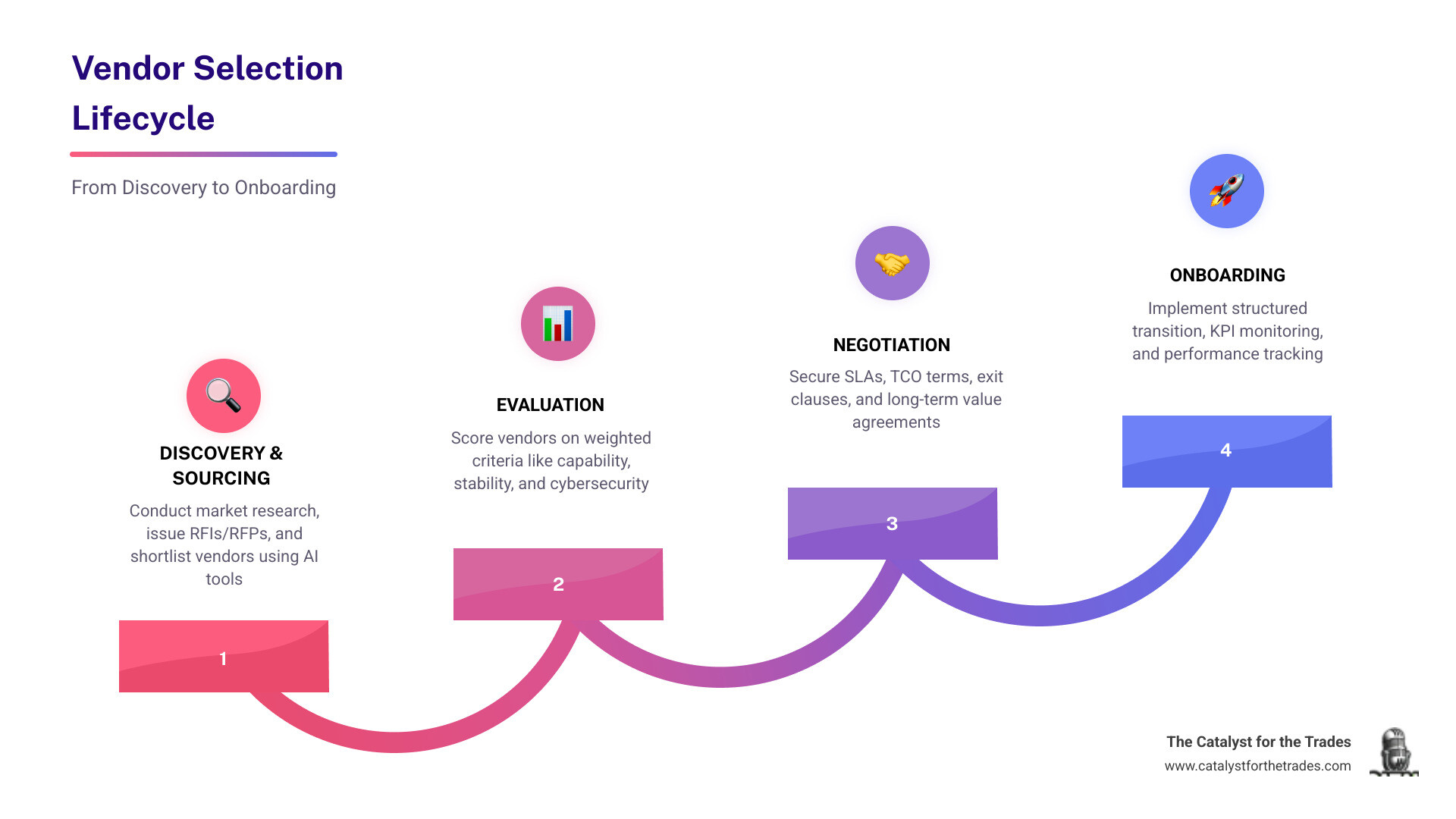
Simple guide to vendor selection strategies:
Defining Your Core Vendor Selection Strategies
Before we even look at a single brochure or website, we need to know what we are looking for. Most vendor selection failures don’t happen because of a bad negotiation; they happen at the very beginning when requirements are vague.
Strategic sourcing is about more than just buying a product; it’s about building operational resilience and a competitive advantage. We have to distinguish between direct procurement (the raw materials and parts we use to fix an HVAC unit or a leaky pipe) and indirect procurement (the software, office supplies, or marketing services that keep the business running). Both require a high level of supply chain integrity to ensure our business doesn’t grind to a halt because a third party failed.
When we talk about Choosing Right Vendors, we are looking for partners who align with our business continuity plans. If a vendor goes under or suffers a data breach, how does that impact our ability to show up at a customer’s house on time? Defining these stakes early ensures everyone is on the same page.
Establishing Weighted Vendor Selection Strategies
Not every requirement is created equal. If we’re buying a new fleet of service vans, safety and reliability might be our top priorities. If we’re picking a new CRM, ease of use for our techs in the field might take the lead. This is where a scoring matrix becomes our best friend.
By assigning weights to different criteria, we can compare “apples to apples” even when vendors offer different features. For example, in 2026, cybersecurity risk and ESG (Environmental, Social, and Governance) compliance have become board-level concerns. We can’t afford to ignore them.
| Criteria | Software Vendor Weight | Hardware/Parts Vendor Weight |
|---|---|---|
| Technical Capability | 30% | 20% |
| Financial Stability | 15% | 20% |
| Cybersecurity/Risk | 25% | 10% |
| Price/Total Cost | 20% | 35% |
| Customer Support | 10% | 15% |
Assembling a Cross-Functional Evaluation Team
We’ve seen it happen: the owner buys a new software because it looks cool, but the service managers hate it, and the finance team can’t get the reports they need. To avoid this, we assemble a cross-functional team.
- Operations Leads: They ensure the vendor fits the daily workflow.
- Finance Oversight: They look at the Total Cost of Ownership (TCO), not just the sticker price.
- IT/Security: They vet the vendor for data protection and integration.
- End-Users: The techs or office staff who will actually use the tool provide the most honest feedback on usability.
The Step-by-Step Sourcing and Discovery Process
Once we know what we need, it’s time to hit the market. We don’t just want the first name that pops up on a search engine. We want a deep dive into market research, using supplier directories and industry referrals from fellow trade business owners.
Understanding the difference between an RFI, RFP, and RFQ is vital for effective Vendor Management Strategies:
- RFI (Request for Information): Use this early on when you’re still exploring the market and need to see what’s possible.
- RFP (Request for Proposal): This is for complex projects where you want the vendor to propose a solution.
- RFQ (Request for Quote): Use this when you know exactly what you want and just need the best price and terms.
Leveraging AI for Rapid Vendor Discovery
It’s April 2026, and the way we find vendors has changed forever. Generative AI and Agentic AI workflows can now reduce the time it takes to identify suitable suppliers by 90% or more. Instead of spending weeks manually vetting websites, we can use automated screening tools to scan thousands of vendors against our specific requirements.
These tools don’t just find names; they provide data-driven shortlisting by analyzing financial records, public reviews, and even past performance data. This allows us to focus our energy on the top 3-5 candidates who actually move the needle.
Conducting Rigorous Due Diligence and Risk Assessments
Before we sign on the dotted line, we have to play detective. Third-party vendors account for over 50% of cyber incidents in many organizations. We need to ask for SOC 2 reports, perform financial audits, and check third-party breach histories.
Don’t just take their word for it. Conduct reference checks with specific questions: “What was the gap between the promised and actual timeline?” or “How did they handle the first major issue that cropped up?” If the vendor is providing critical physical goods, site visits or vulnerability scans of their digital infrastructure are not overkill—they are essential protections for our business.
Evaluating Proposals and Negotiating for Long-Term Value
When the proposals start rolling in, we look for more than just the lowest price. We look for value. This is where scenario-based demos and Proof-of-Concept (POC) trials come in. We want to see how the vendor handles a real-world workflow—like a sudden surge in emergency plumbing calls during a freeze.
Total Cost of Ownership (TCO) is the metric that matters. This includes implementation, training, maintenance, and the potential cost of downtime. Building Strategic Partnerships means finding vendors who are invested in our growth, not just our next payment.
Mastering Negotiation Beyond the Bottom Line
Negotiation is a conversation about risk and value, not just a haggle over cents. We focus on:
- Service Level Agreements (SLAs): Get specific. What is the guaranteed uptime? What is the response time when a system goes down?
- Data Portability: If we leave, do we get our data back in a usable format?
- Exit Clauses: We need a way out if the vendor fails to perform, ideally with a “termination for convenience” clause.
- Performance-Based Incentives: Reward the vendor for helping us hit our KPIs.
Finalizing Contracts with Modern Vendor Selection Strategies
The contract is our safety net. It should include clear language on indemnification (who pays if something goes wrong), security audits (our right to check their homework), and intellectual property rights. We also ensure there are scalability terms—so as our HVAC or plumbing business grows from five trucks to fifty, our vendor can grow with us without a massive price shock.
Transitioning from Selection to Performance Monitoring
The work doesn’t end when the contract is signed. In fact, that’s just the beginning. We use a structured onboarding process—a 90-day playbook—to ensure the vendor is integrated into our team correctly.
By assigning internal owners to the relationship, we ensure that the vendor doesn’t just “set it and forget it.” Continuous monitoring through a performance scorecard keeps everyone accountable.
Key Metrics for Post-Selection Success
To know if our vendor selection strategies worked, we have to measure the results. We track KPIs like:
- SLA Compliance: Are they hitting the marks they promised?
- Delivery Speed: How fast do parts arrive when we have a tech waiting on a job site?
- Quality Rate: What percentage of their products or services are defect-free?
- Innovation Contribution: Are they bringing us new ideas to help us scale?
- Error Rates: How often do we have to call to fix an invoice or a botched order?
Frequently Asked Questions about Vendor Selection
What is the difference between vendor selection and vendor management?
Think of it like dating versus marriage. Vendor selection is the “dating” phase—identifying, vetting, and choosing the right partner. Vendor management is the “marriage”—the ongoing effort to maintain the relationship, monitor performance, and optimize the value you get over the long term. Selection ends at the contract; management lasts for the life of the partnership.
How does AI streamline the procurement process in 2026?
AI has turned a weeks-long process into a matter of hours. It automates the creation of RFPs, uses predictive scoring to flag high-risk vendors before you even talk to them, and analyzes complex contracts for “red flag” clauses. In 2026, AI tools can even detect anomalies in invoices and performance data in real-time, allowing us to fix issues before they become expensive problems.
Why should home service businesses prioritize cybersecurity in vendor vetting?
As a trade business, you hold sensitive customer data—addresses, credit card info, and gate codes. If your software vendor or parts supplier has a breach, your data (and your customers’ data) is at risk. Beyond the legal liability, a breach destroys the trust you’ve spent years building in your community. Vetting your vendors’ security is the only way to protect your brand.
Conclusion
At The Catalyst for the Trades, we believe that every decision you make should be a stepping stone toward strategic growth and operational scaling. Whether you’re listening to Jennifer Bagley discuss the latest in AI-driven marketing or Chuck Staszkiewicz break down the nuts and bolts of operational efficiency, our mission remains the same: empowering home service businesses to lead their industries.
Choosing your vendors like a pro isn’t just a procurement task; it’s a leadership strategy. By implementing these vendor selection strategies, you aren’t just buying services—you’re building the foundation for a more resilient, innovative, and profitable business.
Don’t leave your success to chance. Take control of your supply chain, vet your partners with rigor, and use the tools available in 2026 to stay ahead of the curve.


