Learn · May 7, 2026
5 Proven Outbound Call Strategies for Contractors
Boost revenue with outbound call strategies for contractors: happy calls, memberships, unsold estimates & AI tools for growth.
By The Catalyst Editorial Team Operator education · 9 min read · Updated July 24, 2026

Why Most Contractors Are Leaving Money on the Table Without Outbound Calls
Outbound call strategies for contractors are one of the most underused growth levers in the trades — and that gap is costing home service businesses real revenue every week.
Here’s the quick version of what works:
- Happy calls — Follow up after every job to build loyalty and uncover upsell opportunities
- Maintenance reminders — Reach out before peak seasons to fill your schedule proactively
- Membership renewals — Re-engage lapsed service agreement customers before they go elsewhere
- Unsold estimate follow-ups — Check back in with prospects who never pulled the trigger
- Idle account reactivation — Reconnect with past customers who haven’t called in over a year
Think about it this way: the average HVAC company spends around $350 to acquire a single new customer. Meanwhile, a proactive call to an existing customer can book a maintenance visit that prevents a much larger emergency repair down the road — and it costs a fraction of that new customer spend.
Most contractors are stuck in a reactive cycle — waiting for the phone to ring, scrambling during slow seasons, and watching their dispatch board go empty while technicians sit idle. Outbound calling flips that model entirely. Instead of waiting for demand, you create it.
The challenge isn’t knowing that outbound calls matter. It’s knowing how to do them well — the right types of calls, the right timing, the right scripts, and the right tools to make it all run without burning out your team.
That’s exactly what this guide covers.
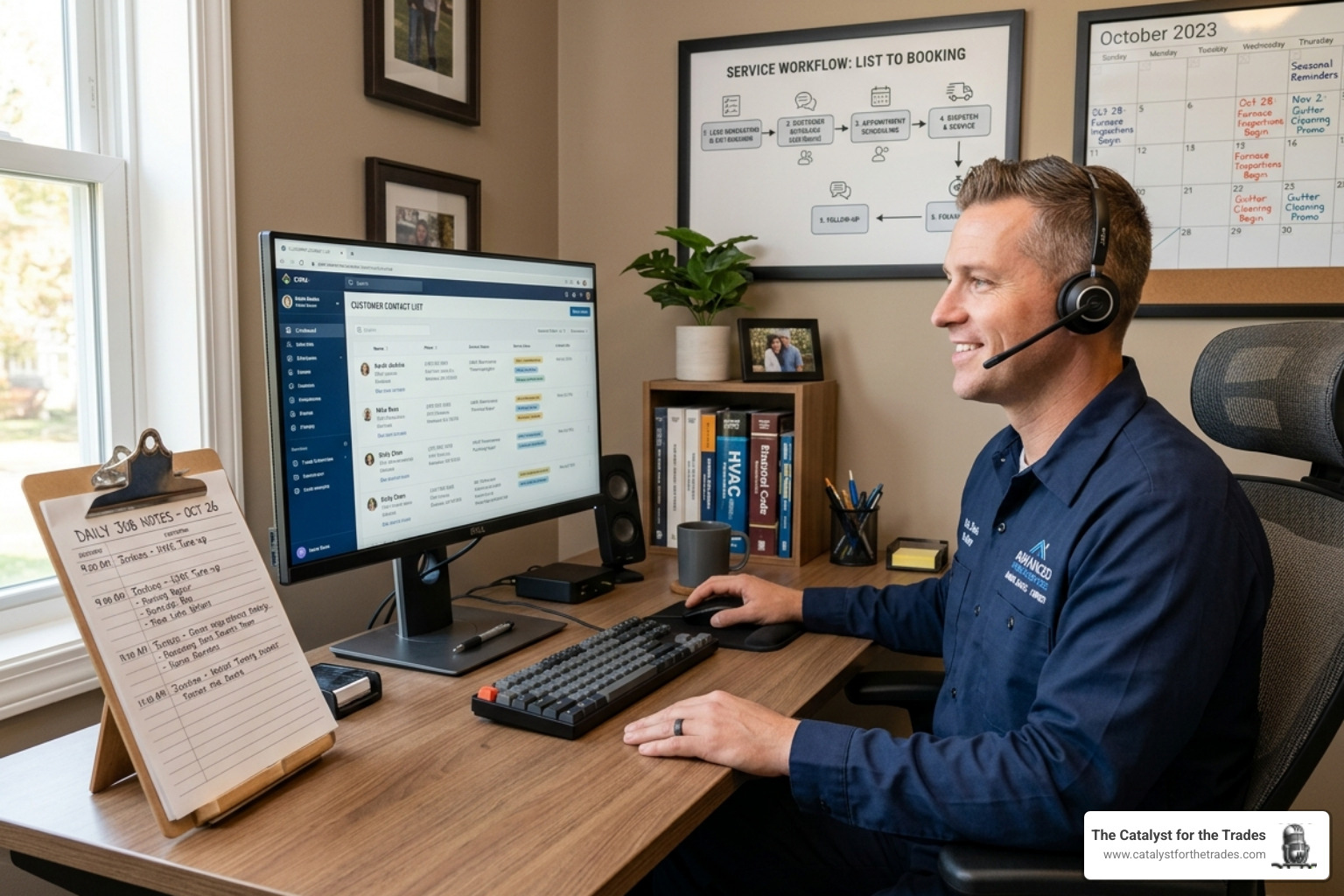
Quick look at outbound call strategies for contractors:
Why Outbound Calling is Essential for Trade Growth
In the home services world, we often fall into the trap of “emergency-only” thinking. We wait for the furnace to die or the pipe to burst before we hear from a customer. But relying solely on inbound emergencies is like running a fishing boat with the engines off—you’re just waiting for something to bite.
Outbound calling allows us to take control of our destiny. It is a vital tool for customer acquisition and, more importantly, relationship building. Research shows that companies utilizing cold calling and proactive outreach can grow up to 42% faster than those that don’t. Why? Because you are engaging decision-makers directly and solving problems before they become disasters.
Furthermore, it’s about revenue predictability. When we master outbound call strategies for contractors, we stop riding the “feast or famine” roller coaster. Instead of Stop Chasing New Leads – Start Closing the Ones You Already Have, we focus on the goldmine already sitting in our CRM. This proactive approach expands our market presence and ensures our brand is the first one a homeowner thinks of when they need service.
High-Value Industries for Proactive Outreach
While almost any service business can benefit, certain trades see a massive ROI from outbound efforts. HVAC, plumbing, electrical, roofing, and landscaping are prime candidates. These industries rely on recurring maintenance and seasonal shifts. For example, a $150 maintenance visit often prevents a $1,500 emergency repair. By calling to schedule that visit, you aren’t “bothering” the customer; you’re saving them money and stress. Implementing a solid Customer Service Strategy ensures these calls feel like a concierge service rather than a sales pitch.
Filling the Schedule During Slow Seasons
Every contractor knows the “shoulder seasons”—those weeks where the weather is mild and the phones go quiet. This is where your CSRs (Customer Service Representatives) become your secret weapon. Instead of having technicians sit idle—which costs the company money in overhead—we can use outbound calls to fill the board with seasonal tune-ups and safety inspections.
As we often say, Your CSRs Are Sitting on Untapped Revenue – Here’s How to Fix It. By reaching out to past customers for “Happy Calls” or maintenance reminders, we keep our team productive and our cash flow steady, even when the weather isn’t doing the marketing for us.
5 High-Impact Outbound Call Strategies for Contractors
To make outbound calling work, you need a plan. You can’t just tell your team to “start dialing.” You need categorized lists and specific goals.
- Happy Calls: These are made within 1-3 days of a completed job. We ask how the service was and if the technician exceeded expectations. This builds massive brand loyalty and often leads to reviews or referrals.
- Maintenance Reminders: Call customers who are due for their 6-month or annual check-up.
- Expired Memberships: Reach out to those whose service agreements have lapsed.
- Unsold Estimates: Follow up on quotes that were given but not booked.
- Idle Accounts: Re-engage customers who haven’t used your services in over 12 months.
Implementing Outbound Call Strategies for Contractors via Membership Renewals
Membership programs are the lifeblood of a stable contracting business. They provide recurring revenue and a “locked-in” customer base. When a membership expires, it’s often just because the homeowner forgot. A quick call to remind them of the benefits—like priority scheduling or repair discounts—can bring them back into the fold. This is a core part of Sales Process Optimization Complete Guide. We aren’t just selling a subscription; we’re selling peace of mind and loyalty.
Re-engaging Unsold Estimates with Outbound Call Strategies for Contractors
This is perhaps the biggest missed opportunity in the trades. A technician goes out, provides a professional estimate for a new system or a major repair, and the customer says, “I’ll think about it.” If we don’t follow up, that lead dies.
Statistics show that 80% of sales require at least five follow-ups, yet most people stop after the first or second attempt. By calling back within 3-10 days, we can answer lingering questions and use proven Closing Techniques for HVAC Sales to move the project forward. It’s not about being pushy; it’s about providing the value and clarity they need to make a decision.
Proven Best Practices for Professional Outreach
Success in outbound calling isn’t about the volume of dials; it’s about the quality of the conversation. Before picking up the phone, our team should research the customer’s history. What equipment do they have? When was their last service? Did they have a problem last time?
Using Sales Training Contractors can help your team move from “telemarketers” to “service advisors.” This transition often requires ongoing Sales Coaching to keep skills sharp.
Key best practices include:
- Local Presence: Use a local area code. People are much more likely to answer a local number than a toll-free one.
- Timing: We’ve found that mid-to-late afternoon on Wednesdays and Thursdays often yields the highest connection rates.
- Active Listening: Don’t just read a script. Listen for the customer’s pain points and adapt.
Mastering the Script and Tone
Your script should be a guide, not a crutch. We want our team to sound like neighbors helping neighbors. Start with a warm greeting and a “thank you” for their past business—never apologize for “bothering” them. Use a Sales Methodology that focuses on value-based questions, such as “How has your system been performing during this heatwave?”
Developing a strong Sales Team Development program ensures that every person on the phone represents your brand with professionalism and empathy. Your tone of voice accounts for 38% of a prospect’s perception of you!
Handling Common Objections
Objections are a natural part of the process. They aren’t “no’s”—they are just requests for more information.
| Objection | Professional Rebuttal |
|---|---|
| “I’m too busy right now.” | “I completely understand. I can be very brief, or would it be better if I called back tomorrow at 10 AM?” |
| “I don’t have the budget for this.” | “I hear you. Many of our customers feel the same way, which is why we offer maintenance to prevent those much more expensive emergency repairs later.” |
| “Everything is working fine.” | “That’s great to hear! Our goal with this visit is to keep it that way and ensure your system is running at peak efficiency to save you on utility bills.” |
Building resilience is a key part of our Sales Team Development Complete Guide. Every “no” is just one step closer to a “yes.”
Leveraging Technology and AI for Outbound Success
In 2024 and beyond, we don’t have to do everything manually. Technology is a force multiplier for outbound call strategies for contractors. Integrating your CRM with your phone system allows CSRs to see customer data the moment the call connects.
Tools like auto-dialers can help a single agent reach three times more prospects per day by eliminating manual dialing and navigating voicemails. Furthermore, AI CSR Implementation can help categorize calls and provide real-time feedback. Using AI in Customer Communication allows us to analyze which scripts are working and where customers are dropping off.
Automating the Follow-Up Process
Automation isn’t just for robots; it’s for efficiency. We can use AI Customer Service tools to send automated appointment reminders via text or email, which can reduce no-shows by up to 30%.
A truly modern approach involves a “multi-touch” sequence. This might look like an email reminder, followed by a phone call, followed by a text. According to our AI Customer Service Automation Complete Guide, these integrated touchpoints keep your brand top-of-mind without overwhelming the customer.
The Role of Virtual Assistants and AI Voice
For many contractors, the hurdle isn’t the desire to call—it’s the manpower. This is where virtual receptionists and AI voice solutions come in. They provide 24/7 availability and scalability that a small in-house team simply can’t match.
How AI Voice and Chat Are Changing the Home Service Game explains how these tools can handle routine tasks like scheduling tune-ups or following up on “Happy Calls,” leaving your high-level staff to focus on complex sales and technical issues.
Frequently Asked Questions about Outbound Calling
What are realistic appointment booking rates for outbound calls?
It varies based on the “warmth” of the lead. For cold leads, a 1-3% booking rate is common. However, for existing customers—like those due for maintenance or with expired memberships—you can see booking rates jump to 10-15% or higher. The key is tracking your “dials to connects” and “connects to appointments” to find your baseline.
When is the best time for contractors to make outbound calls?
While every market is different, data suggests that mid-morning (9:00 AM – 11:00 AM) and late afternoon (4:00 PM – 6:00 PM) are the “sweet spots.” Avoid Monday mornings when people are overwhelmed and Friday afternoons when they are checking out for the weekend. Mid-week (Wednesday and Thursday) usually sees the highest receptivity.
Should I handle outbound calls in-house or outsource?
This depends on your scale. In-house calls are great for building deep relationships and maintaining total quality control. However, it can be an “uphill battle” for a busy office staff to find the time. Outsourcing to a specialized service or using AI tools offers instant scalability and ensures the calls actually get made, regardless of how busy your office gets.
Conclusion
At The Catalyst for the Trades, our mission is to help home service businesses scale through innovation and leadership. Mastering outbound call strategies for contractors is one of the most effective ways to transition from a reactive business to a proactive powerhouse.
By focusing on your existing customer base, leveraging modern AI technology, and training your team to handle objections with empathy, you can fill your schedule, increase your revenue, and build a brand that homeowners trust for the long haul.
Ready to take your operations to the next level? Learn more about our mission and how we empower the trades to lead their markets.


