Learn · March 30, 2026
Top 5 Closing Techniques for HVAC Sales
Master closing techniques for HVAC sales: overcome objections, build trust, and boost conversions with proven strategies today!
By The Catalyst Editorial Team Operator education · 11 min read · Updated July 24, 2026

Boost Your HVAC Sales Closing Rate Today

Mastering closing techniques for hvac sales can transform your business. Here are some of the most effective strategies to consider:
- Assumptive Close: Proceed as if the customer has already decided to buy.
- Alternative Choice Close: Offer two positive options, both leading to a sale.
- Summary Close: Recap all agreed-upon benefits and value before asking for the sale.
- ROI Close: Highlight the financial return and savings customers will gain.
- Upfront Contract: Set clear expectations early in the conversation to address common objections.
Running a successful HVAC business means more than just technical expertise. It means consistently closing deals and turning leads into loyal customers. Many home services business owners face the challenge of inconsistent sales, where great presentations don’t always translate into signed contracts. With an average HVAC sales closing ratio hovering around 32%, there’s a significant opportunity to improve. Learning advanced closing techniques for hvac sales is key to converting more prospects and driving revenue for your business.
Boost Your Sales Team’s Performance and Get Started with The Catalyst for the Trades Today!
Ready to elevate your sales game and ensure your team closes more deals? Contact us to learn how to implement these powerful strategies.
Mastering the Psychology of Closing Techniques for HVAC Sales
Closing a sale isn’t a high-pressure event that happens at the very end of a meeting; it is the natural conclusion to a well-built relationship. In the HVAC industry, we aren’t just selling metal boxes and refrigerant; we are selling sleep, health, and financial security. To improve our closing techniques for hvac sales, we must first understand the psychological drivers that lead a homeowner to say “yes.”
The foundation of every successful close is active listening. Research suggests that 80% of all sales are made based on how well the customer likes and trusts the salesperson. If a homeowner feels heard, they feel valued. By focusing on Sales Coaching that emphasizes empathy over technical jargon, we can move from being “the AC guy” to a “trusted advisor.”
People buy based on emotion and justify with logic. This is why building rapport is critical. We need to identify with the family—laugh with them, acknowledge their concerns about the heat, and show genuine expertise. A solid Sales Methodology focuses on “the likeability factor.” If they don’t like you, they won’t buy from you, even if your price is the lowest in town.
Identifying Customer Pain Points
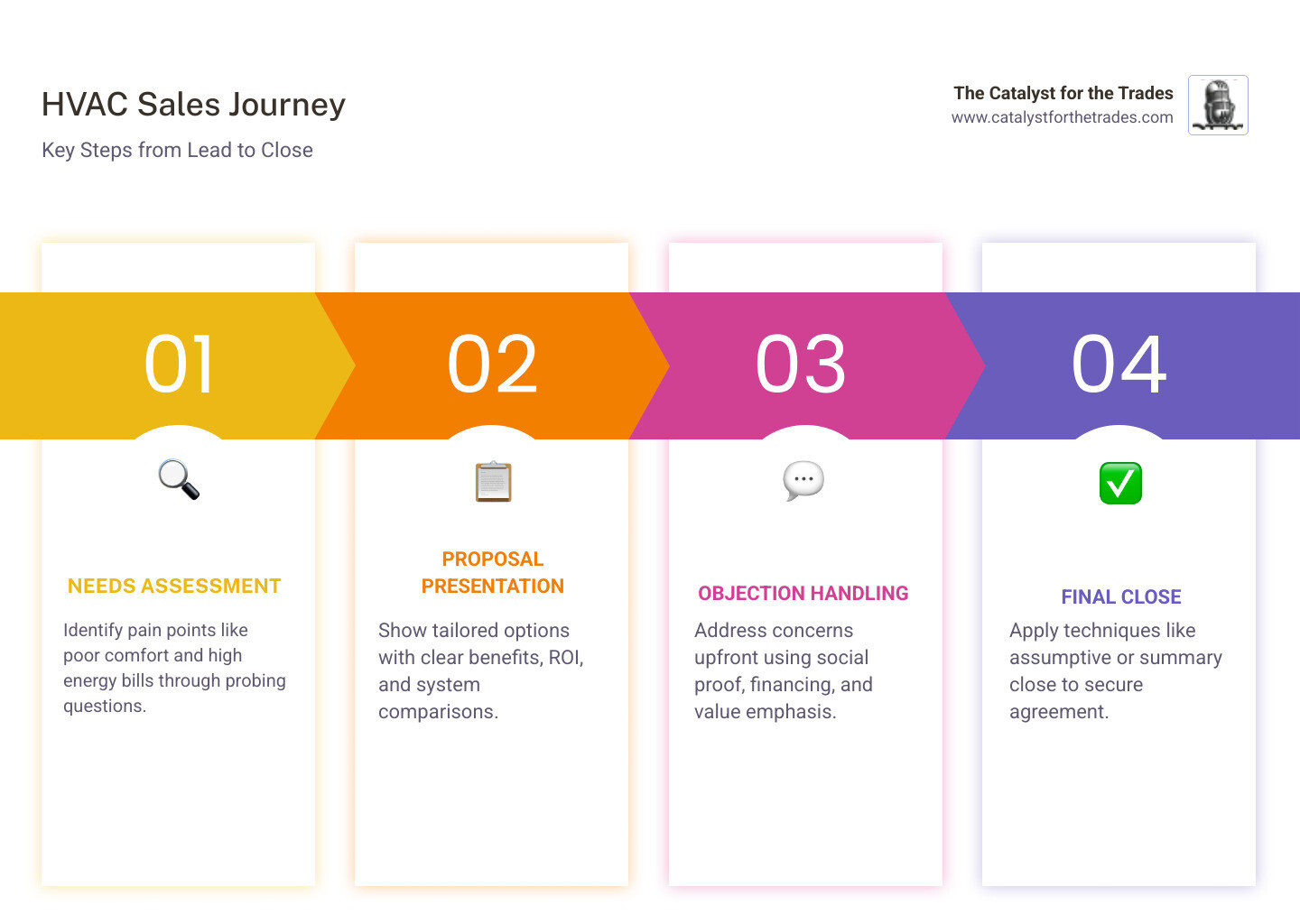
To close effectively, we must uncover what is actually hurting the customer. We do this through probing questions. Instead of asking, “Is your AC working?” we should ask, “Which room in the house is the hardest to keep cool during July?” or “How much did your last energy bill surprise you?”
These questions shift the focus to home comfort, energy efficiency, and indoor air quality. As discussed in our look at From Fitness Sales to HVAC Legend Building a Modern Sales Culture with Darren Tyler Dixon, transitioning into the trades requires a mindset focused on solving problems rather than just pushing products. When we identify that a child has allergies (air quality) or that the master bedroom is sweltering (comfort), the “close” becomes a solution to a real-life problem.
The Power of Silence in the Close
One of the most difficult but effective closing techniques for hvac sales is the use of silence. After you ask a closing question—such as “Which of these options works best for your family?”—you must stop talking.
In sales, there is an old saying: “He who talks first, buys.” If we speak too soon, we often “buy back” the objection or project our own insecurities onto the customer. Silence creates a space for the homeowner to process their decision-making. We must watch for buying signals—nodding, looking at the spouse, or touching the proposal—and wait for their verbal cue. This is a vital part of Sales Team Development. By mastering the “pregnant pause,” we allow the customer to take emotional ownership of the choice.
Top Closing Techniques for HVAC Sales Professionals
Every customer is different, which is why a versatile “tool belt” of closing strategies is necessary. We don’t use these to manipulate; we use them to guide the customer toward a decision that improves their life.
- The Summary Close: This involves recapping everything we’ve discussed. “So, we’re looking at a system that will lower your bills by 20%, remove the humidity from the basement, and come with a 10-year warranty. Does that sound like what you’re looking for?”
- The Sharp Angle Close: If a customer asks for a concession, like “Can you install this by Saturday?” we respond with, “If I can get my crew here Saturday morning, do we have a deal?” This turns a demand into a commitment.
- The Takeaway Close: If a prospect is wavering, we might suggest that a certain high-end feature might actually be “more than they need.” This often triggers a psychological desire to keep the better option.
- The Now-or-Never Close: This uses authentic scarcity. “I have one installation slot left before the heatwave hits on Thursday. Would you like to lock that in?”
Effective Sales Training Contractors focus on these nuances. For those looking at Igniting Sales Success Devon Murphy on Reclaiming Lost Opportunities, it’s often these small shifts in language that bring back “dead” leads.
The Assumptive and Alternative Choice Closing Techniques for HVAC Sales
The Assumptive Close is a mindset. We act as if the customer has already said yes. Instead of asking “Do you want to buy?” we ask logistics questions like, “Would it be better for our team to park in the driveway or on the street when we arrive for the install?”
The Alternative Choice Close is perhaps the most famous of all closing techniques for hvac sales. We never ask a “yes or no” question. Instead, we offer two paths to a “yes.” The Power of Choice Why Menu Pricing Changes Everything with Danielle Putnam highlights how giving customers options (Good, Better, Best) empowers them. We might ask, “Would you prefer the high-efficiency unit that maximizes your rebates, or the standard model that fits your current budget?” Both options result in a sale. This is a core part of Fast to Cash Products and Smarter Sales with Karen Sager, focusing on moving the process forward efficiently.
Using the ROI and Urgency Closing Techniques for HVAC Sales
In the HVAC world, a new system is an investment, not just an expense. The ROI (Return on Investment) close is incredibly powerful for analytical buyers. We can show them how a 20% reduction in energy bills provides a better “return” than a standard savings account.
Urgency is also a natural part of our industry. Seasonal demand means that waiting two weeks could mean a much longer lead time. By highlighting loss aversion—the idea that they are “losing” money every day they run an old, inefficient unit—we encourage faster action. For more on this, listen to Relentless Growth Sam Wakefields Sales Transformation Follow-up Tactics for the Trades. Similarly, From Gym Floors to HVAC Superstar Tyler Dixons Leap into Trades Sales shows how high-energy, urgent communication can drive results.
Overcoming Common Objections and Stalls
Roughly 68% of prospects who say they “need to think about it” actually end up buying something—often from the person who followed up best or addressed their fears most clearly.
One of the best ways to handle objections is to use an “Upfront Contract.” This is a verbal agreement made at the start of the visit: “Mr. Homeowner, at the end of our talk today, I’m fine if you say ‘yes’ and I’m fine if you say ‘no.’ All I ask is that we don’t leave it at a ‘maybe.’ Does that sound fair?” This simple step can shortcut 90% of common stalls.
For a deeper dive into managing the entire journey, see our Sales Process Optimization Complete Guide. Pre-handling objections is another pro move. If you know people usually worry about the mess, say: “Most people ask about the cleanup; here is how we protect your floors.” This demonstrates you are ahead of the game, a key principle in our HVAC Business Operations Guide.
Handling the “Need to Check Around” Objection
When a customer wants to “check around,” they are usually looking for certainty. They want to know they aren’t being overcharged. We can address this by providing a “Shopper’s Guide” that compares different system types and what to look for in a contractor.
By demonstrating expertise and providing social proof through a “Testimonial Close” (showing letters from neighbors who also shopped around but chose us), we build the certainty they crave. As noted in the Sales Team Development Complete Guide, the goal is to move from persuasion to providing absolute certainty that we are the right choice.
Addressing Spouse and Budget Hesitations
“I need to talk to my spouse” is a classic stall. We can avoid this by ensuring all decision-makers are present for the presentation. If they aren’t, we can frame the ROI and comfort benefits in a way that the person present can easily “sell” to their partner.
| Common HVAC Objection | Strategy to Overcome |
|---|---|
| “The price is too high.” | Focus on ROI, energy savings, and financing options. |
| “I need a second bid.” | Provide a Shopper’s Guide and emphasize your unique guarantees. |
| “I need to think about it.” | Use the Upfront Contract or ask, “What part haven’t we covered yet?” |
| “My old system still works.” | Highlight the “cost of waiting” (repairs + high utility bills). |
Transparency is our best friend here. When we offer financing benefits and frame the cost in terms of monthly comfort rather than a scary lump sum, the budget hesitation often disappears.
The Role of Presentation and Choice in the Close
Your presentation is the “runway” for your close. If the runway is bumpy, the landing will be, too.
We recommend the K.I.S.S. method: Keep It Short and Simple. Over-educating a customer can lead to “analysis paralysis.” They don’t need to know the physics of the scroll compressor; they need to know their house will be 72 degrees when it’s 100 degrees outside.
The “Paper Towel Close” is a legendary industry technique where you simply sketch out the options and pricing on a sheet of paper (or a digital equivalent) to keep things informal and transparent. This benefit-focused language is essential. For more, check our Sales Process Optimization Complete Guide.
Creating a Sense of Ownership
How do we get a customer to “own” the system before they buy it? We use trial closes. Throughout the visit, ask small “agreement” questions: “Can you see how this air purifier would help with the dust you mentioned?” or “Doesn’t it make sense to stop spending money on these monthly repairs?”
A Home Energy Survey is another great tool. By involving them in the inspection, they see the problems for themselves. When they see the cracked heat exchanger or the clogged coil, the “close” is no longer your idea—it’s theirs. This interactive approach is supported by The Power of Choice Why Menu Pricing Changes Everything with Danielle Putnam, as it puts the customer in the driver’s seat.
Frequently Asked Questions about HVAC Sales
What is the most effective way to handle a price objection?
The most effective way is to shift the conversation from “cost” to “value.” Explain the Total Cost of Ownership. A cheaper unit that breaks down more often and uses more electricity is actually more expensive over ten years. Use ROI framing to show how the system eventually pays for itself through utility savings.
How do I know when it is the right time to ask for the sale?
Look for buying signals: the customer asks about scheduling, they start discussing where the outdoor unit will sit, or they ask about financing details. However, the best time is simply after you have presented the options and recapped the benefits. If you’ve done a good job, asking for the sale is just the next logical step.
Why is the “Always Be Closing” mindset important in home services?
In our industry, ABC doesn’t mean being a “pushy” salesman. It means every action you take—from how you park your truck to how you explain a thermostat—should be moving the customer toward a decision. It’s about maintaining a mindset of helpfulness and leadership throughout the entire interaction.
Conclusion
At The Catalyst for the Trades, we believe that mastering closing techniques for hvac sales is about more than just numbers—it’s about building a sustainable business that serves your community. By combining psychological insights with proven strategies like the Assumptive Close and the ROI Close, you can significantly improve your conversion rates.
The sale doesn’t end when the contract is signed. A great follow-up strategy ensures long-term relationships and a steady stream of referrals. If you are ready to take your team to the next level, explore our Sales Team Development Complete Guide or Learn more about our mission and team.
Stop being a “professional presenter” and start being a “professional closer.” Your customers need the comfort you provide—don’t let a “maybe” stand in the way of their satisfaction and your growth.


