Learn · May 13, 2026
Future of AI in Home Services: 2026 Revolution
Discover the future of ai in home services: AI-driven customer service, predictive maintenance, workforce optimization & new revenue streams by 2030.
By The Catalyst Editorial Team Operator education · 11 min read · Updated July 24, 2026

The Future of AI in Home Services Is Already Here — Are You Ready?
The future of AI in home services is not a distant concept — it is reshaping how trades businesses operate right now, in April 2026. From the moment a homeowner searches for help to the second a technician closes a job, AI is touching every step of that journey.
Here is a quick look at what AI is changing across the industry:
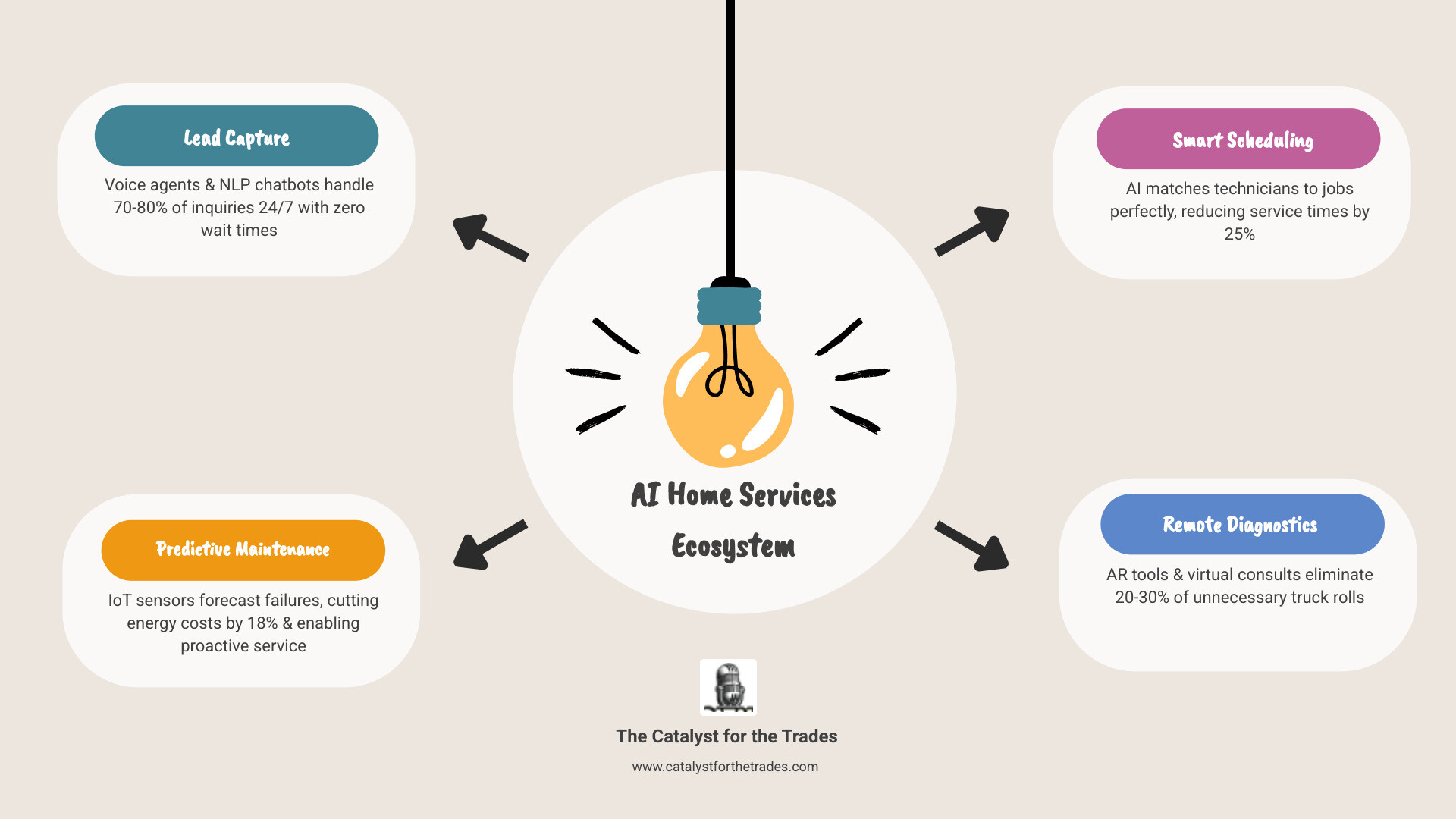
- Customer interactions – Voice agents and NLP chatbots handle 70-80% of inquiries around the clock, with no hold times
- Predictive maintenance – IoT sensors flag equipment failures before they happen, cutting energy costs by up to 18%
- Scheduling and dispatch – AI matches the right technician to the right job, reducing service times by 25%
- Lead generation – AI-powered follow-ups and instant responses drive conversion rates dramatically higher
- Subscription revenue – Proactive service models are growing fast, with customer lifetime value up to 3.2x higher than one-time jobs
- Remote diagnostics – AR tools and virtual consults cut unnecessary truck rolls by 20-30%
The on-demand home services market is projected to grow from $1.8 trillion in 2023 to nearly $3.9 trillion by 2030. That growth is being driven, in large part, by AI adoption. Businesses that embrace these tools now are pulling ahead. Those that wait are handing their competitors a growing advantage.
The gap between businesses using AI strategically and those just dabbling is already visible — in response times, booking rates, and revenue. Over 70% of home service professionals used some form of AI in 2025. But using AI and operationalizing it for real, measurable growth are two very different things.
This guide brings together expert perspectives and provide current industry data to show you exactly where AI is taking home services by 2030 — and what you can do about it today.
Future of ai in home services helpful reading:
The Primary Trends Shaping the Future of AI in Home Services
As we look toward 2030, the future of AI in home services is being defined by a shift from reactive “break-fix” models to autonomous, intelligent operations. One of the most significant shifts we are seeing is the rise of Agentic AI. Unlike basic chatbots that simply follow a script, these autonomous agents can make decisions based on real-time data, such as adjusting a technician’s schedule when a job runs late or automatically ordering a replacement part before the tech even leaves the site.
This evolution is part of a broader movement toward Navigating AI Change and Growth in Home Services. We are moving into an era of hyper-personalization, where AI analyzes years of a customer’s service history, local weather patterns, and equipment age to offer the exact service they need at precisely the right time. With 5G connectivity becoming the standard, these systems can process massive amounts of data instantly, allowing for a seamless flow between the “smart home” and the service provider.
According to The AI Revolution in Home Services: How to Future-Proof Your Trades Business, the businesses that thrive will be those that view AI not as a replacement for people, but as a strategic partner. By 2030, we expect 40% of homes to have some form of autonomous home management, meaning your business software will likely be communicating directly with a customer’s smart HVAC system to book a repair without the homeowner ever picking up the phone.
Revolutionizing Customer Interactions with Voice and Chat
The days of “leave a message after the beep” are effectively over. Modern Natural Language Processing (NLP) agents are providing 24/7 availability that human dispatchers simply can’t match. These aren’t the frustrating “press 1 for sales” menus of the past; today’s voice agents offer sub-second response times and can handle complex, multi-step bookings.
Implementing AI Chatbots for Contractors has allowed many businesses to handle 70-80% of routine inquiries without human intervention. This includes everything from answering “When will my tech arrive?” to providing multilingual support for diverse customer bases. Furthermore, How AI Voice and Chat Are Changing the Home Service Game highlights the use of sentiment analysis. This allows the AI to detect if a customer is frustrated or if they have a genuine emergency, instantly escalating the call to a human manager when necessary. For a deeper dive, our AI Customer Service Automation Complete Guide explores how these tools reduce operational costs by 30-40% while improving the customer experience.
Predictive Maintenance: The Shift from Reactive to Proactive
The most profitable service call is the one you make before the equipment actually breaks. By leveraging IoT sensors and AI Decision-Making Tools, contractors can now monitor the “health” of an HVAC unit or water heater in real-time. When the AI detects a slight vibration or a drop in efficiency, it triggers a proactive outreach to the homeowner.
This shift is a game-changer for energy efficiency. Research shows that AI-based predictive maintenance can reduce home energy costs by 18%. As discussed in our episode Smart Decisions, Big Impact: Teasha Cables’ AI Strategies for Better Business, this technology moves the industry away from seasonal “rushes” and toward a consistent, predictable workload. For the homeowner, it means zero downtime; for the business, it means fewer emergency midnight calls and a more stable bottom line.
Overcoming Barriers to AI Adoption and Implementation
While the benefits are clear, we recognize that the path to full adoption has its hurdles. Data privacy is a top concern for homeowners, and businesses must ensure they are meeting strict security standards. Developing a solid Contractor AI Strategy is essential for integrating these new tools with existing legacy systems without creating “technical debt.”
If you are wondering Who Can Help Me Develop a Contractor AI Strategy to Improve My Business Operations, the answer lies in finding partners who understand both the trades and the tech. Change management is often the biggest barrier; your team needs to understand that AI is there to make their jobs easier, not to replace them. As we cover in Navigating AI Change and Growth in Home Services, successful implementation requires a phased approach: start with one high-impact area, like after-hours call handling, and expand as the team gains confidence.
Optimizing the Workforce: Scheduling, Dispatching, and Diagnostics
Efficiency in the field is where the future of AI in home services truly pays off. AI-driven route optimization does more than just find the shortest path; it considers real-time traffic, technician skill levels, and even the likelihood of a job requiring a specific part that might be on a certain truck.
By using AI Scheduling Software, businesses have seen a 35-40% increase in first-time fix rates. When the system knows exactly which tech is best suited for a complex boiler repair versus a simple thermostat swap, everyone wins. Our AI Tech Implementation Keywords Guide notes that these optimizations frequently lead to a 25% reduction in service times, allowing your team to help more customers every day without increasing their stress levels.
Remote Troubleshooting and AR-Driven Diagnostics
One of the most exciting developments is the use of Augmented Reality (AR) for remote assistance. Imagine a junior technician on-site wearing AR glasses. A senior lead back at the office can see exactly what the tech sees and overlay digital instructions or diagrams directly onto their field of vision.
In the episode Future-Proofing Contracting: Paul Redman on Tech, AI, and the New Customer Experience, we discuss how this provides “visual proof” to the homeowner, building immense trust. Furthermore, AI-First Growth for the Trades Builder Market with Louis Vierra and Brett Taylor highlights that remote diagnostics can reduce unnecessary service calls by up to 30%, saving the business money and the customer time. On average, these tools can slash diagnostic time on-site by 40-50%.
Workforce Optimization in the Future of AI in Home Services
Workforce optimization isn’t just about the techs in the field; it’s about the “administrative drag” that slows everyone down. AI tools can now handle automated invoicing, parts tracking, and even summarizing 20+ invoices a day, saving accounting teams hours of manual work. Platforms like the Cortex Business Platform act as an operational hub, syncing data across the entire company.
When you master AI CSR Implementation, your office staff can stop being “order takers” and start being “growth managers.” As Brad Scruggs explains in How AI is Transforming Call Handling: Brad Scruggs on the Future of Home Service Communication, the goal is to maximize technician utilization. Some businesses have reported a 35% revenue growth in just one year simply by using AI to ensure their schedule is always full and their routes are always tight.
New Revenue Streams and Marketing Mastery Through AI
Marketing in 2026 is no longer about shouting the loudest; it’s about being the most relevant. AI-driven AI Customer Acquisition tools can now score leads in real-time, identifying which homeowners are ready to buy a new system and which just need a simple repair.
In our conversation during Level Up Your Business: Billy Gregus on AI Marketing and Making Partnerships Work, we explore how personalized nurturing sequences can keep your brand top-of-mind without being annoying. For those looking for an aggressive growth strategy, AI Agents: The Future of Marketing – Remy Skerjanz’s Playbook for Outbound Success provides a blueprint for using AI to reach out to past customers at the exact moment their equipment is likely to need service. Some premium remodeling firms using these AI lead systems have reported conversion rates up to 289% higher than traditional methods.
Subscription Models and Proactive Service Contracts
The most stable businesses of the future will be built on recurring revenue. AI makes subscription models easier to manage and more valuable to the customer. Instead of a generic “maintenance plan,” you can offer a data-backed guarantee that their home systems will remain functional.
In AI-Driven Success for Contractors: Lynn Wise’s Blueprint for the Future, the focus is on increasing customer lifetime value. Statistics show that subscription customers have a lifetime value 3.2 times higher than transactional ones.
| Feature | Reactive Model (Traditional) | Proactive Model (AI-Driven) |
|---|---|---|
| Primary Goal | Fix what is broken | Prevent failures before they happen |
| Customer Contact | Only during emergencies | Regular, data-driven touchpoints |
| Revenue Stream | Unpredictable spikes | Steady, recurring subscriptions |
| Energy Efficiency | Low (units run until failure) | High (optimized performance) |
| Response Time | Hours to days | Instant (via remote monitoring) |
Learning How to Stay Competitive as AI and Consumer Behavior Reshape Home Services is about recognizing that today’s homeowners value peace of mind over a “good deal” on a one-time repair.
Personalized Communication in the Future of AI in Home Services
Generative AI (like GPT-powered models) is revolutionizing how we talk to customers. Instead of sending a generic “Thank you for your business” email, AI can craft a message that references the specific unit serviced, the technician’s notes, and a personalized recommendation for the next visit.
This increases “conversion velocity” — the speed at which a lead becomes a booked job. As AI in Customer Communication shows us, customers are much more likely to respond to a message that feels individualized. Expert Jazmin Ramirez: AI Marketing Strategies and Growth Insights for Contractors emphasizes that this consistency builds a powerful brand. Furthermore, using AI Chat Systems and Cortex Local Marketing allows for automated review generation, ensuring your online reputation grows as fast as your business.
Frequently Asked Questions about AI in Home Services
How does AI improve first-time fix rates for technicians?
AI improves first-time fix rates by ensuring the right technician is sent to the right job through skill-based matching. By analyzing AI Business Intelligence, the system can predict which parts are likely needed based on the customer’s initial description and equipment history. Remote diagnostics allow senior staff to assist juniors via AR, and the AI Technology Implementation Keywords Guide suggests that better data leads to a 35-40% improvement in getting the job done right on the first visit.
Can AI really handle customer service calls without human intervention?
Yes, modern Voice AI agents are capable of handling full interactions, from initial lead capture to appointment scheduling, 24/7. They use advanced intent detection to understand what the customer needs and can even detect emergencies. As discussed in AI Customer Service and AI-First Growth for the Trades Builder Market with Louis Vierra and Brett Taylor, these systems now handle 70-80% of inquiries, freeing up your human team for complex problem-solving.
What is the expected ROI for home service businesses adopting AI by 2030?
Early adopters are already seeing massive returns. Common benchmarks include a 30% reduction in operational costs and a 25% increase in revenue within the first two years of implementation. In Future-Proofing Your Business with AI: A Conversation with Remy Skerjanz, we see examples of AI reducing visit fill times by 98%. According to AI-Driven Success for Contractors: Lynn Wise’s Blueprint for the Future, the long-term ROI is found in increased customer retention and a significantly higher business valuation.
Conclusion
At The Catalyst for the Trades, we believe that the future of AI in home services is the greatest opportunity for growth the industry has ever seen. It’s not just about the technology; it’s about using that technology to lead with innovation and provide a superior level of service that was previously impossible.
Whether it’s Women Leading the AI Revolution in Home Services: Real Talk, Real Results or our deep dives into Future-Proofing Your Business with AI: A Conversation with Remy Skerjanz, our mission is to provide you with the strategies you need to thrive. The 2030 landscape will belong to the contractors who start building their AI ecosystem today.
Ready to take the next step? Visit us at www.catalystforthetrades.com to explore more episodes, guides, and tools designed to help you scale your trade business into the future.


