Learn · April 6, 2026
Top 5 AI Scheduling Software for Teams
Discover top ai scheduling software for teams. Boost efficiency, reclaim 395 hours, and automate workflows with AI calendars and assistants.
By The Catalyst Editorial Team Operator education · 8 min read · Updated July 24, 2026

The Best AI Scheduling Software for Busy Home Service Teams

AI scheduling software is a fast-growing category of productivity tools for business owners who are tired of losing hours every week to calendar chaos.
If you run a home services business, scheduling isn’t just an annoyance. It’s a real drain on your day. Research shows that managers spend anywhere from 3 to 10 or more hours every week just on scheduling tasks. That’s time that could go toward supporting your team, taking care of customers, or simply getting home at a reasonable hour.
The problem isn’t just volume. It’s the constant back-and-forth, the rescheduling, the double bookings, and the mental energy it takes to keep everything from falling apart. One industry estimate suggests workers could reclaim as many as 395 hours of focus time per year by switching to AI-powered scheduling tools.
This guide explains what AI scheduling tools can do, how they work, and how to choose the right approach for your team so you can spend less time coordinating calendars and more time delivering great service.
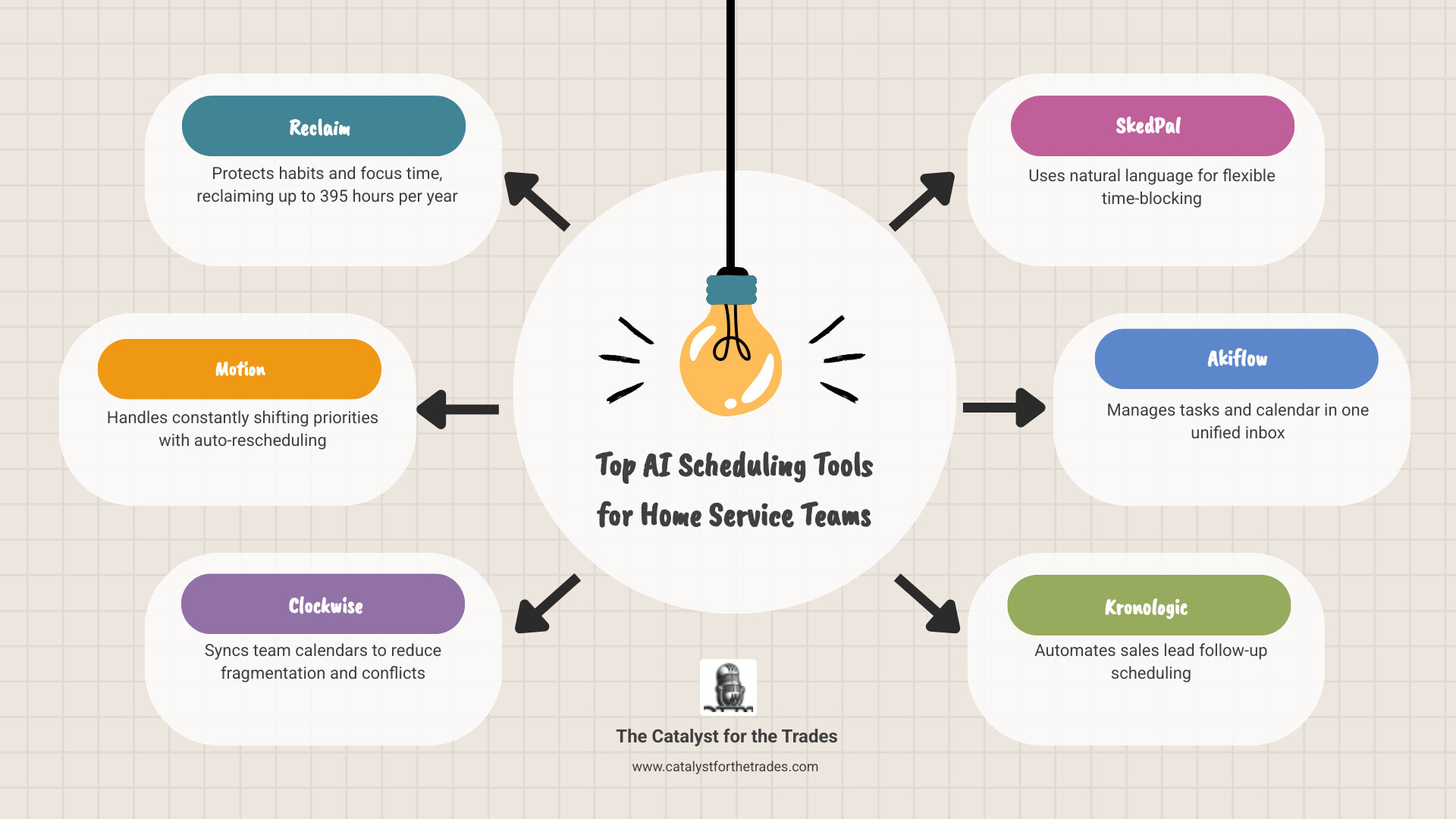
AI Calendars vs. Traditional Smart Scheduling
When we talk about ai scheduling software, it is easy to confuse it with the “smart” calendars we have used for years. However, there is a massive technical leap between a calendar that follows a set of rigid rules and one powered by artificial intelligence.
Traditional smart calendars are “deterministic.” This means they follow fixed, developer-defined rules. If you tell a smart calendar to “block 30 minutes for lunch at noon,” it does exactly that. But if a high-priority emergency call comes in at 11:45 AM, the smart calendar won’t move your lunch; it will just let the events overlap, leaving you to play “calendar Tetris” later.
True AI scheduling assistants utilize Large Language Models (LLMs) and proprietary engines to perform “intent translation.” Instead of just following a rule, the AI understands your goals. If you have a goal to “spend 4 hours on project estimates this week,” the AI looks at your shifting availability, evaluates the importance of other meetings, and dynamically places those blocks where they make the most sense.
This is a core part of modern Technology Implementation. These tools use adaptive learning to understand your preferences over time. If you consistently decline meetings before 8:00 AM, the AI learns that your “work day” starts later, even if you haven’t explicitly changed your settings. It moves from being a digital paper-planner to a proactive partner that makes decisions on your behalf.
Maximizing Efficiency with AI Scheduling Software
The primary reason we advocate for these tools in the trades is simple: time poverty. Approximately 80% of people worldwide report feeling they lack the time and energy to complete their work. In the home services industry, where you are balancing field crews, customer emergencies, and administrative tasks, that “time famine” is even more acute.
By implementing ai scheduling software, users can reclaim up to 395 hours of focus time every year. That is nearly 10 weeks of work time given back to you. This efficiency comes from several key areas:
- Focus Time Protection: AI tools like Clockwise or Reclaim can automatically identify “fragmented” time—those awkward 15 or 30-minute gaps between meetings where nothing meaningful gets done. The AI will move meetings (with everyone’s permission) to create solid 2+ hour blocks of “Focus Time.”
- Conflict Resolution: When an emergency arises, you don’t want to spend 45 minutes reprioritizing your entire week. AI assistants can reshuffle your low-priority tasks and habits instantly to accommodate the new schedule.
- Task Automation: Instead of manually adding every to-do item to your calendar, you can simply tell the AI what needs to be done. It will find the space for you, ensuring that “working on the business” doesn’t get pushed aside by “working in the business.”
For more on how to use these tools effectively, check out our AI Tech Implementation Keywords Guide. We have found that when managers automate these repetitive tasks, they save between 3 and 10 hours a week, allowing them to focus on leadership and growth rather than logistics.
AI Assistants for Specialized Workflows
Not all ai scheduling software is built the same. Some are designed to manage an internal team calendar and daily priorities, while others focus on coordinating appointments with customers and other external contacts.
| Feature Category | Calendar Management (Internal) | Appointment Coordination (External) |
|---|---|---|
| Primary Goal | Optimize the workday and protect focus | Reduce back-and-forth and missed bookings |
| Best For | Dispatchers, office admins, operations leads | Customer booking, inbound requests, follow-ups |
| AI Capability | Reprioritizes tasks and reshuffles blocks | Suggests times and generates invites automatically |
For those in the trades, choosing the right tool often depends on whether you are trying to manage your internal team’s productivity or improve your customer-facing booking experience. Many businesses find success by integrating these tools with their existing Field Service Management Software to create a seamless flow from lead to scheduled job.
How AI Scheduling Supports Day-to-Day Operations
If your day is a mix of calls, dispatch coordination, site visits, and administrative work, AI scheduling can reduce the daily friction that slows everything down:
- Dynamic Rescheduling When the Day Changes: When an emergency job comes in or a tech runs behind, an AI scheduler can help reorganize remaining appointments, internal meetings, and admin blocks so the rest of the day stays workable.
- Focus Time for Critical Admin Work: Time for payroll reviews, supplier coordination, or backlog clean-up often gets squeezed out. AI tools can protect uninterrupted blocks so essential work actually gets finished.
- Smarter Team Coordination: When multiple people need to be involved (office staff, field leads, or a vendor), AI-assisted scheduling reduces the bottlenecks caused by fragmented calendars.
How AI Scheduling Improves Customer Booking
For service businesses, scheduling isn’t just internalthe customer experience starts the moment someone tries to book.
- Faster Appointment Confirmation: AI-assisted scheduling can help confirm appointments quickly without long email chains or repeated calls.
- Fewer Double-Bookings and Missed Appointments: Automated conflict checking, time zone handling, and buffer rules reduce the chance of accidental overlap.
- More Consistent Follow-Up: When customers request a change or need a new time, AI tools can help propose workable options immediately so the schedule stays full and organized.
Integrating these tools with your CRM is vital for maintaining context. Learn more about why this matters in our guide on How to Get Your CRM Right and Why It Matters More Than You Think.
Industry-Specific AI Scheduling Applications
While general productivity tools are great, some industries require heavy-duty AI to manage massive projects.
In the construction industry, AI is making a massive impact on large-scale project scheduling. Generative scheduling tools can simulate millions of different project scenarios. This allows contractors to find the most efficient path forward, often resulting in a 17% reduction in project duration. Even more impressive are the financial gains: a 14% reduction in labor costs and a 12% reduction in equipment costs by optimizing when and where resources are deployed.
In healthcare, AI scheduling ensures HIPAA compliance while drastically reducing patient no-shows. These systems can predict which patients are most likely to miss an appointment and send extra reminders or adjust the schedule in real-time to minimize wait times.
For retail, AI uses demand forecasting. By looking at historical sales data and even weather patterns, AI can predict when a store will be busy and schedule staff accordingly, avoiding both overstaffing and “ghost town” shifts.
For home service businesses, the “AI Revolution” is about more than just a calendar—it’s about future-proofing your operations. You can read more about this transition in our article on The AI Revolution in Home Services: How to Future-Proof Your Trades Business.
Frequently Asked Questions About AI Scheduling
How does AI scheduling software handle different time zones?
One of the most frustrating parts of manual scheduling is the “time zone math.” AI scheduling assistants handle this automatically. When you send a booking link or an AI-generated invite, the software detects the recipient’s local time and presents options that work for both of you. This ensures that a 2:00 PM meeting for you doesn’t accidentally become a 2:00 AM meeting for a remote consultant or client.
Can AI scheduling assistants integrate with my existing tools?
Yes, and this is where the real power lies. Most top-tier ai scheduling software integrates directly with:
- Communication Hubs: Platforms like Slack and Microsoft Teams (for instant notifications and task creation).
- Video Conferencing: Tools like Zoom and Google Meet (to automatically generate meeting links).
- E-mail/Calendars: Outlook, Gmail, and iCloud.
- CRMs: Industry-specific tools to pull customer data and provide context before a call.
What is the difference between an AI agent and a smart calendar?
A smart calendar is a digital tool that records what you tell it. An AI agent is a proactive assistant that makes decisions. For example, if you tell an AI agent you need to “prepare for a big presentation,” it doesn’t just wait for you to find time. It looks at your deadline, calculates how much prep time you usually need, and “claims” that time on your calendar before someone else can book a meeting over it.
Conclusion
At The Catalyst for the Trades, we believe that operational scaling is only possible when you stop being a slave to your schedule. AI scheduling software isn’t just a “nice-to-have” gadget; it is a fundamental shift in how successful businesses manage their most valuable resource: time.
Whether you are looking to protect your focus time, manage complex team projects, or automate your follow-ups, the goal is the same—to get you out of the “calendar Tetris” game and back into the driver’s seat of your business.
Ready to take your home service business to the next level? Explore more innovation strategies and leadership insights at . Let’s stop managing chaos and start building a legacy.


