Learn · May 11, 2026
Adapting to Market Shifts: 2026 Survival Guide
Master adapting to market shifts: Strategies, AI tools, and real stories to thrive amid volatility and change.
By The Catalyst Editorial Team Operator education · 11 min read · Updated July 24, 2026

Why Adapting to Market Shifts Is a Survival Skill for Trades Businesses
Adapting to market shifts is no longer optional for home services business owners — it’s the difference between growing your company and watching it stall out.
Here’s a quick snapshot of what effective adaptation looks like in practice:
- Monitor early warning signals — Watch for declining sales, customer complaints, and changing buying patterns before they become crises.
- Audit your business model regularly — Gather feedback from customers and employees, and benchmark against what’s happening in your market.
- Innovate your offerings — Adjust services, pricing strategies, and messaging to meet where your customers actually are right now.
- Embrace digital tools — Use AI, data analytics, and automation to spot trends faster and respond more efficiently.
- Build an agile culture — Empower your team to think creatively and move quickly when conditions change.
As of April 2026, home services business owners are navigating one of the most turbulent stretches in recent memory. Sticky inflation has been rated the single greatest challenge for small businesses every month since April 2023 — and it’s not the only pressure. Consumer expectations are shifting fast, supply chains remain unpredictable, and AI is reshaping how competitors operate and how customers make decisions.
The businesses that are growing right now aren’t the ones that got lucky. They’re the ones that saw the ground moving beneath them and adjusted their footing before they fell. The ones that struggled? Many of them were optimizing the same playbook that worked two years ago — right up until it didn’t.
The hard truth is that what got your trades business to where it is today may not be enough to get it to where you want to go next.
This guide walks you through exactly how to respond — from spotting the early signals of a market shift to building the organizational muscle to stay ahead of the next one.
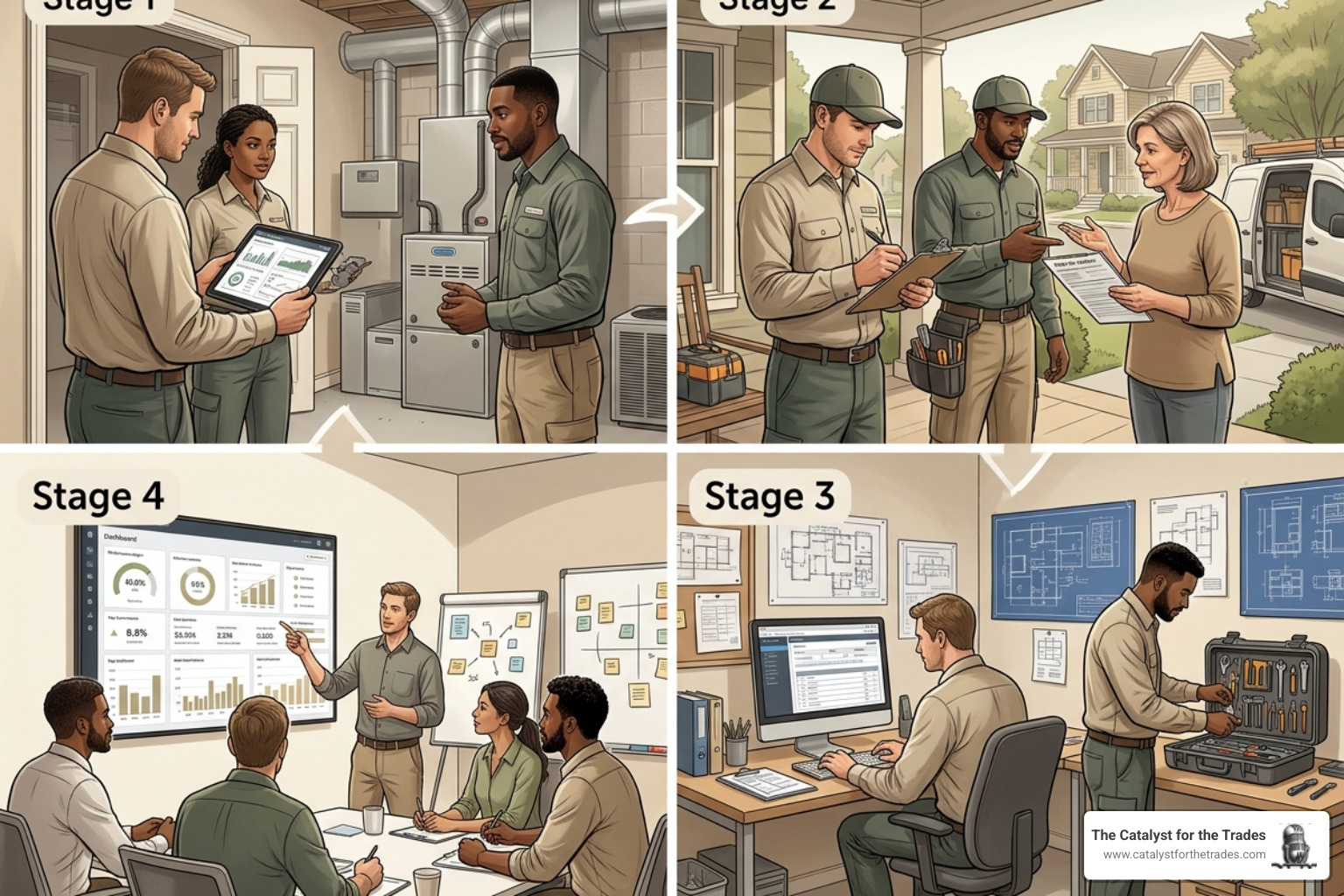
Must-know adapting to market shifts terms:
Identifying the Forces Behind Market Shifts
In the trades, we often feel like we’re at the mercy of the weather or the local housing market. But as we look at the landscape in April 2026, the forces driving change are much broader. Understanding these “why” factors is the first step in adapting to market shifts effectively.
- Economic Fluctuations: Inflation isn’t just a headline; it’s a daily reality. When the cost of copper pipes or HVAC refrigerants climbs, it ripples through your entire pricing structure. High interest rates might also mean homeowners are opting for repairs over full system replacements, forcing a shift in your service mix.
- Technological Disruption: AI isn’t coming; it’s here. From automated scheduling to predictive maintenance sensors that tell a homeowner their water heater is about to fail before it leaks, technology is changing the “value prop” of the local contractor.
- Regulatory Changes: New environmental standards or local building codes can flip an industry overnight. Whether it’s a phase-out of certain refrigerants or new energy efficiency mandates, these aren’t just hurdles—they are opportunities for those who stay informed.
- Supply Chain Volatility: We’ve all learned that we can’t always rely on “just-in-time” delivery. Market shifts often stem from global logistics hiccups that force us to find local suppliers or carry more “just-in-case” inventory.
As we discussed in our look at Why Roofing Contractors Cant Afford To Ignore Change Lessons From The Western States Roofing Expo, ignoring these shifts is a recipe for obsolescence. The market doesn’t send a calendar invite before it changes; it happens quietly, then all at once.
Early Warning Signals for Adapting to Market Shifts
You don’t need a crystal ball to see a shift coming; you just need to look at your own data. Often, the signs are right in front of us, but we’re too busy “in the truck” to notice them.
- Declining Sales or “Ghosting”: If your closing rate on big installs is dropping while your repair calls are rising, the market is telling you that discretionary spending is tight.
- Feedback Mismatch: Are customers asking for things you don’t offer? Maybe they want smart home integration or subscription-based maintenance plans, and you’re still stuck on one-off service calls.
- Operational Lag: If your team is constantly putting out fires or your systems can’t keep up with the current pace of communication, it’s a sign of Organizational Change being overdue.
- Competitor Movement: When the “big box” guys or well-funded franchises in your area suddenly change their messaging to focus on “affordability” or “AI-powered diagnostics,” they’ve likely spotted a shift you haven’t.
A Strategic Framework for Adapting to Market Shifts
To stay relevant, we recommend a system we call the Relevance Flywheel. This isn’t a one-time fix; it’s a continuous loop that keeps your business in sync with the world.
- Signal Detection: This is your “active intelligence” phase. You should be looking at the fringes—what are the tech geeks talking about? What are the new EPA regulations? Don’t just listen to your happy customers; listen to the ones who didn’t hire you.
- Internal Calibration: Once you spot a signal, gather your leadership team. Ask, “If this trend continues, does our current business model survive?” This is about Strategic Adaptation and grounding your decisions in facts rather than “gut feelings.”
- Strategic Experimentation: Don’t bet the whole farm on a new idea. Allocate 5-10% of your resources to small “probes.” Try a new service line in one zip code. Run a small AI-driven marketing campaign. See what sticks before you scale.
Adapting to Market Shifts Through Digital Transformation
Technology is the great equalizer for small trades businesses. In 2026, digital transformation isn’t about having a fancy website; it’s about using data to out-maneuver the competition.
Using tools like predictive analytics can help you forecast when a neighborhood’s HVAC units (installed during a housing boom 15 years ago) are all likely to fail. Google Trends can show you a spike in searches for “heat pump rebates” in your specific city, allowing you to pivot your ad spend instantly.
We’ve explored this deeply in Navigating Ai Change And Growth In Home Services. By using AI to handle the “drudge work” of scheduling and follow-ups, you free up your human talent to do what they do best: build trust and solve complex problems on-site.
Real-World Success Stories of the Pivot
Pivoting doesn’t mean you failed; it means you evolved. History is full of companies that changed their stripes to survive:
- The IT Pivot: One famous mainframe computer company (IBM) saw the writing on the wall for hardware and transformed into a global leader in IT consultancy and services.
- The Subscription Model: We’ve seen software companies move from one-time “box” purchases to monthly subscriptions. In the trades, this looks like moving from “waiting for the phone to ring” to “membership-based comfort clubs” that provide steady, recurring revenue.
- The Content Shift: Netflix went from mailing DVDs to streaming to becoming a massive production studio. They used data to see exactly what their customers wanted before the customers even knew it.
For more on this, check out Future Proofing Your Business With Ai A Conversation With Remy Skerjanz, where we discuss how to build a business that can withstand the test of time.
Tactical Adjustments for Product and Service Offerings
When the market shifts, your “menu” needs to change. If inflation is high, a $20,000 system replacement is a hard sell. But a “System Rejuvenation Package” that extends the life of an old unit for a fraction of the cost? That’s adapting to market shifts.
- Value-Based Messaging: Stop selling “efficiency” and start selling “predictability.” In uncertain times, people want to know their bills won’t spike and their home will remain a sanctuary.
- Ecommerce Optimization: Can a customer book a service, sign a contract, and pay a deposit from their phone while sitting on their couch? If not, you’re losing to the companies that make it easy.
- Agile Research: Use social media polls or quick email surveys to ask your customers what their biggest worry is right now. Is it indoor air quality? Energy bills? Water safety?
- Customer Feedback Loops: Don’t just ask for a 5-star review. Ask, “What’s one thing we could have done to make this easier for you?”
This behavior-first approach is key, as we noted in our episode on Adapting To Consumer Behavior Leveraging Ai And Digital Tools In The Trades.
Re-evaluating Messaging and Customer Engagement
Your marketing should reflect the current mood of your community. If you’re still using the same radio jingle from 2019, it might be time for a refresh.
| Feature | Reactive Messaging | Proactive Messaging |
|---|---|---|
| Focus | “We fix broken ACs fast.” | “We ensure your family’s comfort year-round.” |
| Pricing | “Call for a quote.” | “Transparent, flat-rate options for every budget.” |
| Technology | “We use the latest tools.” | “AI-powered diagnostics to prevent breakdowns.” |
| Outcome | Transactional repair. | Long-term peace of mind and brand loyalty. |
Staying relevant means understanding How To Stay Competitive As Ai And Consumer Behavior Reshape Home Services. It’s about building a relationship, not just completing a ticket.
Building Organizational Agility and Resilience
You can’t adapt if your team is terrified of change. As a leader, your job is to foster a culture where “that’s how we’ve always done it” is a banned phrase.
- Innovation Culture: Reward employees who suggest a better way to organize the trucks or a new app that saves 10 minutes on every job.
- Lean Operations: In 2026, bloat is the enemy. Review your overhead quarterly. Are you paying for software nobody uses? Is your warehouse space optimized?
- Change Management: When you implement a new tool (like an AI dispatcher), explain the why to your team. Show them how it makes their lives easier, not how it replaces them. For a deeper dive, see our guide on Change Management.
Small Business Strategies for Limited Resources
You don’t need a Wall Street budget to adapt. In fact, being small is your superpower—you can turn the ship much faster than a giant corporation.
- Strategic Partnerships: Partner with a local landscaper or electrician. You can share leads and offer “bundled” home wellness packages that a single-trade shop can’t match.
- Local Sourcing: To beat supply chain woes, build strong relationships with local distributors. Sometimes paying a few cents more per fitting is worth it if you know the parts will actually show up.
- Cloud Tools: Use free or low-cost cloud software for team collaboration. You don’t need a dedicated IT person to run your business from a tablet.
- Bartering: In a tight economy, don’t be afraid to trade services with other local businesses. It builds community and keeps your cash flow healthy.
As we discussed in Embracing Change The Future Of Leadership, leading through uncertainty requires a mix of humility and decisiveness.
Measuring Success and Avoiding Common Pitfalls
How do you know if your adaptation is actually working? You can’t just look at the bank balance at the end of the month.
- SMART KPIs: Set goals that are Specific, Measurable, Achievable, Relevant, and Time-bound. For example: “Increase recurring revenue from maintenance plans by 15% by Q3.”
- Review Meetings: Don’t wait for the annual meeting. Hold “pulse checks” every month to see if your strategic experiments are bearing fruit.
- Avoid Overextension: The biggest pitfall is trying to do everything at once. If you’re a plumbing shop, don’t suddenly try to become a solar panel installer and a roofing company in the same month. Focus on one pivot at a time.
- Communication Gaps: Ensure your “boots on the ground” technicians understand the new strategy. If they aren’t selling the new value-based messaging, the whole plan falls apart.
For more on protecting your company’s future, see our resources on Future Proofing Business.
Frequently Asked Questions about Market Adaptation
How can small businesses adapt with limited resources?
Small businesses can stay lean by using cloud-based tools and automating repetitive tasks with AI. Forming strategic partnerships with non-competing trades allows you to share marketing costs and leads. Additionally, focusing on local sourcing and even bartering services can help manage cash flow during economic dips.
What role does AI play in staying competitive?
AI is a game-changer for workflow automation and data analysis. It allows you to provide personalized customer interactions (like 24/7 AI chat) and use predictive modeling to identify which customers are most likely to need service soon. It’s also great for rapid prototyping of new marketing messages to see what resonates.
How do you know when to adjust your strategy further?
Watch for “weak signals” like a slight drop in purchase frequency or an uptick in customer complaints about pricing. If your order volume is flat while the market is growing, or if you see a dip in your online sentiment (reviews), it’s time to recalibrate. Competitor movements—like a rival launching a major new technology—are also a clear sign to move.
Conclusion
At The Catalyst for the Trades, we believe that the future belongs to the flexible. As we navigate the complexities of April 2026, resilience isn’t about standing your ground—it’s about moving with the tide.
Proactive evolution is always better than reactive panic. By monitoring the signals, calibrating your team, and experimenting with new digital tools, you aren’t just surviving a market shift; you’re using it as a springboard for the next level of growth.
Don’t let the dust settle on your business. Stay curious, stay agile, and keep your eyes on the horizon.
Learn more about our mission and how we help businesses navigate change


