Learn · May 8, 2026
7 Cost Control Strategies for Contractors: Save Big
Discover 7 cost control strategies for contractors to prevent budget overruns, boost profits & ensure project success.
By The Catalyst Editorial Team Operator education · 10 min read · Updated July 24, 2026

Why Cost Control Strategies for Contractors Are Make-or-Break in 2026
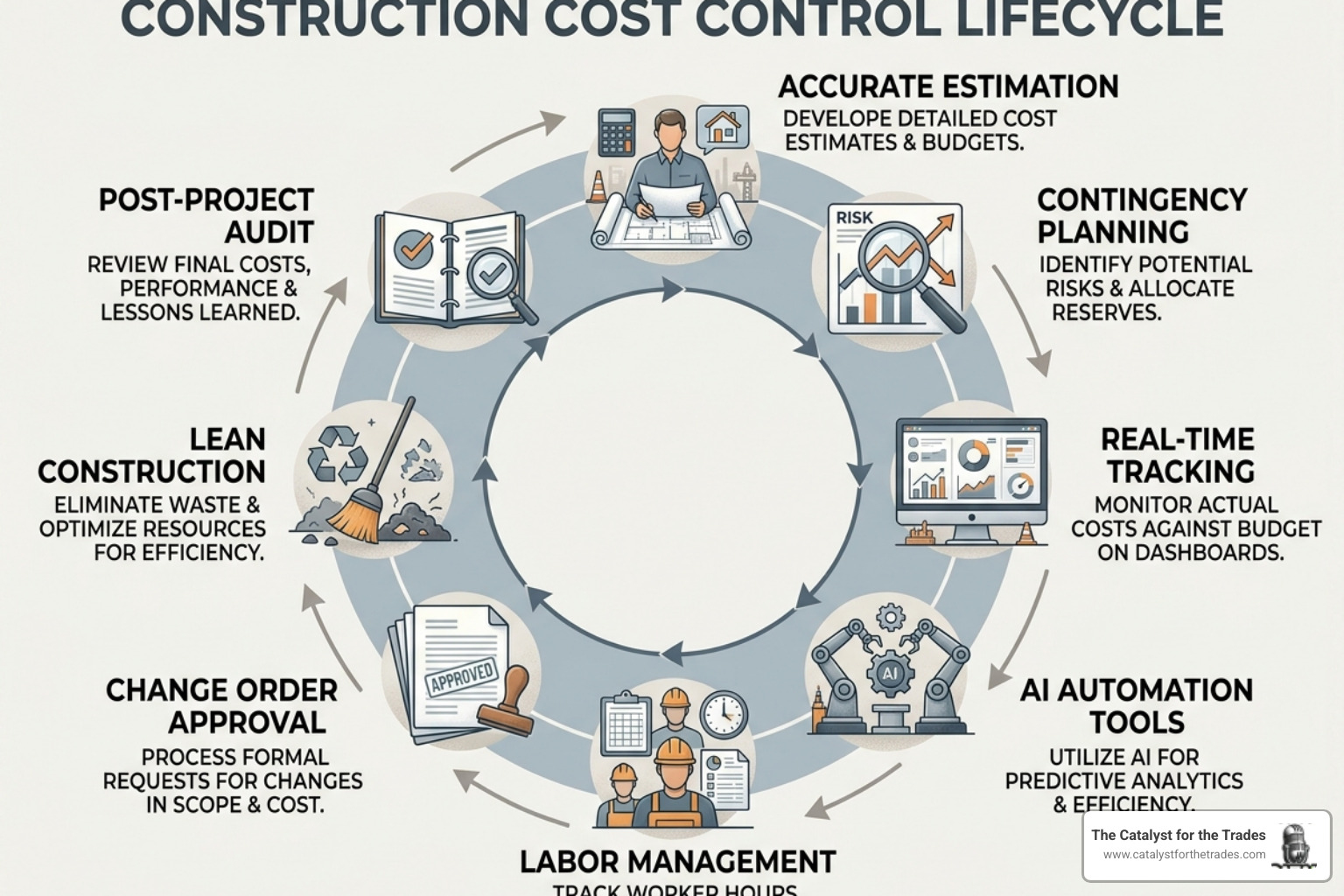
Cost control strategies for contractors are the difference between a profitable project and one that quietly bleeds your business dry. Here’s a quick breakdown of the most effective approaches:
- Accurate budgeting and estimation — Use historical data and structured estimation techniques to set realistic baselines
- Contingency planning — Identify risks early and allocate dedicated funds before work begins
- Real-time expense tracking — Replace spreadsheets with cloud-based tools that show live budget status
- AI and automation — Use smart software to reduce errors, automate takeoffs, and flag cost deviations fast
- Labor and subcontractor management — Track hours closely, level bids, and lock in fixed-price contracts
- Change order management — Require written approval for every scope change before work proceeds
- Lean construction and post-project audits — Eliminate waste, review what went wrong, and apply lessons forward
Construction has always been a thin-margin game. The average net profit for a construction business sits somewhere between 3% and 7% — meaning even small overruns can wipe out what little profit was left on the table. And overruns are far from rare. According to McKinsey, major construction projects exceed their budgets by up to 80% on average.
The problem isn’t that contractors don’t care about costs. It’s that most cost control happens too late — after the damage is done, not before it starts.
In April 2026, with material prices still volatile, labor shortages ongoing, and project complexity rising, having a structured approach to cost control isn’t optional. It’s survival.
The good news? Seven practical strategies can dramatically tighten your financial grip on any project — whether you’re running a small crew or managing multi-million dollar builds.
Easy cost control strategies for contractors glossary:
Strategic Planning and Cost Control Strategies for Contractors
Before a single shovel hits the dirt, the fate of your profit margin is often already sealed. We’ve seen it time and again: a project that looks great on paper falls apart because the initial “map” was missing half the landmarks. Effective cost control starts with baseline discipline. This means creating a formally approved cost baseline that defines your project’s financial boundaries before execution begins.
To get this right, we recommend Financial Planning For Trade Businesses to ensure your overhead is covered and your growth is sustainable. You also need to Know Your Numbers Grow Your Business Financial Strategies For Trades so you aren’t just guessing based on “gut feeling.”
One of the most powerful tools in our arsenal is the Work Breakdown Structure (WBS). By breaking the project into small, manageable work packages, you can assign costs with much higher precision. Don’t do this in a vacuum, though. Use cross-functional validation—get your project managers, procurement team, and field superintendents in the same room to tear the estimate apart before the client sees it.
Way 1: Accurate Budgeting and Estimation
Accurate estimation is the bedrock of cost control strategies for contractors. If your starting number is wrong, no amount of field efficiency can save the job. In 2026, we lean on three primary techniques:
- Parametric Estimating: Using statistical relationships between historical data and other variables (like cost per square foot) to calculate an estimate.
- Analogous Estimating: Looking at similar past projects to gauge costs for the current one. This is fast but requires a deep library of historical data.
- Bottom-Up Approach: The most accurate (and time-consuming) method, where we estimate every individual task and roll them up into a total.
The biggest “budget killers” are often vague scope definitions. If you haven’t clearly defined what is not included, you’re inviting scope creep to dinner. We also have to account for market fluctuations; in today’s climate, a quote for copper or lumber from six months ago is essentially a work of fiction.
Way 2: Structured Contingency Planning
Uncertainty is inherent in construction. Whether it’s a sudden spike in material costs or a week of torrential rain, something will go wrong. The difference between a pro and an amateur is a structured contingency plan.
Take the famous “The World” islands project in Dubai. Poor risk management and environmental factors led to financial setbacks exceeding $10 billion. While your backyard patio or commercial HVAC install might not be on that scale, the principle remains: if you don’t plan for the “what ifs,” they will eat your profit.
Effective contingency planning involves:
- Risk Identification: High-probability and high-impact risks (e.g., labor shortages, permit delays).
- Financial Impact Assessment: Estimating exactly how much that risk will cost if it happens.
- Controlled Drawdown: Don’t just treat the contingency fund as extra profit. Define strict approval protocols for when that money can be touched.
For more on protecting your bottom line, check out these Year End Tax Tips That Actually Work to keep more of what you earn after the project is done.
Leveraging Technology for Real-Time Visibility
The days of waiting until the end of the month to see if you made money are over. If you’re still relying on paper receipts and “I’ll check the bank account later,” you’re flying blind. Real-time visibility is the holy grail of cost control strategies for contractors.
When we talk about Operational Efficiency, we’re talking about data-driven decisions. Statistics show that 61% of project managers report that technology significantly reduces project errors and cost overruns. In April 2026, cloud-based dashboards allow us to see exactly where every dollar is at any given second.
Way 3: Real-Time Expense Tracking
To stay profitable, you need to track “committed costs”—money you’ve promised to spend (like signed subcontracts) but haven’t paid out yet. If you only track checks written, you’ll think you have more money than you actually do.
| Feature | Manual Spreadsheets | Real-Time Digital Tracking |
|---|---|---|
| Data Accuracy | High risk of human error | Automated, high precision |
| Visibility | Lagged (days or weeks) | Instant, live updates |
| Communication | Siloed in one file | Cloud-based, accessible to all |
| Forecasting | Reactive | Predictive |
Daily site reports should be digital and fed directly into your cost management software. This allows for weekly “budget health checks” where you compare actuals to your baseline and course-correct before a 5% overrun turns into a 20% disaster.
Way 4: Leveraging AI and Robotics as Cost Control Strategies for Contractors
The future is here, and it’s saving us a fortune. One of the most exciting developments in 2026 is the use of construction layout robots. These little guys (like HP SitePrint) can take a digital blueprint and print it directly onto the floor with sub-millimeter accuracy. This eliminates manual layout errors that used to lead to massive rework costs for plumbing and electrical trades.
We are also seeing the rise of:
- AI Takeoff Software: Automating the process of counting materials from digital plans, cutting estimation time by 50% or more.
- Predictive Analytics: AI that looks at your past project data to flag which current jobs are most likely to go over budget.
- Digital Twins & IoT: Using sensors on heavy equipment to monitor idle time. If a backhoe is sitting idle for four hours a day, that’s fuel and rental money evaporating.
- 3D Laser Scanning: Creating a “point cloud” of a site to ensure new work fits perfectly with existing structures, preventing “it doesn’t fit” moments in the field.
Operational Excellence in the Field
You can have the best software in the world, but if your field operations are messy, your budget will explode anyway. This is where the “rubber meets the road.” We always emphasize the importance of a solid Hvac Business Operations Guide or similar trade-specific operational standards.
A huge part of field cost control is managing who you work with. Choosing Right Vendors and having clear Vendor Management Strategies can save you thousands in avoided delays and material markups.
Way 5: Labor Productivity and Subcontractor Management
Labor is typically the largest and riskiest cost in any project. It’s the most volatile variable. To keep it under control, we use:
- Biometric Verification: Tools like SmartBarrel use facial recognition to prevent “buddy punching” and time theft.
- Bid Leveling: When hiring subcontractors, don’t just pick the lowest number. Level the bids to ensure everyone is quoting the exact same scope. A low bid with “exclusions” is just a change order waiting to happen.
- Quick Buyouts: Lock in your subcontractors and material prices as early as possible. In a volatile market, a “fixed-price” contract signed today is a shield against inflation tomorrow.
By tightening these screws, you are directly Increasing Service Margins without having to raise your prices on the customer.
Way 6: Proactive Change Management: Essential Cost Control Strategies for Contractors
If there is one thing that destroys budgets more than anything else, it’s the unmanaged change order. Look at London’s Wembley Stadium—cost overruns skyrocketed from $458 million to over $1.5 billion, largely due to poorly managed changes and scope creep.
We follow a strict “No Work Without Paper” policy.
- Formal Governance: Every change must be documented, priced, and approved in writing before a single tool is lifted.
- Documentation Trail: Use digital tools to timestamp approvals so there’s no “he-said, she-said” at the end of the job.
- 1:1 Cost Recovery: If a subcontractor makes a mistake that requires a change, they should bear the cost. If the client adds a light fixture, they pay for the labor and the material. Don’t “eat” small changes—they add up to a feast that devours your profit.
Long-Term Efficiency and Waste Reduction
Cost control isn’t just about the current project; it’s about building a more efficient business. We suggest using Financial Management And Profitability Keywords to track your long-term health and mastering Financial Management Contractors techniques to ensure you aren’t just “busy,” but actually profitable.
The most successful contractors we work with perform post-project reviews. They sit down after every job and perform a variance analysis: “We budgeted $10k for copper; we spent $14k. Why?” Was it waste? Theft? A bad estimate? If you don’t ask the question, you’ll make the same mistake on the next job.
Way 7: Lean Construction and Value Engineering
Lean construction is all about eliminating waste—waste of time, waste of movement, and waste of material.
- Just-in-Time (JIT) Delivery: Don’t have $50,000 worth of equipment sitting on a muddy site for three weeks where it can be damaged or stolen. Schedule delivery for the day you need it.
- Pull Production: Work is “pulled” based on actual demand rather than “pushed” based on a rigid, potentially outdated schedule.
- Value Engineering: This isn’t just “cheapening” the project. It’s analyzing every component to see if there is a more cost-effective way to achieve the same function and quality.
- Life Cycle Costing: Sometimes, spending more upfront on a high-efficiency HVAC unit saves the client (and you, in warranty calls) more money over the long term. Plus, many energy-efficient designs come with government incentives that can offset initial costs.
Conclusion
At The Catalyst for the Trades, we are obsessed with helping you scale. Whether it’s through the cutting-edge tech insights Jennifer Bagley brings to the table or the operational scaling expertise of Chuck Staszkiewicz, our goal is to move you from “surviving” to “thriving.”
As we move through April 2026, the contractors who embrace these cost control strategies for contractors will be the ones winning the best bids and keeping the most profit. It’s not just about working harder; it’s about having the systems in place to ensure your hard work actually shows up in your bank account.
Ready to take your trade business to the next level? Learn more About Us and how we can help you innovate and lead in your market.
Frequently Asked Questions
What is the biggest expense in a construction project?Typically, labor is the largest and most variable expense. However, in recent years, material volatility and indirect expenses (like fuel, insurance, and equipment maintenance) have become significant “silent killers” of project budgets.
How does technology reduce project cost overruns?Technology provides real-time visibility, allowing you to catch mistakes when they cost $100 to fix rather than $10,000. Features like AI-driven takeoffs and robotic site layouts have been shown to reduce project errors by up to 61%, directly protecting your margins.
Why are change orders so damaging to a budget?Change orders lead to “scope creep,” where the project grows beyond the original plan. Without a formal approval process, contractors often perform extra work that never gets billed, or they suffer administrative delays that keep crews idle, as seen in massive projects like Wembley Stadium.


