Learn · May 5, 2026
Employee Retention Strategies for Contractors: 2026 Guide
Discover proven employee retention strategies for contractors: cut turnover, boost loyalty, and save costs with stay interviews, tech, and wellness.
By The Catalyst Editorial Team Operator education · 8 min read · Updated July 24, 2026

Why Employee Retention Strategies for Contractors Are More Urgent Than Ever
Employee retention strategies for contractors are no longer a “nice to have” — they’re a survival skill. Here’s a quick breakdown of what works:
Top retention strategies for contractors:
- Offer competitive, benchmarked pay — review compensation against market rates at least annually
- Build a comprehensive benefits package — health coverage, 401(k), and EAP programs
- Conduct stay interviews — ask workers what would make them leave before they do
- Create clear career paths — document advancement from laborer to foreman to superintendent
- Invest in mentorship programs — pair new hires with experienced field leaders
- Prioritize mental health and wellness — integrate well-being into your safety culture
- Leverage modern HR technology — reduce friction with digital onboarding and mobile communication
- Recognize and celebrate contributions — milestone programs, safety bonuses, and public praise
- Offer flexible scheduling where possible — results-focused management over rigid hours
- Foster a purpose-driven culture — connect daily work to real community impact
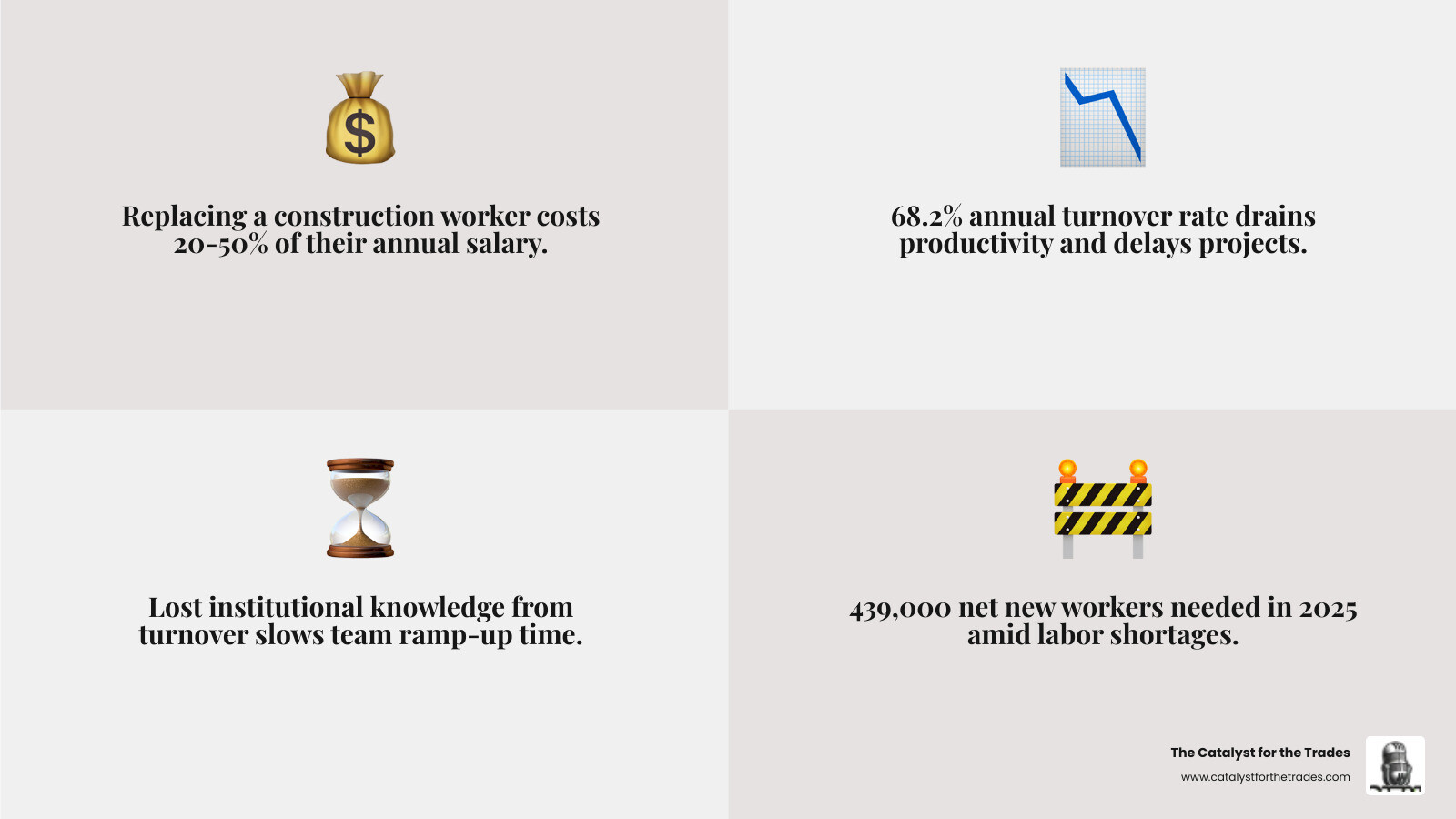
The U.S. construction industry needed to hire 439,000 net new workers in 2025 just to keep pace with already-planned projects. At the same time, nearly 9 in 10 contractors reported struggling to fill both hourly and salaried positions. The industry’s average annual turnover rate sits at a staggering 68.2% — meaning contractors aren’t just fighting to find workers, they’re fighting to keep the ones they already have.
This isn’t a new problem, but it’s getting worse. An aging workforce, rising competition for skilled labor, and shifting expectations from younger generations have created a perfect storm. Workers today want more than a paycheck — they want purpose, support, career growth, and a workplace that treats them like long-term investments, not interchangeable parts.
The good news? The data is clear on what actually moves the needle. Contractors who take a deliberate, multi-layered approach to retention are building teams that stay, perform, and grow — even in the tightest labor markets.
Must-know employee retention strategies for contractors terms:
The High Cost of Turnover in the Construction Industry
When a skilled technician or a seasoned foreman walks out the door, they take more than just their tools with them. They take years of institutional knowledge, client relationships, and team chemistry. In an industry where the average annual turnover rate is approximately 68.2%, the “revolving door” isn’t just an HR headache—it’s a massive drain on your bottom line.
Research indicates that the cost of replacing a single construction worker can range from 50% to 200% of their annual salary. This isn’t just about the check you write to a recruiter. It includes:
- Recruitment Expenses: Advertising roles, background checks, and the time spent interviewing.
- Onboarding and Training: The “ramp-up” period where a new hire is learning your specific systems and safety protocols.
- Lost Productivity: While a position is vacant, projects slow down. Once filled, it takes time for a new hire to reach full efficiency.
- Project Delays: High turnover leads to missed deadlines, which can result in liquidated damages or a tarnished reputation with developers.
- Safety Risks: New workers are statistically more likely to be involved in jobsite accidents as they acclimate to a new environment.
By focusing on Workforce Planning, we can anticipate these gaps before they become crises. Effective Talent Retention isn’t about preventing every departure; it’s about making your company a place where the best people want to build their futures.
Core Employee Retention Strategies for Contractors
To stop the leak, we have to look at the foundation: how we take care of our people. While competitive pay gets people in the door, it’s the total package that keeps them there.
| Benefit Category | Traditional Approach | Modern Retention Package |
|---|---|---|
| Compensation | Flat hourly rate | Market-benchmarked pay + performance bonuses |
| Health | Basic medical only | Comprehensive medical, dental, vision + Telehealth |
| Financial | Paycheck only | 401(k) with matching + financial literacy tools |
| Wellness | “Walk it off” culture | EAP programs + mental health support |
| Growth | Learn as you go | Documented career paths + paid certifications |
Implementing Stay Interviews as Employee Retention Strategies for Contractors
Most contractors wait until an exit interview to ask why someone is leaving. By then, it’s too late. The “stay interview” is a proactive tool where we sit down with our current high-performers to ask: “What keeps you here, and what might tempt you to leave?”
To get honest feedback, these should feel like a conversation, not an interrogation. Some firms find success using a neutral third party to conduct these, ensuring workers feel safe sharing their true thoughts on Workplace Satisfaction. If you hear that a lack of specific tools or a frustrating scheduling process is bothering your best lead tech, you can fix it before they start browsing job boards. For more in-depth tactics, check out our Employee Retention Strategies Guide 2026.
Leveraging Technology as Employee Retention Strategies for Contractors
In the modern trades, technology isn’t just for the office; it’s a retention tool for the field. Outdated, manual processes create “administrative friction” that wears down your team. Imagine a technician who has to drive an hour to the office just to drop off a paper timesheet—that’s a recipe for burnout.
Investing in modern Human Capital Management (HCM) software allows for:
- Digital Onboarding: New hires can complete paperwork on their phones, making them feel like they’ve joined a professional, modern outfit from Day 1.
- SMS Communication: Field crews often ignore emails. Using text-based platforms for schedule updates and company news keeps everyone in the loop.
- Hiring Process Optimization: Streamlining how you bring people in sets a tone of efficiency that resonates throughout their tenure. Learn more about Hiring Process Optimization to improve that first impression.
Building a Purpose-Driven Culture and Professional Growth
The “Great Resignation” proved that workers, especially Millennials and Gen Z (who now make up nearly half the workforce), want to feel that their work matters. In construction, we have a unique advantage: we build the infrastructure and homes our communities rely on.
Positioning construction as a modern, purpose-driven career is one of the most effective employee retention strategies for contractors. We aren’t just “digging holes”; we’re providing clean water, climate control for families, and safe shelter. Highlighting this impact during team meetings helps build Employee Loyalty.
Furthermore, teams with documented career paths experience 34% longer retention. Workers need to see a “ladder” they can climb. Whether it’s moving from an apprentice to a journeyman or transitioning into a superintendent role, clear Employee Growth plans show that we are invested in their long-term success. This is a core part of Workforce Development.
Mentorship and One-on-One Engagement
Mentorship programs are a “win-win.” They help junior talent acclimate faster and give seasoned foremen a sense of legacy and leadership. Regular one-on-one check-ins—even just 15 minutes every two weeks—can drastically improve employee engagement. It’s an opportunity to provide praise, address friction points, and reinforce Team Building Strategies.
Prioritizing Wellness, Safety, and Work-Life Balance
Construction is physically demanding, but the mental toll is often overlooked. Shockingly, the suicide rate in construction is six times higher than the rate of workplace fatalities. Prioritizing mental health isn’t just the right thing to do; it’s a critical safety initiative.
A tired or distracted worker is a danger to themselves and the team. By integrating wellness into your Company Culture Development, you strengthen the bond with your employees.
Wellness and Balance Initiatives:
- Mental Health First Aid: Train supervisors to recognize signs of stress or burnout.
- Flexible Scheduling: While field work requires presence, offering “time banks” or rotating Friday afternoons off can prevent burnout.
- Safety Bonuses: Reward teams for incident-free quarters, which aligns financial incentives with physical well-being.
Measuring Success and the 90-Day Retention Action Plan
You can’t manage what you don’t measure. Contractors should track specific Retention Metrics to see if their strategies are working:
- Turnover Rate: (Number of departures / Average number of employees) x 100.
- Average Tenure: How long does the typical worker stay?
- Time-to-Productivity: How long from the start date until a new hire is “billing” at full capacity?
- Employee Net Promoter Score (eNPS): Use anonymous surveys to ask, “How likely are you to recommend working here to a friend?”
The 90-Day Retention Sprint:
- Days 1-30: Conduct stay interviews with your top 20% of performers. Identify one “easy win” (e.g., better rain gear or a new communication app) and implement it immediately.
- Days 31-60: Document career paths for every role. Meet with each employee to show them their personalized “ladder.”
- Days 61-90: Launch a formal recognition program. Celebrate work anniversaries and project milestones publicly.
Frequently Asked Questions about Retention in the Trades
Why is employee retention a critical challenge for contractors?
The industry is facing a massive labor shortage, needing hundreds of thousands of new workers annually. When a contractor loses an employee, they aren’t just losing labor; they are losing a competitive edge in a market where 9 in 10 firms are struggling to hire.
How much does employee turnover actually cost a construction firm?
Between recruitment, onboarding, lost productivity, and potential project delays, replacing a worker typically costs between 50% and 200% of that worker’s annual salary. For a skilled technician, this can easily reach tens of thousands of dollars.
What flexible work arrangements work best in the field?
While “work from home” isn’t an option for a plumber, flexibility can include four-day work weeks (4x10s), staggered start times to avoid traffic, or “results-based” scheduling where a crew can head home once a specific project milestone is safely met.
Conclusion
At The Catalyst for the Trades, we believe that your people are your most valuable asset. In an era of record labor shortages and high competition, the contractors who win won’t just be the ones with the best equipment—they’ll be the ones who have mastered employee retention strategies for contractors.
By investing in competitive pay, modern technology, and a culture that prioritizes mental health and career growth, you aren’t just “stopping the leak.” You’re building a resilient, loyal workforce that will carry your business toward long-term growth and innovation. Learn more about our mission to empower the trades through leadership and technology.


