Episode
January 12, 2026

Your Sales Playbook: A Guide to Effective Methodologies

What is a Sales Methodology and Why It Matters

A sales methodology is a structured framework that guides your sales team through each stage of the selling process—from initial contact to closing the deal. Unlike a sales process, which tells you what to do (prospect, qualify, present, close), a methodology explains how to do it effectively. It's the repeatable playbook that helps your team sell consistently, whether you're selling HVAC replacements, plumbing repairs, or electrical upgrades.

Quick Answer: Sales Methodology vs. Sales Process

  • Sales Process = The sequence of steps (what to do)
  • Sales Methodology = The philosophy and techniques (how to do it)
  • Sales Methodology = Provides principles, behaviors, and best practices
  • Sales Process = Maps stages like lead generation → qualification → proposal → close

For home services business owners looking to scale, a solid sales methodology turns your best salesperson's instincts into a system everyone can follow. It shortens sales cycles, increases close rates, and creates predictable revenue. The concept isn't new—Xerox pioneered Professional Selling Skills in the 1970s, and Miller and Heiman introduced Strategic Selling in 1985. Today, methodologies like SPIN, Challenger, and Sandler dominate because they work across industries, including the trades.

Explore proven business growth strategies to scale your operations, or schedule a consultation to build a custom sales playbook for your team.

Without a methodology, your sales team is winging it. Some reps might succeed through personality alone, but you can't replicate that across ten or fifty technicians. A methodology gives everyone the same roadmap, so your newest hire can sell like your top performer. It also helps you diagnose what's working and what's not—if deals stall at the same stage, your methodology tells you where to fix the process.
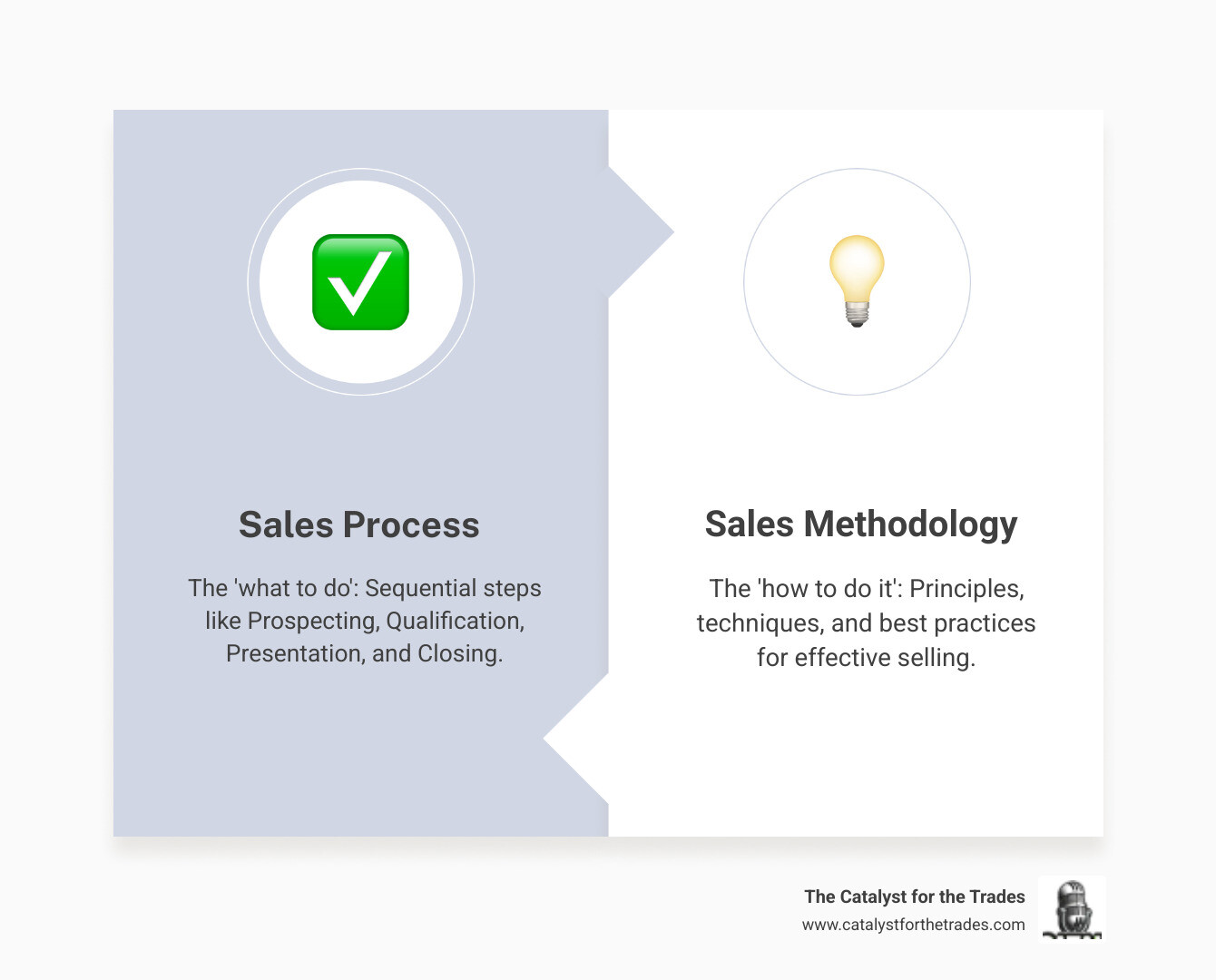
Infographic comparing sales process stages on the left (Prospecting, Qualifying, Presenting, Closing) with sales methodology principles on the right (Ask the right questions, Build trust, Focus on pain points, Tailor solutions). Arrows show how methodology guides each process stage. - sales methodology infographic comparison-2-items-formal

Simple sales methodology word guide:

When it comes to sales methodology, there's no one-size-fits-all solution. What works for a complex B2B software sale might not be the best fit for a routine HVAC service call. However, understanding the core principles of leading methodologies helps us craft a custom approach for our home services business. Let's explore some of the most popular and effective frameworks.

1. The Challenger Sale: Teach, Tailor, Take Control

The Challenger Sale methodology, from a 2011 book by Brent Adamson and Matthew Dixon, posits that there are five types of B2B seller personas. Their research found that "Challengers" represent 40% of top-performing sales reps. This methodology helps all reps sell more like those top performers.

Core Principles:

  • Teach: Challengers teach customers new insights about their business and how to save money or avoid risk. They disrupt the customer's thinking, which is effective for differentiation in competitive markets.
  • Tailor: They personalize their message to resonate with the customer's specific needs and challenges, demonstrating how their offering uniquely solves those problems.
  • Take Control: Challengers are comfortable asserting their expertise and guiding the conversation, confidently leading the customer toward a solution that addresses previously unrecognized issues.

Ideal Scenarios for Trades Businesses:This approach shines in complex sales, such as selling high-efficiency HVAC system upgrades or comprehensive home energy audits. It's ideal for educating homeowners on long-term benefits or hidden problems they hadn't considered, like the value of an advanced air purification system over a basic filter.

Weaknesses/Limitations:The Challenger Sale requires deep industry knowledge. Your sales team must be well-versed in your services, home efficiency trends, and local regulations. It demands significant training, and some prospects might resist having their assumptions challenged if not handled with finesse.

Building a modern sales culture that accepts continuous learning and challenging insights is key to this methodology's success. Learn more about building a modern sales culture.

2. SPIN Selling: The Art of the Right Question

SPIN Selling, popularized by Neil Rackham, is all about asking the right questions to uncover a customer's needs. Rackham's research showed that a solid questioning strategy can significantly increase closure rates by helping diagnose problems and develop viable solutions.

Core Principles (the S.P.I.N. acronym):

  • Situation Questions: Gather facts and background information about the customer's current situation. (e.g., "How old is your water heater?", "What kind of heating system do you currently have?")
  • Problem Questions: Uncover specific problems, difficulties, or dissatisfactions the customer is experiencing. (e.g., "Are you experiencing inconsistent water temperature?", "Do you find your energy bills are higher than you'd like?")
  • Implication Questions: Explore the consequences or effects of the problems, helping the customer understand their severity and urgency. (e.g., "How does that inconsistent water temperature impact your family's daily routine?", "What's the long-term cost of those high energy bills?")
  • Need-Payoff Questions: Focus on the value or usefulness of solving the problem, shifting the customer's focus to a solution's benefits. (e.g., "If you had consistent hot water, what would that mean for your comfort?", "How would a more energy-efficient system impact your monthly budget and peace of mind?")

Ideal Scenarios for Trades Businesses:SPIN Selling is excellent for consultative services like diagnosing persistent plumbing issues or recommending a comprehensive HVAC maintenance plan. It's perfect for building trust by genuinely understanding the homeowner's unique situation and is useful for lead qualification.

Weaknesses/Limitations:While powerful, SPIN can feel formulaic if reps aren't trained to ask questions naturally. It requires practice, can be time-consuming, and might not be ideal for simple, transactional sales where the customer's need is already clear.

Effective lead conversion often starts with asking the right questions. Explore strategies for Lead Conversion Optimization.

3. The Sandler System: Qualifying the Buyer

The Sandler Sales methodology, created by David H. Sandler, reverses the traditional sales dynamic. Instead of the salesperson chasing the prospect, it positions both parties as equally invested in determining if there's a good fit.

Core Principles:

  • Mutual Investment: The salesperson acts as a trusted advisor, and both parties decide if a relationship makes sense, avoiding wasted time on deals that aren't a good fit.
  • Upfront Contract: Before every interaction, both parties agree on the purpose, agenda, and desired outcome, creating clear expectations.
  • Identify Pain Early: Through questioning, reps uncover the customer's "pain" (problems, frustrations) at a deep, emotional level.
  • Budget and Decision Process: Crucially, Sandler encourages identifying the prospect’s budget and decision-making process early, before presenting a solution. This prevents wasting time on someone who can't buy.
  • "Reverse Psychology": Reps are trained to use questioning that might seem counter-intuitive, prompting prospects to clarify their needs or objections themselves.

Ideal Scenarios for Trades Businesses:The Sandler System is ideal for high-ticket sales and complex solutions in home services, like whole-home generator installations or major remodels. It's great for consultative selling where mutual qualification prevents wasted time.

Weaknesses/Limitations:This methodology requires significant discipline, especially the willingness to "walk away" from deals that aren't a good fit. Its complexity makes it less suitable for short, transactional sales cycles, and it might feel unnatural to new reps.

We often spend too much time chasing leads that aren't a good fit. Learn how to Stop Chasing New Leads, Start Closing the Ones You Already Have.

4. Solution Selling: Focusing on the Pain Point

Solution Selling is an approach that centers on the customer's problems, offering custom solutions rather than just pitching products. It was a significant innovation in sales methodology, moving away from simply "getting the order" to a "win-win" approach.

Core Principles:

  • Diagnose Needs Before Prescribing: Like a doctor, we must understand the customer's symptoms and underlying issues before offering a remedy. This involves extensive questioning and active listening.
  • Focus on Outcomes: The emphasis is on the benefits and results the customer will achieve by implementing our solution, not just the features of our product or service.
  • Build Long-Term Relationships: By consistently solving problems and delivering value, we foster trust and create lasting partnerships with our customers.
  • Customized Solutions: Acknowledges that every customer's situation is unique, and solutions should be adapted accordingly.

Ideal Scenarios for Trades Businesses:This methodology is perfect for home services where customization is key, such as designing a new HVAC system for a custom home or proposing a specific water filtration system. It's beneficial for focusing on value and building strong customer relationships.

Weaknesses/Limitations:Solution Selling can lengthen the sales cycle due to the in-depth findy required. It demands thorough research and customization, which might be resource-intensive and overkill for simple services.

Focusing on solutions helps protect our profitability and leads to more purposeful business. Find more about protecting profit and leading with purpose.

5. MEDDICC: The High-Value Deal Checklist

MEDDICC (Metrics, Economic Buyer, Decision Criteria, Decision Process, Identify Pain, Champion, Competition) is a rigorous qualification process designed for complex, high-stakes enterprise deals. While originating in B2B, its principles are valuable for high-value residential or commercial projects in the trades.

Core Principles (the M.E.D.D.I.C.C. acronym):

  • Metrics: What quantifiable impact will our solution have? How will the customer measure success? (e.g., "How much will a new furnace reduce your monthly heating costs?", "What's the ROI on upgrading to LED lighting?")
  • Economic Buyer: Who has the ultimate authority to sign off on the budget? This is often the CFO or business owner in commercial settings, or the primary decision-maker in a household.
  • Decision Criteria: What are the specific criteria the customer will use to evaluate solutions and choose a vendor? (e.g., "Are you prioritizing energy efficiency, upfront cost, or warranty?", "What are your must-have features for a new AC unit?")
  • Decision Process: What are the steps the customer will take to make a purchase, and what's the timeline? Who else needs to be involved? (e.g., "Will you get multiple quotes?", "Do you need to consult with your spouse or a contractor?")
  • Identify Pain: What are the critical problems or challenges our solution addresses? This goes beyond symptoms to the root cause.
  • Champion: Who within the customer's household or organization is advocating for our solution? This internal supporter is crucial for navigating complex deals.
  • Competition: Who are we up against, and what are their strengths and weaknesses from the customer's perspective?

Ideal Scenarios for Trades Businesses:MEDDICC is perfect for large commercial HVAC installations or multi-unit residential contracts. It helps ensure you invest time wisely on qualified deals with a high probability of closing, especially when the sales cycle is long and involves multiple stakeholders.

Weaknesses/Limitations:This methodology is overkill for smaller, routine jobs like a leaky faucet repair. Its rigidity and complexity require significant training and time, making it unsuitable for high-volume transactional sales.

Building predictable systems is essential for managing complex projects and sales. Find how to create building predictable systems.

6. Conceptual Selling: Selling the Win-Win Outcome

Conceptual Selling, developed by Robert Miller and Stephen Heiman, is based on the idea that customers don't buy a product or service – they buy the concept of a solution. It urges salespeople to uncover the prospect's concept of their problem and understand their decision process.

Core Principles:

  • Understand the Customer's Concept: Instead of presenting our solution, seek to understand their vision of the solution and their desired outcome.
  • Focus on Win-Win Results: A core guideline is that the sale must be a mutually beneficial "win-win" for both the customer and the sales rep. If it's not, we shouldn't proceed.
  • Question-Based Approach: Like SPIN, this methodology relies heavily on asking insightful questions to gain a deeper understanding of the customer's thought process and objectives.
  • Collaborative Conversation: It fosters a partnership where the salesperson helps the customer refine their concept and align it with a viable solution.

Ideal Scenarios for Trades Businesses:Conceptual Selling is ideal for complex projects where the customer has a vague idea of their needs but isn't sure how to achieve them, such as smart home automation or integrated indoor air quality solutions. It's well-suited for situations requiring deep customer understanding.

Weaknesses/Limitations:This methodology can be too abstract for some sales teams. It's time-consuming, requires seasoned reps skilled in conceptual thinking, and may not explicitly emphasize the closing phase.

Delivering exceptional customer experience excellence often means understanding their underlying concepts and desires.

7. SNAP Selling: For the Modern, Busy Homeowner

SNAP Selling, created by Jill Konrath, is designed for today's busy, overwhelmed buyers. It focuses on streamlining the sales cycle, recognizing that modern homeowners are often stressed and in a hurry.

Core Principles (the S.N.A.P. acronym):

  • Simple: Make it incredibly easy for the customer to buy. Avoid jargon, keep proposals concise, and simplify the decision-making process.
  • iNvaluable: Position ourselves as an invaluable resource, providing relevant insights and information that helps the customer make smart decisions.
  • Always Align: Align our solutions with the customer's current beliefs, objectives, and priorities. Don't try to change their mind; work within their existing framework.
  • Priorities: Understand the customer's top priorities and demonstrate how our solution directly addresses them, creating urgency.

Ideal Scenarios for Trades Businesses:SNAP Selling is perfect for high-volume, straightforward services where homeowners want quick, clear solutions. Think urgent repairs, routine maintenance, or standard appliance installations. It's great when the homeowner wants efficiency without a lengthy sales process.

Weaknesses/Limitations:While efficient, SNAP Selling is not ideal for complex, relationship-driven sales that require deep findy and customization. It's better for shorter sales cycles and might not allow for the relationship building that leads to larger projects.

When we need to convert leads into sales quickly and efficiently, especially for standard services, SNAP Selling can be a game-changer. It helps us offer Fast to Cash Products and Smarter Sales with Karen Sager.

How to Choose and Implement the Right Sales Methodology

Choosing and implementing the right sales methodology is not a one-time decision; it's an ongoing process of adaptation and refinement. For home services businesses, this means understanding our unique market, customer base, and service offerings.

Factors to Consider When Choosing Your Sales Methodology

Selecting the best sales methodology for your business requires careful consideration of several factors. The goal is to find a framework that improves the process for both your team and your customers.

  • Business Objectives: Are you focused on rapid growth, increasing average ticket size, or customer retention? If increasing ticket size for complex jobs is key, Challenger or Solution Selling might be appropriate.
  • Sales Cycle Length: How long does it take to close a deal? For short service calls, a streamlined approach like SNAP is best. For longer cycles with significant investments (e.g., geothermal HVAC), methodologies like MEDDICC or Conceptual Selling are better.
  • Deal Complexity: Are you selling simple repairs or customized, multi-stage projects? Complex deals with multiple decision-makers benefit from methodologies that map out the buying process, like MEDDICC or Conceptual Selling.
  • Target Customer Profile: Who are your ideal customers? A homeowner needing an emergency repair values speed (SNAP), while one planning a custom build appreciates a consultative approach (Solution Selling, Challenger). Tailoring your approach is crucial.
  • Industry Norms for the Trades: The trades industry often involves direct-to-consumer sales, building trust, and delivering tangible results. Methodologies that emphasize relationship building and clear communication resonate well.

By aligning our sales methodology with our overall business growth strategies and following a clear strategic planning process, we can ensure our sales efforts are targeted and effective.

Combining Methodologies for a Hybrid Approach

The "perfect" sales methodology rarely exists in its pure form. Many successful home services businesses use a hybrid approach, combining elements from different methodologies. This allows you to adapt to various customer situations, service types, and team strengths.

Why Combine?

  • Different Buyer Personas: We might have different customer segments (e.g., first-time homeowners needing basic repairs vs. long-term clients considering major upgrades). Each might respond best to a different approach.
  • Varied Sales Cycle Stages: One methodology might excel in findy, while another is better for qualification or closing.
  • Creating a Custom Playbook: Blending methodologies allows us to create a proprietary sales system that leverages the strengths of each, custom specifically to our unique services and market.

Hybrid Model Examples:

  • Findy & Insight: Use SPIN Selling's structured questioning to uncover needs, then use The Challenger Sale's "Teach" principle to offer new insights.
  • Qualification & Solution: Use the Sandler System's rigorous qualification to ensure mutual fit, followed by Solution Selling to craft a custom proposal.
  • Speed & Value: For busy homeowners, use SNAP Selling's simplicity for initial contact, then transition to articulating the measurable benefits of your service.
  • Complex Projects: For large commercial bids, apply MEDDICC for qualification and stakeholder mapping, while using Conceptual Selling to align with the client's vision.

The key is to define when and why each sales methodology should be used and to revisit that plan regularly across our organization.

Successful Implementation and Team Training

Even the best sales methodology is useless if not effectively implemented and consistently used. Successful adoption requires a concerted effort from leadership.

  • Leadership Buy-in: Leaders must believe in the chosen methodology, demonstrate its value, and champion the change.
  • Clear Documentation: Provide concise guides outlining the principles and steps of the methodology to ensure everyone speaks the same language.
  • Role-playing: Practical application is crucial. Sales reps should regularly engage in role-playing exercises to practice new questioning techniques, objection handling, and conversation structures.
  • Ongoing Coaching: Sales managers must actively coach reps, providing constructive feedback. Tools like call recordings are invaluable for demonstrating good execution and identifying areas for improvement.
  • Reinforcement: Embed the methodology into daily workflows through your CRM, sales tools, and team meetings. Present changes as an evolution, introducing them in manageable chunks to avoid overwhelming the team.

Investing in trades leadership development and managing organizational change effectively are critical for embedding any new sales methodology successfully.

The Future of Sales: Technology and AI's Role

The landscape of sales is constantly evolving, and technology plays an increasingly pivotal role in modern sales methodologies. For home services businesses, embracing these advancements can lead to unprecedented efficiency and effectiveness.

  • Role of CRM: Our Customer Relationship Management (CRM) system is the backbone of our sales operations. It's where we fine-tune sales stages, gather insights into customer interactions, spot improvements, and monitor results. A well-implemented CRM allows us to track adherence to our chosen sales methodology, ensuring consistency across the team. Getting our CRM right is foundational.
  • Data-Driven Decisions: Technology allows us to collect and analyze vast amounts of data, enabling us to make informed, data-driven decisions about our sales methodology. We can identify which approaches lead to higher win rates, shorter sales cycles, and more satisfied customers.
  • Tracking Methodology Adherence: Modern sales tools can track specific language, behaviors, and questions used by our sales team during calls. This helps managers understand if reps are truly applying the sales methodology and provides concrete examples for coaching.
  • AI in Sales: Artificial Intelligence is revolutionizing sales:
    • Automating Tasks: AI can automate mundane tasks like lead scoring, scheduling, and data entry, freeing up our sales team to focus on customer interactions.
    • Real-time Coaching: AI-powered tools can provide real-time feedback during sales calls, prompting reps with relevant questions or insights based on the chosen sales methodology.
    • Predictive Analytics: AI can analyze historical data to predict which deals are at risk, which leads are most likely to convert, and even suggest the next best action for a sales rep.
    • Hyper-Personalization: AI enables us to personalize communications and offers at scale, making every customer feel understood and valued.

AI and digital tools are fundamentally changing how home services sell. Learn more about how AI and digital tools are changing the way home services sell and how AI can boost customer acquisition.

Conclusion: Building a Winning Sales Playbook

A well-defined sales methodology is more than just a set of rules; it's the strategic roadmap that empowers our home services business to achieve consistent growth and cultivate lasting customer relationships. We've seen how methodologies like Challenger, SPIN, Sandler, Solution Selling, MEDDICC, Conceptual Selling, and SNAP each offer unique strengths, from challenging customer assumptions to streamlining interactions for busy homeowners.

The key isn't to rigidly adhere to a single methodology, but rather to understand their core principles, adapt them to our specific business objectives, and even combine them into a powerful hybrid approach. By considering factors like our sales cycle, deal complexity, and target customer profile, we can craft a sales playbook that truly resonates.

Successful implementation hinges on strong leadership, continuous training, and the smart integration of technology. With CRM systems and AI-powered tools, we can track adherence, provide real-time coaching, and ensure our sales team is always operating at its best.

A robust sales methodology provides our team with a repeatable, scalable, and predictable way of operating. It's the backbone of a successful sales organization, enabling us to achieve process maturity, improve win rates, and confidently steer the evolving landscape of the trades industry.

Ready to refine your sales approach and open up new levels of success? Explore strategies to grow your trades business with The Catalyst for the Trades.

What is a Sales Methodology and Why It Matters

A sales methodology is a structured framework that guides your sales team through each stage of the selling process—from initial contact to closing the deal. Unlike a sales process, which tells you what to do (prospect, qualify, present, close), a methodology explains how to do it effectively. It's the repeatable playbook that helps your team sell consistently, whether you're selling HVAC replacements, plumbing repairs, or electrical upgrades.

Quick Answer: Sales Methodology vs. Sales Process

  • Sales Process = The sequence of steps (what to do)
  • Sales Methodology = The philosophy and techniques (how to do it)
  • Sales Methodology = Provides principles, behaviors, and best practices
  • Sales Process = Maps stages like lead generation → qualification → proposal → close

For home services business owners looking to scale, a solid sales methodology turns your best salesperson's instincts into a system everyone can follow. It shortens sales cycles, increases close rates, and creates predictable revenue. The concept isn't new—Xerox pioneered Professional Selling Skills in the 1970s, and Miller and Heiman introduced Strategic Selling in 1985. Today, methodologies like SPIN, Challenger, and Sandler dominate because they work across industries, including the trades.

Explore proven business growth strategies to scale your operations, or schedule a consultation to build a custom sales playbook for your team.

Without a methodology, your sales team is winging it. Some reps might succeed through personality alone, but you can't replicate that across ten or fifty technicians. A methodology gives everyone the same roadmap, so your newest hire can sell like your top performer. It also helps you diagnose what's working and what's not—if deals stall at the same stage, your methodology tells you where to fix the process.

Infographic comparing sales process stages on the left (Prospecting, Qualifying, Presenting, Closing) with sales methodology principles on the right (Ask the right questions, Build trust, Focus on pain points, Tailor solutions). Arrows show how methodology guides each process stage. - sales methodology infographic comparison-2-items-formal

Simple sales methodology word guide:

When it comes to sales methodology, there's no one-size-fits-all solution. What works for a complex B2B software sale might not be the best fit for a routine HVAC service call. However, understanding the core principles of leading methodologies helps us craft a custom approach for our home services business. Let's explore some of the most popular and effective frameworks.

1. The Challenger Sale: Teach, Tailor, Take Control

The Challenger Sale methodology, from a 2011 book by Brent Adamson and Matthew Dixon, posits that there are five types of B2B seller personas. Their research found that "Challengers" represent 40% of top-performing sales reps. This methodology helps all reps sell more like those top performers.

Core Principles:

  • Teach: Challengers teach customers new insights about their business and how to save money or avoid risk. They disrupt the customer's thinking, which is effective for differentiation in competitive markets.
  • Tailor: They personalize their message to resonate with the customer's specific needs and challenges, demonstrating how their offering uniquely solves those problems.
  • Take Control: Challengers are comfortable asserting their expertise and guiding the conversation, confidently leading the customer toward a solution that addresses previously unrecognized issues.

Ideal Scenarios for Trades Businesses:This approach shines in complex sales, such as selling high-efficiency HVAC system upgrades or comprehensive home energy audits. It's ideal for educating homeowners on long-term benefits or hidden problems they hadn't considered, like the value of an advanced air purification system over a basic filter.

Weaknesses/Limitations:The Challenger Sale requires deep industry knowledge. Your sales team must be well-versed in your services, home efficiency trends, and local regulations. It demands significant training, and some prospects might resist having their assumptions challenged if not handled with finesse.

Building a modern sales culture that accepts continuous learning and challenging insights is key to this methodology's success. Learn more about building a modern sales culture.

2. SPIN Selling: The Art of the Right Question

SPIN Selling, popularized by Neil Rackham, is all about asking the right questions to uncover a customer's needs. Rackham's research showed that a solid questioning strategy can significantly increase closure rates by helping diagnose problems and develop viable solutions.

Core Principles (the S.P.I.N. acronym):

  • Situation Questions: Gather facts and background information about the customer's current situation. (e.g., "How old is your water heater?", "What kind of heating system do you currently have?")
  • Problem Questions: Uncover specific problems, difficulties, or dissatisfactions the customer is experiencing. (e.g., "Are you experiencing inconsistent water temperature?", "Do you find your energy bills are higher than you'd like?")
  • Implication Questions: Explore the consequences or effects of the problems, helping the customer understand their severity and urgency. (e.g., "How does that inconsistent water temperature impact your family's daily routine?", "What's the long-term cost of those high energy bills?")
  • Need-Payoff Questions: Focus on the value or usefulness of solving the problem, shifting the customer's focus to a solution's benefits. (e.g., "If you had consistent hot water, what would that mean for your comfort?", "How would a more energy-efficient system impact your monthly budget and peace of mind?")

Ideal Scenarios for Trades Businesses:SPIN Selling is excellent for consultative services like diagnosing persistent plumbing issues or recommending a comprehensive HVAC maintenance plan. It's perfect for building trust by genuinely understanding the homeowner's unique situation and is useful for lead qualification.

Weaknesses/Limitations:While powerful, SPIN can feel formulaic if reps aren't trained to ask questions naturally. It requires practice, can be time-consuming, and might not be ideal for simple, transactional sales where the customer's need is already clear.

Effective lead conversion often starts with asking the right questions. Explore strategies for Lead Conversion Optimization.

3. The Sandler System: Qualifying the Buyer

The Sandler Sales methodology, created by David H. Sandler, reverses the traditional sales dynamic. Instead of the salesperson chasing the prospect, it positions both parties as equally invested in determining if there's a good fit.

Core Principles:

  • Mutual Investment: The salesperson acts as a trusted advisor, and both parties decide if a relationship makes sense, avoiding wasted time on deals that aren't a good fit.
  • Upfront Contract: Before every interaction, both parties agree on the purpose, agenda, and desired outcome, creating clear expectations.
  • Identify Pain Early: Through questioning, reps uncover the customer's "pain" (problems, frustrations) at a deep, emotional level.
  • Budget and Decision Process: Crucially, Sandler encourages identifying the prospect’s budget and decision-making process early, before presenting a solution. This prevents wasting time on someone who can't buy.
  • "Reverse Psychology": Reps are trained to use questioning that might seem counter-intuitive, prompting prospects to clarify their needs or objections themselves.

Ideal Scenarios for Trades Businesses:The Sandler System is ideal for high-ticket sales and complex solutions in home services, like whole-home generator installations or major remodels. It's great for consultative selling where mutual qualification prevents wasted time.

Weaknesses/Limitations:This methodology requires significant discipline, especially the willingness to "walk away" from deals that aren't a good fit. Its complexity makes it less suitable for short, transactional sales cycles, and it might feel unnatural to new reps.

We often spend too much time chasing leads that aren't a good fit. Learn how to Stop Chasing New Leads, Start Closing the Ones You Already Have.

4. Solution Selling: Focusing on the Pain Point

Solution Selling is an approach that centers on the customer's problems, offering custom solutions rather than just pitching products. It was a significant innovation in sales methodology, moving away from simply "getting the order" to a "win-win" approach.

Core Principles:

  • Diagnose Needs Before Prescribing: Like a doctor, we must understand the customer's symptoms and underlying issues before offering a remedy. This involves extensive questioning and active listening.
  • Focus on Outcomes: The emphasis is on the benefits and results the customer will achieve by implementing our solution, not just the features of our product or service.
  • Build Long-Term Relationships: By consistently solving problems and delivering value, we foster trust and create lasting partnerships with our customers.
  • Customized Solutions: Acknowledges that every customer's situation is unique, and solutions should be adapted accordingly.

Ideal Scenarios for Trades Businesses:This methodology is perfect for home services where customization is key, such as designing a new HVAC system for a custom home or proposing a specific water filtration system. It's beneficial for focusing on value and building strong customer relationships.

Weaknesses/Limitations:Solution Selling can lengthen the sales cycle due to the in-depth findy required. It demands thorough research and customization, which might be resource-intensive and overkill for simple services.

Focusing on solutions helps protect our profitability and leads to more purposeful business. Find more about protecting profit and leading with purpose.

5. MEDDICC: The High-Value Deal Checklist

MEDDICC (Metrics, Economic Buyer, Decision Criteria, Decision Process, Identify Pain, Champion, Competition) is a rigorous qualification process designed for complex, high-stakes enterprise deals. While originating in B2B, its principles are valuable for high-value residential or commercial projects in the trades.

Core Principles (the M.E.D.D.I.C.C. acronym):

  • Metrics: What quantifiable impact will our solution have? How will the customer measure success? (e.g., "How much will a new furnace reduce your monthly heating costs?", "What's the ROI on upgrading to LED lighting?")
  • Economic Buyer: Who has the ultimate authority to sign off on the budget? This is often the CFO or business owner in commercial settings, or the primary decision-maker in a household.
  • Decision Criteria: What are the specific criteria the customer will use to evaluate solutions and choose a vendor? (e.g., "Are you prioritizing energy efficiency, upfront cost, or warranty?", "What are your must-have features for a new AC unit?")
  • Decision Process: What are the steps the customer will take to make a purchase, and what's the timeline? Who else needs to be involved? (e.g., "Will you get multiple quotes?", "Do you need to consult with your spouse or a contractor?")
  • Identify Pain: What are the critical problems or challenges our solution addresses? This goes beyond symptoms to the root cause.
  • Champion: Who within the customer's household or organization is advocating for our solution? This internal supporter is crucial for navigating complex deals.
  • Competition: Who are we up against, and what are their strengths and weaknesses from the customer's perspective?

Ideal Scenarios for Trades Businesses:MEDDICC is perfect for large commercial HVAC installations or multi-unit residential contracts. It helps ensure you invest time wisely on qualified deals with a high probability of closing, especially when the sales cycle is long and involves multiple stakeholders.

Weaknesses/Limitations:This methodology is overkill for smaller, routine jobs like a leaky faucet repair. Its rigidity and complexity require significant training and time, making it unsuitable for high-volume transactional sales.

Building predictable systems is essential for managing complex projects and sales. Find how to create building predictable systems.

6. Conceptual Selling: Selling the Win-Win Outcome

Conceptual Selling, developed by Robert Miller and Stephen Heiman, is based on the idea that customers don't buy a product or service – they buy the concept of a solution. It urges salespeople to uncover the prospect's concept of their problem and understand their decision process.

Core Principles:

  • Understand the Customer's Concept: Instead of presenting our solution, seek to understand their vision of the solution and their desired outcome.
  • Focus on Win-Win Results: A core guideline is that the sale must be a mutually beneficial "win-win" for both the customer and the sales rep. If it's not, we shouldn't proceed.
  • Question-Based Approach: Like SPIN, this methodology relies heavily on asking insightful questions to gain a deeper understanding of the customer's thought process and objectives.
  • Collaborative Conversation: It fosters a partnership where the salesperson helps the customer refine their concept and align it with a viable solution.

Ideal Scenarios for Trades Businesses:Conceptual Selling is ideal for complex projects where the customer has a vague idea of their needs but isn't sure how to achieve them, such as smart home automation or integrated indoor air quality solutions. It's well-suited for situations requiring deep customer understanding.

Weaknesses/Limitations:This methodology can be too abstract for some sales teams. It's time-consuming, requires seasoned reps skilled in conceptual thinking, and may not explicitly emphasize the closing phase.

Delivering exceptional customer experience excellence often means understanding their underlying concepts and desires.

7. SNAP Selling: For the Modern, Busy Homeowner

SNAP Selling, created by Jill Konrath, is designed for today's busy, overwhelmed buyers. It focuses on streamlining the sales cycle, recognizing that modern homeowners are often stressed and in a hurry.

Core Principles (the S.N.A.P. acronym):

  • Simple: Make it incredibly easy for the customer to buy. Avoid jargon, keep proposals concise, and simplify the decision-making process.
  • iNvaluable: Position ourselves as an invaluable resource, providing relevant insights and information that helps the customer make smart decisions.
  • Always Align: Align our solutions with the customer's current beliefs, objectives, and priorities. Don't try to change their mind; work within their existing framework.
  • Priorities: Understand the customer's top priorities and demonstrate how our solution directly addresses them, creating urgency.

Ideal Scenarios for Trades Businesses:SNAP Selling is perfect for high-volume, straightforward services where homeowners want quick, clear solutions. Think urgent repairs, routine maintenance, or standard appliance installations. It's great when the homeowner wants efficiency without a lengthy sales process.

Weaknesses/Limitations:While efficient, SNAP Selling is not ideal for complex, relationship-driven sales that require deep findy and customization. It's better for shorter sales cycles and might not allow for the relationship building that leads to larger projects.

When we need to convert leads into sales quickly and efficiently, especially for standard services, SNAP Selling can be a game-changer. It helps us offer Fast to Cash Products and Smarter Sales with Karen Sager.

How to Choose and Implement the Right Sales Methodology

Choosing and implementing the right sales methodology is not a one-time decision; it's an ongoing process of adaptation and refinement. For home services businesses, this means understanding our unique market, customer base, and service offerings.

Factors to Consider When Choosing Your Sales Methodology

Selecting the best sales methodology for your business requires careful consideration of several factors. The goal is to find a framework that improves the process for both your team and your customers.

  • Business Objectives: Are you focused on rapid growth, increasing average ticket size, or customer retention? If increasing ticket size for complex jobs is key, Challenger or Solution Selling might be appropriate.
  • Sales Cycle Length: How long does it take to close a deal? For short service calls, a streamlined approach like SNAP is best. For longer cycles with significant investments (e.g., geothermal HVAC), methodologies like MEDDICC or Conceptual Selling are better.
  • Deal Complexity: Are you selling simple repairs or customized, multi-stage projects? Complex deals with multiple decision-makers benefit from methodologies that map out the buying process, like MEDDICC or Conceptual Selling.
  • Target Customer Profile: Who are your ideal customers? A homeowner needing an emergency repair values speed (SNAP), while one planning a custom build appreciates a consultative approach (Solution Selling, Challenger). Tailoring your approach is crucial.
  • Industry Norms for the Trades: The trades industry often involves direct-to-consumer sales, building trust, and delivering tangible results. Methodologies that emphasize relationship building and clear communication resonate well.

By aligning our sales methodology with our overall business growth strategies and following a clear strategic planning process, we can ensure our sales efforts are targeted and effective.

Combining Methodologies for a Hybrid Approach

The "perfect" sales methodology rarely exists in its pure form. Many successful home services businesses use a hybrid approach, combining elements from different methodologies. This allows you to adapt to various customer situations, service types, and team strengths.

Why Combine?

  • Different Buyer Personas: We might have different customer segments (e.g., first-time homeowners needing basic repairs vs. long-term clients considering major upgrades). Each might respond best to a different approach.
  • Varied Sales Cycle Stages: One methodology might excel in findy, while another is better for qualification or closing.
  • Creating a Custom Playbook: Blending methodologies allows us to create a proprietary sales system that leverages the strengths of each, custom specifically to our unique services and market.

Hybrid Model Examples:

  • Findy & Insight: Use SPIN Selling's structured questioning to uncover needs, then use The Challenger Sale's "Teach" principle to offer new insights.
  • Qualification & Solution: Use the Sandler System's rigorous qualification to ensure mutual fit, followed by Solution Selling to craft a custom proposal.
  • Speed & Value: For busy homeowners, use SNAP Selling's simplicity for initial contact, then transition to articulating the measurable benefits of your service.
  • Complex Projects: For large commercial bids, apply MEDDICC for qualification and stakeholder mapping, while using Conceptual Selling to align with the client's vision.

The key is to define when and why each sales methodology should be used and to revisit that plan regularly across our organization.

Successful Implementation and Team Training

Even the best sales methodology is useless if not effectively implemented and consistently used. Successful adoption requires a concerted effort from leadership.

  • Leadership Buy-in: Leaders must believe in the chosen methodology, demonstrate its value, and champion the change.
  • Clear Documentation: Provide concise guides outlining the principles and steps of the methodology to ensure everyone speaks the same language.
  • Role-playing: Practical application is crucial. Sales reps should regularly engage in role-playing exercises to practice new questioning techniques, objection handling, and conversation structures.
  • Ongoing Coaching: Sales managers must actively coach reps, providing constructive feedback. Tools like call recordings are invaluable for demonstrating good execution and identifying areas for improvement.
  • Reinforcement: Embed the methodology into daily workflows through your CRM, sales tools, and team meetings. Present changes as an evolution, introducing them in manageable chunks to avoid overwhelming the team.

Investing in trades leadership development and managing organizational change effectively are critical for embedding any new sales methodology successfully.

The Future of Sales: Technology and AI's Role

The landscape of sales is constantly evolving, and technology plays an increasingly pivotal role in modern sales methodologies. For home services businesses, embracing these advancements can lead to unprecedented efficiency and effectiveness.

  • Role of CRM: Our Customer Relationship Management (CRM) system is the backbone of our sales operations. It's where we fine-tune sales stages, gather insights into customer interactions, spot improvements, and monitor results. A well-implemented CRM allows us to track adherence to our chosen sales methodology, ensuring consistency across the team. Getting our CRM right is foundational.
  • Data-Driven Decisions: Technology allows us to collect and analyze vast amounts of data, enabling us to make informed, data-driven decisions about our sales methodology. We can identify which approaches lead to higher win rates, shorter sales cycles, and more satisfied customers.
  • Tracking Methodology Adherence: Modern sales tools can track specific language, behaviors, and questions used by our sales team during calls. This helps managers understand if reps are truly applying the sales methodology and provides concrete examples for coaching.
  • AI in Sales: Artificial Intelligence is revolutionizing sales:
    • Automating Tasks: AI can automate mundane tasks like lead scoring, scheduling, and data entry, freeing up our sales team to focus on customer interactions.
    • Real-time Coaching: AI-powered tools can provide real-time feedback during sales calls, prompting reps with relevant questions or insights based on the chosen sales methodology.
    • Predictive Analytics: AI can analyze historical data to predict which deals are at risk, which leads are most likely to convert, and even suggest the next best action for a sales rep.
    • Hyper-Personalization: AI enables us to personalize communications and offers at scale, making every customer feel understood and valued.

AI and digital tools are fundamentally changing how home services sell. Learn more about how AI and digital tools are changing the way home services sell and how AI can boost customer acquisition.

Conclusion: Building a Winning Sales Playbook

A well-defined sales methodology is more than just a set of rules; it's the strategic roadmap that empowers our home services business to achieve consistent growth and cultivate lasting customer relationships. We've seen how methodologies like Challenger, SPIN, Sandler, Solution Selling, MEDDICC, Conceptual Selling, and SNAP each offer unique strengths, from challenging customer assumptions to streamlining interactions for busy homeowners.

The key isn't to rigidly adhere to a single methodology, but rather to understand their core principles, adapt them to our specific business objectives, and even combine them into a powerful hybrid approach. By considering factors like our sales cycle, deal complexity, and target customer profile, we can craft a sales playbook that truly resonates.

Successful implementation hinges on strong leadership, continuous training, and the smart integration of technology. With CRM systems and AI-powered tools, we can track adherence, provide real-time coaching, and ensure our sales team is always operating at its best.

A robust sales methodology provides our team with a repeatable, scalable, and predictable way of operating. It's the backbone of a successful sales organization, enabling us to achieve process maturity, improve win rates, and confidently steer the evolving landscape of the trades industry.

Ready to refine your sales approach and open up new levels of success? Explore strategies to grow your trades business with The Catalyst for the Trades.

What is a Sales Methodology and Why It Matters

A sales methodology is a structured framework that guides your sales team through each stage of the selling process—from initial contact to closing the deal. Unlike a sales process, which tells you what to do (prospect, qualify, present, close), a methodology explains how to do it effectively. It's the repeatable playbook that helps your team sell consistently, whether you're selling HVAC replacements, plumbing repairs, or electrical upgrades.

Quick Answer: Sales Methodology vs. Sales Process

  • Sales Process = The sequence of steps (what to do)
  • Sales Methodology = The philosophy and techniques (how to do it)
  • Sales Methodology = Provides principles, behaviors, and best practices
  • Sales Process = Maps stages like lead generation → qualification → proposal → close

For home services business owners looking to scale, a solid sales methodology turns your best salesperson's instincts into a system everyone can follow. It shortens sales cycles, increases close rates, and creates predictable revenue. The concept isn't new—Xerox pioneered Professional Selling Skills in the 1970s, and Miller and Heiman introduced Strategic Selling in 1985. Today, methodologies like SPIN, Challenger, and Sandler dominate because they work across industries, including the trades.

Explore proven business growth strategies to scale your operations, or schedule a consultation to build a custom sales playbook for your team.

Without a methodology, your sales team is winging it. Some reps might succeed through personality alone, but you can't replicate that across ten or fifty technicians. A methodology gives everyone the same roadmap, so your newest hire can sell like your top performer. It also helps you diagnose what's working and what's not—if deals stall at the same stage, your methodology tells you where to fix the process.

Infographic comparing sales process stages on the left (Prospecting, Qualifying, Presenting, Closing) with sales methodology principles on the right (Ask the right questions, Build trust, Focus on pain points, Tailor solutions). Arrows show how methodology guides each process stage. - sales methodology infographic comparison-2-items-formal

Simple sales methodology word guide:

When it comes to sales methodology, there's no one-size-fits-all solution. What works for a complex B2B software sale might not be the best fit for a routine HVAC service call. However, understanding the core principles of leading methodologies helps us craft a custom approach for our home services business. Let's explore some of the most popular and effective frameworks.

1. The Challenger Sale: Teach, Tailor, Take Control

The Challenger Sale methodology, from a 2011 book by Brent Adamson and Matthew Dixon, posits that there are five types of B2B seller personas. Their research found that "Challengers" represent 40% of top-performing sales reps. This methodology helps all reps sell more like those top performers.

Core Principles:

  • Teach: Challengers teach customers new insights about their business and how to save money or avoid risk. They disrupt the customer's thinking, which is effective for differentiation in competitive markets.
  • Tailor: They personalize their message to resonate with the customer's specific needs and challenges, demonstrating how their offering uniquely solves those problems.
  • Take Control: Challengers are comfortable asserting their expertise and guiding the conversation, confidently leading the customer toward a solution that addresses previously unrecognized issues.

Ideal Scenarios for Trades Businesses:This approach shines in complex sales, such as selling high-efficiency HVAC system upgrades or comprehensive home energy audits. It's ideal for educating homeowners on long-term benefits or hidden problems they hadn't considered, like the value of an advanced air purification system over a basic filter.

Weaknesses/Limitations:The Challenger Sale requires deep industry knowledge. Your sales team must be well-versed in your services, home efficiency trends, and local regulations. It demands significant training, and some prospects might resist having their assumptions challenged if not handled with finesse.

Building a modern sales culture that accepts continuous learning and challenging insights is key to this methodology's success. Learn more about building a modern sales culture.

2. SPIN Selling: The Art of the Right Question

SPIN Selling, popularized by Neil Rackham, is all about asking the right questions to uncover a customer's needs. Rackham's research showed that a solid questioning strategy can significantly increase closure rates by helping diagnose problems and develop viable solutions.

Core Principles (the S.P.I.N. acronym):

  • Situation Questions: Gather facts and background information about the customer's current situation. (e.g., "How old is your water heater?", "What kind of heating system do you currently have?")
  • Problem Questions: Uncover specific problems, difficulties, or dissatisfactions the customer is experiencing. (e.g., "Are you experiencing inconsistent water temperature?", "Do you find your energy bills are higher than you'd like?")
  • Implication Questions: Explore the consequences or effects of the problems, helping the customer understand their severity and urgency. (e.g., "How does that inconsistent water temperature impact your family's daily routine?", "What's the long-term cost of those high energy bills?")
  • Need-Payoff Questions: Focus on the value or usefulness of solving the problem, shifting the customer's focus to a solution's benefits. (e.g., "If you had consistent hot water, what would that mean for your comfort?", "How would a more energy-efficient system impact your monthly budget and peace of mind?")

Ideal Scenarios for Trades Businesses:SPIN Selling is excellent for consultative services like diagnosing persistent plumbing issues or recommending a comprehensive HVAC maintenance plan. It's perfect for building trust by genuinely understanding the homeowner's unique situation and is useful for lead qualification.

Weaknesses/Limitations:While powerful, SPIN can feel formulaic if reps aren't trained to ask questions naturally. It requires practice, can be time-consuming, and might not be ideal for simple, transactional sales where the customer's need is already clear.

Effective lead conversion often starts with asking the right questions. Explore strategies for Lead Conversion Optimization.

3. The Sandler System: Qualifying the Buyer

The Sandler Sales methodology, created by David H. Sandler, reverses the traditional sales dynamic. Instead of the salesperson chasing the prospect, it positions both parties as equally invested in determining if there's a good fit.

Core Principles:

  • Mutual Investment: The salesperson acts as a trusted advisor, and both parties decide if a relationship makes sense, avoiding wasted time on deals that aren't a good fit.
  • Upfront Contract: Before every interaction, both parties agree on the purpose, agenda, and desired outcome, creating clear expectations.
  • Identify Pain Early: Through questioning, reps uncover the customer's "pain" (problems, frustrations) at a deep, emotional level.
  • Budget and Decision Process: Crucially, Sandler encourages identifying the prospect’s budget and decision-making process early, before presenting a solution. This prevents wasting time on someone who can't buy.
  • "Reverse Psychology": Reps are trained to use questioning that might seem counter-intuitive, prompting prospects to clarify their needs or objections themselves.

Ideal Scenarios for Trades Businesses:The Sandler System is ideal for high-ticket sales and complex solutions in home services, like whole-home generator installations or major remodels. It's great for consultative selling where mutual qualification prevents wasted time.

Weaknesses/Limitations:This methodology requires significant discipline, especially the willingness to "walk away" from deals that aren't a good fit. Its complexity makes it less suitable for short, transactional sales cycles, and it might feel unnatural to new reps.

We often spend too much time chasing leads that aren't a good fit. Learn how to Stop Chasing New Leads, Start Closing the Ones You Already Have.

4. Solution Selling: Focusing on the Pain Point

Solution Selling is an approach that centers on the customer's problems, offering custom solutions rather than just pitching products. It was a significant innovation in sales methodology, moving away from simply "getting the order" to a "win-win" approach.

Core Principles:

  • Diagnose Needs Before Prescribing: Like a doctor, we must understand the customer's symptoms and underlying issues before offering a remedy. This involves extensive questioning and active listening.
  • Focus on Outcomes: The emphasis is on the benefits and results the customer will achieve by implementing our solution, not just the features of our product or service.
  • Build Long-Term Relationships: By consistently solving problems and delivering value, we foster trust and create lasting partnerships with our customers.
  • Customized Solutions: Acknowledges that every customer's situation is unique, and solutions should be adapted accordingly.

Ideal Scenarios for Trades Businesses:This methodology is perfect for home services where customization is key, such as designing a new HVAC system for a custom home or proposing a specific water filtration system. It's beneficial for focusing on value and building strong customer relationships.

Weaknesses/Limitations:Solution Selling can lengthen the sales cycle due to the in-depth findy required. It demands thorough research and customization, which might be resource-intensive and overkill for simple services.

Focusing on solutions helps protect our profitability and leads to more purposeful business. Find more about protecting profit and leading with purpose.

5. MEDDICC: The High-Value Deal Checklist

MEDDICC (Metrics, Economic Buyer, Decision Criteria, Decision Process, Identify Pain, Champion, Competition) is a rigorous qualification process designed for complex, high-stakes enterprise deals. While originating in B2B, its principles are valuable for high-value residential or commercial projects in the trades.

Core Principles (the M.E.D.D.I.C.C. acronym):

  • Metrics: What quantifiable impact will our solution have? How will the customer measure success? (e.g., "How much will a new furnace reduce your monthly heating costs?", "What's the ROI on upgrading to LED lighting?")
  • Economic Buyer: Who has the ultimate authority to sign off on the budget? This is often the CFO or business owner in commercial settings, or the primary decision-maker in a household.
  • Decision Criteria: What are the specific criteria the customer will use to evaluate solutions and choose a vendor? (e.g., "Are you prioritizing energy efficiency, upfront cost, or warranty?", "What are your must-have features for a new AC unit?")
  • Decision Process: What are the steps the customer will take to make a purchase, and what's the timeline? Who else needs to be involved? (e.g., "Will you get multiple quotes?", "Do you need to consult with your spouse or a contractor?")
  • Identify Pain: What are the critical problems or challenges our solution addresses? This goes beyond symptoms to the root cause.
  • Champion: Who within the customer's household or organization is advocating for our solution? This internal supporter is crucial for navigating complex deals.
  • Competition: Who are we up against, and what are their strengths and weaknesses from the customer's perspective?

Ideal Scenarios for Trades Businesses:MEDDICC is perfect for large commercial HVAC installations or multi-unit residential contracts. It helps ensure you invest time wisely on qualified deals with a high probability of closing, especially when the sales cycle is long and involves multiple stakeholders.

Weaknesses/Limitations:This methodology is overkill for smaller, routine jobs like a leaky faucet repair. Its rigidity and complexity require significant training and time, making it unsuitable for high-volume transactional sales.

Building predictable systems is essential for managing complex projects and sales. Find how to create building predictable systems.

6. Conceptual Selling: Selling the Win-Win Outcome

Conceptual Selling, developed by Robert Miller and Stephen Heiman, is based on the idea that customers don't buy a product or service – they buy the concept of a solution. It urges salespeople to uncover the prospect's concept of their problem and understand their decision process.

Core Principles:

  • Understand the Customer's Concept: Instead of presenting our solution, seek to understand their vision of the solution and their desired outcome.
  • Focus on Win-Win Results: A core guideline is that the sale must be a mutually beneficial "win-win" for both the customer and the sales rep. If it's not, we shouldn't proceed.
  • Question-Based Approach: Like SPIN, this methodology relies heavily on asking insightful questions to gain a deeper understanding of the customer's thought process and objectives.
  • Collaborative Conversation: It fosters a partnership where the salesperson helps the customer refine their concept and align it with a viable solution.

Ideal Scenarios for Trades Businesses:Conceptual Selling is ideal for complex projects where the customer has a vague idea of their needs but isn't sure how to achieve them, such as smart home automation or integrated indoor air quality solutions. It's well-suited for situations requiring deep customer understanding.

Weaknesses/Limitations:This methodology can be too abstract for some sales teams. It's time-consuming, requires seasoned reps skilled in conceptual thinking, and may not explicitly emphasize the closing phase.

Delivering exceptional customer experience excellence often means understanding their underlying concepts and desires.

7. SNAP Selling: For the Modern, Busy Homeowner

SNAP Selling, created by Jill Konrath, is designed for today's busy, overwhelmed buyers. It focuses on streamlining the sales cycle, recognizing that modern homeowners are often stressed and in a hurry.

Core Principles (the S.N.A.P. acronym):

  • Simple: Make it incredibly easy for the customer to buy. Avoid jargon, keep proposals concise, and simplify the decision-making process.
  • iNvaluable: Position ourselves as an invaluable resource, providing relevant insights and information that helps the customer make smart decisions.
  • Always Align: Align our solutions with the customer's current beliefs, objectives, and priorities. Don't try to change their mind; work within their existing framework.
  • Priorities: Understand the customer's top priorities and demonstrate how our solution directly addresses them, creating urgency.

Ideal Scenarios for Trades Businesses:SNAP Selling is perfect for high-volume, straightforward services where homeowners want quick, clear solutions. Think urgent repairs, routine maintenance, or standard appliance installations. It's great when the homeowner wants efficiency without a lengthy sales process.

Weaknesses/Limitations:While efficient, SNAP Selling is not ideal for complex, relationship-driven sales that require deep findy and customization. It's better for shorter sales cycles and might not allow for the relationship building that leads to larger projects.

When we need to convert leads into sales quickly and efficiently, especially for standard services, SNAP Selling can be a game-changer. It helps us offer Fast to Cash Products and Smarter Sales with Karen Sager.

How to Choose and Implement the Right Sales Methodology

Choosing and implementing the right sales methodology is not a one-time decision; it's an ongoing process of adaptation and refinement. For home services businesses, this means understanding our unique market, customer base, and service offerings.

Factors to Consider When Choosing Your Sales Methodology

Selecting the best sales methodology for your business requires careful consideration of several factors. The goal is to find a framework that improves the process for both your team and your customers.

  • Business Objectives: Are you focused on rapid growth, increasing average ticket size, or customer retention? If increasing ticket size for complex jobs is key, Challenger or Solution Selling might be appropriate.
  • Sales Cycle Length: How long does it take to close a deal? For short service calls, a streamlined approach like SNAP is best. For longer cycles with significant investments (e.g., geothermal HVAC), methodologies like MEDDICC or Conceptual Selling are better.
  • Deal Complexity: Are you selling simple repairs or customized, multi-stage projects? Complex deals with multiple decision-makers benefit from methodologies that map out the buying process, like MEDDICC or Conceptual Selling.
  • Target Customer Profile: Who are your ideal customers? A homeowner needing an emergency repair values speed (SNAP), while one planning a custom build appreciates a consultative approach (Solution Selling, Challenger). Tailoring your approach is crucial.
  • Industry Norms for the Trades: The trades industry often involves direct-to-consumer sales, building trust, and delivering tangible results. Methodologies that emphasize relationship building and clear communication resonate well.

By aligning our sales methodology with our overall business growth strategies and following a clear strategic planning process, we can ensure our sales efforts are targeted and effective.

Combining Methodologies for a Hybrid Approach

The "perfect" sales methodology rarely exists in its pure form. Many successful home services businesses use a hybrid approach, combining elements from different methodologies. This allows you to adapt to various customer situations, service types, and team strengths.

Why Combine?

  • Different Buyer Personas: We might have different customer segments (e.g., first-time homeowners needing basic repairs vs. long-term clients considering major upgrades). Each might respond best to a different approach.
  • Varied Sales Cycle Stages: One methodology might excel in findy, while another is better for qualification or closing.
  • Creating a Custom Playbook: Blending methodologies allows us to create a proprietary sales system that leverages the strengths of each, custom specifically to our unique services and market.

Hybrid Model Examples:

  • Findy & Insight: Use SPIN Selling's structured questioning to uncover needs, then use The Challenger Sale's "Teach" principle to offer new insights.
  • Qualification & Solution: Use the Sandler System's rigorous qualification to ensure mutual fit, followed by Solution Selling to craft a custom proposal.
  • Speed & Value: For busy homeowners, use SNAP Selling's simplicity for initial contact, then transition to articulating the measurable benefits of your service.
  • Complex Projects: For large commercial bids, apply MEDDICC for qualification and stakeholder mapping, while using Conceptual Selling to align with the client's vision.

The key is to define when and why each sales methodology should be used and to revisit that plan regularly across our organization.

Successful Implementation and Team Training

Even the best sales methodology is useless if not effectively implemented and consistently used. Successful adoption requires a concerted effort from leadership.

  • Leadership Buy-in: Leaders must believe in the chosen methodology, demonstrate its value, and champion the change.
  • Clear Documentation: Provide concise guides outlining the principles and steps of the methodology to ensure everyone speaks the same language.
  • Role-playing: Practical application is crucial. Sales reps should regularly engage in role-playing exercises to practice new questioning techniques, objection handling, and conversation structures.
  • Ongoing Coaching: Sales managers must actively coach reps, providing constructive feedback. Tools like call recordings are invaluable for demonstrating good execution and identifying areas for improvement.
  • Reinforcement: Embed the methodology into daily workflows through your CRM, sales tools, and team meetings. Present changes as an evolution, introducing them in manageable chunks to avoid overwhelming the team.

Investing in trades leadership development and managing organizational change effectively are critical for embedding any new sales methodology successfully.

The Future of Sales: Technology and AI's Role

The landscape of sales is constantly evolving, and technology plays an increasingly pivotal role in modern sales methodologies. For home services businesses, embracing these advancements can lead to unprecedented efficiency and effectiveness.

  • Role of CRM: Our Customer Relationship Management (CRM) system is the backbone of our sales operations. It's where we fine-tune sales stages, gather insights into customer interactions, spot improvements, and monitor results. A well-implemented CRM allows us to track adherence to our chosen sales methodology, ensuring consistency across the team. Getting our CRM right is foundational.
  • Data-Driven Decisions: Technology allows us to collect and analyze vast amounts of data, enabling us to make informed, data-driven decisions about our sales methodology. We can identify which approaches lead to higher win rates, shorter sales cycles, and more satisfied customers.
  • Tracking Methodology Adherence: Modern sales tools can track specific language, behaviors, and questions used by our sales team during calls. This helps managers understand if reps are truly applying the sales methodology and provides concrete examples for coaching.
  • AI in Sales: Artificial Intelligence is revolutionizing sales:
    • Automating Tasks: AI can automate mundane tasks like lead scoring, scheduling, and data entry, freeing up our sales team to focus on customer interactions.
    • Real-time Coaching: AI-powered tools can provide real-time feedback during sales calls, prompting reps with relevant questions or insights based on the chosen sales methodology.
    • Predictive Analytics: AI can analyze historical data to predict which deals are at risk, which leads are most likely to convert, and even suggest the next best action for a sales rep.
    • Hyper-Personalization: AI enables us to personalize communications and offers at scale, making every customer feel understood and valued.

AI and digital tools are fundamentally changing how home services sell. Learn more about how AI and digital tools are changing the way home services sell and how AI can boost customer acquisition.

Conclusion: Building a Winning Sales Playbook

A well-defined sales methodology is more than just a set of rules; it's the strategic roadmap that empowers our home services business to achieve consistent growth and cultivate lasting customer relationships. We've seen how methodologies like Challenger, SPIN, Sandler, Solution Selling, MEDDICC, Conceptual Selling, and SNAP each offer unique strengths, from challenging customer assumptions to streamlining interactions for busy homeowners.

The key isn't to rigidly adhere to a single methodology, but rather to understand their core principles, adapt them to our specific business objectives, and even combine them into a powerful hybrid approach. By considering factors like our sales cycle, deal complexity, and target customer profile, we can craft a sales playbook that truly resonates.

Successful implementation hinges on strong leadership, continuous training, and the smart integration of technology. With CRM systems and AI-powered tools, we can track adherence, provide real-time coaching, and ensure our sales team is always operating at its best.

A robust sales methodology provides our team with a repeatable, scalable, and predictable way of operating. It's the backbone of a successful sales organization, enabling us to achieve process maturity, improve win rates, and confidently steer the evolving landscape of the trades industry.

Ready to refine your sales approach and open up new levels of success? Explore strategies to grow your trades business with The Catalyst for the Trades.

Episodes you may like

Retention Revolution: Strategies to Keep Your Team Loyal and Engaged

Unlock powerful employee retention strategies. Build a loyal, engaged team with our expert guide to culture, growth, and leadership.

Read more
Published
January 9, 2026
Empowering CSR: The AI Implementation Playbook

Empower your CSR with AI. Learn the playbook for successful ai csr implementation, driving impact, transparency, and sustainability.

Read more
Published
January 8, 2026
The Joy of Work: A Guide to Cultivating Workplace Satisfaction

Boost productivity & retention! Discover strategies to cultivate workplace satisfaction and transform your business for success.

Read more
Published
January 7, 2026

Guests

Gregg Schonhorn
SF&P Advisors