Learn · June 10, 2026
5 Team Building Strategies for HVAC Companies
Discover team building strategies for HVAC companies: clear roles, smart hiring, culture, communication & ongoing activities to boost efficiency.
By The Catalyst Editorial Team Operator education · 11 min read · Updated July 24, 2026

Why Team Building Strategies for HVAC Companies Determine Whether You Grow or Get Stuck
The best team building strategies for HVAC companies share one thing in common: they treat the team as the business, not just the workforce behind it.
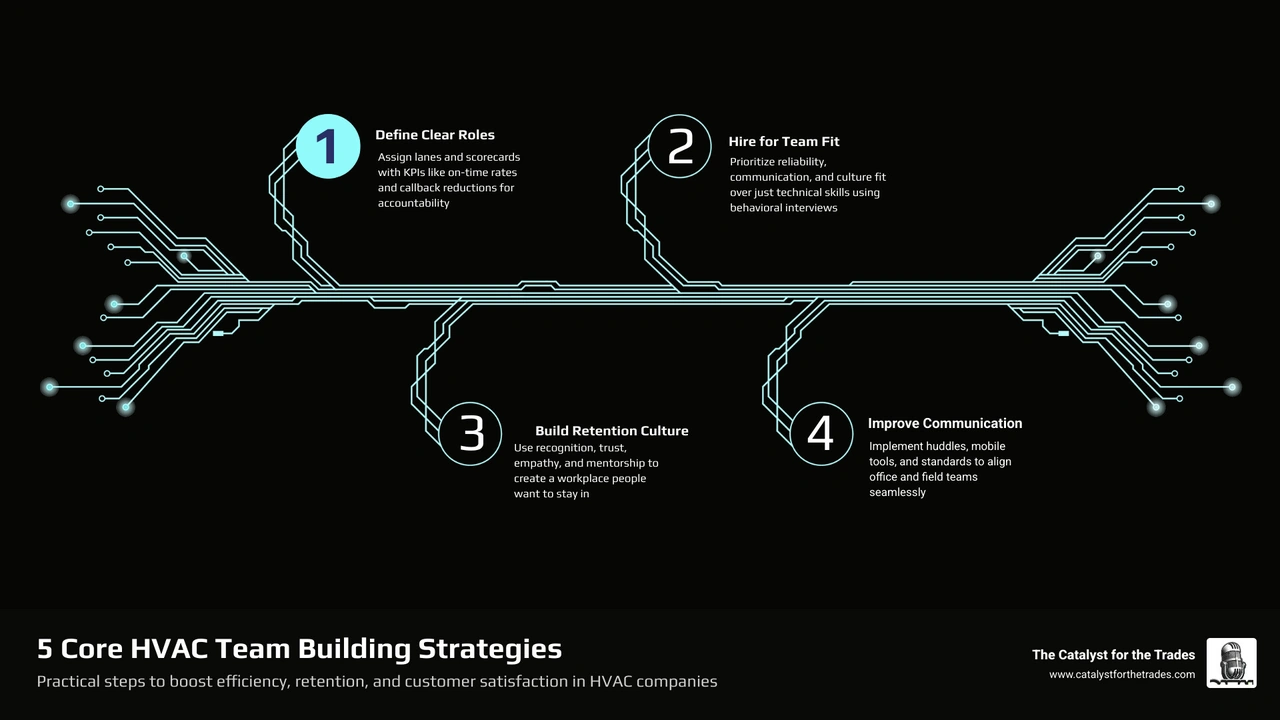
Here is a quick look at the five core strategies covered in this guide:
- Define clear roles and accountability – Give every person on your team a lane and a scorecard.
- Hire for team fit, not just technical skill – Habits and reliability matter as much as role fit.
- Build a culture people want to stay in – Recognition, trust, and empathy are retention tools.
- Improve communication and reduce friction – Align your office and field with consistent rhythms and the right tools.
- Make team building a system, not an event – Embed it into how you operate week to week, not just at the annual picnic.
If your company is struggling with high turnover, callbacks, missed deadlines, or a team that just does not feel like a team, you are not alone. The HVAC industry is facing a serious skilled labor shortage, and the businesses that navigate it best are not the ones that just work harder. They are the ones that build something people actually want to be part of.
The numbers back this up. Employees who work in collaborative environments are 50% more effective at completing tasks. Teams that communicate well are 25% more likely to hit their deadlines. And motivated workers are 87% less likely to quit. That is not just a culture problem. That is a profitability problem.
Peak season makes all of this more urgent. When the calls are stacking up, the attics are hot, and your best tech just called out sick, the difference between a team that holds together and one that falls apart comes down to the habits you built in the slow months.
This guide breaks down five practical strategies you can start using now, whether you are running a crew of five or scaling toward fifty.
Team building strategies for hvac companies vocab to learn:
- authentic leadership in home services
- leadership training for contractors
- people-first leadership in construction
1. Start With Clear HVAC Team Structure and Role Ownership
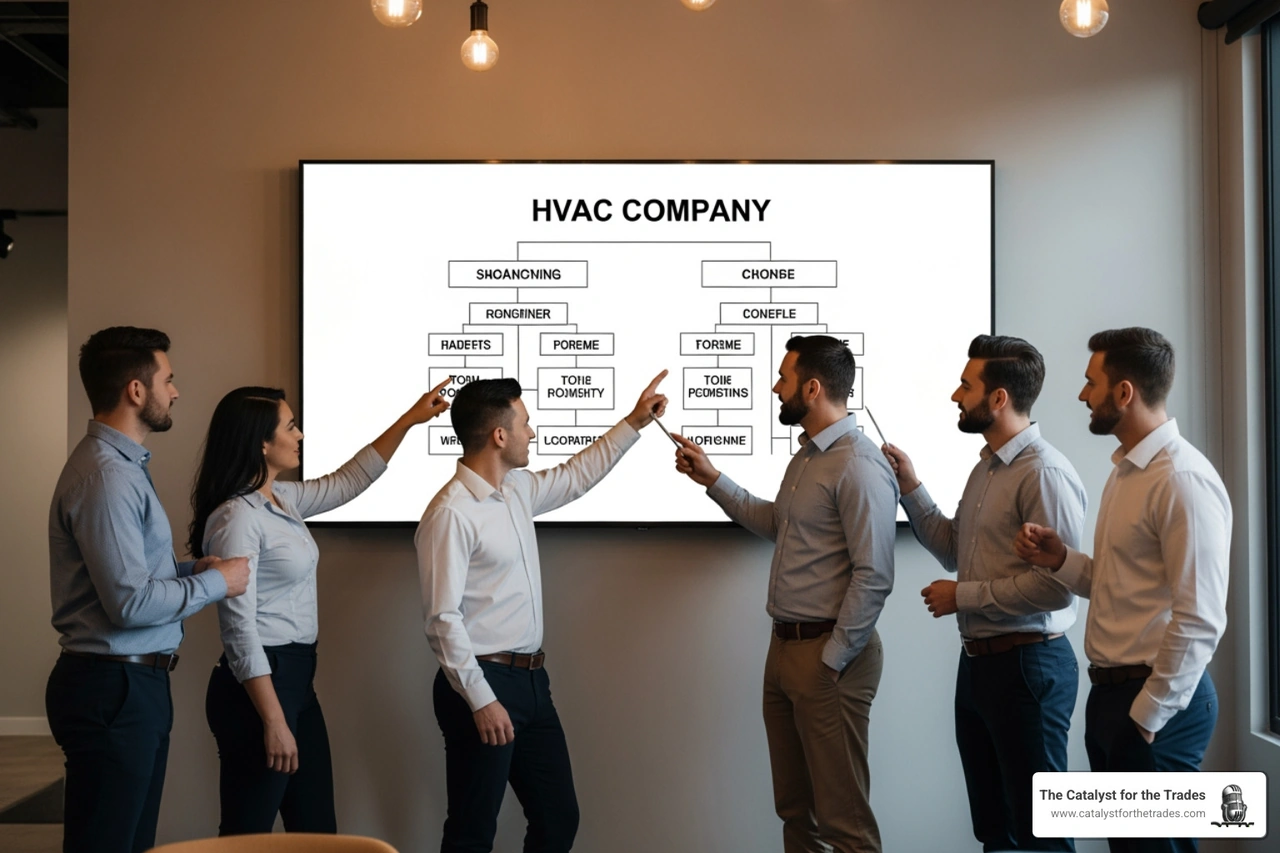
A lot of HVAC team issues are not personality issues. They are structure issues.
When nobody knows who owns what, things slip: late arrivals, messy handoffs, callbacks, and office-versus-field frustration. A strong team starts with a clear structure and visible accountability.
Identify the core roles every growing HVAC company needs
An effective HVAC team usually includes these core functions:
- Owner or general manager: sets direction, priorities, and standards
- Operations or service manager: turns strategy into daily execution
- Dispatcher: manages schedule flow and technician routing
- CSR: handles incoming calls, books jobs, and sets the customer tone
- Field technicians: diagnose, repair, and communicate findings
- Installers: complete replacement and installation work safely and efficiently
- Sales or comfort advisor roles: guide customers through larger system decisions
That does not mean every company needs a giant org chart tomorrow morning. In a smaller business, one person may wear multiple hats. The key is that the hats are still defined.
Use team building strategies for HVAC companies to close role gaps first
Before planning team outings or ordering matching shirts, fix the role gaps creating daily stress.
Ask:
- Where are jobs getting stuck?
- Are callbacks coming from rushed handoffs?
- Are dispatchers making judgment calls that should belong to managers?
- Are technicians doing admin work that should be handled elsewhere?
- Is the owner still solving every problem personally?
This is where workforce planning becomes team building. If your team is constantly overloaded or unclear on decision rights, morale drops fast. Our guide on Workforce Planning is a good next step if you are trying to map future needs against current bottlenecks.
Create simple scorecards so everyone knows what winning looks like
People work better when the target is visible.
Instead of vague expectations like “do a great job,” give each role a simple scorecard with a few measurable outcomes. Weekly goals work especially well because they create momentum without becoming overwhelming.
| Role | Main Responsibility | Useful KPI Examples |
|---|---|---|
| CSR | Book and prepare calls well | booking accuracy, response time, customer experience |
| Dispatcher | Keep the board flowing | on-time arrival rate, schedule efficiency |
| Technician | Solve problems in the field | first-time fix rate, callback rate, documentation quality |
| Installer | Deliver clean installs | completion quality, rework rate, safety compliance |
| Manager | Support team performance | deadline hit rate, coaching cadence, team retention |
Keep it simple. If the scoreboard looks like a tax form, nobody will use it.
2. Hire for Team Fit, Communication, and Reliability
The wrong hire does not just hurt productivity. It strains the whole team.
In HVAC, habits matter. Reliability matters. Communication matters. A brilliant technician who creates chaos is still creating chaos.
Build better job ads with team building strategies for HVAC companies in mind
Job descriptions should do more than list tasks. They should tell candidates how your team works.
Strong HVAC job ads usually include:
- What success looks like in the role
- Who the person reports to
- Expected communication habits
- Schedule realities and physical demands
- Growth opportunities
- Cultural cues like accountability, teamwork, and customer respect
You can strengthen your hiring process with resources like Contractor Recruiting Strategies and Hiring And Talent Management Keywords.
A good rule: if your job ad sounds like every other ad online, it will attract the same pile of random applicants.
Ask interview questions that reveal teamwork under pressure
Structured interviews are better than “just seeing if we click.” They help you assess both skill fit and culture fit more fairly.
Ask behavioral questions such as:
- Tell us about a time you had to handle an unhappy customer.
- Walk us through how you would respond if you were running behind on a job.
- Describe a disagreement with a coworker and how you resolved it.
- What safety issues do you watch for on busy job sites?
- When things get stressful, how do you keep communication clear?
These questions uncover how someone thinks under pressure, not just how well they interview. We also like scenario-based questions because HVAC is real-world work. Teamwork shows up in the messy middle, not in polished rehearsed answers.
Recruit year-round instead of only when you are short-staffed
Reactive hiring is how companies end up making panic decisions.
The better move is to recruit continuously:
- Keep a referral pipeline active
- Stay in touch with potential future hires
- Build relationships with local talent sources
- Maintain a bench, even if you do not have an immediate opening
Referral hires often ramp faster and stay longer than cold applicants, which makes referrals one of the simplest high-impact moves you can make. For a broader system around hiring and retention, see the Talent Management Complete Guide.
3. Build a Culture That People Want to Stay In
Culture is not a poster in the break room. It is the pattern of how people experience work every week.
And yes, people notice the small stuff. Especially the small stuff.
Recognition and support are retention tools, not extras
Recognition works when it is specific, timely, and consistent.
Research shows employees who receive high-quality recognition are much less likely to be job searching. Motivation matters too: motivated workers are far less likely to leave and help businesses perform better overall.
Simple wins include:
- Shout-outs in meetings
- Celebrating safety streaks or great reviews
- Recognizing personal milestones
- Checking in when someone is dealing with family stress
- Following through on promises
For deeper retention ideas, visit Employee Retention Strategies Guide 2026 and Employee Retention Strategies For Contractors.
Team building strategies for HVAC companies work best when leaders model them daily
Leaders set the emotional temperature.
If leadership says “communicate openly” but reacts badly to bad news, people stop speaking up. If leadership talks about teamwork but plays favorites, trust disappears.
Strong leaders in the trades tend to do a few things consistently:
- Own mistakes
- Share credit
- Correct privately
- Praise publicly
- Keep standards fair
- Communicate clearly, then confirm understanding
- Follow through
That kind of day-to-day modeling matters more than any motivational speech. If leadership development is a current focus, our resources on Contractor Leadership and the Leadership Training Contractors Guide can help.
Pair veterans and newer employees to strengthen teamwork
One of the most effective HVAC team moves is simple: pair experienced people with newer ones.
This helps with:
- Knowledge transfer
- Faster field confidence
- Better safety habits
- Stronger relationships across age groups
- Less “tribal knowledge” walking out the door
The best pairings go both ways. Veteran team members bring field judgment. Newer team members often bring fresh perspective and comfort with newer tools and digital workflows. When that exchange is intentional, the whole company gets stronger.
4. Improve Communication and Use Technology to Reduce Friction
Poor communication is one of the fastest ways to burn out a team.
In HVAC, the field and office depend on each other constantly. If updates are late, incomplete, or scattered across calls, texts, and sticky notes, everybody loses time and patience.
Set communication rhythms that keep office and field aligned
Teams communicate better when there is a rhythm, not just random interruptions.
Useful rhythms include:
- Morning huddles for schedule risks and priority calls
- Weekly roundtables for recurring issues
- Post-job debriefs after complex installs
- Clear escalation rules for emergencies
- Regular one-to-ones between managers and team members
These rhythms matter because teams that communicate effectively are more likely to meet deadlines. They also reduce the “I thought someone else handled that” problem, which is basically the unofficial mascot of operational chaos.
Use HVAC software and mobile tools to support collaboration
Technology should reduce friction, not add another login everyone ignores.
The most useful team tools support:
- Scheduling and dispatch visibility
- Mobile job notes
- Customer history access
- Photo documentation
- Checklists and handoff notes
- Shared status updates between office and field
This is especially important during peak season, when technicians need information fast and independently. Good software gives the team one source of truth instead of five partially correct versions.
Replace phone tag with simple field-ready communication standards
You do not need a complicated communication policy. You need a usable one.
Set standards like:
- Status updates at key job stages
- Expected response windows
- Photo requirements for certain job types
- Documentation before closing a call
- Clear handoff notes for follow-up visits
Messaging tools can help too, especially for deskless teams. The point is not to create noise. The point is to make communication easier to follow.
For more on field collaboration, see Building High Performing Field Teams and team building strategies.
5. Make Team Building an Ongoing Operating System, Not a One-Time Event
A pizza lunch is nice. An annual outing is nice. Neither is a system.
The strongest teams build connection, feedback, and accountability into normal operations.
Use simple team-building activities that fit field service reality
HVAC teams are busy. So the best activities are practical, short, and relevant to the work.
Try:
- Ride-alongs with debriefs
- Lunch-and-learns
- Problem-solving challenges based on real service scenarios
- Shop competitions around organization or truck readiness
- Volunteer days in the community
- Team lunches that celebrate wins and promotions
- Quick icebreakers in meetings
- “Do more of, do less of” feedback sessions
If you want more ideas that fit field-service schedules, check out Team Building Strategies 49367.
Develop supervisors from within so culture scales with growth
Promoting from within helps culture scale because internal leaders already understand the team, customers, and standards.
That said, great technicians do not automatically become great leaders. They need support in:
- Delegation
- Coaching
- Running one-to-ones
- Giving feedback
- Setting expectations
- Managing conflict
This is how you build a leadership pipeline instead of hoping someone magically “figures it out” after getting a title. For more on growing leaders in the trades, visit Leadership Development Programs and Trades Leadership Development.
Measure what is improving and fix weak points fast
If you want team building to drive results, measure it.
Look at trends such as:
- Turnover and retention
- Callback rate
- On-time performance
- Safety incidents
- Customer satisfaction
- Deadline hit rate
- Participation in meetings and coaching
- Employee feedback from surveys or stay interviews
This matters because replacing people is expensive, and losing leaders is even more disruptive. Measurement helps you catch weak points before they become culture problems.
Helpful next reads include Workforce Development and Professional Development.
Frequently Asked Questions About Team Building Strategies for HVAC Companies
Why is teamwork so important in HVAC companies?
Because HVAC work is too complex, fast-moving, and safety-sensitive for people to operate like islands.
Teamwork improves:
- Safety, especially on hot or high-risk jobs
- Problem-solving on difficult service calls
- Speed and coordination during installs
- Customer communication and consistency
- Accountability and reduced callbacks
- Burnout prevention during peak season
It also supports growth. Collaborative employees tend to do better work and be more innovative, which matters when service expectations keep rising.
What are the best team building strategies for HVAC companies during peak season?
During peak season, focus on simple systems that reduce stress fast:
- Daily huddles
- Clear role ownership
- Buddy support on demanding jobs
- Mobile-friendly communication
- Fast recognition for team wins
- Balanced workload planning
- Better handoffs between office and field
Peak season is not the time for complicated initiatives. It is the time for clarity, consistency, and quick support.
How can HVAC owners know if team building efforts are working?
Watch both hard and soft indicators.
Hard indicators:
- Fewer callbacks
- Better on-time rates
- More deadlines hit
- Fewer communication misses
- Lower turnover
Soft indicators:
- Stronger meeting participation
- Better morale
- Faster conflict resolution
- More peer support
- Better feedback from employees and customers
If the team communicates better, stays longer, and serves customers more consistently, the effort is working.
Conclusion
The best HVAC teams are not built by accident. They are built through structure, hiring discipline, leadership habits, strong communication, and consistent follow-through.
That is why the best team building strategies for HVAC companies are not really side projects. They are operating decisions.
If we want better service, stronger retention, fewer callbacks, and healthier growth, we have to build teams that trust each other and know how to win together.
At The Catalyst for the Trades, we focus on leadership, operational clarity, and people-first systems that help home service businesses grow with less chaos and more confidence. If you want to learn more about who we are and how we help, visit More info about our services.


