Learn · May 26, 2026
Leadership Development for Business Owners: 7X ROI
Discover leadership development for business owners: Scale your trade business, boost ROI 700%, and transition from doing to leading effectively.
By The Catalyst Editorial Team Operator education · 10 min read · Updated July 24, 2026

Why Leadership Development for Business Owners Is the Missing Link to Scaling Your Trades Business
Leadership development for business owners is the ongoing process of building the skills, mindset, and systems needed to lead a growing company — not just run it day to day.
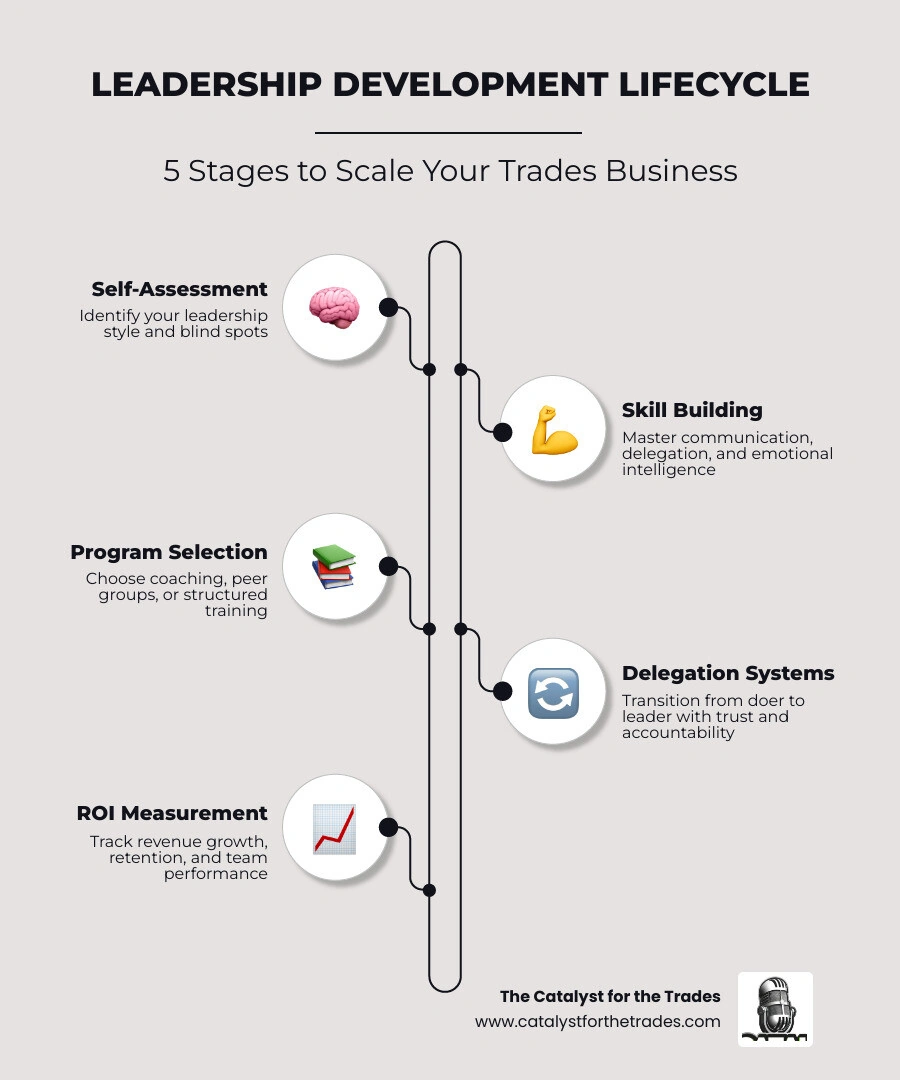
If you’re a home services business owner looking to scale, here’s what that actually looks like in practice:
- Identify your leadership style – Understand how you naturally lead and where your blind spots are
- Build core skills – Focus on communication, delegation, emotional intelligence, and strategic planning
- Choose a development format – Executive coaching, peer advisory groups, or structured programs
- Transition from doer to leader – Create systems so the business doesn’t depend entirely on you
- Measure your results – Track culture, retention, revenue growth, and team performance
- Repeat and compound – Embed development into daily habits, not just annual events
Here’s a problem that almost every successful trades business owner runs into: the same drive and hands-on work ethic that built the business eventually becomes the ceiling that stops it from growing.
You’re great at the work. Your customers trust you. Your team respects you. But as the business grows, you find yourself involved in every decision, every problem, every hire. The days get longer. Growth stalls. And the business starts to feel less like an asset and more like a job you can never leave.
That’s not a people problem. Research from leadership development experts consistently points to what’s actually happening: a leadership execution gap. The skills that make someone an excellent technician or operator are not the same skills that make someone an effective leader of a scaling organization.
The good news? Leadership is not a fixed trait. It’s a developable capability — and the return on investing in it is significant. Data from global coaching studies shows that the median company return on leadership training is around 700%, meaning businesses typically get back roughly seven times what they put in. Some companies see returns of 50 times their initial investment or more.
For trades business owners specifically — whether you run an HVAC company, a plumbing operation, or a home services firm — the challenge is figuring out where to start and what kind of program actually produces results in the real world, not just in a classroom.
This guide breaks that down step by step.
Important leadership development for business owners terms:
Defining Leadership Development for Business Owners

When we talk about leadership development for business owners, we aren’t just talking about attending a one-off seminar or reading a business book on a flight. We are talking about a fundamental shift in how you interact with your company. It is any activity or initiative that improves your confidence and ability to guide others toward a shared vision.
For the owner of a plumbing or HVAC company, this is the primary lever for achieving business results. The statistics are hard to ignore: companies that invest in these programs see a median return of 700%. In fact, some studies show that nearly 20% of companies see an ROI of 5,000%—that is 50 times the initial investment. Furthermore, business owners who participate in peer advisory or coaching models have been shown to grow their companies 2.2 times faster than those who go it alone.
This growth happens because leadership development directly impacts your company culture. When you improve as a leader, employee engagement and retention naturally follow. People don’t just quit jobs; they quit leaders who don’t invest in their growth or provide a clear direction. By focusing on Leadership Development Programs, you create an environment where top-tier technicians want to stay, reducing the high costs of turnover.
Investing in yourself is the first step toward professionalizing your operation. If you want to move from being a “job owner” to a “business owner,” you need a Leadership Training Contractors Guide that helps you navigate the transition from the truck to the boardroom.
Core Skills for Modern Leadership Development for Business Owners
Effective leadership in 2026 requires a blend of hard systems and soft skills. While your technical expertise got you here, your interpersonal effectiveness will take you to the next level.
The “human imperative” in leadership involves several key competencies:
- Emotional Intelligence (EQ): The ability to recognize your own emotions and those of your team. This is the foundation of self-regulation and empathy.
- Active Listening: Truly hearing the challenges your field technicians face without immediately jumping in to “fix” it for them.
- Strategic Planning: Moving beyond today’s schedule to look at where the business will be in three to five years.
- Diplomacy and Tact: Handling high-stress situations—like a major project delay or a disgruntled customer—with composure.
- Conflict Resolution: Turning workplace tension into a catalyst for better relationships rather than letting it simmer.
Mastering these Leadership and Management Keywords isn’t just for corporate CEOs. In the trades, where the labor market is tight and competition is fierce, Trades Leadership Development is what separates the companies that struggle from the ones that dominate their local market.
Identifying Your Unique Style in Leadership Development for Business Owners
No two leaders are exactly alike. Some lead “for the people,” focusing heavily on culture and harmony. Others are “peak performers” who lead by example through sheer work ethic. The danger lies in becoming the “silent struggler”—the owner who carries the weight of the world on their shoulders but doesn’t know how to ask for help.
Identifying your unique style requires deep self-awareness and authenticity. You shouldn’t try to mold yourself into a “corporate” persona that doesn’t fit. Instead, leverage your natural strengths. If you are a visionary, find a strong operational manager to handle the details. If you are detail-oriented, use a Leadership Circles Guide to find peers who can help you think bigger.
A great way to find your rhythm is by attending Leadership Conferences. These events expose you to different decision-making frameworks and values-based leadership models that you can test-drive in your own business. Courage in leadership is like a muscle; it gets stronger the more you use it to take risks and be vulnerable with your team.
Transitioning from Doing the Work to Leading the Team
The hardest transition for any trade business owner is moving from “doing” to “leading.” We call this the “owner bottleneck.” If every field technician has to call you before they make a decision, you haven’t built a business—you’ve built a cage.
Micromanagement is a trap that stems from a lack of trust and a lack of systems. To break free, you must implement delegation systems that empower your team. This doesn’t mean you stop caring; it means you start managing outcomes rather than tasks.
Effective Contractor Leadership involves:
- Removing yourself as the bottleneck: If you are the only one who can bid a job or handle a crisis, you are the ceiling of your company.
- Accountability Frameworks: Setting clear expectations and then stepping back to let your team meet them.
- Trust Building: Showing your team that you believe in their ability to solve problems. This often involves “celebrating failures” that lead to innovation.
By focusing on Organizational Leadership, you shift your focus from the tools to the people. Your job is no longer to be the best plumber or HVAC tech in the company; your job is to build a team of the best technicians and then give them the resources they need to succeed.
Implementing a Systematic Development Framework
Leadership development often fails because it’s treated as an event—a weekend retreat or a three-day course. For leadership development for business owners to actually work, it must be a habit-based system.
Think of it like fitness. You can’t go to the gym for 48 hours straight and expect to be fit for the rest of the year. You need a consistent routine. A successful 12-month implementation plan might include:
- Daily Habits: Spending 10 minutes every morning reflecting on your leadership goals or journaling.
- Bi-Weekly Masterclasses: Dedicating 90 minutes every two weeks to learning a new “force-multiplier” competency.
- Quarterly “Unplugging”: Stepping away from the business for two days every quarter to work on the business rather than in it.
- Peer Advisory Groups: Joining a group of 8–12 non-competing business owners to share unbiased feedback and collective wisdom.
Using a Business Owner Development Complete Guide can help you map out this journey. Whether you choose executive coaching or a more formal academic route, the key is continuous improvement. You are looking for a system that embeds learning into your daily life.
Check out these Leadership and Management Keywords 0Ed17 for more on how to structure your internal training. When you prioritize People First Leadership In Construction, you’re not just building a better business; you’re building a legacy.
Measuring the ROI of Your Leadership Investment
How do you know if your investment in leadership development for business owners is paying off? You look at the bottom line. While “soft skills” can feel hard to measure, their impact on your financial statements is very real.
| Training Type | Typical Outcome | Measured ROI |
|---|---|---|
| Fragmented (One-off books/videos) | Short-term motivation, inconsistent application | Low / Difficult to track |
| Systematic (Coaching/Peer Groups) | Long-term habit change, owner removed from bottleneck | 700% Median (up to 50x) |
| Academic (Elite University Programs) | High-level strategy, massive networking | High (Long-term enterprise value) |
Beyond the numbers, look at your engagement metrics. Are your technicians staying longer? Is your “call-back” rate dropping because your team feels more empowered to do the job right the first time? Scaling from 7 to 8 figures requires operational excellence that can only be achieved through Industry Leadership.
When you become a leader who others want to follow, you naturally develop Thought Leadership in your local community. This makes recruiting easier, marketing more effective, and growth more sustainable.
Frequently Asked Questions about Leadership Development
How can I transition from ‘doing’ to ‘leading’ without micromanaging?
Transitioning requires a shift from “command and control” to “influence and support.” Start by mastering delegation. Identify the talents of your team members and build roles around those strengths. Use outcome-based management: tell them what the goal is and why it matters, but let them figure out the how. Building trust is a two-way street; you have to be willing to let them make small mistakes so they can learn, rather than stepping in at the first sign of trouble.
What role does emotional intelligence play in executive effectiveness?
Emotional intelligence (EQ) is the secret weapon of high-performing executives. It allows for better self-regulation—staying calm when a major piece of equipment breaks or a key employee quits. It also fosters empathy, which is essential for conflict management. When you can influence without authority, you get buy-in from your team because they respect you, not just because you sign their paychecks. EQ is also the foundation of resilience, helping you navigate times of crisis or rapid organizational change.
How do I build and mentor the next generation of leaders?
Succession planning should start long before you plan to exit. Identify high-potential talent early—those technicians who show initiative and a “people-first” mindset. Create mentorship channels where they can shadow you in business meetings, not just on job sites. Provide growth opportunities by giving them “stretch assignments” with clear support. Finally, model the behavior you want to see. If you want them to be leaders who don’t burn out, you must model a healthy work-life balance yourself.
Conclusion
At The Catalyst for the Trades, we know that building a successful home services business is an all-consuming challenge. Our mission is to empower HVAC, plumbing, and electrical business owners with the growth strategies and innovation needed to thrive in a modern market. Through our podcast and resources, we combine cutting-edge tech insights with real-world industry experience to help you bridge the leadership execution gap.
Leadership isn’t about having all the answers; it’s about building a team that can find them. Whether you are just starting your first crew or scaling toward an 8-figure enterprise, the investment you make in your own development is the one that will pay the highest dividends.
Learn more about our mission and join a community of leaders dedicated to elevating the trades.


