Learn · March 5, 2026
Business Owner Development: 5 Proven Steps
Master business owner development: Shift from chaos to strategy, delegate effectively, and grow without burnout. Free resources included!
By The Catalyst Editorial Team Operator education · 8 min read · Updated July 24, 2026

Why Business Owner Development Is the Key to Sustainable Growth

Business owner development is the continuous process of building skills, mindset, and systems that allow you to lead strategically rather than just manage daily operations. For home services business owners in the trades, this shift from working IN your business to working ON it is what separates those who stay stuck from those who scale profitably.
Quick Answer: What Business Owner Development Looks Like
- Self-Assessment – Identify skill gaps through SWOT analysis, staff feedback, and competitive benchmarking
- Strategic Learning – Focus on “just-in-time” skills you can apply immediately (communication, leadership, sales)
- Delegation Systems – Build processes that let your business run without constant oversight
- Time Reallocation – Shift from 68.1% operational work to 80% strategic planning
- Continuous Growth – Use mentorship, online courses, and programs like SBA T.H.R.I.V.E. to accelerate development
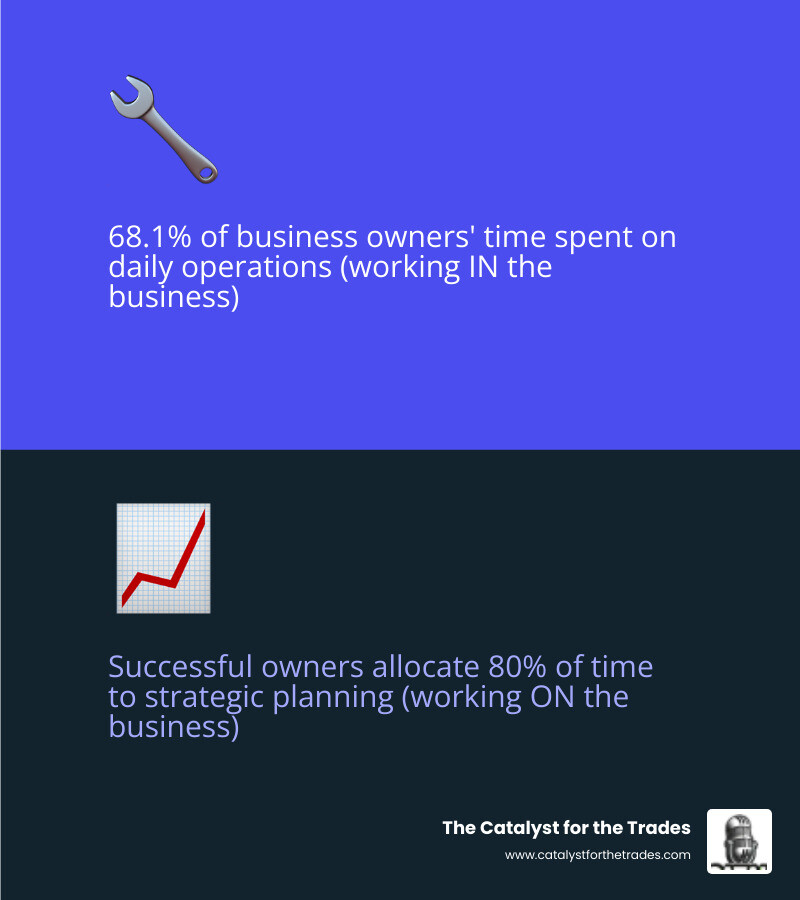
If you’re a trade business owner spending most of your day fixing immediate problems instead of planning for growth, you’re not alone. Research shows that 68.1% of a business owner’s time is spent working IN their business rather than ON their business. But owners who achieve long-term success aim for the opposite: about 80% of their time strategizing, planning, and focusing on growth initiatives. The difference between these two approaches isn’t just about working harder—it’s about developing yourself as a leader so your business can thrive without depending entirely on you.
For home services companies looking to scale operations and improve profitability, professional development creates the foundation for sustainable growth. When you’re ready to take the next step, contact The Catalyst for the Trades for guidance tailored to your business.
Simple business owner development glossary:
The Foundation of Business Owner Development
When we talk about business owner development, we aren’t just talking about learning a new software or a better way to install an HVAC unit. We are talking about the internal evolution of you, the leader. Many owners in the trades started as technicians. You were the best at what you did, so you started a company. But the skills required to fix a leaky pipe are vastly different from the skills required to run a multi-million dollar plumbing enterprise.
Investing in your own career development is the highest-ROI activity you can engage in. Why? Because your business is a reflection of you. If you are disorganized, the business will be chaotic. If you lack confidence in your pricing, your profit margins will suffer. By focusing on personal growth, you sharpen hidden skills, build the confidence necessary to make tough decisions, and boost your overall motivation.
Universal Skills for Trade Success
Regardless of whether you are in HVAC, plumbing, or electrical, there are four “universal” skills that every owner must master. These are the pillars of business owner development:
- Communication: This includes everything from how you speak to your team to how you write copy for your website. Clear communication prevents “re-work” and builds trust with customers.
- Leadership: You need to move from being a “boss” to being a leader. This involves participating in leadership development programs that help you understand how to motivate different personality styles.
- Selling: Even if you have a sales team, you are always “selling” your vision to employees, partners, and the community. Master the art of persuasion to secure the resources your business needs.
- Personal Growth: This is the commitment to being 1% better every day through exercise, meditation, or reading.
By stepping into industry leadership, you position your company as the “formidable” choice in your local market—a trait venture capitalists and high-value partners look for.
The Link Between Personal and Professional Growth
There is a direct correlation between how much you grow and how much your bank account grows. When you improve your productivity, your business becomes more efficient. When you improve your emotional intelligence, your team retention improves.
We’ve seen this time and again: owners who take the time to listen to unfiltered leadership lessons from Kathryn Elizabeth and Laura Kelly or study how Jazmin Ramirez uses real leadership to power change find that their professional problems often have personal solutions. If you can’t manage your own time, you’ll never be able to manage a fleet of twenty trucks.
Identifying Skill Gaps and Growth Opportunities
You can’t fix what you don’t measure. The first step in your business owner development journey is an honest audit of where you stand. It’s easy to get caught in the “ego trap” where you think you have to know everything. Spoiler alert: you don’t. In fact, admitting what you don’t know is a superpower.
To identify your gaps, we recommend a multi-pronged approach:
- Conduct a SWOT Analysis: Use a personal SWOT analysis guide to map out your Strengths, Weaknesses, Opportunities, and Threats.
- Take a Personality Test: Understanding your profile through a personality test helps you lead in a way that complements your natural style rather than fighting against it.
- Staff Feedback: Ask your team, “What is one thing I could do to make your job easier?” The answers might be eye-opening.
- Competitive Benchmarking: Look at the top-performing home service companies in other regions. What skills do those owners have that you haven’t developed yet?
Prioritizing Just-in-Time Learning for Business Owner Development
One of the biggest mistakes owners make is “just-in-case” learning—reading books on topics they might need five years from now. To maximize impact, focus on “just-in-time” learning. This means studying things you can implement today.
For example, if you need to improve your marketing, reading The Advertising Solution is a high-priority “just-in-time” move. If you are struggling with government compliance or looking for free training, the SBA Learning Platform offers immediate resources. This philosophy of continuous learning ensures that your education always translates into revenue.
Effective Methods for Rapid Improvement
Once you know what to learn, you need to decide how to learn it. Busy trade owners don’t have four years for another degree. You need rapid improvement.
- Mentorship: Talking to someone who has already been where you want to go is the fastest way to skip the “learning tax.”
- Leadership Circles: Joining a leadership circles guide provides peer accountability and shared wisdom.
- Online Courses: Platforms like Coursera or LinkedIn Learning allow you to pick up specific skills (like financial decoding) on your own schedule.
- SBDC Training: Local SBDC training provides personalized assistance to help you overcome specific business hurdles.
Shifting from Operator to Strategic Leader
The “Operator” is the person who gets the phone call when a water heater leaks at 2:00 AM. The “Owner” is the person who built the system that ensures a technician is dispatched, the customer is billed, and the profit is tracked—all while the owner is asleep.
| Feature | Operator Mindset (Working IN) | Owner Mindset (Working ON) |
|---|---|---|
| Primary Focus | Daily tasks & fire-fighting | Strategy, systems, & growth |
| Time Allocation | 68.1% (Average) | 80% (Goal) |
| Staff View | “I have to do it myself if I want it done right” | “I need to build a team that challenges me” |
| Vacation | Business stops or slows down | Business sustains or grows |
| Communication | Constant interruptions | Scheduled strategic meetings |
To make this shift, you must embrace trades leadership development. It’s about moving from being the “engine” of the business to being the “architect.”
Mastering Delegation as a Core Business Owner Development Skill
You cannot scale a business on your own two shoulders. Effective delegation is the hallmark of a developed business owner. This requires management development to learn how to hand off tasks without losing quality.
Start by documenting your processes. If you can’t write down how a job should be done, you can’t delegate it. Once you have systems in place, you can exercise organizational leadership. Look at how Trey McWilliams balances big growth with people-first leadership—he focuses on the people, and the people run the systems.
Building a Self-Sustaining Enterprise
The ultimate goal of business owner development is to create a business that doesn’t “need” you for daily survival. This gives you the freedom to choose your involvement and creates a valuable asset for an eventual exit.
Ask yourself: “If I left for a month, would my business still be here when I got back?” If the answer is no, it’s time to empower your team. Focus on the future of leadership and building a team that drives growth. Programs like SBA T.H.R.I.V.E. are designed specifically to help you move into this executive role, providing MBA-equivalent knowledge to over 8,000 graduates who have successfully accelerated their growth.
Frequently Asked Questions about Business Growth
Why is personal development essential for business owners?
Personal growth is the ceiling of your business growth. You cannot lead a company to a level higher than your own level of professional development. Developing your mindset and skills builds the resilience needed to handle market fluctuations and the confidence to lead a growing team.
How can I find time to work ON my business instead of IN it?
It starts with a commitment to the 80% goal. You find time by delegating low-value tasks. If you are a business owner still doing $20-an-hour tasks, you are effectively paying yourself $20 an hour. Use management development strategies to hire or train others to handle the daily operations so you can reclaim your time for strategy.
What free resources are available for business owner development?
There are incredible government-backed resources available. The SBA T.H.R.I.V.E. program is a free, intensive “mini-MBA” for small business owners. Additionally, your local SBDC training centers offer no-cost consulting and workshops to help you identify and bridge your skill gaps.
Conclusion
At The Catalyst for the Trades, we believe that the trades are the backbone of our communities. But being a great technician isn’t enough to build a great company. True success requires a commitment to business owner development. By focusing on strategic planning, embracing innovation, and shifting your mindset from operator to leader, you can build a business that provides both financial freedom and peace of mind.
Don’t let your business own you. Start your journey toward becoming a formidable leader today. Grow your business today with The Catalyst for the Trades.


