Learn · July 9, 2026
How Are HVAC and Plumbing Businesses Using AI to Grow in 2026?
Discover how HVAC and plumbing businesses are using AI to grow in 2026 with practical strategies for efficiency, lead capture, and margin protection.
By The Catalyst Editorial Team Operator education · 11 min read · Updated July 24, 2026

Why AI Is Now the Growth Engine for HVAC and Plumbing Businesses in 2026
How are HVAC and plumbing businesses using AI to grow in 2026? The short answer: they’re using it to answer more calls, book more jobs, dispatch smarter, and stop losing revenue to the cracks that manual operations leave open every single day.
Here’s a quick breakdown of the top ways these businesses are putting AI to work right now:
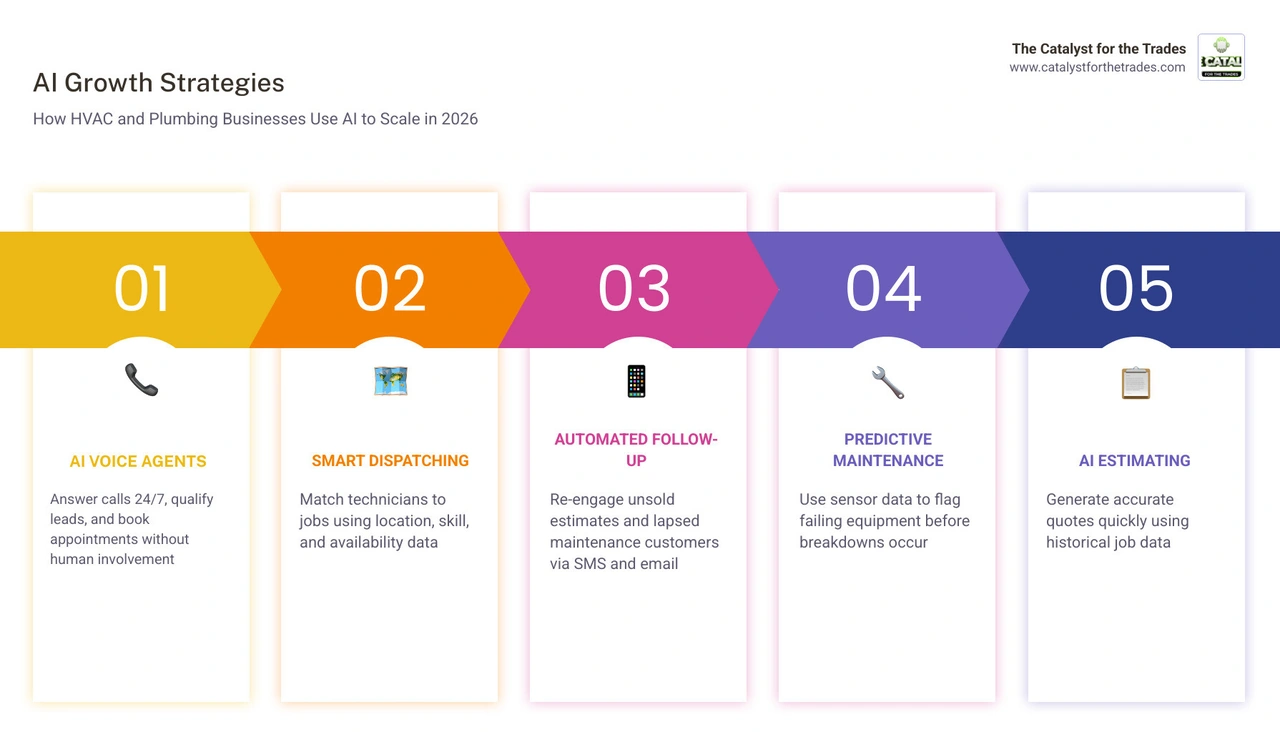
Top AI Growth Strategies for HVAC and Plumbing Businesses in 2026
- AI voice agents – Answer calls 24/7, qualify leads, and book appointments without human involvement
- Smart dispatching – Match the right technician to the right job based on location, skill, and availability
- Automated follow-up – Re-engage unsold estimates and lapsed maintenance customers via SMS and email
- Predictive maintenance – Use sensor data to flag failing equipment before a breakdown happens
- AI-assisted estimating – Generate accurate quotes faster using historical job data
- Automated review requests – Trigger reputation-building messages the moment a job is marked complete
- Seasonal marketing automation – Adjust ad spend and outreach based on weather patterns and demand signals
The gap between businesses using these tools and those that aren’t is widening fast. Research shows that 88% of high-confidence HVAC businesses use AI tools, compared to just 27% of their lower-confidence peers. Meanwhile, 27% of all inbound calls to home service businesses go unanswered — and 85% of callers who hit voicemail never call back. That’s not a small leak. For a business missing just two calls a day, that can add up to roughly $90,000 in lost revenue every year.
Most HVAC and plumbing owners didn’t start their businesses to manage phone queues and chase down unsold estimates. But right now, those are the exact problems quietly draining profit. The good news is that AI has become practical, affordable, and genuinely useful for trade businesses of almost any size — and you don’t need to overhaul your entire operation to start seeing results.
This guide walks you through exactly how to use AI to grow your business in 2026, step by step.
How Are HVAC and Plumbing Businesses Using AI to Grow in 2026?

The home services landscape is undergoing a massive shift. In 2026, the question is no longer whether artificial intelligence belongs in the trades, but how quickly contractors can deploy it to gain a competitive edge. Over 70% of home service contractors have tried AI tools in some capacity, and roughly 40% are actively using AI in their businesses.
For the modern contractor, AI serves as an invisible partner that works 24/7. It doesn’t call in sick, it doesn’t get stuck in traffic, and it never forgets to follow up on an unsold quote. As we discuss in The AI Revolution in Home Services: How to Future-Proof Your Trades Business, future-proofing your business relies on turning these emerging technologies into practical, day-to-day operational tools.
Operational Efficiency: How Are HVAC and Plumbing Businesses Using AI to Grow in 2026?
Operating a service business out of a truck requires balancing complex logistics in real time. AI-driven field service management (FSM) platforms have revolutionized this process through automated dispatching and dynamic route optimization.
Instead of a human dispatcher spending hours trying to piece together the perfect schedule, AI algorithms instantly analyze technician availability, skill certifications, real-time traffic, and job complexity. The system automatically places the technician with the highest likelihood of a first-time fix on the right job, while minimizing windshield time.
Contractors adopting these automated dispatching workflows report saving an average of 3.2 hours per week on administrative tasks. Furthermore, early adopters report a 15% to 20% increase in overall job efficiency and a 10% to 15% boost in revenue per technician simply by cutting down on wasted drive time and optimizing daily schedules.
Customer Acquisition: How Are HVAC and Plumbing Businesses Using AI to Grow in 2026?
On the sales and marketing front, speed is the ultimate currency. Industry data shows that 78% of leads go to the first responder. If a homeowner has a leaking water heater or a broken AC unit in the dead of summer, they aren’t going to wait hours for a callback; they will simply call the next contractor on Google.
AI captures and qualifies leads the instant they arrive. Whether a prospect submits a form on your website at midnight or messages your business page on social media, AI tools trigger a personalized SMS or email response within 60 seconds. This sub-minute response time can improve booking rates by 2 to 3 times compared to traditional manual follow-ups.
To explore how these automated channels are reshaping customer expectations, check out our guide on How AI Voice and Chat Are Changing the Home Service Game.
Plugging Margin Leaks with Trade-Specific AI
Growth is meaningless if your profit margins are constantly eroded by operational inefficiencies. Many HVAC and plumbing companies suffer from silent margin leaks: seasonal scheduling strains, unrecorded diagnostics, lost parts, and massive variances in manual estimates.
To protect your bottom line, it is critical to understand the difference between general-purpose AI tools and trade-specific systems.
| Capability / Feature | General-Purpose AI (e.g., ChatGPT, Gemini) | Trade-Specific AI (Built into FSM Software) |
|---|---|---|
| Data Access | Limited to general internet training data; no access to your customer records. | Deeply integrated with real-time customer history, equipment specs, and technician schedules. |
| Actionable Workflows | Can draft emails or suggest ideas, but cannot take direct action inside your business. | Automatically books jobs, dispatches technicians, updates calendars, and sends invoices. |
| Industry Context | Understands the general concepts of plumbing and HVAC but lacks mechanical diagnostic nuances. | Trained on specific equipment manuals, error codes, local climate patterns, and trade-specific pricing. |
| Customer Privacy | Public models may use input data for training, posing potential privacy risks unless on enterprise tiers. | Built on secure, compliant databases designed to protect sensitive homeowner information. |
As highlighted in How Tech-Savvy Contractors Will Win: E-commerce, AI, and the Lean Business Revolution, the real magic happens when AI is embedded directly into your operational systems.
Automated Scheduling and Dispatching
Manual scheduling is a constant game of telephone. A customer calls, a CSR takes notes, a dispatcher looks at a whiteboard, and a technician gets texted. AI-powered FSM scheduling removes this friction by bidirectionally syncing with CRM calendars.
When a customer books online, the AI scans your entire database to evaluate which technician is closest, has the necessary parts on their truck, and possesses the specific certification required for that brand of equipment. By automating this matching process, companies reduce average drive times, allowing technicians to complete more billable work each day without feeling rushed or burned out.
Proactive Maintenance and Renewal Workflows
Maintenance agreements are the lifeblood of any residential home service business. They provide predictable revenue during mild shoulder seasons and ensure high customer lifetime value. However, tracking and renewing these agreements manually is a monumental task.
AI plugs this leak by automatically flagging lapsed maintenance customers and sending personalized, timely reminders. The system scans your CRM data, identifies customers who haven’t had their system serviced in the last six months, and reaches out to them via automated SMS or email sequences. These proactive workflows keep your trucks busy year-round and prevent competitor poaching.
Maximizing Lead Capture and Seasonal Demand Management
HVAC and plumbing demands are highly seasonal and unpredictable. A sudden heatwave or a winter freeze can cause call volumes to spike by 300% in a single day, completely overwhelming your office staff. Conversely, during mild months, the phones can fall dead silent. AI helps manage these dramatic swings by capturing every single opportunity when demand is high and reactivating old leads when business slows down.
To understand how these tools help you sell more consistently, read our article on How AI and Digital Tools Are Changing the Way Home Services Sell.
Capturing After-Hours and Overflow Calls
Did you know that 35% to 45% of inbound calls to HVAC and plumbing businesses occur outside of normal business hours? If those calls go to voicemail, you are actively losing business to competitors.
AI voice receptionists act as a 24/7 front office. These are not the robotic, frustrating phone menus of the past. Modern AI voice agents hold natural, human-like conversations. They can:
- Identify themselves transparently as an AI assistant.
- Answer common pricing and scheduling questions.
- Triage emergencies (e.g., distinguishing between a minor faucet drip and a major burst pipe).
- Securely book the job directly into your FSM calendar.
By deploying an AI voice agent, early adopters have boosted their booking rates from a standard 55% to over 90% for after-hours and overflow calls.
Database Reactivation and Unsold Follow-Ups
Every contractor has a graveyard of unsold estimates sitting in their CRM. Often, a technician leaves an estimate for a system replacement or a major sewer line repair, and the homeowner gets busy or hesitates. Busy office staff rarely have the time to consistently follow up on these open quotes.
AI solves this by executing automated, multi-channel follow-up sequences. An AI system can be configured to send a polite SMS ten days after an unsold estimate is generated, paired with a helpful email outlining financing options. These automated sequences have been shown to recover 8% to 15% of previously unsold estimates without requiring a single minute of staff labor.
If you are a smaller shop looking to scale, these are the exact automated strategies discussed in our resource on Effective Business Growth Strategies for a Small Plumbing Company.
A Phased, Step-by-Step AI Adoption Strategy
Many contractors feel overwhelmed by the concept of AI, believing they need to completely restructure their operations or replace their existing software overnight. This is a recipe for chaos. The most successful early adopters use a highly practical, phased “crawl-walk-run” approach.
To build a sustainable roadmap for your business, we recommend reviewing our comprehensive guide on Contractor AI Strategy.
Phase 1: Audit and Data Readiness
Before you buy or turn on any AI tool, you must prepare your data. AI is only as smart as the information it is given. If your CRM is filled with duplicate customer profiles, incomplete equipment records, and messy call logs, the AI will make errors.
- Clean Your CRM: Merge duplicate customer records, standardize address formats, and ensure equipment model/serial numbers are accurately logged.
- Audit Your Call Logs: Look at your last 30 days of call logs. Identify exactly how many calls went to voicemail or were missed during peak hours. This gives you a clear baseline of the revenue you are currently leaving on the table.
- Establish Baseline Metrics: Document your current booking rates, average response times, and technician utilization rates so you can measure the true impact of your AI tools.
Phase 2: Pilot and Measure
Once your data is clean, select a single high-impact problem to solve. Do not try to automate scheduling, phone answering, and marketing all at once.
- Deploy One Tool: For most contractors, starting with an after-hours AI voice agent or an automated SMS follow-up sequence for unsold estimates yields the fastest, most measurable ROI.
- Run a 30-Day Trial: Test the tool in a controlled environment. Monitor customer feedback, track how many jobs are successfully booked, and ensure the tool is communicating in your brand’s unique voice.
- Measure and Expand: Compare your 30-day trial results against your baseline metrics. Once you have proven the hard ROI of your first AI tool, gradually roll out additional features like AI-assisted dispatching or predictive maintenance workflows.
Frequently Asked Questions About AI in the Trades
How does AI integrate with existing field service management (FSM) software?
Most modern AI tools do not require you to abandon your current software. Leading FSM platforms have either built-in AI modules or open API connections that allow third-party AI tools to sync bidirectionally. This means when an AI voice assistant books an appointment, it writes that job directly into your existing dispatch board, updates your technician’s mobile app, and logs the customer history in real time without any manual copy-pasting.
Will AI replace human dispatchers and customer service representatives?
No. AI is designed to act as a capacity multiplier, not a replacement for your valued team members. By automating repetitive, administrative tasks—like answering basic after-hours questions, logging customer addresses, and following up on old estimates—AI frees up your office staff to focus on high-priority work. Your dispatchers can focus on managing complex commercial accounts and building deep customer relationships, while the AI handles the routine scheduling logistics.
How do contractors measure the ROI of AI tools?
Contractors track both hard and soft ROI metrics. Hard ROI is measured by calculating the additional revenue generated from captured after-hours calls, recovered unsold estimates, and increased jobs completed per technician per day. Soft ROI is measured by tracking the hours saved weekly on administrative tasks, reduced technician drive times, and improved customer satisfaction scores resulting from faster response times.
Conclusion
The future of the home services industry belongs to tech-savvy contractors who recognize that operational efficiency and rapid customer response times are the ultimate competitive advantages. By adopting a practical, phased approach to AI, your HVAC or plumbing business can plug costly margin leaks, capture every single lead, and scale your operations without burning out your team or unnecessarily increasing your overhead.
At The Catalyst for the Trades, we are dedicated to helping home service businesses navigate this technological evolution. Hosted by Jennifer Bagley (AI and marketing expert) and Chuck Staszkiewicz (operational scaling specialist), our mission is to combine cutting-edge tech insights with real-world industry experience to help you build a highly profitable, sustainable business.
Are you ready to take the next step and build a customized AI roadmap for your company? Learn more about scaling your business with our AI Tech Implementation Guide.


