Learn · July 15, 2026
How the Communication Style of Your Technicians Affects Customer Retention: 7 Proven Tactics
Discover how the communication style of your technicians affects customer retention and learn proven strategies to boost loyalty and reduce churn.
By The Catalyst Editorial Team Operator education · 11 min read · Updated July 24, 2026

Why the Communication Style of Your Technicians Directly Impacts Customer Retention
How the communication style of your technicians affects customer retention is one of the most underestimated levers in a home services business. Most owners focus on technical quality, response times, and pricing — but the words, tone, and behavior of your techs on every call may matter just as much, if not more.
Here is a quick answer:
Technician communication affects customer retention by:
- Building or breaking trust in the first 90 seconds of a visit
- Reducing anxiety through proactive updates before and during the job
- Increasing repeat business when customers feel informed and respected
- Driving 5-star reviews that directly predict future booked revenue
- Preventing churn caused by confusion, silence, or perceived indifference
Consider this: two technicians can show up to the same job, diagnose the same problem, quote the same price — and walk away with completely different outcomes. One earns a five-star review and a loyal customer. The other leaves the homeowner frustrated and searching for a different company next time. The difference almost never comes down to technical skill. It comes down to how they communicated.
Research consistently backs this up. According to a survey of 1,000 homeowners, communication problems account for 38% of customer frustrations in field service — outpacing even unexpected pricing at 21%. And 95% of those same customers were satisfied with the actual technical work. The problem is not the repair. It is everything around it.
For home services business owners trying to scale, this matters enormously. The probability of selling to an existing customer sits between 60% and 70%, compared to just 5% to 20% for a new one. Every communication failure is a retention failure — and a revenue failure.
How the Communication Style of Your Technicians Affects Customer Retention

In the home services sector, your field technicians are the primary human face of your brand. While office staff handle scheduling and dispatching, the technician is the one who enters the private spaces of your customers’ homes. Consequently, the customer’s entire perception of your brand is filtered through that single face-to-face interaction.
When we analyze why customers stay with a service provider, we often look at the core mechanics of customer retention strategies. True loyalty is not built on a transaction; it is built on the feeling of safety and certainty. If a technician is silent, uses heavy technical jargon, or fails to explain what they are doing, the homeowner feels out of the loop. This breeds skepticism. On the flip side, a technician who communicates clearly and politely transforms a stressful home emergency into a controlled, reassuring experience, directly locking in long-term customer loyalty.
How the Communication Style of Your Technicians Affects Customer Retention and Trust
Trust is the ultimate currency in the trades. When homeowners experience an HVAC breakdown or a plumbing leak, they are often in a vulnerable position. They do not understand the complex machinery behind their walls, which makes them highly sensitive to feeling exploited or misled.
By prioritizing service excellence, we ensure that our technicians act as “translators” rather than just “fixers.” When technicians explain technical problems using simple analogies, walk homeowners through their options, and outline the pros and cons of each choice honestly, they build an ironclad foundation of trust.
This trust directly influences Customer Lifetime Value (CLV). A customer who trusts your technicians is far more likely to agree to preventative maintenance agreements and system upgrades. They stop shopping around for the lowest bidder because they value the peace of mind your team provides.
The Cost of Communication Breakdowns and Negative Reviews
What happens when communication breaks down? The financial consequences are immediate and severe. Communication failures are a primary driver of customer complaints and negative online reviews.
Consider the common scenario of a technician who identifies a secondary issue during a repair but fails to explain it properly before performing the work. The homeowner is hit with an unexpected charge on their invoice. Even if the work was absolutely necessary and technically perfect, the communication failure makes the customer feel blindsided.
These breakdowns lead to:
- Negative Reviews: Most 1-star reviews are not about a mechanical failure; they are about a perceived lack of respect, late arrivals without warning, or poor explanations.
- Customer Churn: The average U.S. business loses about 15% of its customers every year. In the trades, a significant portion of this churn is entirely preventable through consistent, proactive communication.
- Wasted Capacity: When dispatchers have to spend hours resolving disputes or explaining invoices that technicians failed to clarify on-site, your entire operational efficiency plummets.
Best Practices for Technician Communication and Customer Loyalty
To combat these challenges, we must establish a repeatable, high-standard customer service strategy that guides our technicians through every single customer touchpoint.
The 90-Second Home-Arrival Ritual and On-Site Etiquette
First impressions are incredibly powerful. In fact, most customer opinions are formed in the first 90 seconds of a visit—long before a tool bag is even opened. An intentional home-arrival ritual ensures that this critical window is used to establish professionalism and respect.
Train your team to execute these steps on every single visit:
- Park Strategically: Park square at the curb, never blocking the customer’s driveway or parking on their lawn.
- The Dashboard Wipe: Before stepping out, take a quick moment to ensure the truck’s dashboard is clean and free of clutter. Homeowners notice clean vehicles.
- Verify Customer Details: Quickly review the customer’s name, history, and the specific reason for the visit.
- The Approach: Walk up the path with your clipboard or tablet in your off-hand, keeping your posture open and welcoming.
- The Greeting: Ring the bell, step back two feet to give the homeowner comfortable personal space, and greet them by their first name. Introduce yourself clearly.
- The Booty Ritual: Put on clean shoe booties right at the threshold—even if the customer says, “Oh, you don’t have to do that.” This simple act communicates immense respect for their home.
- Protect the Space: Lay down a clean drop cloth before placing any tools or equipment on their floors or countertops.
Proactive Updates and Multi-Channel Communication
Maintaining great communication means keeping the customer updated early and often. Modern homeowners expect the same level of convenience they get from major ride-sharing and delivery apps.
Providing multi-channel options—such as SMS, email, and phone calls—allows customers to engage on their own terms. Offering self-scheduling portals gives them control over their time, while proactive SMS notifications eliminate the dreaded “four-hour arrival window” anxiety.
If a technician is running even ten minutes late, an automated, proactive text message keeps the customer informed. Homeowners rarely get angry about delays if they are notified before the scheduled time. They get angry when they are left waiting in silence.
Building Emotional Connections Through Empathy and Personalization
When a homeowner’s basement is flooding or their AC goes out in the middle of summer, they are not just looking for a mechanic—they are looking for reassurance. Empathetic communication is the key to building strong customer rapport.
Technicians should start by actively listening to the homeowner’s concerns before jumping into the technical diagnosis. Acknowledge their frustration with phrases like, “I completely understand how stressful it is to have your system go out on a hot day like this. Let’s get this sorted out for you.”
Personalizing the service by referencing past notes, asking about a pet by name, or remembering a detail from a previous visit turns a cold transaction into a warm, human connection. These small touches are what turn one-time callers into lifelong advocates who refer your business to their friends and family.
Leveraging Technology and CRM Data for Real-Time Communication
Modern technology is not a replacement for the human touch; it is the ultimate enabler of it. By equipping your team with mobile tools, you can streamline interactions and assist in improving technician sales performance through clearer presentation of options.
Reducing Customer Anxiety with Automated Notifications
Automated notifications are incredibly effective at lowering customer anxiety. When a job is booked, an instant confirmation email and text should go out.
The most impactful notification, however, is the “On My Way” alert. Sending an automated text containing the technician’s name, a professional photo, a brief bio, and a real-time GPS tracking link completely removes the safety concerns of opening the door to a stranger. It transforms the technician from an anonymous worker into an expected, trusted guest.
Tailoring Interactions with Customer History and CRM Integration
The burden of information should never fall on the customer. It is incredibly frustrating for a homeowner to have to explain their entire equipment history to a new technician every time they visit.
By integrating technician mobile apps with your central CRM database, you give your team instant access to:
- Past work orders and diagnostic notes
- Complete asset information (make, model, installation date, and past repairs)
- Specific customer preferences (e.g., “Please ring the bell softly because of the baby,” or “Prefers text notifications over phone calls”)
When a technician arrives already knowing the system’s history, they can immediately tailor their communication. They can say, “I see we replaced the blower motor last year; let’s take a look at how that’s running and check the rest of the system today.” This level of personalization makes the customer feel valued and deeply understood.
Training and Measuring Technician Communication Performance
To make these practices stick, communication must be treated as a core technical skill that requires ongoing practice, coaching, and measurement. Use our customer service training guide to build a structured program for your team.
Soft Skills Training and Continuous Coaching
Many technicians are highly skilled at mechanical diagnostics but struggle with interpersonal communication. This is why we must invest in continuous coaching rather than relying on one-time training seminars.
| Technical Skills Focus | Communication & Soft Skills Focus |
|---|---|
| System diagnostics and repair | Translating complex jargon into simple, clear analogies |
| Tool proficiency and safety protocols | Mastering the 90-second arrival ritual and door etiquette |
| Reading electrical schematics | Conducting a post-job walkthrough and presenting options |
| Maximizing mechanical efficiency | Practicing active listening and showing genuine empathy |
Effective training methods include:
- Role-Playing: Run mock homeowner conversations during weekly meetings to help technicians practice explaining complex failures and presenting repair options without using confusing industry jargon.
- Mentoring Programs: Pair your highly technical experts with technicians who naturally excel at customer rapport. This peer-to-peer education creates a balanced, well-rounded team.
- Reviewing Recorded Calls and Ride-Alongs: Use ride-alongs and recorded customer service calls to provide constructive, real-world feedback on tone, body language, and clarity.
Measuring How the Communication Style of Your Technicians Affects Customer Retention
You cannot manage what you do not measure. To understand how your technicians’ communication styles are impacting your bottom line, you must track key retention metrics:
- Net Promoter Score (NPS): Send immediate post-service surveys asking, “How likely are you to recommend us to a friend or colleague?” and follow up on any low scores.
- Repeat Visit Rates: Track which technicians consistently generate repeat business and maintenance agreement renewals from their service calls.
- Loyalty Program Participation: 83% of global respondents say belonging to a loyalty program influences their decision to buy again from a brand. Measure how effectively your technicians are explaining and enrolling customers in your maintenance memberships.
- Review Velocity: Monitor the number of 5-star Google reviews mentioning your technicians by name. Technicians who use a structured post-job walkthrough script and make a verbal review ask at peak satisfaction consistently generate a high volume of positive reviews.
Frequently Asked Questions about Technician Communication
How can we train technicians who are highly technical but struggle with soft skills?
The best approach is to treat soft skills as a technical process. Break down customer interactions into clear, step-by-step procedures—just like a diagnostic checklist. Use role-playing to practice simple analogies for complex repairs, and pair technical experts with team members who excel at customer service to foster natural peer mentoring.
What are the most critical communication touchpoints during a service call?
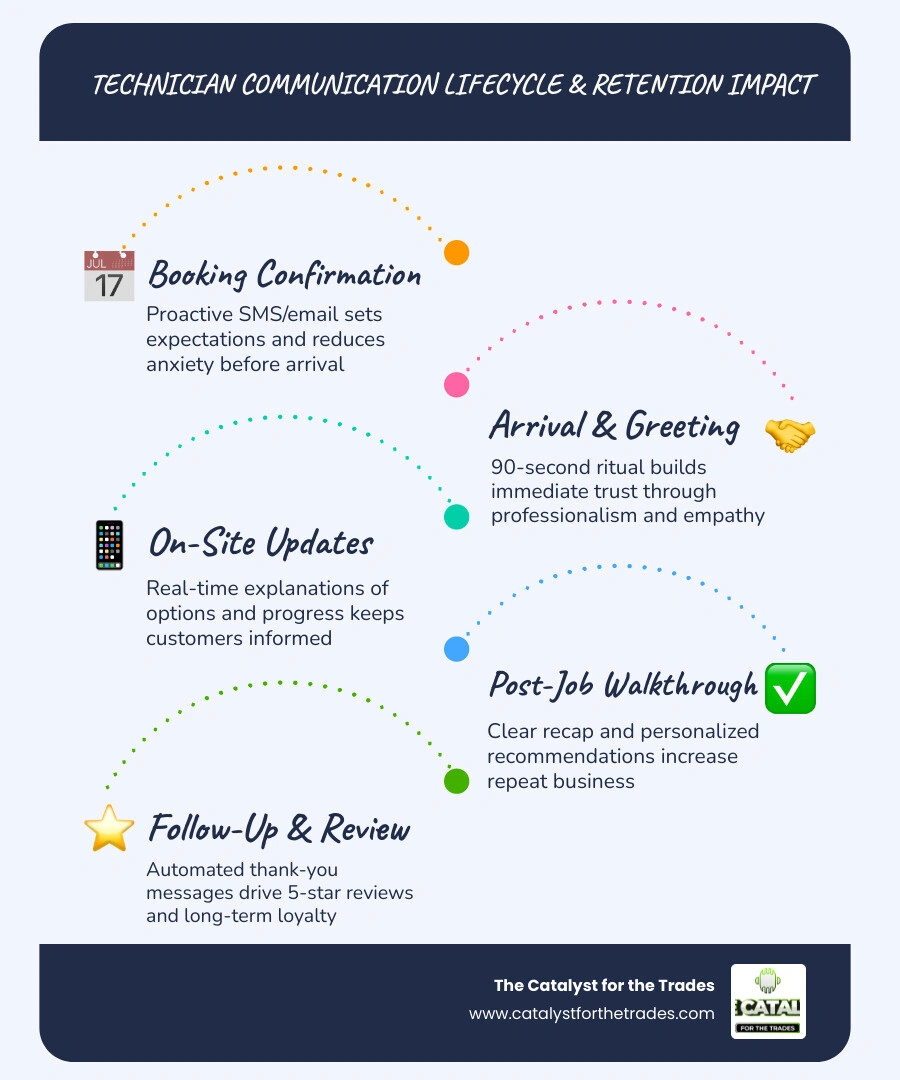
The service journey consists of several key touchpoints:
- Booking Confirmation: Instant SMS and email confirmation.
- Day-Before Reminder: Confirming the scheduled time slot.
- Dispatch Alert: “On my way” notification with the tech’s photo and tracking link.
- On-Site Arrival: The 90-second greeting and booty ritual.
- The Diagnostic Update: Explaining the issue simply with photos before starting work.
- Post-Job Walkthrough: Showing the completed work, explaining warranties, and answering questions.
- Review Ask: A polite, verbal request for feedback before leaving.
How does real-time tracking reduce customer churn?
Real-time tracking eliminates the anxiety of waiting for a technician. By showing the customer exactly where their technician is and when they will arrive, you respect their time and build immediate goodwill. This positive, stress-free start to the service call prevents the frustration that drives customers to look for competitors.
Conclusion
At The Catalyst for the Trades, we believe that scaling a successful home services business requires a perfect balance of operational efficiency, modern technology, and exceptional human connection. The communication style of your technicians is not a “soft” metric—it is a direct driver of your customer retention, online reputation, and overall profitability.
By training your technicians to be trusted advisors, implementing structured rituals, and leveraging modern mobile tools, you can build a loyal customer base that keeps coming back.
Ready to take your customer experience to the next level? Explore our comprehensive customer experience best practices guide to discover more strategies for driving growth, leadership, and service excellence across your entire organization.


