Learn · March 27, 2026
5 Ultimate Customer Experience Best Practices
Transform your trades business. Implement customer experience best practices to foster loyalty, boost growth, and win customers.
By The Catalyst Editorial Team Operator education · 9 min read · Updated July 24, 2026

Why Customer Experience Best Practices Determine Who Wins in the Trades

Customer experience best practices are the proven strategies businesses use to build loyalty, reduce churn, and grow revenue at every stage of the customer journey. Here is a quick overview of the most impactful ones:
- Understand your customers – Build personas and map the full journey from first call to post-service follow-up
- Create a customer-centric culture – Align your whole team, not just front-line staff, around the customer
- Collect and act on feedback – Use NPS, CSAT, and reviews to find gaps and fix them fast
- Deliver omnichannel consistency – Make every touchpoint – phone, text, email, online – feel seamless
- Personalize every interaction – Use customer data to make people feel known, not just processed
- Leverage AI and automation – Handle routine tasks faster so your team can focus on high-value moments
- Empower your staff – Train for empathy, give agents the right tools, and reward great service
- Monitor and adapt continuously – CX is never finished; keep measuring and improving
Think about the last time a customer chose your competitor. Chances are, the product or service was not the deciding factor.
Research shows that 80% of customers say the experience a company provides is just as important as what it actually sells. And in the trades – where homeowners are already stressed when they call you – that gap between a good experience and a bad one can mean the difference between a loyal customer and a scathing online review.
Here is the uncomfortable truth: 80% of consumers have switched brands because of a negative experience, and 43% did so after just one bad interaction. For home services businesses, where word-of-mouth and repeat business drive growth, that number should get your attention.
The good news? CX is not about perfection. It is about consistency, empathy, and building systems that make great service repeatable – not dependent on your best technician having a good day.
This guide breaks down the customer experience best practices that matter most for trades businesses looking to scale, retain more customers, and build a brand people trust.
Defining Customer Experience vs. Customer Service
To master customer experience best practices, we first need to clear up a common misconception: Customer Experience (CX) and Customer Service (CS) are not the same thing.
Think of customer service as a single slice of the pie. It is what happens when a customer has a specific question or a problem—like calling your office because their AC stopped blowing cold air. It is reactive, focused on support, and usually involves a direct interaction with a person.
Customer Experience, on the other hand, is the entire pie. It is the sum of every interaction, emotion, and perception a customer has with your brand. It starts the moment they see your truck driving down the street or find your website on Google, and it continues long after the invoice is paid. CX is holistic; it includes your marketing, your booking process, the cleanliness of your technician’s uniform, and how easy your website is to use.
Every interaction is an opportunity to reinforce your brand’s quality. These are “moments of truth.” If a customer finds it easy to book an appointment but the technician is rude, the overall CX suffers, even if the repair was perfect. To manage this effectively, many top-performing trades businesses utilize customer relationship management (CRM) systems to track these touchpoints and ensure no one falls through the cracks.
Core Customer Experience Best Practices for Growth
Why should a busy HVAC or plumbing business owner care about “feelings” and “perceptions”? Because the numbers don’t lie. Improving your CX isn’t just a “nice to do”—it is a massive engine for revenue growth.
Research shows that 84% of companies that improved their customer experiences saw an increase in revenue. Furthermore, satisfied customers are willing to pay upwards of 18% more for services if the experience is great. In the trades, this means you don’t have to be the “cheapest guy in town” to win. You can command premium pricing by delivering service excellence that makes the homeowner’s life easier.
When you prioritize CX, you see:
- Higher Retention: 90% of highly satisfied customers are likely to return.
- Increased Cross-Selling: Improving CX can increase cross-sell rates by up to 25%.
- Better Resilience: CX leaders achieved three times the total shareholder returns in the long run compared to those who lagged behind.
Understanding Your Audience with Personas and Journey Mapping
You cannot provide a five-star experience if you don’t know who you are serving. This is where creating “customer personas” comes in. A persona is a detailed profile of your typical customer. Is it “Emergency Emily,” who needs a plumber right now and is stressed about her flooded basement? Or is it “Maintenance Mike,” who is tech-savvy and wants to schedule his annual HVAC tune-up via an app without talking to anyone?
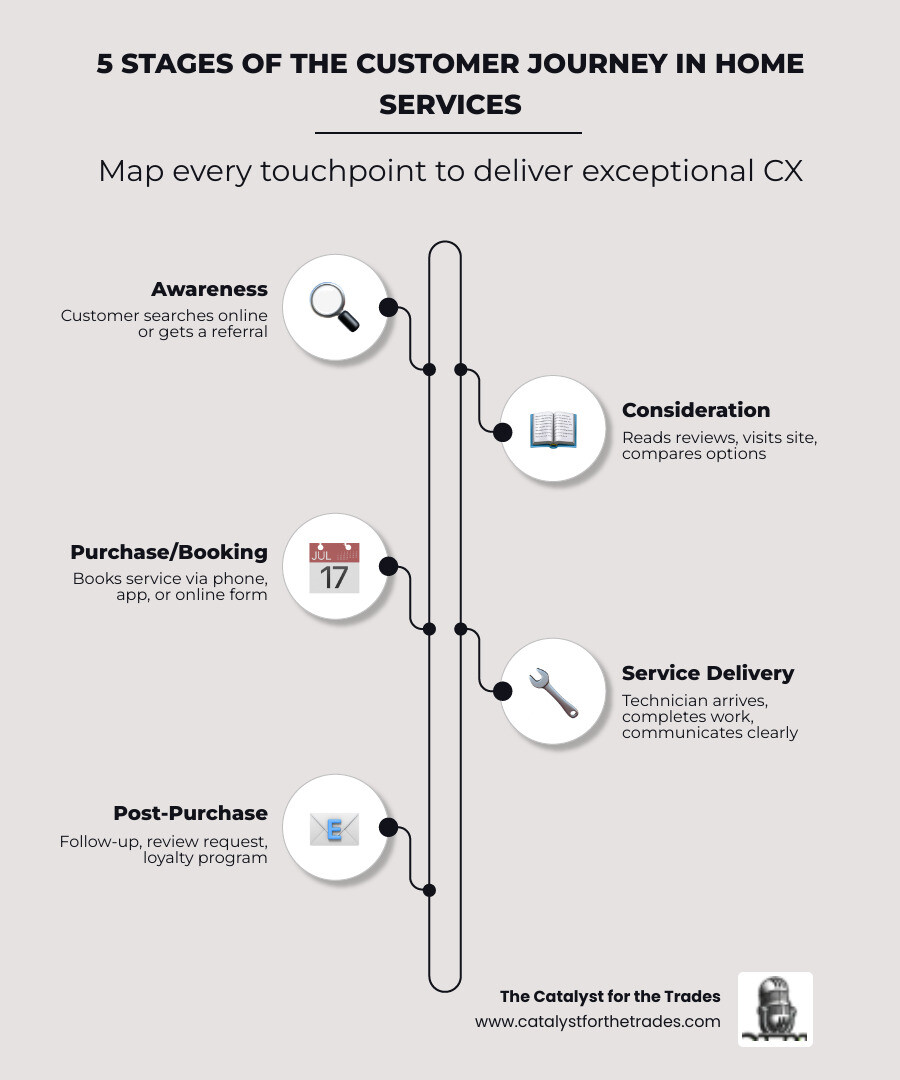
Once you have your personas, you must map the customer journey. This is a visual representation of every step they take with you.
- Awareness: How did they find you?
- Consideration: What did they think of your reviews?
- Purchase: Was the booking process frictionless?
- Service: Did the technician arrive on time and communicate clearly?
- Post-Purchase: Did you follow up to ensure they were happy?
By analyzing the emotions and pain points at each stage, you can proactively fix issues before they cost you a customer. Personas are not “set it and forget it.” As market trends change, your evolving data should help you update these profiles to stay relevant.
Implementing Omnichannel Customer Experience Best Practices
Customers expect to reach you however they want—whether that is a phone call, a text message, an email, or a Facebook message. An omnichannel experience means all these channels are connected.
There is nothing more frustrating for a homeowner than explaining their problem to a dispatcher, only to have to repeat the entire story to the technician when they arrive. Customers rate repeating themselves as one of the most irritating parts of getting help.
A true customer service strategy ensures that data follows the customer. If they texted a photo of a leaking pipe, that photo should be in the technician’s hands before they knock on the door. This creates a low-effort interaction that feels seamless and professional.
Leveraging Technology and AI to Enhance the Journey
The rise of Artificial Intelligence (AI) has changed the game for the trades. We are seeing a clear gap between companies that leverage AI and those that don’t. In fact, 70% of consumers believe there is a clear divide in service quality between AI-users and non-users.
| Task | Manual Approach | Automated/AI Approach |
|---|---|---|
| Booking | Customer waits for office hours to call. | AI chatbot books appointments 24/7. |
| Follow-up | CSR tries to remember to call after 3 days. | Automated text sent 1 hour after job completion. |
| Reviews | Waiting for customers to leave a review. | AI analyzes sentiment and prompts happy customers. |
| Notifications | Customer wonders where the tech is. | Proactive GPS tracking link sent to customer’s phone. |
AI customer service tools can handle the “boring” stuff, like answering FAQs or checking order statuses, freeing up your team to handle complex, emotional situations that require a human touch.
Empowering Customers Through Self-Service and Automation
Believe it or not, 81% of customers try to resolve issues themselves before reaching out to a company. They want to help themselves. By providing a centralized knowledge base on your website—with articles on how to change a filter or what to do if a pilot light goes out—you are actually improving their experience.
Using customer service automation best practices like Interactive Voice Response (IVR) systems or automated scheduling allows your business to stay “open” even when your office is closed. This 24/7 availability is a massive competitive advantage.
Measuring Success with Customer Experience Best Practices
You can’t improve what you don’t measure. To know if your customer experience best practices are working, you need to track specific metrics:
- Net Promoter Score (NPS): “How likely are you to recommend us to a friend?” This measures long-term loyalty.
- Customer Satisfaction Score (CSAT): “How satisfied were you with this specific repair?” This measures short-term happiness.
- Customer Effort Score (CES): “How easy was it to get your issue resolved?” Lower effort usually equals higher loyalty.
- Churn Rate: How many customers are you losing each year?
- Customer Lifetime Value (CLV): How much is a customer worth to you over 5 or 10 years?
By tracking these, you might find that your CSRs are sitting on untapped revenue. For example, if your CSAT is high but your repeat booking rate is low, you might need a better follow-up system.
Fostering a Customer-Centric Culture and Staff Empowerment
You can have the best software in the world, but if your team doesn’t buy into a customer-centric culture, your CX will fail. This starts at the top. Leadership must align on a vision—like “We treat every home as if it were our grandmother’s”—and then empower the staff to live it.
Empowerment means giving your technicians the autonomy to make things right. If a tech sees a small secondary issue that will take five minutes to fix, give them the “OK” to do it for free as a “wow” moment.
Training is essential. A solid customer service training guide shouldn’t just focus on technical skills; it must include empathy and emotional intelligence. 92% of customers say an agent’s mood directly impacts their experience. If your team is stressed and unappreciated, that feeling will be passed directly to the homeowner.
Avoiding Common Pitfalls in CX Strategy
Even with the best intentions, many trades businesses stumble. Here are the most common pitfalls to avoid:
- Data Silos: When the marketing team doesn’t talk to the service team, the customer experience feels disjointed. Use a unified CRM to keep everyone on the same page.
- Ignoring Negative Feedback: 63% of consumers say they’ve never heard back from a business after leaving a review. Responding to a bad review is your best chance to save that relationship.
- Being Purely Reactive: Don’t wait for the customer to call you with a problem. Use customer retention strategies like proactive maintenance reminders to stay top-of-mind.
- Inconsistent Execution: Great service on Monday and poor service on Thursday is a recipe for churn. Standard Operating Procedures (SOPs) are your friend here.
Frequently Asked Questions about CX
What is the difference between CX and customer service?
Customer service is a specific event where a customer asks for help. Customer experience is the total perception of your brand across every touchpoint, from the first ad they see to the last follow-up email they receive.
How does AI improve the customer experience for trades?
AI improves CX by providing 24/7 availability for booking, personalized recommendations based on past service history, and faster response times through automated chatbots and sentiment analysis.
Why is personalization important for home service businesses?
Personalization makes customers feel valued. When you know their name, their equipment’s history, and even their pet’s name, you build trust. 78% of consumers say tailored content makes them more likely to repurchase.
Conclusion
Creating a customer-centric culture isn’t a one-time project; it’s a continuous process of monitoring, adapting, and optimizing. By implementing these customer experience best practices, you aren’t just fixing pipes or AC units—you are building a resilient, high-growth business that homeowners trust.
At The Catalyst for the Trades, we believe that combining cutting-edge technology with real-world industry experience is the secret sauce to success. Every call is an opportunity to stand out. Are you ready to wow every call and take your business to the next level? Start by listening to your customers, empowering your team, and letting the data guide your way to excellence.


