Learn · April 24, 2026
Improving Technician Sales Performance: 11 Steps
Boost improving technician sales performance: Shift to advisor mode, master Good/Better/Best options, track KPIs, and scale with AI coaching.
By The Catalyst Editorial Team Operator education · 9 min read · Updated July 24, 2026

The Foundation of Improving Technician Sales Performance
In many home service businesses, there is an invisible wall between “service” and “sales.” Technicians often feel that their job is strictly to solve mechanical issues, while sales is something “other people” do. However, improving technician sales performance starts by breaking down that wall. This isn’t about turning repair experts into pushy salespeople; it’s about a service-first communication shift.
When a technician enters a home, they are a guest and a trusted expert. This gives them built-in credibility because they have seen the actual problem firsthand. To build on that trust, technicians need to move into “advisor mode.”
In advisor mode, the technician uses situational judgment to help the customer understand the best possible outcome for their home, not just the quickest fix for the immediate issue. This requires a solid Sales Methodology that prioritizes the customer’s long-term comfort and safety.

Transitioning from Repair Mode to Advisor Mode
The biggest hurdle in improving technician sales performance is the technician’s own resistance to “selling.” Many techs pride themselves on being “fixers.” To move them past this, we teach empathy and timing.
Instead of jumping straight to a recommendation, a technician in advisor mode starts by educating the customer. If a system is older and has a major issue, simply fixing the immediate component may not fully serve the homeowner. Strategic advice involves explaining the risks of repeated breakdowns and helping the customer understand their options. As we discussed in our episode From Fitness Sales to HVAC Legend Building a Modern Sales Culture with Darren Tyler Dixon, building a modern sales culture means empowering your team to be proactive. When a tech makes a recommendation based on the system’s condition and the customer’s future plans, they aren’t selling; they are consulting.
The Role of Service Advisors in Driving Results
While the technician is the face of the expertise in the home, the service advisor is the communication hub back at the office. The advisor’s role is to ensure scheduling efficiency and provide the support the technician needs to stay focused on the technical diagnosis.
A high-performing service advisor handles the follow-up process, helps communicate available options, and ensures repair order accuracy. When the advisor and technician are in sync, customer satisfaction improves because the customer feels cared for by a professional team. Developing this synergy is a core part of Sales Team Development, ensuring that every person in the chain knows how to support growth.
Measuring Success: Core Metrics and the 11-Step Baseline
You cannot improve what you do not measure. To see real gains in improving technician sales performance, you need to look past total revenue at the end of the month and dig into the granular data.
| Metric | Definition | Why It Matters |
|---|---|---|
| Productivity | Billable hours vs. total hours on the clock | Measures how much “wrench time” is happening |
| Billable Efficiency | Actual time taken vs. flat-rate time billed | Measures the skill and speed of the technician |
| Effective Labor Rate (ELR) | Total labor revenue divided by total billable hours | Shows the actual yield per hour of work |
| Parts-to-Labor Ratio | Average parts revenue for every $1.00 of labor | Can help identify missed opportunities for recommended repairs or add-ons |
Understanding these numbers allows you to optimize your processes effectively. For a deeper dive, see our Sales Process Optimization Complete Guide.
Establishing a Performance Baseline
To predict future revenue, we recommend an 11-step baseline process. This involves looking at historical labor distribution across five categories: Internal, Warranty, Customer Pay (CP) Repairs, CP Maintenance, and CP Competitive (working on brands you don’t typically sell).
By examining your gross profit percentage in each category, you can create a month-by-month forecast. For example, if your maintenance visits have a lower ELR but a high lead-conversion rate for larger solutions, you can’t just look at labor profit—you have to look at the total revenue ecosystem. This level of detail is essential for Sales Team Development Complete Guide implementations.
KPIs for Long-Term Profitability
Beyond the basics, we track several Key Performance Indicators (KPIs) to ensure long-term health:
- Utilization Rate: How much of the tech’s day is spent on revenue-generating tasks?
- Average Ticket Size: Are we offering relevant accessories or improvements when appropriate?
- Fixed-Cost Absorption: How much of your overhead (rent, insurance) is covered by the gross profit of the service department alone?
- Quote-to-Close Ratio: Are we following up on the opportunities from yesterday?
Mastering the Discovery Framework and Good/Better/Best Options
The secret to improving technician sales performance isn’t a better closing line; it’s a better opening question. Most technicians walk into a mechanical room, look at the equipment, and never look at the customer. The Discovery Framework changes that.
Improving Technician Sales Performance Through Discovery
Before touching a tool, a tech should ask five “must-ask” questions. These aren’t just small talk; they are designed to uncover pain points:
- “How long have you lived in this home?” (Determines short-term repair needs vs. long-term planning).
- “How long do you plan on staying here?”
- “Have you noticed any hot or cold spots in the house?”
- “On a scale of 1-10, how would you rate your indoor air quality?”
- “What is your main priority today: the simplest fix or the longest-term reliability?”
By asking open-ended questions, the technician identifies hidden needs. As Sam Wakefield discusses in Relentless Growth Sam Wakefields Sales Transformation Follow-up Tactics for the Trades, these discovery moments are where the real sale happens.
Presenting Options with the Good/Better/Best Framework
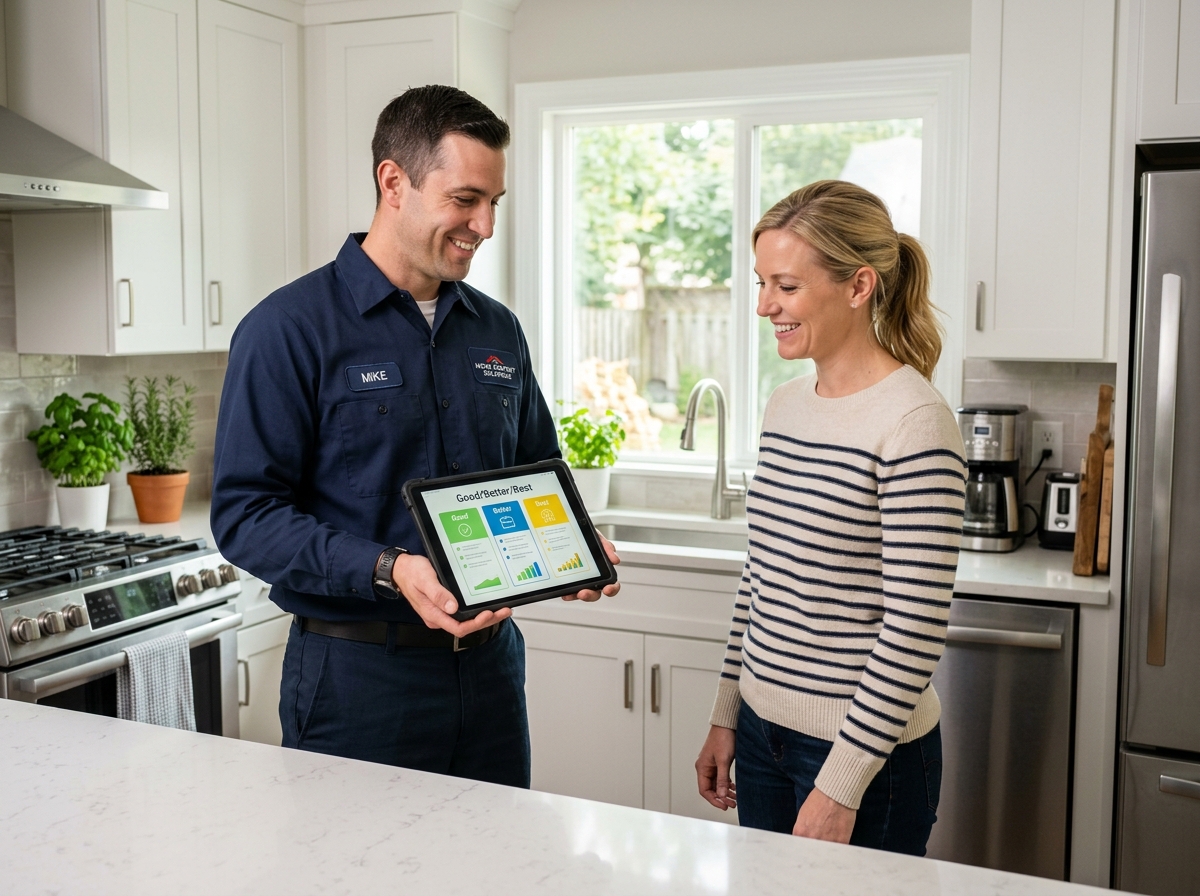
Once the diagnosis is complete, we never present a single option. Presenting only one option creates a simple yes-or-no decision for the customer. Presenting three options (Good/Better/Best) creates a more consultative choice.
- Good: The basic repair to get the system running.
- Better: The repair plus a preventative component or a 1-year maintenance plan.
- Best: The comprehensive solution, often including system improvements or replacement when appropriate.
This choice architecture helps customers evaluate what works best for their goals. Learn more about implementing this in our Sales Training Contractors resource and Igniting Sales Success Devon Murphy on Reclaiming Lost Opportunities.
Overcoming Objections and Closing with Confidence
Even with the best presentation, customers will have concerns. Improving technician sales performance requires training your team to see an objection not as a “no,” but as a request for more information.
Handling Pushbacks for Improving Technician Sales Performance
We teach our technicians to use proven scripts for common hurdles. For example, when a customer says they need time to think about it, the technician shouldn’t get defensive. Instead, they can say: “I completely understand. My goal is to make sure you have the information you need to choose what feels right for your home. Let me walk you through the options again and answer any questions.”
This approach maintains the “advisor” status. Whether the objection is “it’s more than I expected” or “can you just fix what’s broken,” having a prepared response builds the tech’s confidence. For more on this, check out From Gym Floors to HVAC Superstar Tyler Dixons Leap into Trades Sales and our guide on Sales Coaching.
The Role of Financing in Closing High-Ticket Jobs
Financing can help customers move forward with larger home service solutions. Many technicians feel uncomfortable presenting a larger option because they are projecting their own budget onto the customer. We teach “pre-framing” financing by introducing available payment options early in the conversation.
By normalizing payment options early, the budget hurdle becomes easier to discuss. One contractor saw their close rate jump in just two weeks simply by coaching their techs to mention financing on every call. This is part of the revolution we discuss in From Comedy to AI How Sebastian Jimenez is Revolutionizing Sales in the Trades.
Leveraging Technology and AI Coaching for Scalable Growth
A clipboard and a gut feeling aren’t enough. Technology is the force multiplier for improving technician sales performance.
Real-Time Performance Reporting and Accountability
Digital Inspections are a game-changer. When a technician can text a homeowner a high-resolution photo of a rusted-out component or a leaking pipe, the “sales” job is halfway done. Transparency builds trust. Furthermore, real-time reporting allows managers to see billable efficiency and rework rates instantly. If a technician’s conversion rate drops, you can catch it on Tuesday instead of waiting for the end-of-month review.
AI-Powered Coaching and Virtual Ride-Alongs
A challenge for owners is “ride-alongs.” You can’t be in every truck. AI coaching tools now allow for “virtual ride-alongs” by analyzing recorded calls or technician notes. These tools can flag when a tech skips the financing conversation or forgets to ask discovery questions. Companies using AI coaching report 18-22% higher average ticket sizes because the coaching is consistent and scalable.
Sustaining Performance: The 90-Day Training and Coaching Roadmap
Improving sales isn’t an event; it’s a habit. To make these changes stick, you need a structured approach.
Building a Culture of Continuous Improvement
We utilize John Wooden’s “Four Laws of Learning”: Explanation, Demonstration, Imitation, and Repetition. In our weekly meetings, we don’t just talk about sales; we role-play. We take one specific part of the call—like the “front door greet”—and practice it until it’s second nature. Trust is built through these repetitions, and recognition programs ensure that techs who embrace the advisor mindset are rewarded.
The 90-Day Sales Transformation Plan
- Weeks 1-4 (Foundation): Focus on the mindset shift and tracking baseline KPIs.
- Weeks 5-8 (Frameworks): Implement the Good/Better/Best presentation and discovery questions.
- Weeks 9-12 (Refinement): Focus on advanced objection handling and using AI tools for self-correction.
By the end of 90 days, the “repair-only” culture is replaced by a high-performance advisor culture.
Frequently Asked Questions about Technician Sales
How do you transition a technician from “repair mode” to “advisor mode” without being pushy?
The key is reframing. We teach techs that withholding a solution can be a disservice. If a tech knows a system is likely to fail again soon and doesn’t offer a more complete option, they aren’t being helpful—they are setting the customer up for future frustration. Advisor mode is about giving the customer the information they need so they can make the best choice.
What are the most critical KPIs to track for field service sales performance?
Focus on the “Big Three”: Average Ticket Size, Lead-to-Sale Conversion Rate, and Revenue per Labor Hour. If these three are healthy, your shop will be more profitable.
How can digital inspections increase repair order approvals?
Digital inspections provide visual proof. Customers are much more likely to approve a repair when they can see the issue for themselves on their own smartphone. It removes the uncertainty from the service call.
Conclusion
At The Catalyst for the Trades, we believe that your field team is your greatest asset for growth. By empowering your technicians with the right mindset, a structured discovery framework, and the support of modern technology, you can transform your service department from a cost center into a powerful revenue engine.
Improving technician sales performance isn’t just about the bottom line—it’s about providing a better, more professional experience for your customers and a more rewarding career for your team. Ready to empower your field team? Learn more about our approach.


