Learn · March 4, 2026
Top 5 Peer Advisory Groups for Contractors
Discover peer advisory groups for contractors: boost revenue, combat isolation, and accelerate growth with structured, confidential masterminds.
By The Catalyst Editorial Team Operator education · 9 min read · Updated July 24, 2026

Why Running a Home Service Business Can Feel Lonely—And What Peer Advisory Groups Can Do About It

Peer advisory groups are structured forums where 6-16 non-competing business leaders meet regularly—typically monthly—to share challenges, solve problems, and hold each other accountable in a confidential environment. Unlike solo coaching or traditional consulting, these groups provide real-world insights from peers who’ve faced similar situations, often led by an experienced facilitator who guides discussions and ensures productive outcomes.
What you need to know about peer advisory groups:
- Structure: Groups of 6-16 executives from non-competing industries meet monthly for 2-4 hours
- Facilitation: Led by experienced chairs (often former CEOs) who guide discussions and provide one-on-one coaching
- Confidentiality: Members sign formal non-disclosure agreements to create a safe space for vulnerability
- Accountability: Research shows 95% goal achievement when you have a specific accountability appointment, versus just 65% when going it alone
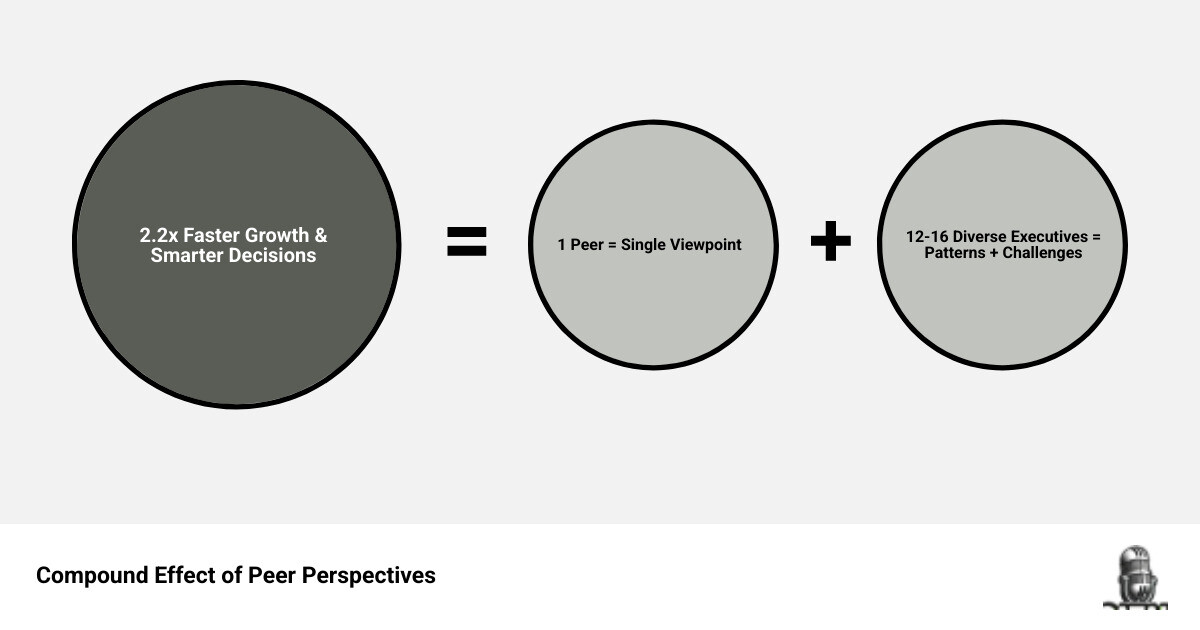
- Results: Member companies grow 2.2x faster and stay in business 21+ years on average, compared to 5 years for typical businesses
- Cost of isolation: Almost 75% of CEOs receive no outside leadership advice, contributing to executive burnout and blind spots
If you’re a home service business owner—whether you run an HVAC company, plumbing operation, or electrical contracting firm—you already know the weight of making every critical decision yourself. From adopting new technologies like AI to recruiting talent in a tight labor market, the challenges can feel isolating. You’re expected to have all the answers on sales optimization, operational scaling, and even exit planning, yet there’s rarely anyone in your circle who truly understands what it’s like to sit in your seat.
That isolation isn’t just uncomfortable—it’s costly. Research from Stanford Graduate School of Business found that nearly three-quarters of CEOs don’t receive outside leadership advice, leaving them vulnerable to confirmation bias, missed opportunities, and burnout. Meanwhile, leaders who participate in peer advisory groups report transformative outcomes: better strategic decisions, faster revenue growth, and the emotional support that comes from knowing you’re not alone in navigating the complexities of running a business.
For more insights on building strong leadership practices in your trade business, explore our Leadership Circles Guide, or if you’re ready to take action, connect with The Catalyst for the Trades to discuss how peer learning can accelerate your growth.
Must-know peer advisory groups terms:
Understanding Peer Advisory Groups for Home Service Leaders
When we talk about peer advisory groups, we aren’t just talking about a casual morning coffee with other local business owners. We are referring to a highly structured, professionally facilitated environment. For those of us in the trades—plumbers, HVAC technicians, and electricians—the value of these groups lies in the diversity of the room.
In a high-functioning group, you aren’t sitting across from your direct competitor from the next town over. Instead, you are surrounded by 6 to 16 non-competing peers. These are leaders who understand the mechanics of overhead, labor shortages, and customer service, but because they aren’t competing for your specific zip codes, they can be 100% honest with you. This creates a “safe harbor” where you can admit what you don’t know without fear of it being used against you in the marketplace.
To learn more about how these dynamics work specifically within the trades, check out our Leadership Circles Guide.
How Peer Advisory Groups Differ from Coaching and Consulting
It is common for contractors to confuse peer advisory groups with solo coaching or traditional consulting. While all have their place, the differences are stark:
- Solo Coaching: This is usually a one-on-one relationship. While a coach can provide great accountability, they offer only one perspective. In a peer group, you get the “compound effect” of multiple viewpoints simultaneously.
- Traditional Consulting: Consultants often come in with theoretical frameworks or “canned” solutions. They tell you how to do things based on a manual. Peers, however, provide vicarious learning. They tell you how they actually handled a $50,000 equipment failure or a mass exodus of technicians last summer.
- Unbiased Feedback: Unlike your spouse, your office manager, or your lead tech, your peers have no “skin in the game” regarding your specific daily operations. This allows them to provide the kind of blunt, unbiased feedback that you simply can’t get anywhere else.
Key Characteristics of Highly Effective Groups
Not all groups are created equal. If you are looking to join or form a group, we have found that the most effective ones share several key traits:
- Diverse Membership: You want a mix of industries and backgrounds. A group with a software CEO, a manufacturing plant owner, and a commercial HVAC contractor provides a much broader range of solutions than a group of people who all think exactly like you.
- Size Matters: The sweet spot is usually between 12 and 16 members. This is large enough to ensure diversity of thought but small enough to maintain intimacy and ensure everyone has time to process their issues.
- Meeting Frequency: Most effective groups meet monthly. This frequency is enough to maintain momentum and see projects through, but not so frequent that it becomes a burden on your schedule.
- Strict Confidentiality: This is the “secret sauce.” Highly effective groups use formal non-disclosure agreements (NDAs). What is said in the room stays in the room. This allows for “strategic vulnerability”—the ability to show your “messy” numbers or admit a leadership failure so you can actually fix it.
The Strategic Benefits of Collective Leadership
Leadership can be a heavy burden when you’re carrying it alone. By tapping into collective leadership, you aren’t just getting advice; you’re gaining a personal board of directors.
According to a Stanford Graduate School of Business study, many CEOs struggle with isolation, while almost 75% do not receive outside leadership advice. This isolation leads to blind spots—those areas where you don’t even know what you don’t know. In a peer group, someone has likely already navigated the “minefield” you’re currently walking through. They can point out the hazards before you step on them.
The ROI of Peer Advisory Groups
Is it worth the time? The data says yes. Statistics show that members of structured peer advisory groups often see significant financial gains. For instance, some member companies have been shown to increase their annual revenue by 4.6% even during economic downturns, while non-members saw decreases.
Beyond just revenue, there is the factor of business longevity. While the average U.S. company might stay in business for only 5 years, members of these groups often see their companies thrive for 21+ years. This is largely due to the power of accountability. A study on accountability by the ASTD discovered that you have a 65% chance of achieving a goal if you commit to someone, but that number jumps to a staggering 95% when you have a specific accountability appointment.
Combating Executive Isolation at the Top
We often hear the phrase “it’s lonely at the top,” and for contractors, it’s a reality. You can’t always vent to your employees about cash flow, and you might not want to stress your family with the details of a legal dispute. This creates a mental health strain that can lead to burnout.
Peer advisory groups address this by providing a trusted space for emotional support. Sharing your toughest problems with a group of people who truly understand the stakes—because they’ve been there—is incredibly cathartic. It transforms a debilitating malady into a growth opportunity.
Structure, Confidentiality, and Commitment
To get the most out of these groups, there needs to be a clear structure. This isn’t a “wing it” situation.
| Feature | Informal Networking | Structured Peer Advisory Groups |
|---|---|---|
| Commitment | Low / Drop-in | High / Mandatory Attendance |
| Agenda | Casual Conversation | Facilitated Problem Solving |
| Confidentiality | Word-of-mouth | Formal NDAs |
| Accountability | None | Specific Goal Tracking |
| Meeting Length | 1 Hour (Coffee/Lunch) | 4 Hours to Full Day |
Typical groups meet about 10 times per year. While 4 hours a month might seem like a lot when you’re busy in the field, members often find that these meetings actually save them time by preventing costly mistakes and streamlining their decision-making processes.
Selecting the Right Group for Your Trade Business
Choosing a group is like hiring a key executive—it requires vetting.
The ideal candidate for a peer advisory group is someone with real decision-making authority—the owner, CEO, or C-suite executive. You need to be in a room with people who can actually pull the trigger on a $100,000 investment or a major pivot in strategy.
When evaluating a group, consider these steps:
- Goal Alignment: Does the group’s focus match your current stage of growth?
- Industry Curation: Ensure there are no direct competitors, but look for geographic diversity or complementary industries.
- One-on-One Vetting: Most high-quality groups start with a conversation with the “Chair” or facilitator to ensure you are a good fit for the existing culture.
- Session Exploration: Many groups allow you to attend a sample session to see if the chemistry and the “level” of the conversation meet your needs.
Specialized Forums for Canadian Nonprofit and Charity Leaders
While our focus at The Catalyst for the Trades is primarily on the home services sector, it’s worth noting that the peer advisory model is incredibly effective for nonprofit and charity leaders as well. In Canada, charity CEOs face a unique and complex regulatory environment, sustainable funding challenges, and the need to manage diverse stakeholder expectations.
Non-competing charity leaders can benefit from the same collective leadership principles. By sharing multifaceted perspectives on fundraising, compliance, and organizational performance, these leaders can transform sector-specific challenges into opportunities. Just like a plumbing contractor, a nonprofit leader needs a confidential professional network to avoid the trap of solo decision-making.
Frequently Asked Questions about Peer Advisory Groups
What is the typical size and meeting frequency of these groups?
Effective groups range from 6 to 16 members and typically meet monthly for several hours to ensure deep-dive problem solving and consistent accountability. Some groups meet 9 or 10 times a year, often for about 4 hours per session, providing enough time to “process” everyone’s most pressing issues.
How is confidentiality maintained among members?
Trust is the foundation of these groups; members sign formal non-disclosure agreements and follow strict protocols to ensure all sensitive business data remains private. In a high-caliber group, the rule is “what is said here, stays here.” This creates the psychological safety required for members to be truly vulnerable about their business failures and fears.
Who is the ideal candidate for a peer advisory group?
The ideal candidate is a high-level leader—such as a CEO, business owner, or senior executive—who possesses decision-making authority and a willingness to be vulnerable and open to feedback. If you are someone who is high on curiosity and low on ego, you will thrive in this environment.
Conclusion
At The Catalyst for the Trades, we believe that the smartest way to scale your home service business is to stop trying to do everything alone. Whether you are looking at operational scaling, implementing new AI marketing tools, or just trying to get your life back from your business, peer advisory groups provide the roadmap.
By surrounding yourself with a powerful community of high-caliber peers who challenge and inspire you, you can achieve results that are simply not possible in isolation. If you’re ready to stop “climbing the mountain” solo and want to join a team that will help you reach the peak faster, it’s time to explore the power of peer learning.
Ready to take your leadership to the next level? Visit Catalyst for the Trades to learn more about our strategies for growth and innovation in the trades.


