Episode
October 22, 2025

The Future is Now: How to Optimize for AI Search and Win the SERP

The Search Revolution That's Already Changing Your Business

AI search visibility is your business's presence in answers from AI engines like Google's AI Overviews, ChatGPT, and Perplexity. For home service businesses, it's the new make-or-break factor for online competition.

Quick Answer: What You Need to Know About AI Search Visibility

  • What it is: Your brand's presence in AI-generated answers and recommendations.
  • Why it matters: A 25% drop in traditional search traffic is expected by 2026.
  • Key difference: The focus shifts from ranking links to influencing AI conversations.
  • Bottom line: AI search visitors convert at 23x higher rates than regular search traffic.

The familiar "10 blue links" on Google are disappearing. Now, a search for "best HVAC repair near me" often returns a direct AI answer, not just a list of websites. This change is happening right now.

With nearly 40% of Americans using AI tools monthly, home service businesses face a huge opportunity and risk. If your business isn't visible in these AI-generated responses, you're becoming invisible to this growing customer base.

Businesses that adapt to AI search will capture high-intent customers. Those who don't will see competitors dominate the conversation, leaving their expertise buried.
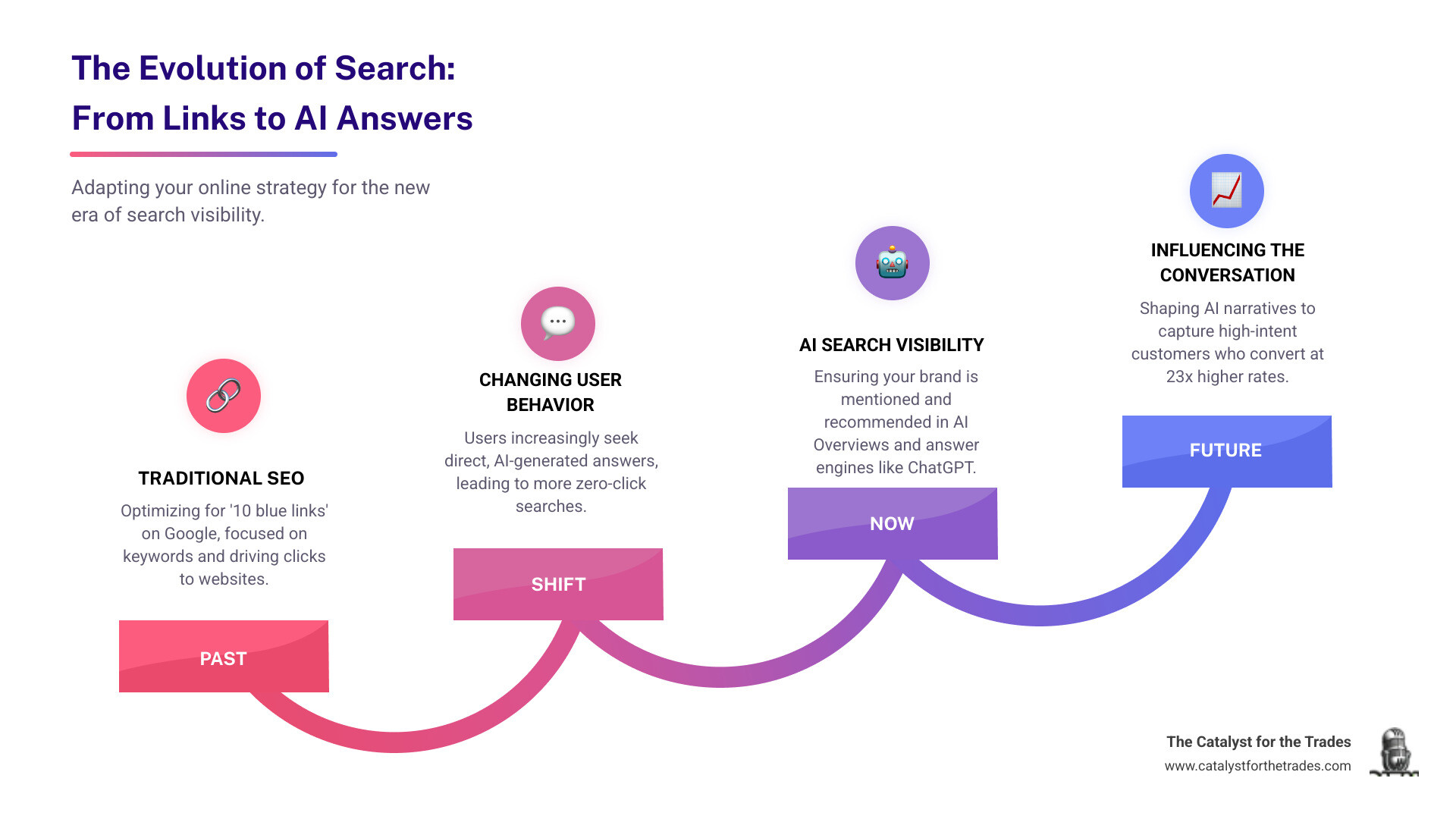
Comprehensive infographic showing the evolution from traditional SEO focused on ranking blue links to AI search visibility focused on being mentioned in AI-generated answers, with key metrics like citation frequency, mention sentiment, and conversion rates from AI traffic versus traditional organic search - ai search visibility infographic step-infographic-4-steps

What is AI Search Visibility and Why Does It Matter for Your Business?

When you ask ChatGPT or Google a question, you likely get a direct answer on the spot. That's AI search visibility in action: how often your business appears when AI tools answer questions about your industry.

Instead of fighting for the top link, you're now competing to be the trusted source that AI recommends. This changes everything. Traditional SEO was about getting citations (links), while AI visibility is about getting mentions (recommendations). When someone asks, "Who's the best HVAC contractor for emergency repairs?" you want your business named in the AI's answer.

The numbers are compelling: AI search visitors convert at a 23x higher rate than regular search traffic. They arrive pre-qualified because the AI has already vetted you as a credible solution.

As Jennifer and Chuck discuss in Adapting to Consumer Behavior: Leveraging AI and Digital Tools in the Trades, contractors who grasp this shift early will capture the highest-intent customers while others wonder where their traffic went.

How AI Search Changes the Customer Journey

The old customer journey—searching, clicking multiple sites, comparing, and then calling—is fading. Today, people have conversational searches with AI, asking questions like, "How much should I expect to pay to fix my air conditioner that's making weird noises?" The AI explains the problem and often recommends specific businesses.

This creates a collapsed marketing funnel. The awareness-consideration-decision process shrinks to two moments: educational (getting a quick answer) and transactional (ready to hire). Critically, nearly 80% of consumers resolve 40% of their searches without clicking any links (zero-click searches). If you're not in that initial AI response, you may never connect with that customer.

The good news is that for important home decisions, people still want human expertise. The key is ensuring AI tools know to recommend your business in those moments. This is brand findability: how easily AI can find and confidently recommend you.

The Risk of Invisibility

If your business doesn't appear in AI-generated answers, you're becoming invisible to a growing segment of potential customers. With nearly 40% of Americans using AI tools monthly, not being mentioned is like not existing in their world.

Meanwhile, your competitors who are mentioned are shaping the entire conversation. If they are cited as examples of quality work or fair pricing, they're not just winning one customer—they're influencing how all future customers in your area choose a contractor.

This isn't just about lost leads; it's about losing market share to businesses that understand how to work with AI. The opportunity to build your AI search visibility is still open, but it won't be forever.

Core Strategies for Improving Your AI Search Visibility
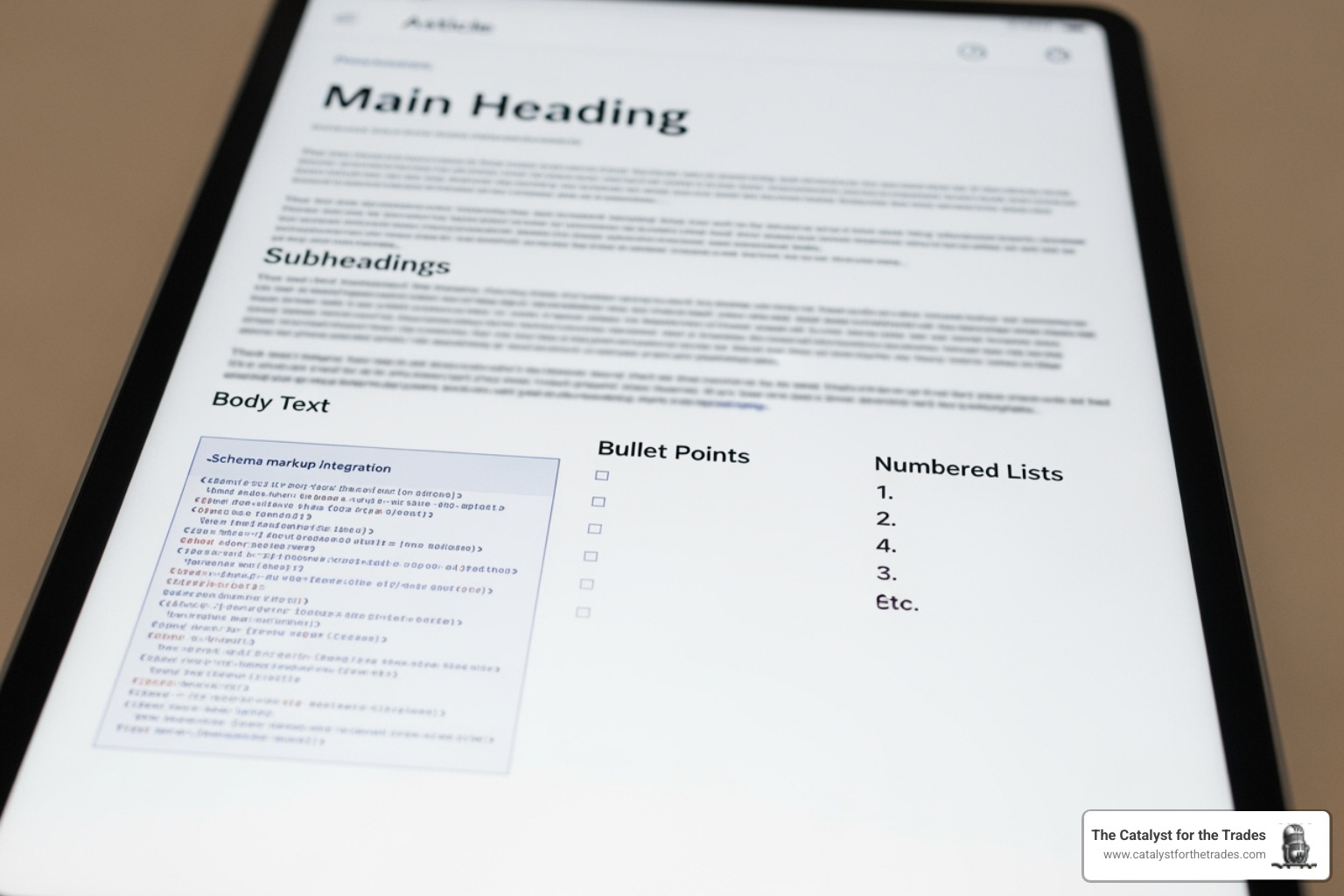
A well-structured article on a tablet with callouts highlighting the main heading (H1), subheadings (H2, H3), bulleted lists, numbered lists, and a section for schema markup integration - ai search visibility

Getting noticed by AI isn't magic; it's about giving these systems what they need to understand your expertise. This new approach, Generative Engine Optimization (GEO), combines with solid technical foundations to help AI recognize and share your knowledge as the go-to expert opinion.

You don't need to discard your SEO knowledge. Instead, you'll build on it with new strategies that help AI understand what makes your business special.

Optimizing Your Content for AI Comprehension

To boost your AI search visibility, you need to speak AI's language while still connecting with customers. Here's how:

  • E-E-A-T is your foundation. AI models actively seek Experience, Expertise, Authoritativeness, and Trustworthiness to identify credible sources.
  • Build topical authority. Create comprehensive resource hubs on your core services. AI favors depth and understands the connections between related topics.
  • Create entity-rich content. Naturally weave together related products, services, and concepts. When writing about furnace installation, mention energy efficiency, ductwork, and maintenance schedules to show the full scope of your expertise.
  • Keep content fresh. Our research shows AI often prefers newer content. Regularly update your key service pages with the latest standards and information.
  • Use simple, clear language. AI, like busy homeowners, appreciates straightforward explanations. Avoid jargon or explain it clearly.
  • Structure is your secret weapon. Use clear headings, bulleted and numbered lists, and comprehensive FAQ sections. Tables are excellent for comparing service options.

By answering the specific questions your customers ask, you become the source AI turns to. This approach aligns with how AI and digital tools are changing the way home services sell.

Technical SEO's Crucial Role in AI Findy

A code snippet illustrating schema markup for a local plumbing business, showing properties like @context, @type, name, address, telephone, openingHours, and priceRange - ai search visibility

Even great content is useless if AI can't read it. Technical SEO is the foundation for your AI search visibility.

  • Use Schema markup. This structured data acts as a translator for AI, clearly labeling your business type, services, and other key information. Research shows that users click on rich results 58% of the time, compared to just 41% for regular results.
  • Prioritize site speed. A slow website frustrates users and can prevent AI crawlers from properly indexing your content. Optimize images and improve your Core Web Vitals.
  • Ensure content is in HTML. AI crawlers often struggle with JavaScript-heavy sites. Make sure your most important information is in clean HTML that any system can read.
  • Check your robots.txt file. Don't accidentally block legitimate AI crawlers like GPTBot or PerplexityBot from accessing your site.
  • Maintain a clean XML sitemap. Guide AI crawlers to all your valuable content, ensuring nothing is missed.

Getting these technical fundamentals right is essential for making your expertise findable and supports the goal of helping contractors make smarter, faster choices in their marketing.

A dashboard showcasing AI visibility metrics, including a graph of citation count over time, a pie chart of brand mention sentiment (positive, neutral, negative), a bar chart comparing brand share of voice across different AI platforms, and a section detailing AI-driven traffic referrals and conversion rates - ai search visibility

With AI search visibility, the old metrics of keyword rankings no longer tell the whole story. We're now measuring how often AI systems trust us enough to recommend our expertise. It's the difference between tracking foot traffic and tracking word-of-mouth referrals.

Key Metrics for Measuring AI Search Visibility

To succeed, you need to learn the new language of AI search metrics.

  • Citation Count: Measures how often AI links to your content as a source, indicating high trust and driving direct traffic.
  • Mention Frequency: Tracks when AI mentions your brand without a link. This builds awareness and authority.
  • Share of Voice: Shows your competitive position by comparing how often you're mentioned versus competitors for key topics.
  • Sentiment Analysis: Ensures AI discusses your business positively, avoiding mentions of negative reviews or complaints.
  • AI-Driven Traffic & CTR: Tracks the actual visitors and clicks coming from AI citations, directly impacting your bottom line.

Monitoring Your Brand and Competitors Across AI Platforms

AI search happens across multiple platforms, each requiring attention.

  • Track key platforms: Regularly check your business's appearance on Google AI Overviews, ChatGPT, Perplexity, and other emerging tools.
  • Use prompt monitoring: Think like your customers and test dozens of questions they might ask about your services, as AI responds differently to slight wording changes.
  • Perform content gap analysis: When competitors are cited for topics where you have expertise, you've found a content opportunity.
  • Identify trusted sources: See which websites AI platforms prefer in your industry and shape your content strategy to mirror their authority.

This systematic monitoring helps you capture high-intent customers who are ready to hire an expert. Learn more about how AI can help home service contractors finally fix lead management.

Measuring the ROI of Your AI Visibility Efforts

These metrics must translate into business results.

  • Track conversions from AI referrals: Attribute calls and form fills directly to clicks from AI citations to show immediate impact.
  • Use lead attribution models: Understand the full customer journey, where an AI mention might be the crucial first touchpoint.
  • Monitor branded search lift: As AI mentions increase, more people will search for your company by name.
  • Analyze customer lifetime value (LTV): AI-referred customers often have a higher LTV because they arrive pre-sold on your expertise.
  • Calculate cost per acquisition (CPA): CPA is typically lower, as optimized content generates leads continuously without ongoing ad spend.

The Future is Now: Generative Engine Optimization (GEO) and What's Next

A futuristic interface displays multimodal search results, seamlessly integrating text answers, high-quality images of products, and short video clips demonstrating service processes, all within a single, dynamic AI-generated response - ai search visibility

The search landscape is evolving into something new. We're witnessing the birth of Generative Engine Optimization (GEO), an approach that moves beyond traditional SEO. This isn't a future concept; it's happening now, and smart home service businesses are adapting.

Traditional SEO was like getting the best spot in a phone book. GEO is about becoming the trusted expert people recommend. It's the difference between being found and being chosen.

What is Generative Engine Optimization (GEO)?

Generative Engine Optimization (GEO) is the practice of making your business a preferred source for AI-generated answers. It shifts the focus from ranking in a list to influencing the AI's knowledge base.

AI models use a process called Retrieval-Augmented Generation (RAG), where they find the most trustworthy information online and use it to craft an answer. Understanding this Retrieval-Augmented Generation (RAG) process is key to GEO. Your foundational SEO still matters—AI must find your content first—but GEO makes that content irresistibly quotable. Instead of just ranking, you become the definitive source AI confidently cites.

Ensuring Your Content is Findable for Better AI Search Visibility

Future-proofing your AI search visibility means embracing constant change. For businesses willing to stay ahead, this is an exciting opportunity.

  • Accept continuous learning. Stay updated on AI developments and be ready to experiment with new approaches. You don't need to be a tech expert, just curious and adaptable.
  • Train your team. When your whole team understands how AI search impacts the customer journey, they'll see content creation in a new light.
  • Prepare for multimodal and voice search. AI is increasingly using images, videos, and voice to generate answers. Optimize this content to be included in future search results.
  • Build long-term brand authority. AI, like humans, trusts brands that consistently deliver valuable, accurate information. Every helpful article and positive review builds a reputation that AI learns to recommend.

For professionals ready to adapt, understanding these shifts is vital. That's why we explore The AI Revolution in Home Services: How to Future-Proof Your Trades Business.

The future belongs to businesses that anticipate change. By focusing on continuous improvement, you can thrive in this new era. Learn more about How to Stay Competitive as AI and Consumer Behavior Reshape Home Services.

Frequently Asked Questions about AI Search Visibility

How does AI visibility differ from traditional SEO?

Traditional SEO focuses on ranking links to get clicks. AI search visibility focuses on becoming the trusted source for AI-generated answers. The goal shifts from driving clicks to building influence and shaping the conversation. You're moving from being a result to being the source.

What are the most important AI platforms for brands to track?

While the landscape is always changing, four platforms are currently key for home service businesses:

  • Google AI Overviews: Reaches a massive audience directly in Google search results, crucial for local intent.
  • ChatGPT: Shapes answers for millions of users seeking advice and recommendations.
  • Perplexity: An "answer engine" that clearly cites its sources, driving high-quality, engaged traffic.
  • Microsoft Copilot: Integrated into Windows and Microsoft products, its reach is rapidly expanding.

How can I ensure my content is understandable by AI models?

Making your content AI-friendly is about clarity and organization. Follow these best practices:

  • Use structured data (Schema): Apply labels to your content so AI can easily categorize your business, services, and reviews.
  • Create clear headings (H1, H2, H3): Organize information in a logical hierarchy that AI can follow.
  • Write in simple language: Use short sentences and avoid industry jargon to make your content easy to process.
  • Format with lists and tables: This makes specific data points easy for AI to parse and feature in its answers.
  • Answer questions directly: Start with the direct answer ("Bottom Line Up Front") before providing supporting details.

The shift from blue links to AI-generated answers is here, reshaping how customers find you. To stay competitive, your home service business must adapt by packaging its expertise in a way that AI can understand and recommend.

This isn't about abandoning old marketing tactics but building on them. By creating well-structured, expert content and ensuring your site is technically sound with schema and fast load times, you become the trusted solution that AI recommends to homeowners in need.

The opportunity is immense. Every AI mention builds your reputation and drives high-intent customers who convert at remarkable rates. Businesses that accept Generative Engine Optimization (GEO) now will become the leaders in their markets.

Your competitors are already adapting. When AI shapes first impressions, invisibility isn't an option. Don't let someone else tell your story.

For home service professionals ready to steer this change, resources like The Catalyst for the Trades provide the insights you need. We encourage you to Learn more about The AI Revolution in Home Services and How to Future-Proof Your Trades Business. The future is here. With the right approach, your business will thrive because of it.

The Search Revolution That's Already Changing Your Business

AI search visibility is your business's presence in answers from AI engines like Google's AI Overviews, ChatGPT, and Perplexity. For home service businesses, it's the new make-or-break factor for online competition.

Quick Answer: What You Need to Know About AI Search Visibility

  • What it is: Your brand's presence in AI-generated answers and recommendations.
  • Why it matters: A 25% drop in traditional search traffic is expected by 2026.
  • Key difference: The focus shifts from ranking links to influencing AI conversations.
  • Bottom line: AI search visitors convert at 23x higher rates than regular search traffic.

The familiar "10 blue links" on Google are disappearing. Now, a search for "best HVAC repair near me" often returns a direct AI answer, not just a list of websites. This change is happening right now.

With nearly 40% of Americans using AI tools monthly, home service businesses face a huge opportunity and risk. If your business isn't visible in these AI-generated responses, you're becoming invisible to this growing customer base.

Businesses that adapt to AI search will capture high-intent customers. Those who don't will see competitors dominate the conversation, leaving their expertise buried.

Comprehensive infographic showing the evolution from traditional SEO focused on ranking blue links to AI search visibility focused on being mentioned in AI-generated answers, with key metrics like citation frequency, mention sentiment, and conversion rates from AI traffic versus traditional organic search - ai search visibility infographic step-infographic-4-steps

What is AI Search Visibility and Why Does It Matter for Your Business?

When you ask ChatGPT or Google a question, you likely get a direct answer on the spot. That's AI search visibility in action: how often your business appears when AI tools answer questions about your industry.

Instead of fighting for the top link, you're now competing to be the trusted source that AI recommends. This changes everything. Traditional SEO was about getting citations (links), while AI visibility is about getting mentions (recommendations). When someone asks, "Who's the best HVAC contractor for emergency repairs?" you want your business named in the AI's answer.

The numbers are compelling: AI search visitors convert at a 23x higher rate than regular search traffic. They arrive pre-qualified because the AI has already vetted you as a credible solution.

As Jennifer and Chuck discuss in Adapting to Consumer Behavior: Leveraging AI and Digital Tools in the Trades, contractors who grasp this shift early will capture the highest-intent customers while others wonder where their traffic went.

How AI Search Changes the Customer Journey

The old customer journey—searching, clicking multiple sites, comparing, and then calling—is fading. Today, people have conversational searches with AI, asking questions like, "How much should I expect to pay to fix my air conditioner that's making weird noises?" The AI explains the problem and often recommends specific businesses.

This creates a collapsed marketing funnel. The awareness-consideration-decision process shrinks to two moments: educational (getting a quick answer) and transactional (ready to hire). Critically, nearly 80% of consumers resolve 40% of their searches without clicking any links (zero-click searches). If you're not in that initial AI response, you may never connect with that customer.

The good news is that for important home decisions, people still want human expertise. The key is ensuring AI tools know to recommend your business in those moments. This is brand findability: how easily AI can find and confidently recommend you.

The Risk of Invisibility

If your business doesn't appear in AI-generated answers, you're becoming invisible to a growing segment of potential customers. With nearly 40% of Americans using AI tools monthly, not being mentioned is like not existing in their world.

Meanwhile, your competitors who are mentioned are shaping the entire conversation. If they are cited as examples of quality work or fair pricing, they're not just winning one customer—they're influencing how all future customers in your area choose a contractor.

This isn't just about lost leads; it's about losing market share to businesses that understand how to work with AI. The opportunity to build your AI search visibility is still open, but it won't be forever.

Core Strategies for Improving Your AI Search Visibility

A well-structured article on a tablet with callouts highlighting the main heading (H1), subheadings (H2, H3), bulleted lists, numbered lists, and a section for schema markup integration - ai search visibility

Getting noticed by AI isn't magic; it's about giving these systems what they need to understand your expertise. This new approach, Generative Engine Optimization (GEO), combines with solid technical foundations to help AI recognize and share your knowledge as the go-to expert opinion.

You don't need to discard your SEO knowledge. Instead, you'll build on it with new strategies that help AI understand what makes your business special.

Optimizing Your Content for AI Comprehension

To boost your AI search visibility, you need to speak AI's language while still connecting with customers. Here's how:

  • E-E-A-T is your foundation. AI models actively seek Experience, Expertise, Authoritativeness, and Trustworthiness to identify credible sources.
  • Build topical authority. Create comprehensive resource hubs on your core services. AI favors depth and understands the connections between related topics.
  • Create entity-rich content. Naturally weave together related products, services, and concepts. When writing about furnace installation, mention energy efficiency, ductwork, and maintenance schedules to show the full scope of your expertise.
  • Keep content fresh. Our research shows AI often prefers newer content. Regularly update your key service pages with the latest standards and information.
  • Use simple, clear language. AI, like busy homeowners, appreciates straightforward explanations. Avoid jargon or explain it clearly.
  • Structure is your secret weapon. Use clear headings, bulleted and numbered lists, and comprehensive FAQ sections. Tables are excellent for comparing service options.

By answering the specific questions your customers ask, you become the source AI turns to. This approach aligns with how AI and digital tools are changing the way home services sell.

Technical SEO's Crucial Role in AI Findy

A code snippet illustrating schema markup for a local plumbing business, showing properties like @context, @type, name, address, telephone, openingHours, and priceRange - ai search visibility

Even great content is useless if AI can't read it. Technical SEO is the foundation for your AI search visibility.

  • Use Schema markup. This structured data acts as a translator for AI, clearly labeling your business type, services, and other key information. Research shows that users click on rich results 58% of the time, compared to just 41% for regular results.
  • Prioritize site speed. A slow website frustrates users and can prevent AI crawlers from properly indexing your content. Optimize images and improve your Core Web Vitals.
  • Ensure content is in HTML. AI crawlers often struggle with JavaScript-heavy sites. Make sure your most important information is in clean HTML that any system can read.
  • Check your robots.txt file. Don't accidentally block legitimate AI crawlers like GPTBot or PerplexityBot from accessing your site.
  • Maintain a clean XML sitemap. Guide AI crawlers to all your valuable content, ensuring nothing is missed.

Getting these technical fundamentals right is essential for making your expertise findable and supports the goal of helping contractors make smarter, faster choices in their marketing.

A dashboard showcasing AI visibility metrics, including a graph of citation count over time, a pie chart of brand mention sentiment (positive, neutral, negative), a bar chart comparing brand share of voice across different AI platforms, and a section detailing AI-driven traffic referrals and conversion rates - ai search visibility

With AI search visibility, the old metrics of keyword rankings no longer tell the whole story. We're now measuring how often AI systems trust us enough to recommend our expertise. It's the difference between tracking foot traffic and tracking word-of-mouth referrals.

Key Metrics for Measuring AI Search Visibility

To succeed, you need to learn the new language of AI search metrics.

  • Citation Count: Measures how often AI links to your content as a source, indicating high trust and driving direct traffic.
  • Mention Frequency: Tracks when AI mentions your brand without a link. This builds awareness and authority.
  • Share of Voice: Shows your competitive position by comparing how often you're mentioned versus competitors for key topics.
  • Sentiment Analysis: Ensures AI discusses your business positively, avoiding mentions of negative reviews or complaints.
  • AI-Driven Traffic & CTR: Tracks the actual visitors and clicks coming from AI citations, directly impacting your bottom line.

Monitoring Your Brand and Competitors Across AI Platforms

AI search happens across multiple platforms, each requiring attention.

  • Track key platforms: Regularly check your business's appearance on Google AI Overviews, ChatGPT, Perplexity, and other emerging tools.
  • Use prompt monitoring: Think like your customers and test dozens of questions they might ask about your services, as AI responds differently to slight wording changes.
  • Perform content gap analysis: When competitors are cited for topics where you have expertise, you've found a content opportunity.
  • Identify trusted sources: See which websites AI platforms prefer in your industry and shape your content strategy to mirror their authority.

This systematic monitoring helps you capture high-intent customers who are ready to hire an expert. Learn more about how AI can help home service contractors finally fix lead management.

Measuring the ROI of Your AI Visibility Efforts

These metrics must translate into business results.

  • Track conversions from AI referrals: Attribute calls and form fills directly to clicks from AI citations to show immediate impact.
  • Use lead attribution models: Understand the full customer journey, where an AI mention might be the crucial first touchpoint.
  • Monitor branded search lift: As AI mentions increase, more people will search for your company by name.
  • Analyze customer lifetime value (LTV): AI-referred customers often have a higher LTV because they arrive pre-sold on your expertise.
  • Calculate cost per acquisition (CPA): CPA is typically lower, as optimized content generates leads continuously without ongoing ad spend.

The Future is Now: Generative Engine Optimization (GEO) and What's Next

A futuristic interface displays multimodal search results, seamlessly integrating text answers, high-quality images of products, and short video clips demonstrating service processes, all within a single, dynamic AI-generated response - ai search visibility

The search landscape is evolving into something new. We're witnessing the birth of Generative Engine Optimization (GEO), an approach that moves beyond traditional SEO. This isn't a future concept; it's happening now, and smart home service businesses are adapting.

Traditional SEO was like getting the best spot in a phone book. GEO is about becoming the trusted expert people recommend. It's the difference between being found and being chosen.

What is Generative Engine Optimization (GEO)?

Generative Engine Optimization (GEO) is the practice of making your business a preferred source for AI-generated answers. It shifts the focus from ranking in a list to influencing the AI's knowledge base.

AI models use a process called Retrieval-Augmented Generation (RAG), where they find the most trustworthy information online and use it to craft an answer. Understanding this Retrieval-Augmented Generation (RAG) process is key to GEO. Your foundational SEO still matters—AI must find your content first—but GEO makes that content irresistibly quotable. Instead of just ranking, you become the definitive source AI confidently cites.

Ensuring Your Content is Findable for Better AI Search Visibility

Future-proofing your AI search visibility means embracing constant change. For businesses willing to stay ahead, this is an exciting opportunity.

  • Accept continuous learning. Stay updated on AI developments and be ready to experiment with new approaches. You don't need to be a tech expert, just curious and adaptable.
  • Train your team. When your whole team understands how AI search impacts the customer journey, they'll see content creation in a new light.
  • Prepare for multimodal and voice search. AI is increasingly using images, videos, and voice to generate answers. Optimize this content to be included in future search results.
  • Build long-term brand authority. AI, like humans, trusts brands that consistently deliver valuable, accurate information. Every helpful article and positive review builds a reputation that AI learns to recommend.

For professionals ready to adapt, understanding these shifts is vital. That's why we explore The AI Revolution in Home Services: How to Future-Proof Your Trades Business.

The future belongs to businesses that anticipate change. By focusing on continuous improvement, you can thrive in this new era. Learn more about How to Stay Competitive as AI and Consumer Behavior Reshape Home Services.

Frequently Asked Questions about AI Search Visibility

How does AI visibility differ from traditional SEO?

Traditional SEO focuses on ranking links to get clicks. AI search visibility focuses on becoming the trusted source for AI-generated answers. The goal shifts from driving clicks to building influence and shaping the conversation. You're moving from being a result to being the source.

What are the most important AI platforms for brands to track?

While the landscape is always changing, four platforms are currently key for home service businesses:

  • Google AI Overviews: Reaches a massive audience directly in Google search results, crucial for local intent.
  • ChatGPT: Shapes answers for millions of users seeking advice and recommendations.
  • Perplexity: An "answer engine" that clearly cites its sources, driving high-quality, engaged traffic.
  • Microsoft Copilot: Integrated into Windows and Microsoft products, its reach is rapidly expanding.

How can I ensure my content is understandable by AI models?

Making your content AI-friendly is about clarity and organization. Follow these best practices:

  • Use structured data (Schema): Apply labels to your content so AI can easily categorize your business, services, and reviews.
  • Create clear headings (H1, H2, H3): Organize information in a logical hierarchy that AI can follow.
  • Write in simple language: Use short sentences and avoid industry jargon to make your content easy to process.
  • Format with lists and tables: This makes specific data points easy for AI to parse and feature in its answers.
  • Answer questions directly: Start with the direct answer ("Bottom Line Up Front") before providing supporting details.

The shift from blue links to AI-generated answers is here, reshaping how customers find you. To stay competitive, your home service business must adapt by packaging its expertise in a way that AI can understand and recommend.

This isn't about abandoning old marketing tactics but building on them. By creating well-structured, expert content and ensuring your site is technically sound with schema and fast load times, you become the trusted solution that AI recommends to homeowners in need.

The opportunity is immense. Every AI mention builds your reputation and drives high-intent customers who convert at remarkable rates. Businesses that accept Generative Engine Optimization (GEO) now will become the leaders in their markets.

Your competitors are already adapting. When AI shapes first impressions, invisibility isn't an option. Don't let someone else tell your story.

For home service professionals ready to steer this change, resources like The Catalyst for the Trades provide the insights you need. We encourage you to Learn more about The AI Revolution in Home Services and How to Future-Proof Your Trades Business. The future is here. With the right approach, your business will thrive because of it.

The Search Revolution That's Already Changing Your Business

AI search visibility is your business's presence in answers from AI engines like Google's AI Overviews, ChatGPT, and Perplexity. For home service businesses, it's the new make-or-break factor for online competition.

Quick Answer: What You Need to Know About AI Search Visibility

  • What it is: Your brand's presence in AI-generated answers and recommendations.
  • Why it matters: A 25% drop in traditional search traffic is expected by 2026.
  • Key difference: The focus shifts from ranking links to influencing AI conversations.
  • Bottom line: AI search visitors convert at 23x higher rates than regular search traffic.

The familiar "10 blue links" on Google are disappearing. Now, a search for "best HVAC repair near me" often returns a direct AI answer, not just a list of websites. This change is happening right now.

With nearly 40% of Americans using AI tools monthly, home service businesses face a huge opportunity and risk. If your business isn't visible in these AI-generated responses, you're becoming invisible to this growing customer base.

Businesses that adapt to AI search will capture high-intent customers. Those who don't will see competitors dominate the conversation, leaving their expertise buried.

Comprehensive infographic showing the evolution from traditional SEO focused on ranking blue links to AI search visibility focused on being mentioned in AI-generated answers, with key metrics like citation frequency, mention sentiment, and conversion rates from AI traffic versus traditional organic search - ai search visibility infographic step-infographic-4-steps

What is AI Search Visibility and Why Does It Matter for Your Business?

When you ask ChatGPT or Google a question, you likely get a direct answer on the spot. That's AI search visibility in action: how often your business appears when AI tools answer questions about your industry.

Instead of fighting for the top link, you're now competing to be the trusted source that AI recommends. This changes everything. Traditional SEO was about getting citations (links), while AI visibility is about getting mentions (recommendations). When someone asks, "Who's the best HVAC contractor for emergency repairs?" you want your business named in the AI's answer.

The numbers are compelling: AI search visitors convert at a 23x higher rate than regular search traffic. They arrive pre-qualified because the AI has already vetted you as a credible solution.

As Jennifer and Chuck discuss in Adapting to Consumer Behavior: Leveraging AI and Digital Tools in the Trades, contractors who grasp this shift early will capture the highest-intent customers while others wonder where their traffic went.

How AI Search Changes the Customer Journey

The old customer journey—searching, clicking multiple sites, comparing, and then calling—is fading. Today, people have conversational searches with AI, asking questions like, "How much should I expect to pay to fix my air conditioner that's making weird noises?" The AI explains the problem and often recommends specific businesses.

This creates a collapsed marketing funnel. The awareness-consideration-decision process shrinks to two moments: educational (getting a quick answer) and transactional (ready to hire). Critically, nearly 80% of consumers resolve 40% of their searches without clicking any links (zero-click searches). If you're not in that initial AI response, you may never connect with that customer.

The good news is that for important home decisions, people still want human expertise. The key is ensuring AI tools know to recommend your business in those moments. This is brand findability: how easily AI can find and confidently recommend you.

The Risk of Invisibility

If your business doesn't appear in AI-generated answers, you're becoming invisible to a growing segment of potential customers. With nearly 40% of Americans using AI tools monthly, not being mentioned is like not existing in their world.

Meanwhile, your competitors who are mentioned are shaping the entire conversation. If they are cited as examples of quality work or fair pricing, they're not just winning one customer—they're influencing how all future customers in your area choose a contractor.

This isn't just about lost leads; it's about losing market share to businesses that understand how to work with AI. The opportunity to build your AI search visibility is still open, but it won't be forever.

Core Strategies for Improving Your AI Search Visibility

A well-structured article on a tablet with callouts highlighting the main heading (H1), subheadings (H2, H3), bulleted lists, numbered lists, and a section for schema markup integration - ai search visibility

Getting noticed by AI isn't magic; it's about giving these systems what they need to understand your expertise. This new approach, Generative Engine Optimization (GEO), combines with solid technical foundations to help AI recognize and share your knowledge as the go-to expert opinion.

You don't need to discard your SEO knowledge. Instead, you'll build on it with new strategies that help AI understand what makes your business special.

Optimizing Your Content for AI Comprehension

To boost your AI search visibility, you need to speak AI's language while still connecting with customers. Here's how:

  • E-E-A-T is your foundation. AI models actively seek Experience, Expertise, Authoritativeness, and Trustworthiness to identify credible sources.
  • Build topical authority. Create comprehensive resource hubs on your core services. AI favors depth and understands the connections between related topics.
  • Create entity-rich content. Naturally weave together related products, services, and concepts. When writing about furnace installation, mention energy efficiency, ductwork, and maintenance schedules to show the full scope of your expertise.
  • Keep content fresh. Our research shows AI often prefers newer content. Regularly update your key service pages with the latest standards and information.
  • Use simple, clear language. AI, like busy homeowners, appreciates straightforward explanations. Avoid jargon or explain it clearly.
  • Structure is your secret weapon. Use clear headings, bulleted and numbered lists, and comprehensive FAQ sections. Tables are excellent for comparing service options.

By answering the specific questions your customers ask, you become the source AI turns to. This approach aligns with how AI and digital tools are changing the way home services sell.

Technical SEO's Crucial Role in AI Findy

A code snippet illustrating schema markup for a local plumbing business, showing properties like @context, @type, name, address, telephone, openingHours, and priceRange - ai search visibility

Even great content is useless if AI can't read it. Technical SEO is the foundation for your AI search visibility.

  • Use Schema markup. This structured data acts as a translator for AI, clearly labeling your business type, services, and other key information. Research shows that users click on rich results 58% of the time, compared to just 41% for regular results.
  • Prioritize site speed. A slow website frustrates users and can prevent AI crawlers from properly indexing your content. Optimize images and improve your Core Web Vitals.
  • Ensure content is in HTML. AI crawlers often struggle with JavaScript-heavy sites. Make sure your most important information is in clean HTML that any system can read.
  • Check your robots.txt file. Don't accidentally block legitimate AI crawlers like GPTBot or PerplexityBot from accessing your site.
  • Maintain a clean XML sitemap. Guide AI crawlers to all your valuable content, ensuring nothing is missed.

Getting these technical fundamentals right is essential for making your expertise findable and supports the goal of helping contractors make smarter, faster choices in their marketing.

A dashboard showcasing AI visibility metrics, including a graph of citation count over time, a pie chart of brand mention sentiment (positive, neutral, negative), a bar chart comparing brand share of voice across different AI platforms, and a section detailing AI-driven traffic referrals and conversion rates - ai search visibility

With AI search visibility, the old metrics of keyword rankings no longer tell the whole story. We're now measuring how often AI systems trust us enough to recommend our expertise. It's the difference between tracking foot traffic and tracking word-of-mouth referrals.

Key Metrics for Measuring AI Search Visibility

To succeed, you need to learn the new language of AI search metrics.

  • Citation Count: Measures how often AI links to your content as a source, indicating high trust and driving direct traffic.
  • Mention Frequency: Tracks when AI mentions your brand without a link. This builds awareness and authority.
  • Share of Voice: Shows your competitive position by comparing how often you're mentioned versus competitors for key topics.
  • Sentiment Analysis: Ensures AI discusses your business positively, avoiding mentions of negative reviews or complaints.
  • AI-Driven Traffic & CTR: Tracks the actual visitors and clicks coming from AI citations, directly impacting your bottom line.

Monitoring Your Brand and Competitors Across AI Platforms

AI search happens across multiple platforms, each requiring attention.

  • Track key platforms: Regularly check your business's appearance on Google AI Overviews, ChatGPT, Perplexity, and other emerging tools.
  • Use prompt monitoring: Think like your customers and test dozens of questions they might ask about your services, as AI responds differently to slight wording changes.
  • Perform content gap analysis: When competitors are cited for topics where you have expertise, you've found a content opportunity.
  • Identify trusted sources: See which websites AI platforms prefer in your industry and shape your content strategy to mirror their authority.

This systematic monitoring helps you capture high-intent customers who are ready to hire an expert. Learn more about how AI can help home service contractors finally fix lead management.

Measuring the ROI of Your AI Visibility Efforts

These metrics must translate into business results.

  • Track conversions from AI referrals: Attribute calls and form fills directly to clicks from AI citations to show immediate impact.
  • Use lead attribution models: Understand the full customer journey, where an AI mention might be the crucial first touchpoint.
  • Monitor branded search lift: As AI mentions increase, more people will search for your company by name.
  • Analyze customer lifetime value (LTV): AI-referred customers often have a higher LTV because they arrive pre-sold on your expertise.
  • Calculate cost per acquisition (CPA): CPA is typically lower, as optimized content generates leads continuously without ongoing ad spend.

The Future is Now: Generative Engine Optimization (GEO) and What's Next

A futuristic interface displays multimodal search results, seamlessly integrating text answers, high-quality images of products, and short video clips demonstrating service processes, all within a single, dynamic AI-generated response - ai search visibility

The search landscape is evolving into something new. We're witnessing the birth of Generative Engine Optimization (GEO), an approach that moves beyond traditional SEO. This isn't a future concept; it's happening now, and smart home service businesses are adapting.

Traditional SEO was like getting the best spot in a phone book. GEO is about becoming the trusted expert people recommend. It's the difference between being found and being chosen.

What is Generative Engine Optimization (GEO)?

Generative Engine Optimization (GEO) is the practice of making your business a preferred source for AI-generated answers. It shifts the focus from ranking in a list to influencing the AI's knowledge base.

AI models use a process called Retrieval-Augmented Generation (RAG), where they find the most trustworthy information online and use it to craft an answer. Understanding this Retrieval-Augmented Generation (RAG) process is key to GEO. Your foundational SEO still matters—AI must find your content first—but GEO makes that content irresistibly quotable. Instead of just ranking, you become the definitive source AI confidently cites.

Ensuring Your Content is Findable for Better AI Search Visibility

Future-proofing your AI search visibility means embracing constant change. For businesses willing to stay ahead, this is an exciting opportunity.

  • Accept continuous learning. Stay updated on AI developments and be ready to experiment with new approaches. You don't need to be a tech expert, just curious and adaptable.
  • Train your team. When your whole team understands how AI search impacts the customer journey, they'll see content creation in a new light.
  • Prepare for multimodal and voice search. AI is increasingly using images, videos, and voice to generate answers. Optimize this content to be included in future search results.
  • Build long-term brand authority. AI, like humans, trusts brands that consistently deliver valuable, accurate information. Every helpful article and positive review builds a reputation that AI learns to recommend.

For professionals ready to adapt, understanding these shifts is vital. That's why we explore The AI Revolution in Home Services: How to Future-Proof Your Trades Business.

The future belongs to businesses that anticipate change. By focusing on continuous improvement, you can thrive in this new era. Learn more about How to Stay Competitive as AI and Consumer Behavior Reshape Home Services.

Frequently Asked Questions about AI Search Visibility

How does AI visibility differ from traditional SEO?

Traditional SEO focuses on ranking links to get clicks. AI search visibility focuses on becoming the trusted source for AI-generated answers. The goal shifts from driving clicks to building influence and shaping the conversation. You're moving from being a result to being the source.

What are the most important AI platforms for brands to track?

While the landscape is always changing, four platforms are currently key for home service businesses:

  • Google AI Overviews: Reaches a massive audience directly in Google search results, crucial for local intent.
  • ChatGPT: Shapes answers for millions of users seeking advice and recommendations.
  • Perplexity: An "answer engine" that clearly cites its sources, driving high-quality, engaged traffic.
  • Microsoft Copilot: Integrated into Windows and Microsoft products, its reach is rapidly expanding.

How can I ensure my content is understandable by AI models?

Making your content AI-friendly is about clarity and organization. Follow these best practices:

  • Use structured data (Schema): Apply labels to your content so AI can easily categorize your business, services, and reviews.
  • Create clear headings (H1, H2, H3): Organize information in a logical hierarchy that AI can follow.
  • Write in simple language: Use short sentences and avoid industry jargon to make your content easy to process.
  • Format with lists and tables: This makes specific data points easy for AI to parse and feature in its answers.
  • Answer questions directly: Start with the direct answer ("Bottom Line Up Front") before providing supporting details.

The shift from blue links to AI-generated answers is here, reshaping how customers find you. To stay competitive, your home service business must adapt by packaging its expertise in a way that AI can understand and recommend.

This isn't about abandoning old marketing tactics but building on them. By creating well-structured, expert content and ensuring your site is technically sound with schema and fast load times, you become the trusted solution that AI recommends to homeowners in need.

The opportunity is immense. Every AI mention builds your reputation and drives high-intent customers who convert at remarkable rates. Businesses that accept Generative Engine Optimization (GEO) now will become the leaders in their markets.

Your competitors are already adapting. When AI shapes first impressions, invisibility isn't an option. Don't let someone else tell your story.

For home service professionals ready to steer this change, resources like The Catalyst for the Trades provide the insights you need. We encourage you to Learn more about The AI Revolution in Home Services and How to Future-Proof Your Trades Business. The future is here. With the right approach, your business will thrive because of it.

Episodes you may like

The Efficiency Edge: Reducing Costs and Boosting Output

Learn to boost output & reduce costs. Master operational efficiency with strategies, tools, and metrics for your trade business.

Read more
Published
December 30, 2025
The Skill Set Upgrade: Boosting Your Team's Potential

Boost your team's potential! Learn how skill development drives growth, retention, and competitive advantage for your home service business.

Read more
Published
December 29, 2025
From Skeptic to Super-User: Navigating the Technology Adoption Curve

Master technology adoption in home services. Navigate the S-curve, overcome skepticism, and gain a competitive edge for business growth.

Read more
Published
December 26, 2025