Learn · July 17, 2026
How to Manage Cash Flow in a Seasonal Trades Business Like HVAC or Plumbing: 5 Proven Changes
Learn how to manage cash flow in a seasonal trades business like HVAC or plumbing with five proven changes that stabilize revenue year-round.
By The Catalyst Editorial Team Operator education · 13 min read · Updated July 24, 2026

Why Knowing How to Manage Cash Flow in a Seasonal Trades Business Like HVAC or Plumbing Can Make or Break Your Company
If you’ve ever wondered how to manage cash flow in a seasonal trades business like HVAC or plumbing, here’s the short answer:
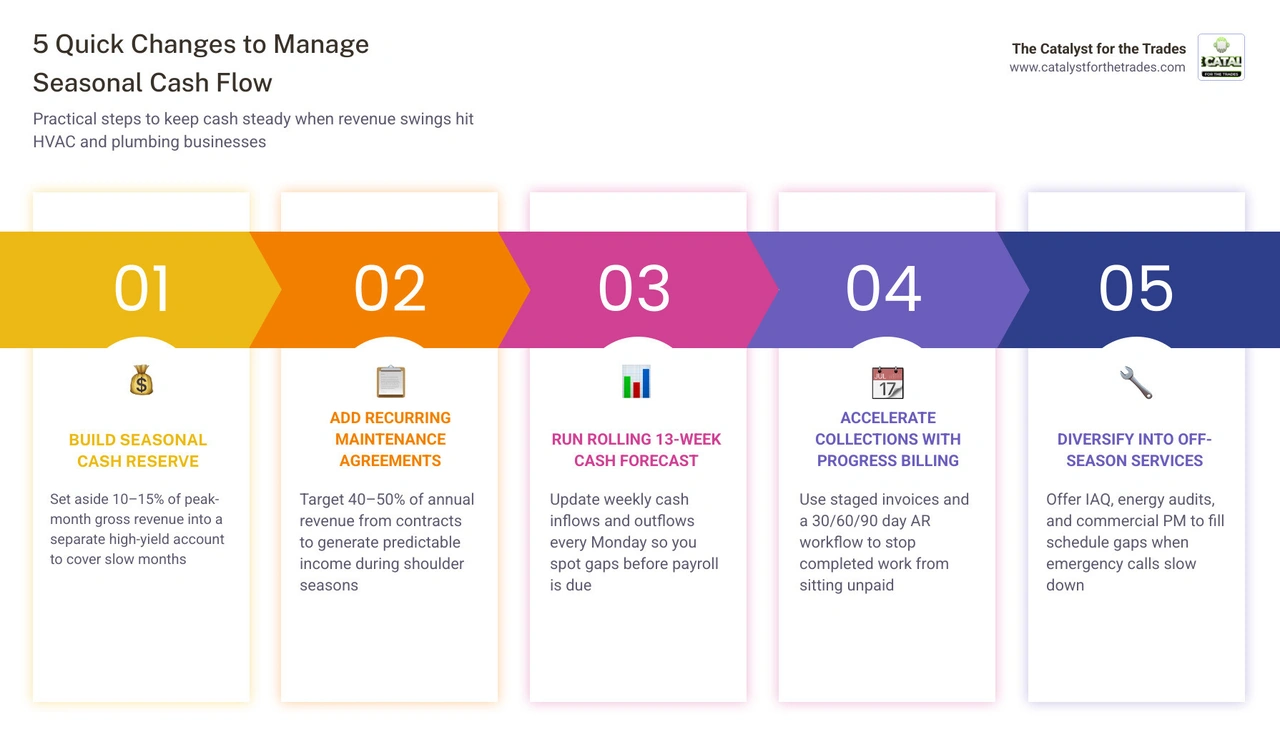
5 changes that move the needle most:
- Build a dedicated seasonal cash reserve — set aside 10–15% of peak-month gross revenue into a separate account
- Add recurring maintenance agreements — target 40–50% of annual revenue from contracts to smooth out slow months
- Run a rolling 13-week cash forecast — update it every Monday so you see cash gaps before they hit
- Use progress billing and AR follow-up workflows — stop letting completed work sit unpaid for 60+ days
- Diversify into off-season services — IAQ, energy audits, and commercial PM fill schedule gaps when emergency calls dry up
Most HVAC and plumbing owners know exactly when the phone goes quiet. What catches them off guard is that their fixed costs — payroll, fleet payments, insurance, rent — don’t go quiet with it.
A typical $2 million HVAC company can watch revenue fall from $250,000 in July down to $85,000 in October, while monthly overhead holds steady near $110,000. That gap doesn’t show up as a crisis on a profit-and-loss statement. It shows up as a Friday when payroll is due and the checking account isn’t cooperating.
This is what makes seasonal trades businesses fundamentally different from other small businesses. You’re not running a steady, predictable operation. You’re running two or three very different businesses inside one calendar year — and the financial systems you use have to reflect that reality. Businesses with sound financial practices are 30% more likely to outlast those without them, and in a trade business, those practices start with understanding your cash cycle, not just your revenue.
The five changes below won’t require a complete financial overhaul. They’re practical, sequenced, and built specifically for how HVAC and plumbing businesses actually operate.
How to Manage Cash Flow in a Seasonal Trades Business Like HVAC or Plumbing

To master your cash flow, you must first understand the fundamental difference between accrual accounting profit and cash in the bank. Your profit and loss (P&L) statement might show a highly profitable month because you completed several large installations. However, if those customers are billed on net-30 or net-60 terms, that revenue is “trapped” in accounts receivable. Meanwhile, your distributor expects payment for the equipment immediately, and your technicians must be paid every single Friday.
This disconnect creates the “profitable but broke” paradox. During peak summer and winter demand, the sheer volume of high-margin emergency service calls hides these systemic timing mismatches. But when the shoulder season dead zones hit in the spring and fall, the emergency calls dry up, and the lag in installation collections caught from previous months can cause a severe cash crunch. Proactive Financial Planning for Trade Businesses is the only way to align your cash inflows with your fixed outflows.
Change 1: Build a Dedicated Seasonal Cash Reserve
The Small Business Administration (SBA) recommends that small businesses maintain 3 to 6 months of operating expenses in cash reserves. For seasonal trade businesses, we highly recommend targeting the upper end of this range. If your fixed monthly overhead—including payroll, rent, and vehicle leases—is substantial, your cash reserve must be structured to sustain your business through the predictable shoulder-season lulls without relying on panic-induced borrowing.
To build this cushion without putting a strain on your daily operations, we recommend implementing the Peak-Season Skim Strategy:
- Identify your peak months: For HVAC, this is typically June through August and December through February. For plumbing, it often aligns with winter freeze events and early spring.
- Automate the skim: Set up your banking system to automatically transfer 10% to 15% of all gross incoming revenue during these peak months into a separate, dedicated high-yield business savings account.
- Treat savings as a fixed cost: Do not wait to see what is “left over” at the end of the month. Treat your savings transfer with the same urgency as your rent or payroll.
By keeping these funds in a high-yield savings account, your reserves will earn competitive interest while remaining fully liquid. Most importantly, separating these funds from your primary operating account prevents the common mistake of spending peak-season cash on non-essential equipment upgrades or premature hiring. Developing this discipline is a cornerstone of effective Financial Management for Contractors.
Change 2: Smooth Out Valleys with Recurring Maintenance Agreements
If cash reserves are your financial shield, maintenance agreements are your sword. Industry benchmarks suggest that maintenance contracts should generate 40% to 50% of annual revenue for the best cash flow stability. In well-run companies, these plans can account for up to 55% of total service revenue, and the segment is growing steadily year-over-year.
Maintenance agreements stabilize cash flow in three distinct ways:
- Predictable Recurring Revenue: Whether you bill monthly or annually, membership dues provide a baseline of predictable cash that lands in your account regardless of the weather.
- Strategic Scheduling Control: You can intentionally schedule your maintenance agreement tune-ups during your slowest shoulder months (such as March-April and September-October). This keeps your trucks rolling, keeps your technicians fully utilized, and prevents you from having to lay off your best people when the phones stop ringing.
- High Lifetime Value: It is five times more expensive to get a new customer than to keep an existing one. Furthermore, maintenance customers are 3 to 5 times more valuable over their lifetime than one-off repair customers because they trust your company and are highly likely to choose you when it comes time for a full system replacement.
When implementing these plans, prepaid annual maintenance agreements represent deferred revenue. The cash lands in your bank account today, but you still owe the customer the service in the future. To avoid a cash flow trap, track this deferred revenue properly on your books and recognize it only after the maintenance visit is completed. Training your team to present these options on every service call is a highly effective method of Upselling HVAC Services that directly feeds your off-season stability.
Advanced Forecasting and Cash Management Strategies
Static annual budgets often fail seasonal trade businesses because they rely on monthly averages. If your annual budget divides your projected expenses and revenues into twelve equal parts, it will not help you manage the reality of a massive revenue drop during the shoulder seasons. To stay ahead of cash flow problems, you need dynamic, rolling forecasting models that track real-time cash movement. To truly scale, you must Know Your Numbers, Grow Your Business: Financial Strategies for Trades.
Change 3: Implement a Rolling 13-Week Cash Flow Forecast
A 13-week rolling cash forecast is the ultimate short-term tool for managing seasonal cash swings. It looks exactly one quarter ahead, which is the perfect horizon for accuracy in the trades. By mapping out weekly cash inflows and outflows, you can spot exactly which week your bank account will dip and take corrective action weeks before it happens.
To build and maintain your rolling forecast:
- Start with actual cash: Begin every Monday morning by entering your current, cleared bank balance as your starting point.
- Project weekly inflows: Estimate your collections based on scheduled installations, active progress billings, and historical service call volume. Be realistic about payment timing rather than assuming every invoice will be paid instantly.
- Map weekly outflows: List all fixed expenses (payroll, truck payments, software subscriptions) and variable expenses (equipment orders, fuel, materials). Don’t forget irregular outflows like quarterly tax payments or annual insurance renewals.
- Roll it forward: Every week, replace your previous projections with actual numbers and add a new “Week 13” to the end of your spreadsheet.
This weekly rhythm gives you the visibility needed to make critical business decisions, such as delaying a non-essential tool purchase or shifting marketing spend, long before a cash crunch occurs. This systematic approach is highlighted in our discussion on Smart Accounting Moves: Devin Nordgran’s Financial Strategies for Contractors.
How to Manage Cash Flow in a Seasonal Trades Business Like HVAC or Plumbing with Proactive Forecasting
While the 13-week forecast manages your immediate cash runway, a broader 12-to-18-month forecast is essential for long-term strategic growth. To build an accurate long-term forecast, analyze your profit and loss statements from the past three years to identify your unique seasonal revenue patterns.
For example, you might discover that your business consistently generates 15% of its annual revenue in July but only 4% in October. Applying these historical percentages to your projected annual revenue allows you to build a highly accurate, month-by-month cash flow model.
This long-term view is particularly critical for quarterly tax planning. Quarterly estimated taxes are due in April, June, September, and January. If you do not plan for these dates, a large tax bill in September—right at the start of the fall shoulder season—can completely deplete your operating cash. Working with a specialized accountant to align your tax strategies with your seasonal cash flow ensures you keep more of your hard-earned money. For more details on navigating these seasonal tax pressures, check out How to Keep More of What You Earn: Year-End Tax Tips That Actually Work.
Strategic Funding: Cash Reserves vs. Lines of Credit
Every seasonal trade business should have access to both a robust cash reserve and a business line of credit. However, understanding when to use each is vital for maintaining long-term financial health. Drawing down a line of credit to cover predictable, recurring seasonal lulls is a sign of poor planning; it turns a temporary timing gap into expensive, interest-bearing debt.
| Feature / Scenario | Cash Reserves (Savings) | Business Line of Credit (LOC) |
|---|---|---|
| Primary Source | Your own accumulated profits | Bank-approved debt facility |
| Cost to Use | Free (forgoes minor interest) | Interest rate + potential draw fees |
| Best Used For | Predictable, seasonal revenue dips | Unexpected emergencies or rapid scaling |
| Examples | Covering shoulder-season payroll | Replacing a stolen piece of machinery |
| Financial Impact | Preserves equity, zero debt | Creates a liability, impacts cash flow |
By reserving your line of credit strictly for genuine emergencies or short-term working capital needs (such as purchasing materials upfront for a massive commercial project), you protect your business from the debt spiral. For more insights on balancing these tools, read through our Cash Flow Management Tips for Contractors.
Optimizing Inflows and Diversifying Revenue
To keep cash flowing smoothly, you must optimize the timing of your cash inflows while actively working to diversify your revenue streams. In residential service work, cash collection is usually immediate. However, large installation projects and commercial contracts operate on a completely different “cash clock” that can drag down your liquidity if not managed aggressively. Keeping your team aligned on these financial goals is essential, and tracking your Financial Management and Profitability Keywords will help you monitor these changes.
Change 4: Accelerate Collections with Progress Billing and AR Workflows
On large residential replacements or commercial projects, waiting until 100% completion to send an invoice is a recipe for cash flow disaster. Instead, implement a strict progress billing structure in your contracts:
- Deposit: Require a substantial deposit (e.g., 30% to 50%) upon contract signing to cover the cost of equipment and initial materials.
- Milestones: Bill incremental percentages at clearly defined project milestones (such as rough-in completion).
- Final Payment: Collect the remaining balance immediately upon final inspection and job sign-off.
For commercial work where general contractors often hold back a percentage of your payment (retainage), make sure to track retainage as a separate accounts receivable line on your books. Negotiate terms that allow for the partial release of retainage as milestones are completed, rather than waiting for the entire building to be finished.
Additionally, establish a disciplined, automated 30/60/90 day accounts receivable workflow:
- Day 30: Send an automated, friendly email reminder with a copy of the invoice and a direct payment link.
- Day 45: Have your office manager place a polite phone call to confirm receipt of the invoice and check the payment status.
- Day 60: Send a formal demand letter. At this stage, we recommend implementing a strict policy to stop all warranty or non-emergency work for customers with balances past 60 days.
- Day 90: Initiate the formal collections process or file a mechanic’s lien to protect your claim.
Reducing your Days Sales Outstanding (DSO) by even a few days can instantly inject thousands of dollars of working capital back into your bank account.
Change 5: Diversify Services to Fill Off-Season Schedule Gaps
To completely eliminate the shoulder-season blues, look for high-margin, seasonal-resistant services that you can offer when standard repair and replacement calls drop. Diversifying your offerings allows you to keep your technicians productive and your revenue stable year-round. Excellent options include:
- Indoor Air Quality (IAQ): Selling air purifiers, humidifiers, and UV lights is an excellent way to boost average ticket sizes. IAQ installations carry strong margins and are highly relevant to customers year-round.
- Energy Audits & Weatherization: Offering home energy audits during the mild spring and fall months helps homeowners identify efficiency leaks and naturally leads to system upgrade opportunities.
- Commercial Preventive Maintenance: Commercial facilities often have fixed annual maintenance budgets. Securing quarterly commercial PM contracts provides highly predictable off-season work.
- Plumbing-Adjacent Services: If you are primarily an HVAC shop, adding water heater replacements, water filtration systems, or drain cleaning services can keep your crews busy during mild weather.
To learn more about maximizing the profitability of these add-on services, explore our guide on Increasing Service Margins.
How to Manage Cash Flow in a Seasonal Trades Business Like HVAC or Plumbing Through Service Expansion
Expanding your service lines should always be done strategically to avoid overextending your team. The most successful expansions leverage your existing customer database through targeted cross-marketing. Since it is far cheaper to sell a new service to an existing customer than to acquire a new one, use your slow seasons to reach out to your maintenance members with exclusive offers on IAQ upgrades or water heater flushes.
This approach maximizes your technician labor utilization rate (the percentage of paid hours that are actually billed to a customer) and ensures that your new service lines are highly profitable from day one. To ensure your new services are priced correctly to support your overall cash flow, review our breakdown of Pricing Strategies for HVAC Companies.
Frequently Asked Questions about Managing Trade Cash Flow
How much cash reserve should an HVAC or plumbing business maintain?
As a general rule, we recommend maintaining a cash reserve equal to 3 to 6 months of your peak-season operating expenses. For a seasonal business, using your peak-season overhead as the benchmark—rather than your slow-season overhead—ensures you have a sufficient cushion to cover higher busy-period costs and safely weather any unexpected market downturns or unseasonably mild weather.
When should a business use a line of credit versus cash reserves?
You should use your cash reserves to manage predictable, anticipated seasonal lulls that you have mapped out in your 13-week forecast. A business line of credit should be reserved strictly as a backstop for unexpected emergencies (such as a major fleet vehicle breakdown) or as short-term working capital to fund major commercial projects where you must purchase materials upfront before progress payments begin.
How do maintenance agreements stabilize cash flow during shoulder seasons?
Maintenance agreements provide a baseline of recurring monthly or annual membership revenue that flows into your business regardless of the weather. Additionally, they give you the operational flexibility to schedule non-emergency tune-ups during your slowest spring and fall months, keeping your technicians fully utilized, reducing employee turnover, and generating consistent opportunities for system upgrades.
Conclusion
Managing cash flow in a seasonal trade business isn’t about hoping for extreme weather; it is about building robust financial systems that turn seasonal fluctuations into a distinct competitive advantage. By implementing a dedicated cash reserve, building a strong maintenance agreement program, tracking your cash weekly with a 13-week rolling forecast, accelerating your collections, and strategically diversifying your services, you can establish year-round financial stability.
At The Catalyst for the Trades, we are dedicated to helping home service business owners transition from hands-on operators to strategic leaders. Through actionable insights and real-world industry expertise, we help you build systems that scale.
Ready to master your numbers and build a highly profitable, sustainable trade business? Explore our comprehensive guide on Know Your Numbers, Grow Your Business: Financial Strategies for Trades to take your operations to the next level.


