Learn · July 16, 2026
How to Build a Home Service Website That Converts Visitors Into Booked Jobs in 2026
Learn how to build a home service website that converts visitors into booked jobs with proven strategies that boost leads and reduce bounce rates.
By The Catalyst Editorial Team Operator education · 10 min read · Updated July 24, 2026

Why Your Home Service Website Needs to Book Jobs, Not Just Look Good
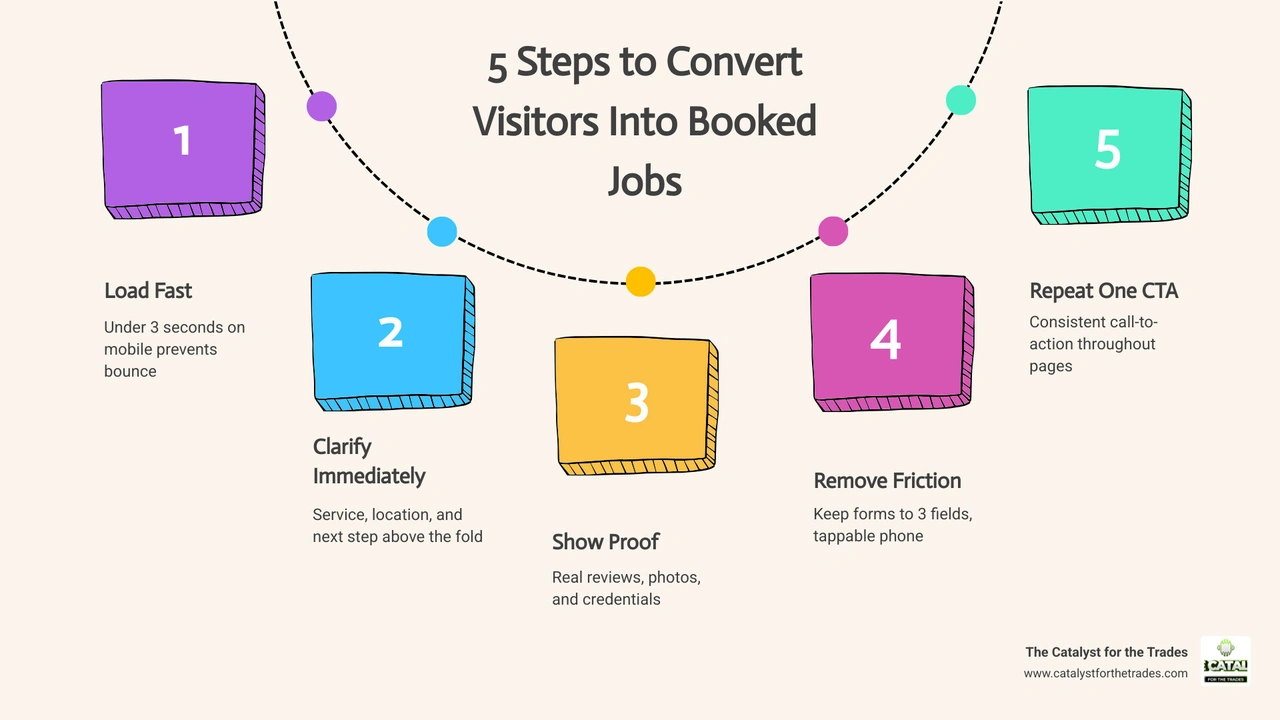
If you’re trying to figure out how to build a home service website that converts visitors into booked jobs, here’s the short answer:
- Load fast – under 3 seconds on mobile
- Clarify immediately – service, location, and next step above the fold
- Show proof – real reviews, photos, and credentials where doubt lives
- Remove friction – keep forms to 3 fields, make your phone number tappable
- Repeat one clear CTA – throughout every page, not competing calls to action
Most contractor websites look fine. Some look great. But looking good and booking jobs are two very different things.
Here’s a number that puts it in perspective: the average home service website converts around 2% of visitors. Elite sites hit 10% or more. If you’re getting 1,000 visitors a month at 2%, that’s 980 potential customers leaving without ever picking up the phone.
That gap isn’t about design. It’s about what happens in the first few seconds after someone lands on your page. In 2026, homeowners decide fast — often in under a minute — and 75% of them are already forming a judgment about your professionalism the moment your site loads.
Your website isn’t just a digital business card. For a home service business, it’s either your best salesperson or your biggest leak.
Why Most Contractor Websites Fail to Generate Leads
Most contractor websites don’t fail because they are ugly. They fail because they are built for the business owner’s ego rather than the customer’s problem.
When we look at website heatmaps, we see a recurring pattern of user friction. Homeowners land on a site, scroll past a massive, slow-loading video of a contractor’s office, get confused by generic marketing jargon, and leave. In fact, research shows that 63% of contractors operate websites that actively repel customers due to poor user experience.
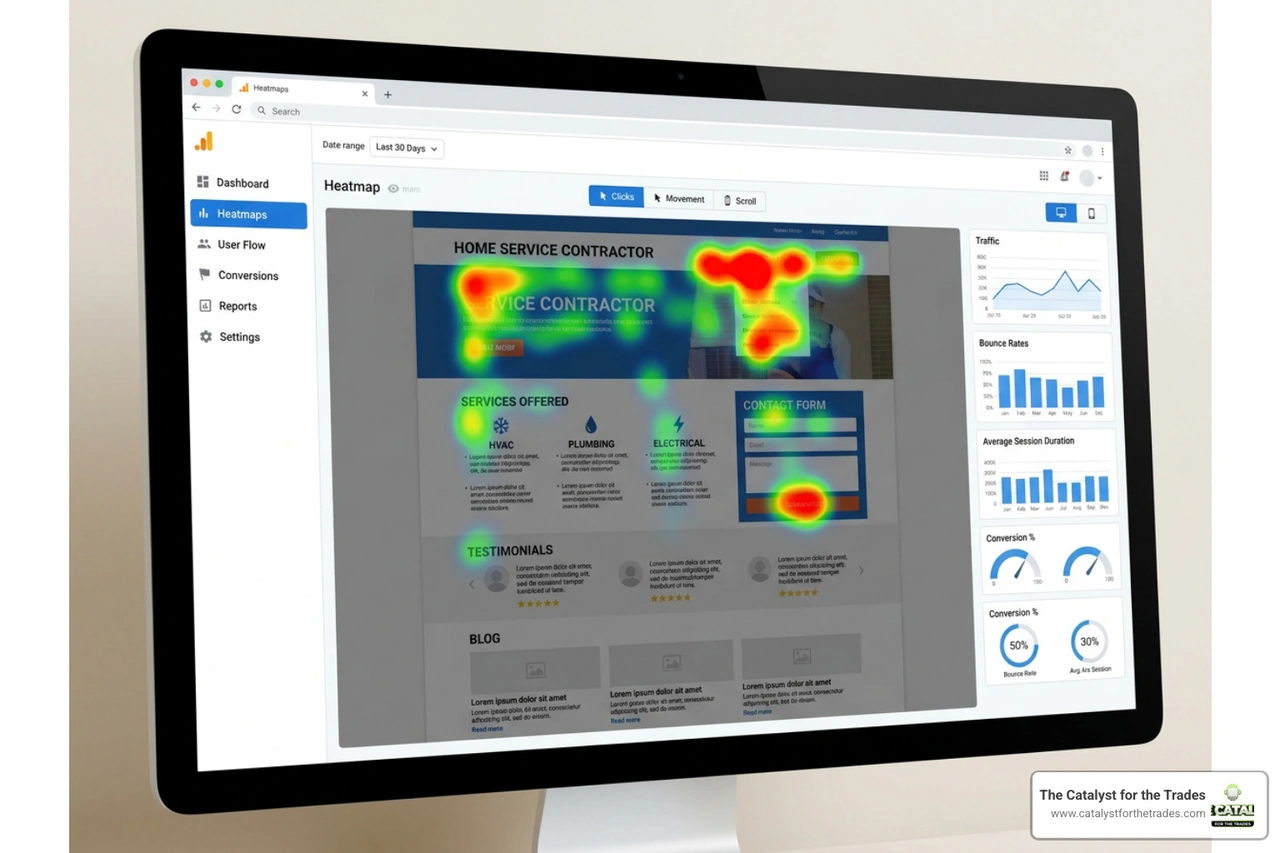
High bounce rates are often caused by “code bloat” — heavy, unoptimized templates packed with unnecessary scripts that drag down page speed. If your page takes longer than three seconds to load, 53% of mobile users will abandon it entirely.
Another silent killer is the over-reliance on stock photography. Homeowners can spot a fake smile from a mile away. When you display stock images of pristine, model-like technicians holding pristine, unused wrenches, you send a subconscious signal that you might not be a real, local business.
To turn things around, you must stop treating your website as a static brochure. It needs to be a transactional system designed to capture high-intent searchers. For a deeper look at how your online presence fits into your overall growth, check out our guide on Contractor Marketing Strategy Best 2026 and discover how to calculate your true Digital Marketing ROI.
The Psychology Behind How to Build a Home Service Website That Converts Visitors Into Booked Jobs
To build a website that converts, you must first understand the homeowner’s state of mind. Generally, they land on your site in one of two distinct modes:
- Emergency Mode: Their basement is flooding, their AC just quit on a humid July afternoon, or their lights are flickering. They are stressed, impatient, and making decisions with one hand on their phone. They do not want to read your company history. They want to know: Do you service my area? Can you fix this today? How do I call you?
- Planned Mode: They are researching a water heater upgrade, a roof replacement, or a new electrical panel. They are still driven by a degree of worry — specifically, the fear of making a bad hire or being overcharged. They are looking for deep trust signals, clear process explanations, and reassurance.
In both scenarios, decision fatigue is your enemy. If you force a stressed homeowner to choose between five different call-to-action (CTA) buttons, navigate a cluttered menu, or fill out a massive 12-field form, they will click the back button and call the next listing on Google.
Your job is to remove every ounce of friction. You can learn more about crafting an exceptional online journey in our Customer Experience Best Practices Guide.
How to Build a Home Service Website That Converts Visitors Into Booked Jobs
When planning your web presence, one of the first decisions you will face is whether to use a standard website template or invest in a fully custom build. Both have their place, depending on your current business stage and long-term goals.
| Feature | Standard Template Build | Custom Website Build |
|---|---|---|
| Speed to Launch | Very Fast (1–3 weeks) | Moderate to Slow (6–12 weeks) |
| Initial Investment | Lower | Higher |
| Page Speed & Code Cleanliness | Often bloated with unnecessary plugins | Highly optimized, clean code |
| SEO Scalability | Limited by template structure | Unlimited custom silos and location pages |
| Conversion Focus | Requires manual optimization | Engineered from day one for user flow |
Regardless of the path you choose, the cornerstone of your homepage must be a clear, benefit-focused value proposition placed directly above the fold (the area visible before scrolling).
Instead of a vague headline like “Comfort Starts Here,” use direct, literal language that matches exactly what the user is searching for: “Emergency AC Repair in [City Name] — Fixed Today or You Don’t Pay.”
This immediate clarity answers their core questions in under three seconds. Directly beneath this headline, place your primary CTA. Make it stand out with a contrasting color, and keep the language action-oriented, such as “Schedule Your Repair” or “Call Now.” To dive deeper into refining your site’s performance, explore our insights on Lead Conversion Optimization.
Technical Steps on How to Build a Home Service Website That Converts Visitors Into Booked Jobs
Once your visual layout is set, you must address the technical foundation. In 2026, technical performance is not just an IT concern; it is a direct driver of your bottom line.
- Optimize Page Speed: Every second of delay costs you roughly 4.4% in conversions. If a page takes five seconds to load instead of two, your conversion rate can drop by over 30%. To fight this, compress all images to under 200KB, limit your custom font files to two, utilize a reliable Content Delivery Network (CDN), and leverage browser caching.
- Design Mobile-First: Nearly 64% of global web traffic comes from mobile devices, and for emergency home services, that number often climbs past 80%. Your mobile layout should not be a squished desktop version. It must feature a sticky header with a large, tappable phone number.
- Minimize Form Fields: Long forms kill conversions. Dropping your form fields from 11 down to 4 can result in a 120% conversion lift. For home services, we recommend a maximum of three fields: Name, Phone Number, and How Can We Help?
- Implement Click-to-Call: Make sure every phone number on your site is wrapped in a proper
tel:link. A mobile user should be able to touch the number and initiate a call instantly without copying and pasting.
For a comprehensive breakdown of technical search engine requirements, read our guide on SEO for Contractors.
Structuring Service Pages and Contact Forms to Remove Hesitation
To maximize your organic search visibility and keep users engaged, structure your website using dedicated “service silos.” Rather than listing all your offerings on a single, messy page, build individual landing pages for each core service (e.g., Water Heater Repair, Drain Cleaning, Emergency Plumbing).
Each service page should be structured as a reassuring, logical progression:
- The Problem: Acknowledge the homeowner’s pain point immediately.
- The Solution: Explain how your service resolves it, using plain, non-technical language.
- The Process: Detail exactly what happens when they book (e.g., “Step 1: Book online. Step 2: Receive a text with your technician’s photo. Step 3: Job completed.”).
- FAQ Schema: Include a structured Frequently Asked Questions section. Using FAQ schema helps search engines understand your content and can display your answers directly in search results.
Additionally, if you serve multiple geographic areas, build dedicated location pages. These should not be generic copies of each other; customize them with local reviews, local team photos, and mentions of nearby landmarks to prove your local relevance.
Integrating self-service booking widgets can also capture the 67% of modern customers who prefer booking non-emergency appointments online. For more tactical advice on handling inbound requests, check out our Service Call Conversion Tips.
Essential Trust Signals and Mobile-First Architecture
Because home service professionals enter a customer’s private residence, trust is the ultimate conversion metric. You can have the fastest, most beautiful website in the world, but if the visitor doesn’t feel safe, they will not book.
To build instant credibility, place your primary trust signals close to your call-to-action buttons.
- Online Reviews: Don’t just display a static badge that says “5 Stars.” Embed a live widget that pulls real Google reviews. Highlight reviews that mention specific details, like a technician’s name, speed of service, or cleanliness.
- Real Team Photos: Replace stock images with high-quality photos of your actual team, your branded trucks, and your office. Seeing real faces humanizes your brand and immediately lowers a homeowner’s guard.
- Licenses, Badges, and Guarantees: Display your state license numbers, worker’s compensation insurance badges, and any industry certifications (like NATE or BBB accreditation) clearly in your header or footer.
- Video Testimonials: A short video of a local homeowner explaining how your team solved their problem can do more heavy lifting than pages of text.
To manage and grow your online reputation effectively, review our guide on Online Reputation Management.
Aligning Local SEO and Conversion Rate Optimization
SEO and conversion rate optimization (CRO) should never compete; they are two sides of the same coin. SEO gets the user to your site, and CRO ensures they book.
To align these two disciplines:
- Target Intent-Driven Keywords: Optimize your pages for transactional search terms (e.g., “plumber near me” or “furnace installation in [City]”) rather than purely informational queries.
- Utilize LocalBusiness Schema: Implement clean structured data markup on your homepage and contact page. This helps search engine crawlers verify your Name, Address, and Phone number (NAP) consistency, boosting your Google Maps visibility.
- Build a Logical Internal Linking Structure: Link your service pages to your location pages naturally. This tells search engines exactly where you perform specific services, strengthening your authority for local queries.
For a complete blueprint on dominating your local market, read our Home Service Marketing Complete Guide.
Frequently Asked Questions About Home Service Website Conversions
How fast should a home service website load to prevent losing jobs?
Your website should load in under three seconds on mobile devices. Because a significant portion of home service searches are performed on mobile, speed is a critical trust signal. Every single second of delay beyond two seconds can cut your conversion rate by roughly 32%. You can achieve faster load times by using aggressive image compression, minimizing code bloat, and selecting a high-performance hosting provider.
How many fields should a contractor booking form have?
To maximize lead capture and reduce friction, we recommend keeping your booking forms to a maximum of three fields: name, phone number, and a brief description of the service needed. If you require more information to qualify the lead, you can gather those details during the follow-up phone call or through an automated text sequence once the initial contact is made.
Should a home service website use templates or a custom build?
The choice depends on your business goals and budget. If you are a growing home service business looking to launch quickly, a performance-focused template can work exceptionally well, provided it is optimized for mobile speed and conversion. If you are an established business looking to dominate a highly competitive multi-location market, a custom build offers the clean code, advanced SEO architecture, and unique brand storytelling needed to maximize your market share.
Turn Your Website Into a Lead-Generating Machine
Building a high-converting website is one of the most impactful steps you can take to secure the long-term value of your company. Whether your goal is to scale your current operations or prepare your business for an eventual transition, a structured, high-performing digital asset is essential. For deeper insights on building a highly valuable trade business, read about How to Build a Sellable Trades Business Insights from a 3.7 Billion Advisor and explore our guide on how to Build a Sellable Home Service Business What Actually Works.
Your website should work as hard as your best crew in the field. It shouldn’t just sit online looking pretty — it should actively dispatch jobs to your calendar day and night.
Ready to stop losing high-ticket service calls to your local competitors? Transform your website into a lead-generating machine today with Catalyst for the Trades and start turning casual website visitors into loyal, booked clients.


