Learn · February 26, 2026
Market Positioning: 5 Ultimate Steps
Master market positioning: Boost your brand's competitive edge with STP strategies, perceptual maps, and proven steps for trades success.
By The Catalyst Editorial Team Operator education · 8 min read · Updated July 24, 2026

Why Market Positioning Matters for Home Services Companies

If you run an HVAC, plumbing, or electrical business, your success often comes down to one thing: market positioning. This is the strategic process of shaping how customers perceive your brand—and it’s essential for establishing a clear identity in the trades market.
What is Market Positioning?
Market positioning defines the mental space your business occupies in your customers’ minds. It answers:
- Who you serve – Your ideal customer segment
- What problem you solve – The specific need you address with excellence
- Why you’re unique – Your unique value and specialized focus
- How you prove it – Credible reasons customers should trust your expertise
Without clear positioning, your business becomes just another name in a list of search results. Customers default to choosing based on vague criteria, which makes sustainable growth more difficult.
The research shows that 86% of consumers prefer brands that feel relaxed and approachable. For home services businesses, this means authenticity and clarity beat fancy marketing jargon every time.
Effective positioning isn’t about inventing something new—it’s about influencing existing perceptions. As marketing experts Ries and Trout famously put it, positioning is “what you do to the mind of the prospect, not to the product.” For trades businesses focusing on reputation, response time, and reliability, getting this right can mean the difference between steady growth and stagnation.
To build a positioning strategy that actually works, you need to understand the proven STP framework—Segmentation, Targeting, and Positioning—which we’ll break down in practical terms for home services owners. Learn more about developing a comprehensive business strategy, and discover how Catalyst for the Trades helps you scale profitably.
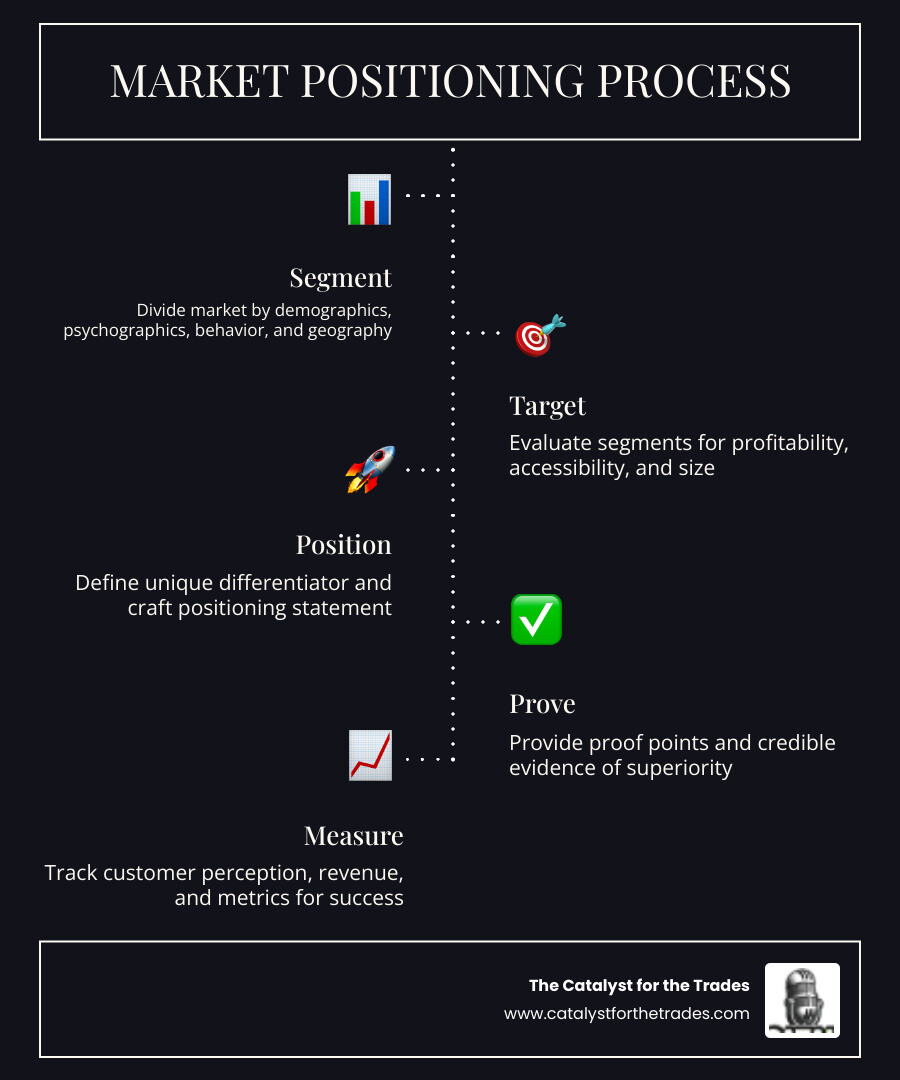
Market positioning terms simplified:
The STP Model: Foundation of Market Positioning
In professional marketing, market positioning is the final step of a three-part journey known as the STP model: Segmentation, Targeting, and Positioning. Think of it as a funnel that helps you move from “everyone with a house” to “the specific customers who value your specialized expertise.”
- Segmentation: This is where we break down the market into smaller groups of people who share similar characteristics.
- Targeting: Here, we look at those groups and decide which ones align best with your business goals and service capabilities.
- Positioning: Finally, we tailor our message so that the chosen “target” sees your brand as the ideal choice for their specific problem.
Using this model ensures that your marketing isn’t just “noise.” Instead, it becomes a laser-focused tool for business strategy development. When you know exactly who you are talking to, your market positioning becomes much more persuasive.
Evaluating Segments for Effective Targeting
To choose the right target, we evaluate segments based on key criteria:
- Size: Is the segment large enough to sustain your business?
- Difference: Are the people in this segment actually different enough from others to justify a unique marketing message?
- Accessibility: Can you actually reach them through digital ads, local mailers, or community events?
- Specific Benefits: Do they need something specific (like 24/7 emergency service) that aligns with your strengths?
By focusing on the most attractive segments, you can build a contractor business strategy ultimate guide that prioritizes high-value leads.
Types of Market Segmentation
To get your market positioning right, you need to decide how you’re going to slice the pie. In the home services industry, we typically use four main types of segmentation:
- Demographics: The basics like age, income level, and home ownership status. For example, targeting homeowners aged 45-65 for full system replacements.
- Psychographics: This dives into beliefs and values. Some customers value “eco-friendly” solutions, while others prioritize high-tech backup systems.
- Behavioral: Based on how people use a service. Is this a one-time emergency repair, or a customer looking for a long-term maintenance contract?
- Geographic: Crucial for trades. You likely only serve specific zip codes or a set radius around your shop.
Understanding these nuances is a key part of how to build a sellable trades business, as it allows you to dominate specific niches.
Key Steps to Develop a Positioning Strategy
Developing a market positioning strategy involves understanding your own brand’s strengths and the specific needs of your audience.
First, we start with internal research. Define your core values and the high-standard services you provide. Are you focusing on “white-glove service” or “unmatched technical expertise”? Establishing this identity is the first step toward clarity.
Second, we identify audience needs. What keeps your customers up at night? Is it the fear of a flooded basement or the frustration of an AC that dies in July? Your positioning should speak directly to that pain point.
By combining these insights, you can craft a competitive strategy that makes your brand the obvious choice for your target audience.
Crafting a Winning Market Positioning Statement
Once you’ve done the legwork, it’s time to put it on paper. A positioning statement is an internal document—it’s not a slogan or a catchy jingle. It’s a guide that keeps your whole team aligned.
A classic template for a positioning statement looks like this:“For [Target Audience] who [Specific Need], [Your Brand] is the [Category] that [Unique Benefit]. We [Proof Point/Differentiation].”
For an HVAC company, it might look like:“For busy suburban families who value health and comfort, Catalyst Air is the indoor air quality specialist that guarantees allergen-free homes. We use hospital-grade filtration technology backed by a 100% comfort guarantee.”
Writing this down helps you avoid the contractor trap of being a “jack of all trades, master of none.”
Differentiating Through Value Propositions
To make your market positioning stick, you need to offer value in three ways:
- Functional Benefits: Does the furnace work? Does the toilet stop leaking? This is the foundation of your service.
- Symbolic Value: How does the customer feel about themselves for hiring you? Do they feel like a “smart homeowner” who invests in quality?
- Experiential Positioning: What is it like to work with you? Is the technician friendly? Is the booking process easy?
When you lead with purpose and focus on these three layers, you build a legacy that goes beyond just turning a wrench.
Visualizing Your Place with a Perceptual Map
A perceptual map (or positioning map) is a visual tool that helps you see where your brand stands. Usually, this is a simple graph with two axes representing “determinant attributes”—the factors that actually drive a customer’s decision.
For a plumber, the axes might be “Technical Complexity” and “Speed of Response.” By positioning your brand as the “High-Complexity / Immediate Response” specialist, you define a clear and focused identity.
| Feature | Market Positioning | Branding |
|---|---|---|
| Focus | Identity in the mind | Overall identity and “vibe” |
| Goal | Occupy a specific niche or “spot” | Build emotional connection and trust |
| Tools | STP Model, Perceptual Maps | Logos, slogans, color palettes |
| Audience | Specific target segments | The market at large |
Using these tools is essential if you want to build a sellable home service business. Buyers want to see a company that has a clear, defensible focus in the market.
Identifying Gaps in Market Positioning
The goal of a perceptual map is to see where your brand can best serve the community. These opportunities are your biggest strengths. For example, if there is a need for a “High-Tech/Smart Home Plumber,” that’s a niche you can own.
Understanding your position relative to the landscape also helps with business valuation for contractors. A business with a unique, focused position is always highly valued.
Measuring Success and Repositioning Strategies
How do you know if your market positioning is working? You need to track specific metrics:
- Win Rates: Are you winning more jobs when you lean into your specific differentiator?
- Search Visibility: Are you showing up for terms related to your focus (e.g., “emergency 24/7 plumber”)?
- Social Sentiment: Are customers mentioning your key differentiator in their 5-star reviews?
- Revenue and Pipeline: Good positioning should lead to a steadier stream of leads.
As you grow, you’ll also need to ensure the future of your leadership is aligned with this position, so every employee delivers on the brand promise.
When to Pivot Your Brand Position
Sometimes, the market changes. Customer needs might shift (like the rise in demand for indoor air quality). This is when you consider repositioning.
Repositioning involves changing the variables of your marketing mix—service offerings, promotion, or location—to shift how customers see you. In the trades, this might mean moving from “General Electrician” to “EV Charging Station Specialist.” For more on how to navigate these shifts, listen to Crystal Williams discuss contractor growth strategy.
Frequently Asked Questions about Market Positioning
How does positioning differ from a value proposition?
Positioning is about your place in the market (the “where”). A value proposition is the specific promise of value you deliver to the customer (the “what”). Positioning sets the stage, while the value proposition fulfills the promise.
What are the most common pitfalls in positioning?
The biggest mistake is trying to be everything to everyone. If you try to position yourself as the provider for every possible need without a clear focus, the message becomes diluted. Another pitfall is “under-positioning,” where customers have only a vague idea of what makes your brand unique.
How has digital marketing changed STP?
Digital marketing has made “S” (Segmentation) and “T” (Targeting) incredibly precise. We can now reach customers based on their exact search intent or their specific interests. Martech tools allow us to deliver personalized messages to different segments simultaneously, making market positioning more dynamic than ever.
Conclusion
At the end of the day, market positioning is about taking control of your reputation. If you don’t define your spot in the market, the market will define it for you. By using the STP model, crafting a clear positioning statement, and visualizing your place with perceptual maps, you can focus on delivering true value and excellence.
At The Catalyst for the Trades, we are dedicated to helping home service leaders find their unique focus and scale with purpose. Whether you are looking for operational scaling or cutting-edge marketing insights, we provide the tools to help you lead your local market.
Ready to claim your spot? Visit Catalyst for the Trades and let’s start building your unstoppable brand today.


