Learn · May 27, 2026
Top Field Service Management Software Comparison
Compare top field service management software options now. Explore features, reviews, and best picks for your team to boost efficiency and ROI.
By The Catalyst Editorial Team Operator education · 9 min read · Updated July 24, 2026

Why a Field Service Management Software Comparison Can Make or Break Your Business
A solid field service management software comparison starts with knowing what you’re actually evaluating — so here’s a quick breakdown of the top platforms to help you decide fast:
| Platform | Best For | Gartner Rating | Standout Feature |
|---|---|---|---|
| IFS Cloud | Enterprise / asset-heavy | 4.7/5 | Highest-rated overall; Customers’ Choice 2024-2025 |
| Praxedo | Mid-market | 4.6/5 | Highest willingness to recommend |
| Salesforce Field Service | Enterprise / manufacturers | 4.4/5 | AI scheduling + CRM integration |
| Microsoft Dynamics 365 | Enterprise | 4.3/5 | ERP-native field ops |
| Jobber | Small-to-mid home services | 4.5/5 | Fastest onboarding; 200,000+ users |
| Housecall Pro | HVAC / plumbing / electrical | 4.5/5 | Built-in consumer financing |
| Connecteam | Small teams | 4.4/5 | #1 easiest to use (G2 2025) |
| Wello | Growing SMB teams | 4.8/5 | 1-2 week implementation |
| ServiceTitan | High-volume home services | N/A | End-to-end business management |
Running a field service business without the right software is a bit like dispatching trucks without knowing where they are — you’re burning time, money, and goodwill all at once.
The stakes are real. Every unresolved service call means sending another truck, and each one of those truck rolls costs somewhere between $200 and $300. The industry average first-time fix rate sits around 75%, which means roughly one in four jobs requires a return visit. That’s not just a cost problem — it’s a customer satisfaction problem.
For home services business owners trying to scale, the question isn’t really whether to use field service management software. It’s which one fits where your business is right now and where you want it to go. The market has exploded with options — from lightweight tools built for solo operators to enterprise platforms that manage thousands of assets across multiple regions. Choosing the wrong one can be just as costly as choosing none at all.
That’s exactly what this comparison is built to help you navigate.
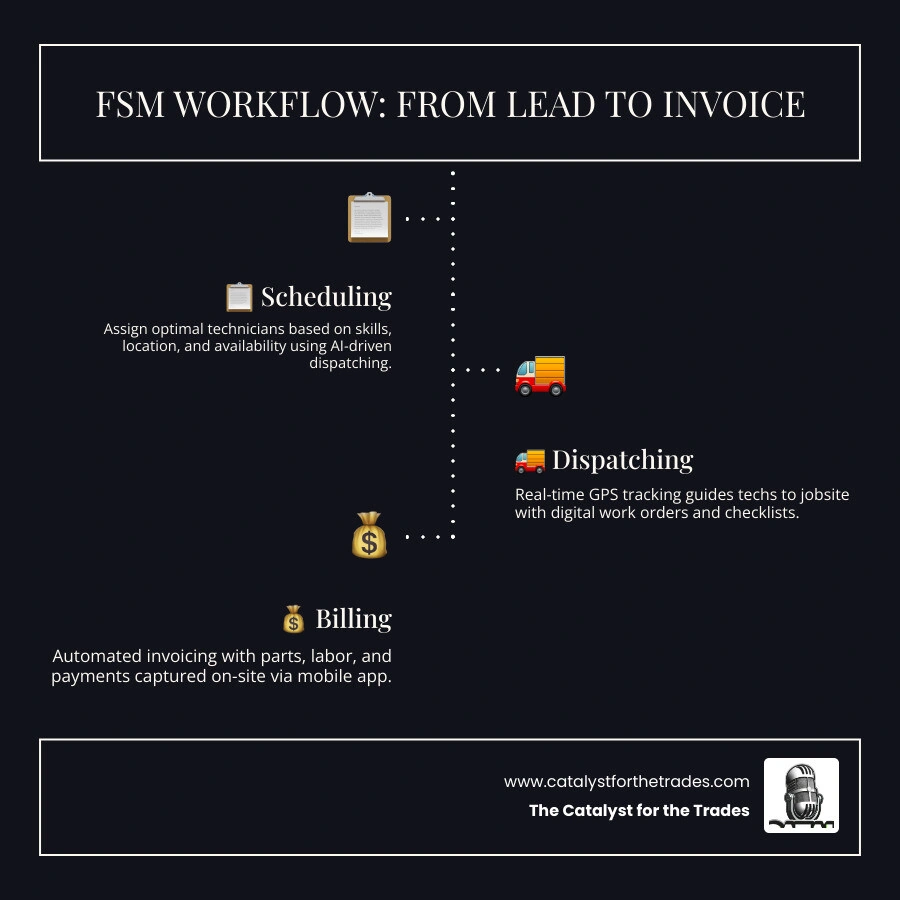
Field service management software comparison terms you need:
- Best CRM for HVAC Companies
- Service Scheduling Software Reviews
- Tech Stack for Home Service Businesses
Defining Modern Field Service Management (FSM)

At its heart, field service management software is the “central nervous system” of your business. It is a modular digital toolset designed to coordinate work and commercial interactions for teams that travel to remote locations to install, inspect, maintain, or repair equipment and assets.
In the past, many of us relied on whiteboards, spreadsheets, or even carbon-copy paper forms. But as we move through 2026, those manual systems are becoming a liability. Modern FSM platforms move everything to the cloud, allowing for real-time tracking of technicians and equipment. Whether you are managing a single residential HVAC repair or a massive utility maintenance contract, these tools ensure that the right technician arrives at the right place with the right parts.
Key pillars of FSM include:
- Work Order Management: Centralizing every detail of a job from the initial request to the final sign-off.
- Demand Management: Collecting work requests from customers, IoT sensors, or asset management systems.
- Asset Maintenance: Tracking the lifecycle of equipment to predict when it might fail before it actually does.
- Mobile Enablement: Giving your techs a tool that works in their pocket, even when they are offline in a basement or a rural area.
Essential Features for a Field Service Management Software Comparison
When we sit down to conduct a field service management software comparison, it is easy to get distracted by flashy interfaces. However, the real ROI comes from core functionality that solves daily operational headaches.
| Feature | Why It Matters |
|---|---|
| AI Scheduling | Automatically matches technicians based on skill, location, and tools to reduce travel time. |
| Offline Mobile Access | Ensures techs can log data and capture signatures even without a cellular signal. |
| Inventory Tracking | Real-time visibility into what parts are on which truck to prevent “missing part” return visits. |
| Automated Reminders | Reduces no-shows by texting or emailing customers as the tech approaches. |
One of the most critical metrics we look at is the first-time fix rate. Research shows that when a job isn’t resolved on the first visit, the cost of the “truck roll” eats your profit margins alive. Tools that offer digital guidance and skills-based routing ensure your senior techs are assigned to complex jobs, while apprentices handle routine maintenance, optimizing your workforce’s efficiency.
To dive deeper into how different tools handle these logistics, check out our service scheduling software reviews.
Mobile Enablement in Your Field Service Management Software Comparison
If your technicians don’t use the software, the investment is essentially a bust. This is why mobile app quality is the make-or-break factor for many trade businesses. A top-tier mobile experience includes two-way communication between the field and the office, digital checklists to ensure compliance, and the ability to upload photos of completed work.
Technicians often work in “dead zones.” Therefore, low-bandwidth performance and offline support are non-negotiable. The app should allow for signature capture and instant work order debriefs so that as soon as the tech hits a Wi-Fi signal, the office can send the invoice immediately.
Integration Capabilities for a Field Service Management Software Comparison
Your FSM shouldn’t be an island. It needs to talk to your other tools to prevent double data entry and administrative errors. This is where customer-relationship management (CRM) and ERP connectivity come into play.
Essential integrations include:
- Accounting Synchronization: Bidirectional sync with tools like QuickBooks ensures that when a job is marked “complete” in the field, the invoice is ready in your books.
- CRM Centralization: Understanding how to get your crm right and why it matters more than you think is key to long-term growth. Your FSM should feed customer history back into your CRM so your sales team knows exactly what equipment is in the home.
- API Access: For larger companies, having an open API allows you to build custom connections between your supply chain and your field operations.
Top-Rated Solutions for Enterprise and Mid-Sized Operations
For organizations managing complex workflows, thousands of assets, or high-volume dispatching, enterprise-grade software is a necessity. These platforms focus on the entire asset lifecycle and predictive maintenance.
Salesforce Field Service is a powerhouse in this category, particularly for manufacturers and large-scale service providers. Its strength lies in its deep CRM integration and AI-optimized scheduling. According to Gartner Peer Insights, it maintains a strong 4.4/5 rating for its ability to handle complex service networks.
IFS Cloud currently holds one of the highest ratings at 4.7/5. It is specifically designed for asset-intensive industries like utilities and manufacturing. While the implementation timeline can be longer—often 3 to 6 months—the level of control it provides over global workforces is unmatched.
Microsoft Dynamics 365 Field Service (4.3/5 rating) is the go-to for teams already deep in the Microsoft ecosystem. It excels at turning “reactive” service into “proactive” service by using IoT sensors to trigger work orders before a machine breaks down.
For those in the HVAC world looking for a balanced approach to scaling, we’ve put together a guide on the best crm for hvac companies that highlights how these enterprise tools fit into a growth strategy.
Agile Platforms for Small to Mid-Sized Service Teams
Not every business needs an enterprise-level beast. If you are a solo operator or a growing plumbing company with 5 to 15 technicians, you need agility, ease of use, and rapid implementation.
Jobber is often considered the gold standard for small to mid-sized home services. With over 200,000 users, it’s built for speed. You can often get a crew onboarded in a single afternoon. It handles the basics—quoting, scheduling, and invoicing—flawlessly.
Connecteam was ranked the #1 easiest-to-use FSM software in the G2 2025 Spring Grid Reports. It’s an excellent “starter” tool that focuses heavily on communication and employee management alongside basic field dispatching.
Wello is a rising star for growing SMB teams. While enterprise tools take months to set up, Wello offers implementation in just 1 to 2 weeks. It boasts a 4.8/5 rating and is praised for its high mobile app quality (4.7/5).
Housecall Pro is a favorite for HVAC and electrical trades because of its built-in consumer financing tools. Being able to offer a customer a payment plan on a $10,000 furnace replacement directly through the app is a massive sales advantage.
For more insights on how to handle the data side of this transition, listen to crm success in the trades celia churchs guide to data implementation and next level growth.
Strategic Implementation and ROI Best Practices
Choosing the software is only half the battle. The other half is ensuring your team actually uses it. Implementation timelines vary wildly: agile tools like Jobber or Wello can be live in days, while platforms like IFS or Salesforce may take months of configuration.
To see a real return on investment (ROI), we recommend a phased rollout framework:
- Clean Your Data: Before migrating, remove duplicate customers and fix typos in your equipment lists.
- Get Technician Buy-In: Show your field team how the app reduces their paperwork and helps them get home earlier.
- Monitor Key Metrics:
- Admin Time Reduction: Aim for a 30-40% drop in office paperwork.
- Travel Time Optimization: Use GPS routing to cut fuel costs by 10-20%.
- First-Time Fix Rate: Track this religiously; improving it is the fastest way to boost profitability.
- Phased Rollout: Start with your most tech-savvy technician, let them master the app, and then have them help train the rest of the crew.
Frequently Asked Questions about FSM Software
What is the difference between FSM and CRM software?
While they often overlap, CRM (Customer Relationship Management) focuses on the “before” and “after”—sales, marketing, and long-term customer history. FSM (Field Service Management) focuses on the “during”—the actual execution of the work, dispatching, and technician workflows. Most modern businesses use an FSM that integrates directly with their CRM.
How long does it typically take to implement a new FSM platform?
For small business tools like Jobber or Housecall Pro, you can be up and running in 24 to 48 hours. Mid-market solutions like Wello usually take 1 to 2 weeks. Enterprise platforms like IFS or Microsoft Dynamics often require 3 to 6 months for full deployment, data migration, and custom integrations.
Why is offline functionality critical for field technicians?
Technicians often work in basements, mechanical rooms, or remote rural areas where cell service is spotty or non-existent. Without offline functionality, they can’t access equipment manuals, log their time, or capture customer signatures. A “mobile-first” FSM ensures that data is saved locally on the device and synced automatically once a connection is restored.
Conclusion
At The Catalyst for the Trades, we believe that operational scaling isn’t just about working harder—it’s about working smarter through innovation. Choosing the right platform from our field service management software comparison is one of the most significant moves you can make for your business’s future.
Whether you are a solo operator looking to look more professional or a multi-state enterprise aiming to optimize every truck roll, the right tech stack will give you the visibility and control you need to lead your market. Don’t let manual processes hold your growth hostage.
Learn more about our mission at Catalyst for the Trades and join us as we explore the strategies that empower home service leaders to reach the next level.


