Learn · July 18, 2026
How to Retain Top Technicians in a Competitive Trades Labor Market: 7 Proven Strategies
Learn how to retain top technicians in a competitive trades labor market with proven retention strategies, better onboarding, and a stronger workplace culture.
By The Catalyst Editorial Team Operator education · 10 min read · Updated July 24, 2026

Why Retaining Top Technicians Is the Most Urgent Challenge in the Trades Right Now
Knowing how to retain top technicians in a competitive trades labor market comes down to a handful of proven moves: pay competitively, build a culture of respect, create clear advancement paths, structure your onboarding, and invest in the tools and recognition that make people want to stay.
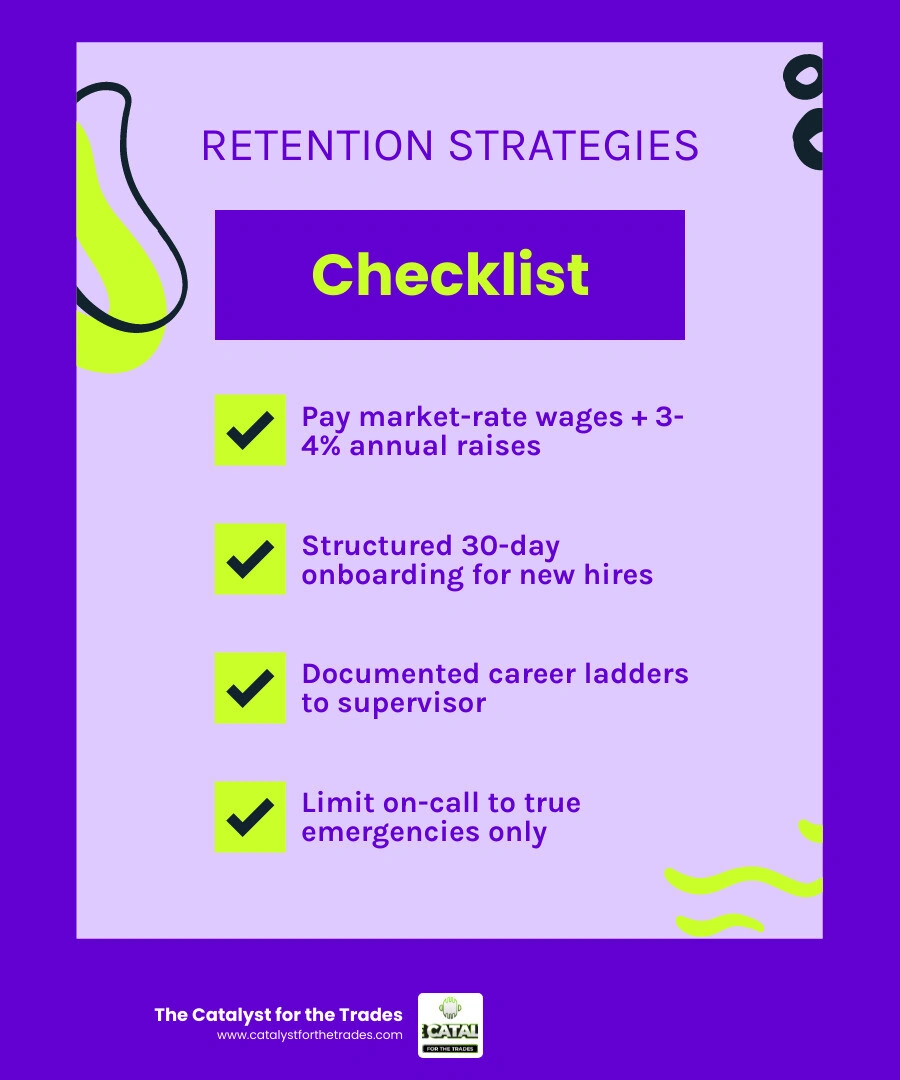
Here is a quick-reference checklist of the most impactful retention strategies:
- Pay competitive wages and review them regularly
- Build a structured 30-day onboarding so new hires feel set up to succeed
- Create documented advancement paths from apprentice to supervisor
- Limit on-call to true emergencies and set clear scheduling expectations
- Invest in modern tools and software that reduce daily friction
- Recognize performance publicly and reward it with bonuses tied to real results
- Develop your managers — poor leadership drives more exits than low pay
- Offer skill development opportunities that grow technician value and confidence
- Build a referral program so your best people help recruit the next great hire
- Conduct regular one-on-ones so small problems never become resignation letters
If you run a trades business in 2026, you already feel the pressure. The HVAC industry alone is short 110,000 qualified technicians, with another 25,000 leaving the field every year. Plumbing is staring down a projected shortfall of 550,000 workers by 2027. These are not temporary dips — they are structural realities that are reshaping how every shop, contractor, and service company has to think about their workforce.
What makes this even harder is that most technician turnover is preventable. Research consistently shows that 42% of employees who quit say their employer could have done something to keep them. Yet most businesses keep treating retention as a back-burner issue — something to deal with after the next slow season — while the real impact quietly compounds in the background.
Replacing a single technician can be incredibly costly once you account for recruiting, lost productivity during the search, and the ramp-up time before a new hire reaches full output. For a growing team, high turnover can quietly drain your bottom line every year.
The businesses winning the talent war right now are not necessarily the ones paying the highest wages. They are the ones that have built systems — for onboarding, culture, recognition, and professional development — that give technicians a genuine reason to stay.
This guide gives you the complete checklist to build that kind of operation.
The Core Drivers of Churn in the Modern Trades
To solve the turnover problem, we must first understand why technicians walk out the door. Many business owners assume it is always about money. They believe that as soon as another offer comes along, their best people will bolt.
But the data tells a different story. In fact, 72% of technician departures are completely unrelated to base pay. Instead, they are driven by chronic work-life balance issues, toxic culture, poor management, and on-call fatigue. When technicians feel like nameless gears in a machine, their Employee Loyalty evaporates.

On-call schedules are one of the single biggest drivers of burnout. When teams are short-staffed, technicians can find themselves on call for up to 26 weeks out of the year. This constant state of alert strains family relationships and makes it impossible to unplug.
Furthermore, a lack of clear communication from leadership breeds frustration. If a technician only hears from their supervisor when something goes wrong, they quickly feel undervalued. When we fail to establish healthy accountability and instead manage through fear or silence, we pave the way for high turnover.
Addressing On-Call Burnout and Scheduling Demands
If we want to know how to retain top technicians in a competitive trades labor market, we must address the scheduling strain. Forcing technicians to work grueling hours under the threat of emergency calls is a surefire way to lose them to industries with predictable schedules.
To combat this, leading contractors are implementing structural scheduling changes:
- True Emergency Filtering: Define strictly what constitutes an after-hours emergency (e.g., active flooding or no heat in freezing temperatures) and route non-emergencies to the next business day.
- Compressed Workweeks: Offer alternative schedules, such as four 10-hour shifts with three-day weekends. This gives technicians dedicated time to rest and handle personal errands without burning paid time off.
- On-Call Rotation Pools: Establish a larger rotation pool to ensure no single technician is on-call more than one week per month.
- On-Call Compensation Adjustments: Pay technicians a flat standby rate just for holding the phone, plus a premium rate for every dispatch, ensuring their sacrificed personal time is respected financially.
How to Retain Top Technicians in a Competitive Trades Labor Market Through Culture
Culture is not a pool table in the breakroom or a box of donuts on Friday morning. True culture is built on respect, clear expectations, and open communication. It is the daily experience of how your team is treated by leadership and dispatch.
Applying People First Leadership in Construction and home services means recognizing that our technicians are our most valuable asset. If we treat them with transactional indifference, they will treat us the same way.
To foster a positive workplace culture, start by improving daily interactions. Say good morning to your crew, ask about their families, and actively listen to their field challenges. Implement regular recognition programs that celebrate wins publicly — whether it is a handwritten thank-you note from a homeowner or a shout-out in the company group chat for hitting a callback-free milestone. When we transform mistakes into collaborative teaching moments rather than public call-outs, we build an environment where technicians feel safe, respected, and motivated to stay.
How to Retain Top Technicians in a Competitive Trades Labor Market
Succeeding in today’s tight labor market requires shifting from a transactional mindset to a relational one. In a transactional model, you trade money for hours, and the relationship ends there. In a relational model, you invest in the technician’s long-term success, safety, and well-being, which builds deep organizational loyalty.
When executing your Talent Retention strategies, consider how your current practices align with this shift:
| Transactional Retention Strategies | Relational Retention Strategies |
|---|---|
| Offering spot bonuses only when someone threatens to quit | Implementing staged, milestone-based retention bonuses |
| Expecting technicians to fund all their own specialized tools | Providing annual tool allowances and shop-owned equipment |
| Conducting performance reviews only once a year | Holding brief, biweekly one-on-one alignment chats |
| Relying solely on overtime to meet customer demand | Structuring predictable schedules and respecting personal time |
| Treating skill development as an occasional, mandatory chore | Co-creating clear growth paths with paid development support |
Designing a Structured 30-Day Onboarding Experience
Most technicians decide whether they will stay with a company long-term within their first 30 days. If their first week consists of riding in a messy truck with a cynical lead technician while trying to figure out unwritten rules, they will start looking for their next job before their first paycheck clears.
Proper onboarding can increase retention rates by 82%. To achieve this, we need a highly structured, repeatable onboarding process backed by solid standard operating procedures (SOPs).
During the first 30 days, focus on answering one fundamental question for the new hire: “Can I succeed here?” Pair them with a dedicated mentor who is culturally aligned with your business, not just the most senior technician. Provide them with a clean, fully stocked service vehicle, clear technology onboarding, and a warm welcome from the entire team. Reviewing our Employee Retention Strategies for Contractors can help you map out a week-by-week integration plan that eliminates first-month friction.
Equipping Your Team with Modern Tools and Technology
Technicians are creatures of habit, but they are also highly sensitive to operational friction. Expecting a modern technician to navigate outdated paper invoicing, poorly routed dispatching, and broken shop tools is a recipe for frustration.
In fact, 87% of responding technicians state that proper equipment in the shop and field is a “must-have” for their workplace. When we invest in high-quality, reliable tools, we show our team that we respect their labor and physical safety.
Similarly, field service management technology should make their lives easier, not harder. Modern dispatch software should optimize routes to minimize windshield time, automate customer notifications, and provide clear job histories before the technician arrives onsite. When technology eliminates administrative hassle and paperwork, technicians can focus on what they do best: diagnosing and fixing systems. This pride in craftsmanship, supported by modern tools, is a massive anchor for retention.
Building a Sustainable Talent Pipeline and Reducing Churn
To stop the endless cycle of reactive hiring, we must build a proactive pipeline that consistently attracts both active and passive candidates. When you only recruit when you are desperate, you are forced to compromise on cultural fit and skill, which inevitably leads to more turnover down the road.
Effective Workforce Planning requires treating recruitment and retention as two sides of the same coin. By showcasing your strong culture and investing in the development of your current team, you turn your business into a place where top talent actively wants to work.
Cultivating Passive Candidates and Systematic Hiring
The best technicians are rarely scouring job boards; they are usually already employed and taking care of their customers. To reach them, we must build a systematic, ongoing hiring process.
Leveraging modern Contractor Recruiting Strategies means maintaining warm relationships with passive candidates in your market. Share your team’s wins on social media, highlight your community involvement, and make your shop’s positive culture visible to outsiders. When you are ready to hire, follow a structured process like those outlined in our guide on Recruiting Skilled HVAC Technicians.
To measure the health of your hiring and retention systems, keep a close eye on these key metrics:
- First-Year Turnover Rate: The percentage of new hires who leave within 12 months (aim for under 15%).
- Time-to-Productivity: How many weeks it takes for a new technician to generate consistent, independent revenue.
- Employee Net Promoter Score (eNPS): Regular anonymous surveys asking your team how likely they are to recommend your shop as a great place to work.
- Callback Rate: The percentage of completed jobs requiring a return visit, which indicates skill and quality levels.
- Referral Hire Rate: The percentage of new hires sourced through internal employee referrals, which typically yield the highest retention.
For more insights on optimizing your recruiting copy and targeting the right professionals, explore our breakdown of Hiring and Talent Management Keywords.
How to Retain Top Technicians in a Competitive Trades Labor Market with Clear Growth Pathing
Younger generations entering the trades are highly focused on progression. If they cannot see a clear, structured path for their future within your company, they will find another organization that will show them one.
Developing a robust program for Workforce Development means mapping out explicit advancement paths. A helper should know exactly what skills, milestones, and performance metrics are required to become a junior technician, a lead technician, and eventually a foreman or service manager.
Tie these milestones to clear compensation increases. For instance, obtaining relevant vocational milestones can boost a technician’s earning potential while bringing immense technical expertise back into your shop. When technicians know that their loyalty and professional growth are matched by clear, predictable advancement, they have no reason to look elsewhere.
Frequently Asked Questions about Technician Retention
Why do skilled technicians leave their jobs?
While pay is always a factor, the primary reasons skilled technicians leave are poor workplace culture, lack of professional growth, unsupportive management, and excessive on-call hours. When technicians feel their personal lives are constantly sacrificed for the business without clear communication or recognition, they quickly burn out and seek other opportunities.
How does onboarding affect long-term technician retention?
Onboarding sets the tone for the entire employment relationship. A structured, supportive first 30 days reduces the anxiety of joining a new team and quickly integrates the technician into your company culture. It shows them that your business is organized, values their success, and has clear systems in place to help them win.
What non-financial incentives are most effective for tradespeople?
Some of the most powerful non-financial incentives include predictable and flexible scheduling, modern and well-maintained shop equipment, paid professional development, tool allowances, and consistent, public recognition of their hard work. Providing a safe, low-stress working environment is often worth more to a seasoned technician than a slight bump in hourly pay.
Conclusion
Retaining top talent in 2026 is no longer just an HR task — it is a core operational strategy. When you build a business that prioritizes structured onboarding, clear advancement paths, modern tools, and a respectful, people-first culture, you naturally insulate your team from external poaching.
At The Catalyst for the Trades Podcast, hosted by Jennifer Bagley and Chuck Staszkiewicz, we are dedicated to helping home service businesses scale their operations, master modern technology, and build world-class teams. By combining cutting-edge digital strategies with real-world operational experience, we empower contractors to thrive in any labor market.
Ready to completely revolutionize how you manage, develop, and keep your team? Dive into our Talent Management Complete Guide and start building a sustainable, high-performing workforce today.


