Learn · May 28, 2026
Recruiting Skilled HVAC Technicians: 2026 Crisis Fix
Master recruiting skilled HVAC technicians in 2026's shortage. Proven strategies, pipelines, hiring tips & retention to scale your team fast.
By The Catalyst Editorial Team Operator education · 9 min read · Updated July 24, 2026

Why Recruiting Skilled HVAC Technicians Is One of the Hardest Jobs in the Trades Right Now
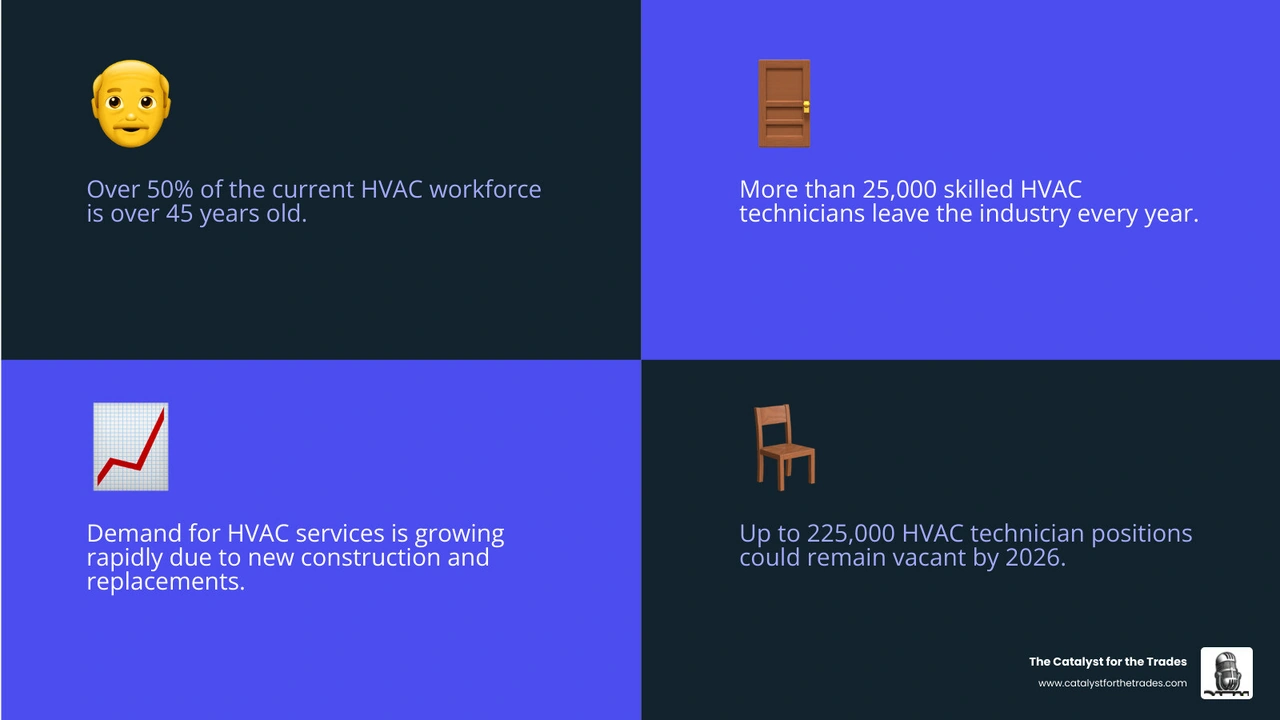
Recruiting skilled HVAC technicians is a serious challenge for home services business owners in 2026 — and the numbers back that up. Demand for HVAC work is growing fast, but the pool of qualified technicians is shrinking just as quickly. Over 50% of the current HVAC workforce is over 45 years old. More than 25,000 skilled technicians leave the industry every year. And a Better Business Bureau report warns that as many as 225,000 service technician positions could sit vacant within the next five years.
Here is a quick-reference guide to the most effective ways to find and hire skilled HVAC technicians:
- Write compelling, mobile-friendly job ads that highlight pay, benefits, and career growth — not just a list of requirements
- Build a talent pipeline through trade schools, apprenticeship programs, and community college partnerships
- Launch an employee referral program with structured bonuses paid at 90 days and one year
- Post on HVAC-specific job boards and social media, including Facebook groups and LinkedIn
- Offer competitive compensation with perks like tool allowances, health insurance, and performance bonuses
- Streamline your hiring process — most strong candidates are gone within two weeks if you move too slowly
- Invest in onboarding and retention — most turnover happens within the first 30 to 90 days
The reality is that the companies winning this talent war are not just the ones offering the most money. They are the ones building a reputation as a great place to work — and being intentional about every step of the recruiting process.
If you are a business owner or manager feeling the pressure of an empty roster or a team stretched too thin, this guide walks you through exactly what to do.
Essential recruiting skilled hvac technicians terms:
The 2026 HVAC Labor Shortage Reality
As we navigate through April 2026, the HVAC industry is facing a “perfect storm.” On one side, we have an aging workforce. With over half of our most experienced technicians nearing retirement age, we are losing decades of institutional knowledge every single month. On the other side, the demand for HVAC services is skyrocketing. The U.S. Bureau of Labor Statistics previously projected a 14% growth in demand, which translates to roughly 40,000 new jobs that need filling.

The “Silver Tsunami” isn’t just a catchy phrase; it’s a statistical reality. When 25,000 technicians hang up their gauges every year, and the Better Business Bureau predicts a quarter-million vacancy gap, we have to stop and ask: Where did everyone go? The answer is often found in Workforce Planning. Many companies failed to plan for this demographic shift, relying on “post and pray” methods that no longer work in a market where the technician holds all the cards.
In 2026, the shortage is fueled by a combination of high-tech advancements (smart homes and green energy requiring more specialized skills) and a historical push toward four-year degrees that left the skilled trades overlooked. To survive, we have to change how we view our team members—not as replaceable labor, but as the most valuable asset in our portfolio.
Proven Strategies for Recruiting Skilled HVAC Technicians
If you want to win in this environment, you can’t just be a “boss”—you have to be an “Employer of Choice.” This means your reputation in the local community must be so strong that technicians want to work for you before they even see a job ad.
Success in recruiting skilled hvac technicians requires a shift toward Strategic Recruiting. You cannot wait until your lead tech quits to start looking for a replacement. You need a “bench” of talent. This involves a mix of active and passive sourcing.
| Feature | Active Sourcing | Passive Sourcing |
|---|---|---|
| Target | People actively looking for jobs | People currently employed but open to better offers |
| Method | Job boards (Indeed, ZipRecruiter) | LinkedIn, networking, social media |
| Speed | Fast, but high competition | Slower, but higher quality “A-players” |
| Cost | High (pay-per-click ads) | Lower (relationship building) |
Writing Compelling Ads for Recruiting Skilled HVAC Technicians
The goal of a job ad is to sell the opportunity, not to list your demands. Most HVAC technicians are checking job boards on their phones during lunch or between calls. If your ad is a giant wall of text with 50 bullet points of requirements, they will swipe right past it.
To master Talent Acquisition, your ads should be:
- Mobile-Friendly: Keep it concise. If they can’t read it in 60 seconds, it’s too long.
- Jargon-Free: Speak like a human. Instead of “Utilize diagnostic instrumentation,” say “Figure out what’s wrong and fix it right.”
- Benefit-Focused: Lead with what they get. Mention the tool allowance, the flexible scheduling, and the clear path to becoming a Service Manager.
- Transparent: Include the pay range. In 2026, top talent won’t waste time on an “apply to find out” salary.
Leveraging Social Media for Recruiting Skilled HVAC Technicians
Social media is the modern-day water cooler. We spend nearly 143 minutes a day on these platforms, and your future technicians are no different. Effective Recruitment Marketing means showing up where they hang out.
Don’t just post “We’re Hiring” graphics. Instead, share:
- Video Testimonials: Let your current techs talk about why they love working for you.
- Day-in-the-Life Stories: Show off your clean trucks, high-end tools, and the cool projects you’re working on.
- Community Involvement: If you sponsor a local Little League team, show it. Technicians want to work for companies that care about the community.
Building a High-Performance Talent Pipeline
One of the biggest mistakes we see is companies trying to “buy” talent from competitors. While that works occasionally, it’s expensive and often leads to a bidding war. The real winners in 2026 are “growing” their own talent.
Building a pipeline starts with community. We recommend forming deep relationships with local trade schools and community colleges. Don’t just show up for career fairs; offer to speak to classes or donate equipment. As discussed in the episode with Mike Disney on Building Trust, Recruiting Top Talent & Winning in the Trades, trust is the currency of the trades. If the instructors trust you, they will send their best students your way.
Other pipeline strategies include:
- Apprenticeships: Create an “Earn While You Learn” program. This attracts younger workers who might be wary of student debt.
- Employee Referrals: Your current team knows who the “A-players” are in the field. Incentivize them! A structured program—paying half a bonus at 90 days and the rest at one year—ensures they only refer people who will actually stick around.
- Vendor Networks: Your local supply house sees every tech in town. If they know you’re a great employer, they’ll put in a good word for you.
Streamlining the Hiring and Onboarding Experience
In 2026, speed is a competitive advantage. If a skilled tech applies to your company, they likely applied to three others. If you take a week to call them back, they’re already wearing someone else’s uniform.
Statistics show that 96% of job applicants opt in to text message communication. Use this! Texting is faster, more personal, and has a much higher response rate than email. Hiring Process Optimization means moving from application to interview in 48 hours or less.
Once they are in the door, don’t just throw them the keys to a van. The first 90 days are critical. Use a Talent Management Complete Guide approach to onboarding:
- The First Day: Have their uniform, iPad, and truck ready. Make them feel expected and welcome.
- Skills Testing: Don’t just take their word for it. Conduct a 15-minute hands-on test. Can they actually diagnose a compressor failure?
- Mentorship: Pair every new hire with a senior tech for the first month. This builds culture and prevents “rookie” mistakes that lead to callbacks.
Retention Strategies to Protect Your Investment
It costs between $4,000 and $6,000 to replace a single employee. If you’re recruiting skilled hvac technicians only to lose them six months later, you’re pouring money down the drain. Retention is the other half of the recruiting coin.
Our Employee Retention Strategies Guide 2026 emphasizes that while pay is important, it’s rarely the only reason people leave. Technicians leave because of poor communication, lack of growth, or burnout.
To keep your “A-players,” consider these Talent Retention tactics:
- Career Check-ins: Don’t wait for an annual review. Have monthly “stay interviews” to ask: “What can we do to make your job better?”
- Work-Life Balance: Burnout is real, especially in the summer. Rotate on-call shifts and encourage technicians to actually use their PTO.
- Profit Sharing: When the company wins, the team should win. This creates an ownership mindset where techs care about callbacks and efficiency.
- The “Tool” Factor: Provide a tool allowance or high-quality company-provided tools. A tech is only as good as their equipment.
Frequently Asked Questions about HVAC Recruiting
What is causing the HVAC technician shortage in 2026?
The shortage is a “perfect storm” of factors. First, we have an aging workforce where over 50% of techs are over age 45 and nearing retirement. Second, there is a massive surge in demand for services due to aging infrastructure and the push for energy-efficient “green” technology. Finally, for decades, the trades were deprioritized in favor of four-year degrees, leading to fewer young people entering the pipeline.
How long does the typical HVAC hiring process take?
Ideally, the process should take between two and six weeks. However, for a “star” candidate, you should aim to make an offer within 7 to 10 days. If your process is bogged down by slow background checks or multiple rounds of unnecessary interviews, you will lose top talent to faster competitors.
What compensation and benefits packages are competitive for HVAC technicians?
In 2026, “competitive” means more than just a high hourly wage. Top packages include:
- Comprehensive health, dental, and vision insurance.
- 401(k) matching to help with that eventual retirement.
- Performance-based bonuses or profit-sharing.
- Tool allowances or tool replacement programs.
- Paid time off (PTO) that technicians are actually encouraged to use.
- Sign-on bonuses for highly specialized certifications (like NATE or specialized VRF training).
Conclusion
Recruiting skilled hvac technicians in 2026 isn’t just about placing an ad; it’s about building a culture that people want to be a part of. By focusing on strategic sourcing, streamlining your hiring process, and investing heavily in retention, you can build a team that doesn’t just “show up,” but helps your business scale to new heights.
At The Catalyst for the Trades, we are dedicated to helping home service businesses bridge the gap between “working in the business” and “working on the business.” Whether it’s through operational scaling, embracing new technology, or mastering the art of leadership, our goal is to help you grow.
Ready to transform your team and your bottom line? Learn more about our mission and join a community of contractors who are winning in the trades.


