Learn · March 25, 2026
Tech Stack for Home Service Businesses: 5 Layers
Build your tech stack for home service businesses: CRM, AI, FSM & unified platforms for efficiency, scalability & growth.
By The Catalyst Editorial Team Operator education · 9 min read · Updated July 24, 2026

Why Your Tech Stack for Home Service Businesses Can Make or Break Your Growth
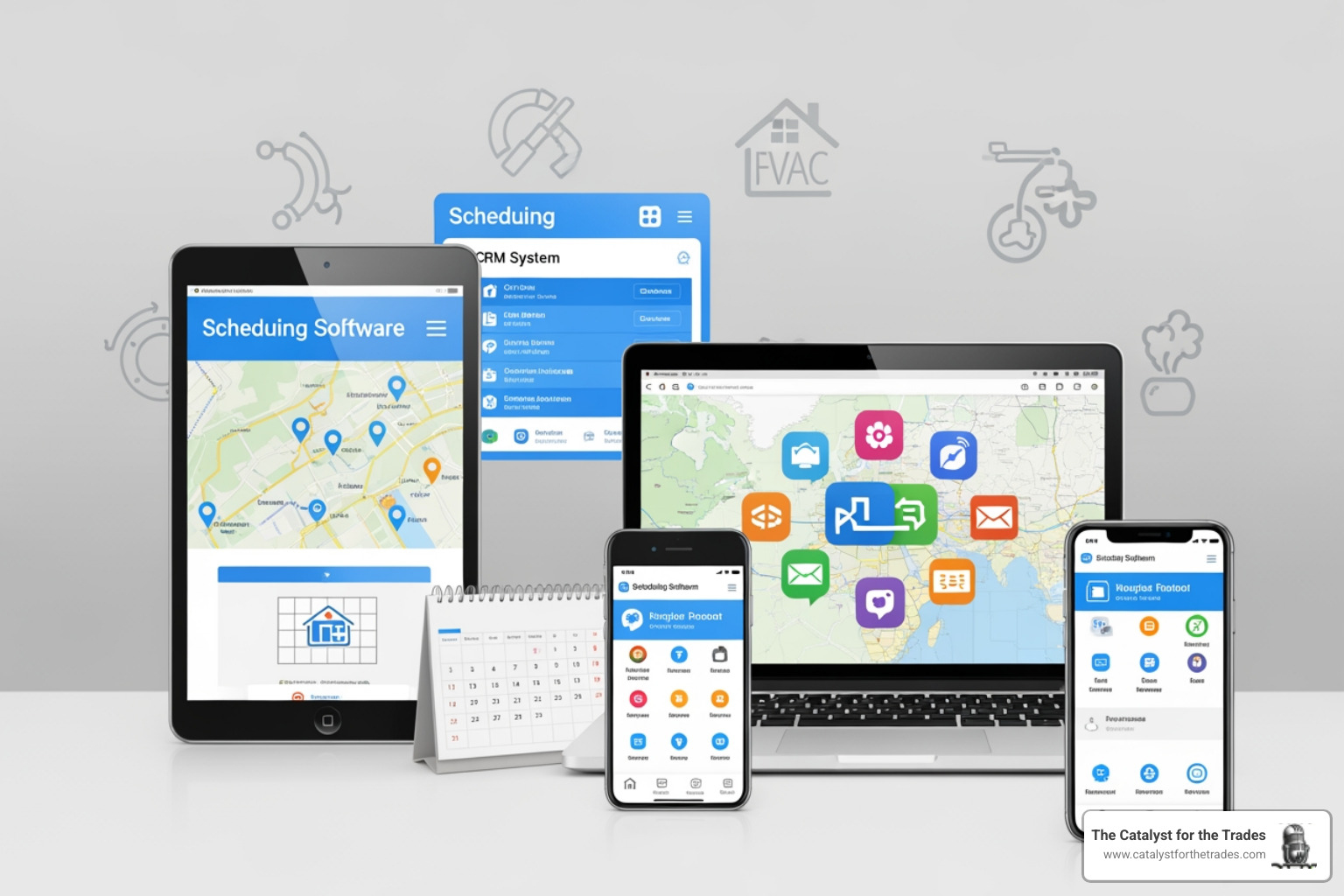
A solid tech stack for home service businesses is the difference between a company that scales smoothly and one that drowns in missed calls, paper invoices, and scheduling chaos.
Here is a quick summary of what a strong home service tech stack looks like:
| Layer | Purpose | Examples |
|---|---|---|
| CRM | Track leads, customers, and follow-ups | Jobber, HouseCall Pro, ServiceTitan |
| Scheduling & Dispatch | Book jobs, optimize routes, reduce no-shows | Jobber, FieldPulse |
| Payment Processing | Collect on-site, reduce bad debt | Stripe, Square, built-in FSM payments |
| Communication | SMS, calls, review requests, team messaging | Podium, OpenPhone |
| Field Service Management | Tie everything together in the field | ServiceTitan, Jobber, Simpro |
Most contractors start with a patchwork of disconnected tools, a spreadsheet here, a group text there, maybe a basic invoicing app. It feels manageable at first. But as the business grows, that patchwork becomes expensive and exhausting. One contractor frustration that comes up again and again: spending thousands every month on software that does not talk to each other, making it nearly impossible to track where leads come from or how profitable each job really is.
The good news is that building the right foundation does not have to be complicated. It just has to be intentional.
Defining the Tech Stack for Home Service Businesses
In trades, your “tech stack” is simply the group of software and digital tools you use to run your company. Think of it as your digital toolbox. Just as you wouldn’t try to install an HVAC system with only a hammer, you shouldn’t try to run a modern business with only a legal pad and a flip phone.
A well-designed tech stack for home service businesses acts as your operational nervous system. It connects the office to the field, ensures the customer journey is frictionless, and provides a single source of truth for your data. When your systems are integrated, information flows seamlessly from a lead clicking an ad to a technician swiping a credit card on a driveway.
This level of Field Service Management Software integration allows for workflow automation that saves hours of administrative time. Instead of manually typing customer details three different times, the data moves automatically. This is especially critical for mobile-first operations; research shows that 80% of software usage in the field happens on mobile devices. If your tech isn’t easy to use on a smartphone, your technicians simply won’t use it.
Essential Components of a Tech Stack for Home Service Businesses
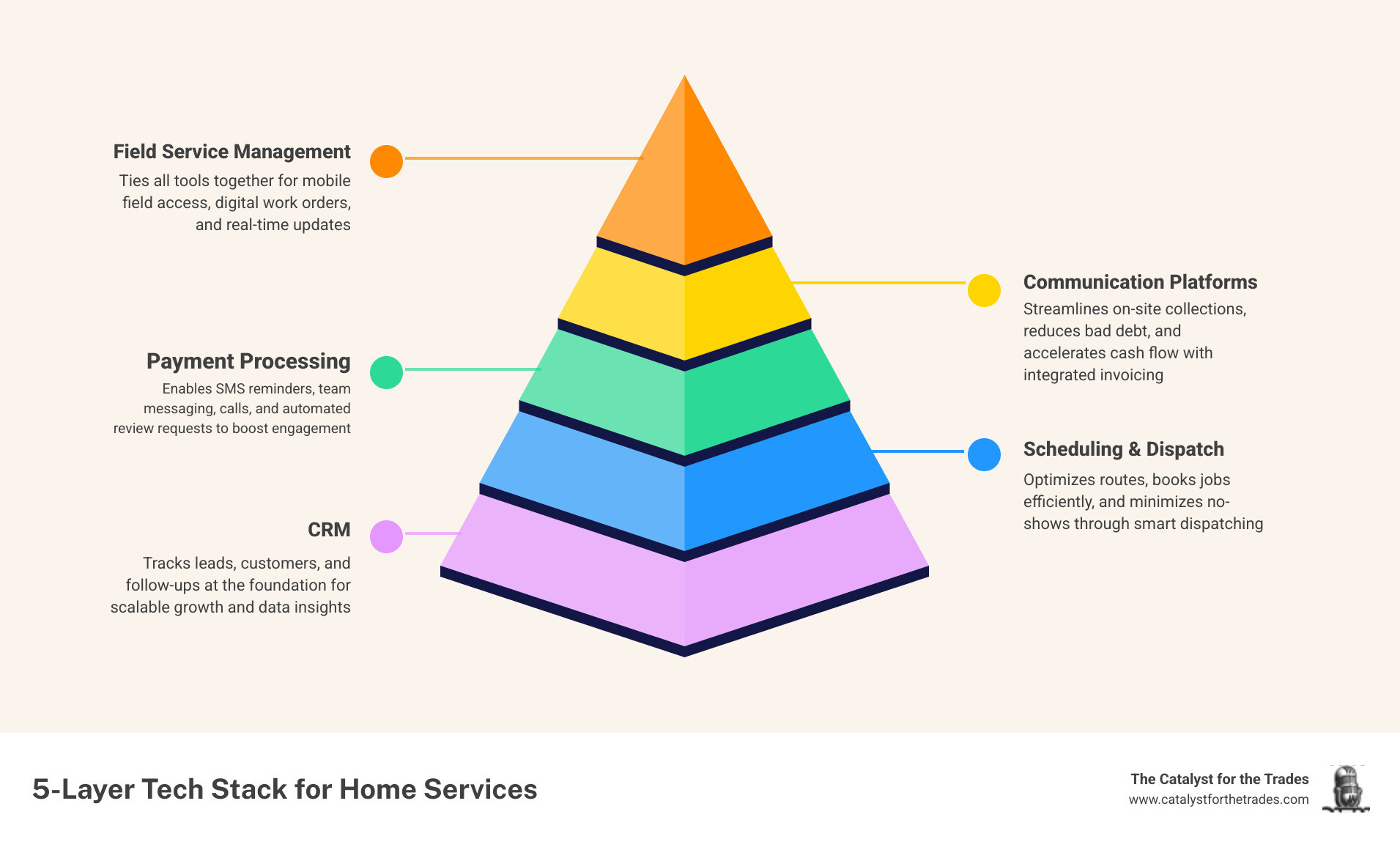
To build a foundation that lasts, we need to look at the core layers:
- CRM (Customer Relationship Management): This is where every relationship begins. A solid Customer Relationship Management system tracks every interaction, from the first phone call to the final thank-you note. Systematic follow-up through a CRM can increase lead-to-customer conversion by 15-20%.
- Scheduling & Dispatch: These tools move beyond simple calendars. They offer route optimization, which can save 15-25% on fuel and drive time. They also handle the “scramble” when a technician calls out or an emergency job comes in.
- Payment Processing: The goal is to get paid faster. Moving to 95% on-site payment collection can reduce Days Sales Outstanding (DSO) by 15-20 days and slash bad debt by 40-60%.
- Communication Platforms: Customers today prefer texting. Automated appointment confirmations can reduce no-shows by 30-40%, while business SMS platforms can increase your online reviews by 300-400%.
The Role of AI in Modern Service Operations
We are moving into an era where “basic” scheduling is becoming obsolete. The AI Customer Service Automation Complete Guide highlights how artificial intelligence is taking over the heavy lifting.
Imagine a system that uses predictive scheduling to assign the right technician based on their past performance and current location, or chatbots that handle 24/7 booking so you never miss a midnight lead. Developing a Contractor AI Strategy isn’t just for tech giants; it’s for the local plumber who wants to reduce office phone volume by 20-30% through customer self-booking. AI-driven insights can even analyze your data to tell you which neighborhoods are most profitable, allowing you to spend your marketing budget where it actually works.
All-in-One Platforms vs. Best-of-Breed Tools
One of the biggest decisions we face is whether to go with an “all-in-one” platform or a “best-of-breed” approach.
| Feature | All-in-One (e.g., ServiceTitan) | Best-of-Breed (e.g., Specialized Apps) |
|---|---|---|
| Data Centralization | Excellent; one login for everything | Requires third-party integrations |
| Feature Depth | Broad, but some modules may be basic | Very deep for specific tasks |
| User Adoption | Easier; one interface to learn | Harder; multiple apps for the crew |
| Cost | Often higher upfront | Can be cheaper initially, but adds up |
For most small to medium contractors, the all-in-one approach is usually the winner. It reduces the “software fatigue” that happens when your team has to jump between five different apps just to complete one job. Platforms like the Cortex Business Platform focus on bringing these elements together so you can focus on the work, not the software.
Benefits of a Unified Business Ecosystem
The magic happens when your tools talk to each other. System Integration eliminates the “double entry” nightmare where an office manager spends 10 hours a week copying data from a scheduling app into an accounting program.
With a unified system, you get real-time reporting. You can look at Cortex Pulse Analytics and see your exact profit margin on a job before the technician even leaves the driveway. This transparency improves team collaboration and simplifies management because everyone—from the apprentice to the owner—is looking at the same data.
A Phased Roadmap for Implementation
One of the most common mistakes contractors make is trying to flip a switch and change everything overnight. This leads to “tool overload” and a frustrated team. Instead, we recommend a strategic, phased Technology Implementation over 12 to 18 months.
Successful adoption requires more than just buying a login; it requires Standard Operating Procedures (SOPs). You need to define how the tool is used. For example, “Every job must have three photos attached before the invoice is sent.” Without these rules, even the most expensive software becomes a glorified digital filing cabinet.
Phase 1: Establishing the Foundation (Months 1-3)
Your first priority is getting your house in order. This starts with How to Get Your CRM Right and Why It Matters More Than You Think. You cannot build a marketing machine on top of a messy database.
During this phase, clean your customer list. Delete duplicates. Ensure you have correct email addresses and phone numbers. Integrate your payment processing so you can start collecting money in the field immediately. This quick win provides the cash flow needed to fund the rest of your tech journey.
Phase 2: Optimizing Your Tech Stack for Home Service Businesses (Months 4-12)
Once the foundation is solid, it’s time to add the “smart” layers. This includes AI CSR Implementation to handle incoming leads and automated reminders to keep your schedule full.
Now you can lean into Cortex Local Marketing to drive more leads into your optimized system. With advanced reporting, you’ll know exactly which ads are resulting in high-ticket jobs. You can also implement SMS marketing to reach out to past customers for seasonal maintenance, keeping your technicians busy during the slow shoulder seasons.
Measuring ROI and Avoiding Common Mistakes
Technology should be an investment, not an expense. Most contractors who properly implement the right tech stack for home service businesses see a 10-15x ROI within 18 months. But how do you measure that?
Look at these key metrics:
- Lead Conversion: Are you closing more of the leads you pay for?
- Drive Time: Has route optimization reduced your fuel bill?
- No-Show Rate: Have automated reminders saved you from “dry runs”?
- Admin Time: Is your office staff spending less time on paperwork and more time on sales?
Your Technology Strategy should aim for an annual benefit that is at least five times the annual cost of the software. If it isn’t delivering that, it’s time to re-evaluate.
Common Technology Pitfalls for Contractors
We see the same mistakes over and over. Avoiding these can save you tens of thousands of dollars:
- Buying Before Planning: Don’t buy software because a salesperson had a good demo. Buy it because it solves a specific, quantified problem in your business.
- Skipping Training: Allocate 20-30% of your software budget to training. If your team doesn’t know how to use the tool, the ROI will be zero.
- Ignoring Mobile Experience: If the app is clunky or slow in the field, technicians will revert to paper.
- Over-Customization: Start with the “out-of-the-box” settings. The more you customize, the harder it is to update the software later.
- Poor Integration: Using tools that don’t talk to each other creates “data silos” and manual work. Consult an AI Technology Implementation Keywords Guide to ensure your systems are future-proofed.
Frequently Asked Questions
How do I know if my current tools are holding me back?
If you are still doing manual data entry between systems, you’re being held back. Other red flags include high no-show rates, technicians getting lost or arriving late, and an inability to see your real-time profit margins. If your office feels like a “chaos center” rather than a command center, check out our HVAC Business Operations Guide for a look at what “smooth” looks like.
Can I integrate my existing accounting software?
Yes, and you absolutely should. Most modern platforms offer System Integration with tools like QuickBooks or Xero. This allows for automated syncing of invoices, payments, and payroll. It provides financial transparency and ensures your cash flow data is always accurate without needing a bookkeeper to spend hours on data entry.
What is the most important feature for field technicians?
Mobile accessibility is non-negotiable. Beyond that, technicians need digital work orders that include job history, photos, and clear instructions. A good Field Service Management Software should also include an “offline mode” for when they are working in basements or rural areas without a signal, ensuring they can still capture job data and signatures.
Conclusion
At The Catalyst for the Trades, we believe that technology is the ultimate lever for growth. A well-chosen tech stack for home service businesses doesn’t just make you more efficient; it changes the quality of your life as an owner. It allows you to step away from the daily “firefighting” and focus on strategic leadership and innovation.
Building a bulletproof stack is a journey, not a destination. As your business evolves, your tools should grow with you. By following a phased roadmap and focusing on integration and ROI, you can future-proof your business and dominate your local market.
Learn more about our approach to trade business growth and how we can help you turn your technology from a headache into a powerhouse.


