Learn · June 24, 2026
How Customer Experience Drives Growth In HVAC Plumbing And Electrical Businesses: 7 Proven Strategies
Discover how customer experience drives growth in HVAC plumbing and electrical businesses with proven strategies for retention, referrals, and revenue.
By The Catalyst Editorial Team Operator education · 13 min read · Updated July 24, 2026

Why Customer Experience Is the Real Growth Engine for HVAC, Plumbing, and Electrical Businesses
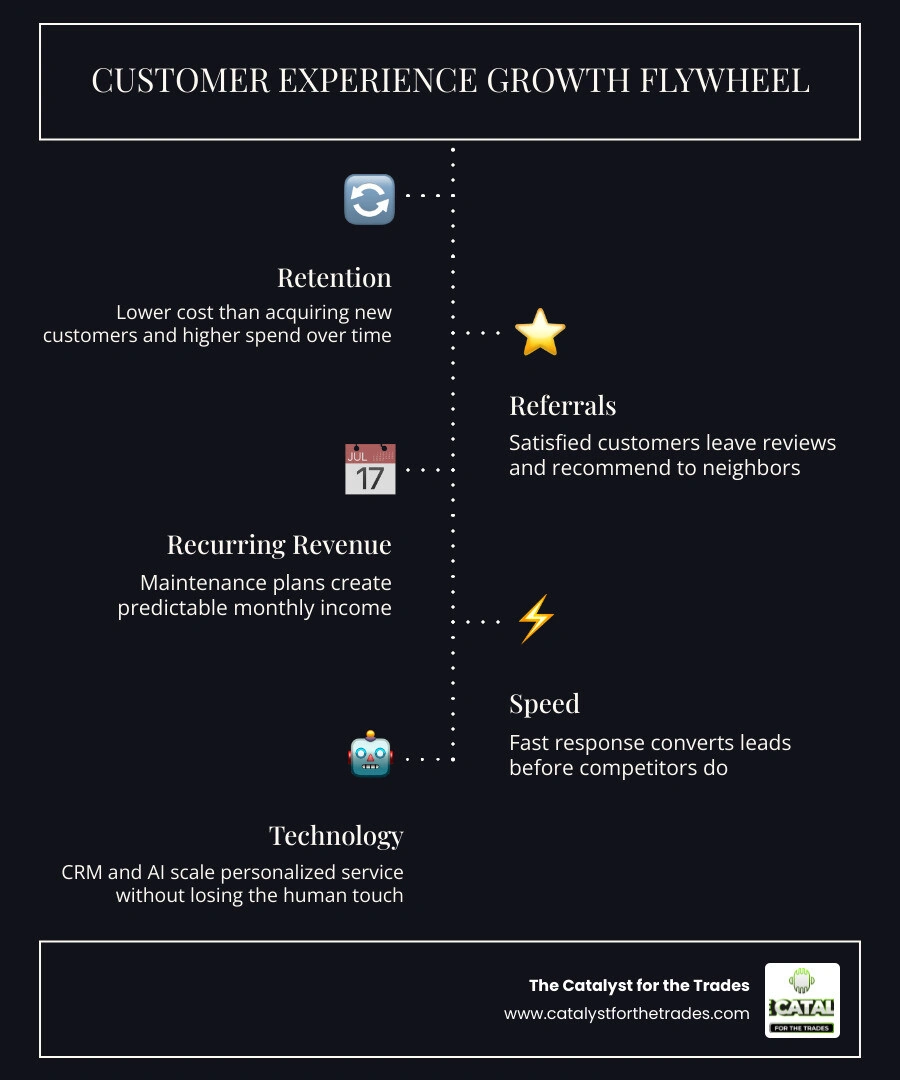
How customer experience drives growth in HVAC, plumbing, and electrical businesses comes down to a straightforward idea: homeowners return to — and refer — the contractors who made them feel heard, valued, and well-served. Here is a quick summary of the core ways CX fuels growth:
- Retention over acquisition — Keeping an existing customer costs far less than winning a new one, and loyal customers spend more over time.
- Referrals and reviews — Satisfied customers leave reviews and recommend contractors to neighbors, driving low-cost, high-trust leads.
- Recurring revenue — Maintenance agreements turn one-time jobs into predictable monthly income and dramatically increase customer lifetime value.
- Speed and responsiveness — Answering fast and following up consistently converts more inquiries into booked jobs before a competitor does.
- Technology at scale — CRM systems, automation, and AI help contractors deliver personalized service to hundreds of customers without losing the human touch.
The U.S. HVAC market alone is valued at over $133 billion, and the plumbing market sits close behind at $121 billion. With numbers like that, there is no shortage of demand. The real question is which contractors capture and keep their share of it.
The answer, consistently, is the ones who treat customer experience as a business system — not an afterthought.
Right now, in June 2026, customer expectations are higher than ever. Research shows that 74% of mobile workers report customers expect more than they did just a few years ago, and 66% of customers expect a business to recognize and understand their specific needs. At the same time, 70% of homeowners say they will not hire an HVAC contractor without reading reviews first.
Technical skill still matters — but it no longer sets you apart on its own. The contractors scaling from one truck to seven, from $250,000 to multi-million dollar revenue, are doing it by building repeatable customer experience systems that generate loyalty, referrals, and recurring income.
This guide walks you through exactly how to do that — from first contact to long-term retention — so you can build a business that grows because customers choose to come back.
The Core Pillars of How Customer Experience Drives Growth in HVAC Plumbing and Electrical Businesses
To build a customer-first trade business, we must look beyond basic technical competence. A perfectly installed heat pump or a flawlessly copper-piped water heater is only half the battle. The other half is how the customer felt while that work was being done.
When we focus on Service Excellence, we shift from treating jobs as one-off transactions to treating them as the beginning of a lifelong relationship. This shift is the foundation of sustainable, scalable business growth.
The Power of Personalized Service in Modern Home Services
Personalized service is not a sales gimmick; it is an operational mindset. In the home services industry, we are entering people’s most private spaces—their homes. This requires a high level of trust, empathy, and active listening.
When a technician arrives at a home, they should not just see a broken air conditioner or a tripped circuit breaker. They should see a homeowner who is stressed, hot, or worried about their family’s safety. By training our teams to practice active listening, we can understand the customer’s true concerns before proposing solutions.
Personalization also means keeping detailed records of customer history. When a client calls, our team should immediately know what equipment is in their home, who serviced it last, and even small details like whether they have a dog that likes to slip out the front door. This level of customized care proves to the client that they are not just another ticket on our dispatch board. For a deeper dive into establishing these standards, check out our Customer Experience Best Practices Guide.
Key Elements of Customer Experience That Drive Referrals
Word-of-mouth has always been the lifeblood of the trades, but today, referrals are turbocharged by digital communication. To turn a standard service call into a referral engine, we must focus on three elements:
- Proactive Communication: No customer likes to sit in a four-hour window wondering where their technician is. Sending real-time “on-the-way” text messages with the technician’s photo and bio reduces anxiety and builds immediate rapport.
- Post-Service Follow-Up: A simple phone call or automated message 24 to 48 hours after a job to ask, “How is everything running?” shows we care about the outcome, not just the income.
- Consistent Satisfaction Checks: Giving customers a low-friction way to share feedback allows us to catch minor issues before they turn into public complaints.
When we execute these steps consistently, we tap into a powerful growth multiplier. Referred customers cost significantly less to acquire than cold leads from paid advertising. In fact, industry data shows that referred customers spend roughly 25% more over their lifetime and are 37% more likely to return for repeat service. By focusing on these touchpoints, we naturally implement highly effective Customer Retention Strategies.
Operational Speed and Responsiveness: Converting Leads into Loyal Customers
You can have the best technicians in the city, but if you do not answer the phone or reply to web inquiries quickly, your competitors will win the job before you even get a chance to bid. Speed-to-lead is no longer a competitive advantage—it is the baseline for survival.
Why Speed-to-Lead is the Ultimate Growth Driver
The modern consumer operates in an on-demand world. If their kitchen sink is backing up or their furnace dies in the dead of winter, they are not going to wait hours for a callback. They will simply click the next contractor on Google.
Industry statistics reveal that the average home services company misses up to 27% of its inbound calls. Even worse, approximately 62% of service calls occur outside regular business hours. If we are letting those calls go to voicemail, we are actively throwing away revenue.
Every missed call is a missed opportunity to build a relationship. By implementing 24/7 responsiveness—whether through an after-hours call center, an on-call dispatch system, or smart automated booking tools—we can capture leads while our competitors are asleep. If you suspect your office team is letting opportunities slip through the cracks, read our guide on Your CSRs Are Sitting on Untapped Revenue Here’s How to Fix It.
How Customer Experience Drives Growth in HVAC Plumbing and Electrical Businesses Through Seamless Communication
To truly excel at responsiveness, we must meet customers where they want to communicate. While some prefer phone calls, a growing percentage of homeowners—especially younger buyers—prefer text messaging and online booking.
An omnichannel communication strategy ensures that whether a customer reaches out via web chat, text, social media, or phone, the experience remains seamless. One of the highest-leverage tools we can implement is missed-call text-back automation. If a customer calls and we cannot answer, an automated text is instantly sent: “Sorry we missed your call! How can we help you today?” This simple touchpoint keeps the customer from dialing the next company on the list and keeps them engaged with us. To build this into your daily operations, explore our comprehensive Customer Service Strategy.
Leveraging Technology and AI to Scale Personalized Service
As a home service business grows from a couple of trucks to a large fleet, maintaining a personal touch becomes increasingly difficult. Without the right systems, things start to slip through the cracks. This is where modern technology, CRMs, and artificial intelligence become essential tools for scaling.
Balancing Automation with the Human Touch
The goal of technology is not to replace human interaction, but to eliminate the manual, repetitive tasks that keep our team from focusing on the customer. When we automate our backend processes, we free up our Customer Service Representatives (CSRs) and technicians to deliver genuine, empathetic service.
For example, using automated systems to send appointment reminders, invoice receipts, and post-job reviews ensures these tasks are completed 100% of the time without human error. Meanwhile, our team can focus on explaining complex system options or helping an elderly customer understand their new smart thermostat. To see how to implement these systems successfully, check out our AI Customer Service Automation Complete Guide, as well as our deep dives into AI in Customer Communication and Customer Service Automation Best Practices.
How Customer Experience Drives Growth in HVAC Plumbing and Electrical Businesses Using Smart CRM Systems
A modern Customer Relationship Management (CRM) system acts as the single source of truth for our entire operation. It connects our office dispatchers, our field technicians, and our marketing campaigns into one cohesive system.
| Feature | Manual Tracking (Paper/Whiteboards) | Automated CRM System |
|---|---|---|
| Scheduling & Dispatch | High risk of double-booking; slow updates | Real-time GPS dispatching; instant tech updates |
| Customer History | Scattered in paper files; often lost | Full digital history accessible on tech mobile apps |
| Follow-Up & Reviews | Reliant on memory; rarely happens consistently | Automated SMS/Email triggers post-job |
| Equipment Tracking | Hard to track age, model, and warranty | Automated alerts for warranty expirations & age |
By centralizing this data, we can move from reactive repairs to proactive customer care. If our CRM shows us that a customer’s electrical panel is nearing the end of its safe lifespan, or that their AC unit is over ten years old, we can reach out with targeted, helpful suggestions before an emergency occurs. Learn more about optimizing these databases with our guide on Customer Relationship Management.
Maximizing Customer Lifetime Value Through Recurring Service Plans and Re-engagement
The most successful home service businesses do not rely solely on finding new customers. Instead, they focus on maximizing the value of the relationships they have already built. Two of the most effective ways to do this are maintenance agreements and database reactivation.
The Multiplier Effect of Maintenance Agreements
Maintenance agreements (often called service clubs or membership plans) are the holy grail of trade business growth. They provide homeowners with peace of mind through regular safety inspections, and they provide contractors with steady, predictable recurring revenue.
The lifetime value (LTV) difference between a one-time service customer and a maintenance plan member is staggering. Industry benchmarks show that while a service-only customer might spend a small amount over a few years, a plan-attached customer can generate multiple times that amount in lifetime value. Why? Because plan members are highly loyal.
When it comes time to replace an HVAC system, upgrade an electrical panel, or repipe a home, plan members have a 70% to 80% likelihood of choosing the same contractor who has been performing their regular maintenance. To build a program that keeps your customers locked in, read our guide on Customer Loyalty Programs.
Database Reactivation and Re-engaging Past Customers
Most contractors are sitting on a goldmine of uncontacted past customers. Over months and years, we build up databases of thousands of homeowners who bought from us once but were never contacted again.
Database reactivation is the process of reaching out to these past clients with highly targeted, helpful offers. For instance, sending a personalized SMS campaign in the spring offering a pre-summer AC tune-up, or an autumn electrical safety check, can fill our dispatch boards during seasonal slow periods.
In one notable industry example, an HVAC business generated 119 booked jobs and substantial revenue simply by reactivating a dormant database of 5,000 prospects. We do not always need to spend more on Google Ads to grow; often, we just need to talk to the people who already know, like, and trust us.
Reputation Management and Business Valuation: The Long-Term ROI of CX
Investing in customer experience is not just about making people happy in the short term—it is about building long-term brand equity and increasing the overall value of your business.
Turning Five-Star Reviews into a Growth Engine
In 2026, your online reputation is your business. Because 70% of homeowners will not hire a contractor without checking reviews, a weak online presence is an immediate dealbreaker.
To build a powerful review engine, we must focus on review velocity—the frequency and consistency of new reviews. Search engines like Google prioritize businesses that receive steady, fresh reviews over those that have hundreds of old, stagnant reviews.
The best way to increase review velocity is to ask for the review at the “moment of relief.” This is the exact moment the technician finishes the repair, cleans up their workspace, and shows the happy homeowner that their system is working perfectly. By sending an automated review link via text right then and there, we make it incredibly easy for the customer to leave five stars while their gratitude is at an all-time high.
How Superior Customer Experience Drives Business Valuation
If you ever plan to sell your business, partner with private equity, or pass it down to the next generation, your customer experience metrics will directly dictate your company’s financial valuation.
Acquirers and private equity firms are not just buying trucks and tools; they are buying predictable future cash flow. A business with high customer retention rates, a massive base of recurring maintenance agreements, and a flawless online reputation commands a significantly higher valuation multiplier than a business that relies entirely on volatile, expensive paid leads. By building a customer-obsessed culture, you are creating an asset that is highly attractive to investors and buyers.
Overcoming Pitfalls in Scaling Customer Relationships
As we scale our operations, we inevitably run into challenges that can threaten the quality of our customer experience. Knowing what these pitfalls are allows us to proactively build systems to avoid them:
- The Communication Gap: As volume increases, office staff can become overwhelmed, leading to missed calls and slow follow-ups. Solution: Implement robust CRM tracking and automated text-backs to ensure no lead is ignored.
- Inconsistent Service Quality: What works with two trucks can break down with ten. If different technicians deliver completely different experiences, your brand reputation will suffer. Solution: Create strict Standard Operating Procedures (SOPs) for every service call—from how we greet the customer to how we document the job with photos.
- Technician Soft Skills Bottlenecks: Many technicians are brilliant technically but struggle with communication, empathy, or presenting options. Solution: Provide regular training focused on soft skills, active listening, and professionalism. A technician who can explain things clearly is always more valuable than one who only speaks in technical jargon.
Frequently Asked Questions about Customer Experience in Home Services
What metrics should contractors track to measure the ROI of customer experience?
To ensure your CX investments are paying off, you should track:
- Customer Lifetime Value (LTV): The total revenue a customer generates over their entire relationship with your business.
- Customer Acquisition Cost (CAC): How much you spend on marketing and sales to acquire a single new customer.
- Retention Rate: The percentage of customers who continue to do business with you year after year.
- First-Time Fix Rate: The percentage of service calls resolved on the very first visit without requiring a callback (top performers maintain this above 80%).
How do online reviews impact a contractor’s ability to win new business?
Online reviews are the digital equivalent of a neighbor’s recommendation. They directly impact your local search rankings on Google Maps and search engines. High ratings combined with consistent review velocity build immediate consumer trust, allowing you to convert more website visitors and even charge premium rates because customers feel confident in your quality.
What are the most common pitfalls that prevent contractors from scaling customer relationships?
The most common mistakes are failing to follow up after the first visit, slow response times to new inquiries, inconsistent service delivery across different technicians, and ignoring the existing customer database in favor of constantly chasing expensive new leads.
Conclusion
At the end of the day, how customer experience drives growth in HVAC, plumbing, and electrical businesses is not about a single magic trick. It is about operational excellence, consistency, and building a culture that puts the homeowner first at every single touchpoint.
When we answer the phone faster, communicate more clearly, leverage smart automation, and secure recurring maintenance agreements, we build a highly profitable, self-sustaining growth engine.
At The Catalyst for the Trades, hosted by Jennifer Bagley and Chuck Staszkiewicz, we are dedicated to helping home service businesses combine cutting-edge technology with real-world operational strategies to scale. If you are ready to stop chasing low-quality leads and start building a customer-obsessed business that scales naturally, explore our Customer Experience Best Practices Guide and let’s build something great together.


