Learn · July 4, 2026
How Private Equity Is Changing Acquisitions in the Trades Industry: 2026
Discover how private equity is changing acquisitions in the trades industry with expert insights on roll-ups, platform deals, and growth strategies.
By The Catalyst Editorial Team Operator education · 13 min read · Updated July 24, 2026

How Private Equity Is Reshaping the Trades Industry — And What It Means for Your Business
How private equity is changing acquisitions in the trades industry is one of the most important questions any home services or specialty trades business owner can ask right now. Here is the short answer:
Private equity is transforming trades acquisitions by:
- Flooding the market with capital — PE firms have deployed approximately $12 billion in construction and trades acquisitions since January 2024 alone
- Driving up valuations — average acquisition multiples have risen to 7.2x EBITDA in 2026, up from 5.8x just three years ago
- Consolidating a fragmented industry — PE-led deals now account for more than 54% of all construction sector M&A, the first time on record
- Creating a two-tier market — platform companies sell for 7-10x EBITDA while smaller add-on targets sell for 3-5x, with millions of dollars separating the two
- Raising the bar on operations — PE-backed platforms are accelerating technology adoption, standardizing processes, and professionalizing businesses that were once run on gut instinct and handshakes
For decades, private equity largely ignored the trades. The businesses were considered too small, too owner-dependent, and too cyclical. That perception has completely reversed. Today, HVAC companies, plumbing businesses, electrical contractors, pest control operators, and specialty trade firms are among the hottest acquisition targets in the entire private equity universe. Since 2014, investment firms have poured over $31 billion into home services acquisitions alone — and the pace is accelerating, not slowing down.
Whether you are thinking about selling, trying to navigate a PE-backed market, or simply trying to understand what is happening in your market, this guide breaks down exactly what is going on and what you can do about it.
The Capital Surge: How Private Equity Is Changing Acquisitions in the Trades Industry
The sheer volume of institutional capital flowing into the trades is staggering. Private equity firms have deployed approximately $12 billion in construction and specialty trades acquisitions since January 2024. This represents a massive 180% increase over the comparable prior period, with 142 PE-backed construction and trades deals closed across specialty contracting and related sectors.
Historically, acquisitions in this space were strategic—one local contractor buying another to expand into a neighboring county. Today, financial buyers dominate the landscape. In 2025, private equity led 54.3% of all construction sector M&A deals, marking the first time in history that financial sponsors closed the majority of transactions. This milestone was reached across 305 PE-led transactions, representing a 31% year-over-year increase.
To understand how rapidly this wave has crested, we can look at the progression of PE-backed construction and trades acquisitions over the last several years:
| Year | Number of Closed Deals | Total Capital Deployed |
|---|---|---|
| 2020 | 86 deals | $4.2 Billion |
| 2021 | 98 deals | $5.8 Billion |
| 2022 | 124 deals | $7.4 Billion |
| 2023 | 138 deals | $9.2 Billion |
| 2024 | 156 deals | $12.6 Billion |
| 2025 | 142 deals | $11.8 Billion |
This unprecedented flood of capital has completely altered valuation dynamics. The average acquisition multiple for construction and trades companies rose to 7.2x EBITDA in 2026, up from 5.8x three years prior. When looking at long-term transaction data between 2018 and 2025, PE buyers paid an average of 10.6x EV/EBITDA for construction targets, compared to just 7.5x paid by strategic buyers.
This premium exists because PE firms are not just looking for a stable business to run; they are looking for a foundation upon which to build a massive, consolidated regional or national brand. If you are a contractor trying to understand where your business fits in this high-valuation environment, calculating your baseline value is the first step. You can read more about how these valuations are calculated in our guide on Business Valuation Contractors.
Why Private Equity Is Targeting Specialty Trades and Home Services
Why are some of the most sophisticated financial minds on Wall Street suddenly obsessed with local plumbing, electrical, and HVAC companies? There are several structural characteristics that make the trades sector incredibly attractive to private equity investors:
1. Essential, Non-Discretionary Demand
When a homeowner’s air conditioner breaks in July or a commercial building’s sewer main backs up, repair is not optional. This creates a highly recession-resistant business model. Unlike tech startups or retail brands, the demand for specialty trades remains stable regardless of macroeconomic shifts.
2. Extreme Market Fragmentation
The trades industry is incredibly fragmented. For example, the U.S. construction industry is made up of roughly 843,000 firms, with an average revenue of $1.84 million. The top 100 construction firms control only about 22% of total industry revenue. In residential services, the fragmentation is even more extreme. There are roughly 120,000 plumbing companies in the United States, and the largest individual brand controls less than 1% of the total market. This fragmentation is a goldmine for PE firms, who can buy dozens of small companies and merge them to gain market share.
3. Aging Ownership Demographics
Approximately 48% of construction and trades company owners are over 55 years old, and many are between 55 and 65. The majority of these owners do not have a clear succession plan. Internal successions are rare, as younger generations often pursue other paths. PE firms step in to solve this succession gap, providing liquidity to founders ready to retire. To prepare for this inevitable transition, owners must understand the mechanics of Succession Planning.
4. Recurring Revenue Characteristics
Many specialty trades generate 60% to 80% of their revenue through recurring service contracts, maintenance agreements, and preventative care plans. This predictable, stable cash flow is highly prized by PE firms because it provides a reliable stream of income that can easily service the debt used to fund the acquisition.
How Private Equity Is Changing Acquisitions in the Trades Industry Through Platform Sourcing
When PE firms enter a new market, they do not just buy any business that is for sale. They look for a “platform” company. A platform is a highly sophisticated, scalable business that serves as the foundation for future acquisitions.
The criteria for a platform target typically include:
- Revenue: $15 million to $75 million
- EBITDA: $2 million to $10 million (with margins ideally above 10%)
- Management Depth: A complete leadership team (General Manager, Head of Operations, HR Director) that can run daily operations without the founder’s hands-on involvement
- Systems: Modern, integrated CRM, enterprise accounting software, and documented standard operating procedures (SOPs)
A platform company commands premium valuation multiples, often trading between 7x and 10x EBITDA (and sometimes 12x to 15x for highly scalable residential platforms with heavy recurring revenue). Founders who build their companies to meet these strict platform criteria are positioning themselves to build a highly valuable asset. Learn more about this path in our article on Building a Legacy Business.
How Private Equity Is Changing Acquisitions in the Trades Industry for Add-On Targets
Once a PE firm has acquired its platform company, it immediately begins looking for “add-on” (or “bolt-on”) acquisitions. These are smaller, local businesses that can be integrated into the platform to rapidly expand geographic reach, add new trade capabilities, or acquire skilled labor.
The criteria for an add-on target typically include:
- Revenue: $3 million to $20 million
- EBITDA: $500,000 to $4 million
- Operational Profile: Often highly dependent on the founder, with simpler systems, basic technology, and limited management depth
Because add-ons are smaller and carry more operational risk, they trade at much lower valuation multiples, typically between 3x and 5x EBITDA. Once acquired, the platform absorbs their back-office operations (accounting, HR, purchasing), moving them onto the platform’s advanced software and professionalizing their sales and operational strategies. For business owners in this tier, understanding how to structure an exit is critical. Explore your options in our guide on Exit Strategies for HVAC Business Owners.
The Private Equity Roll-Up Playbook in Action
To understand how private equity is changing acquisitions in the trades industry, you must understand the “roll-up” playbook. This strategy relies on a financial mechanism called multiple arbitrage.
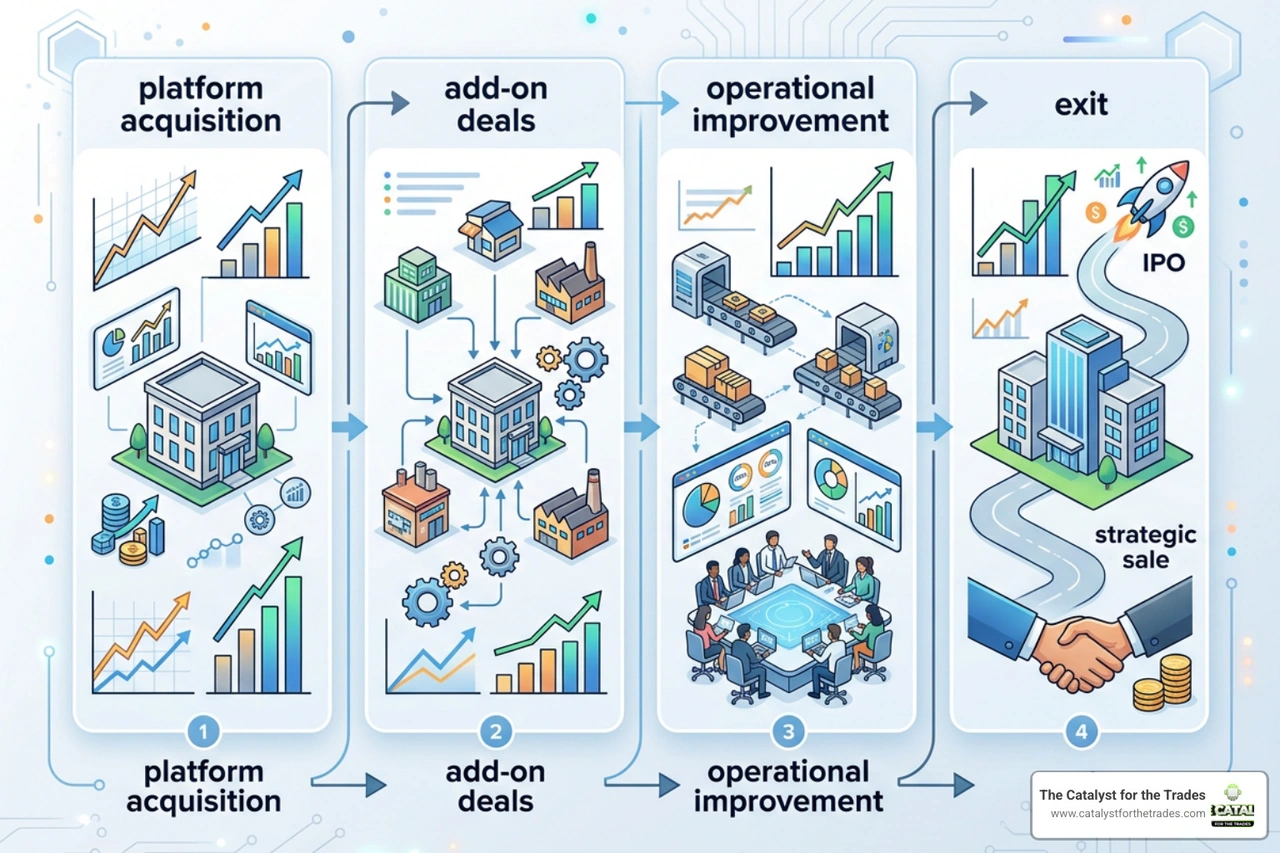
Here is how the roll-up playbook works in practice, broken down into four distinct phases:
Phase 1: Platform Acquisition
The PE firm buys a high-quality platform business (e.g., a commercial mechanical contractor generating $5 million in EBITDA) at a premium multiple of 8x EBITDA. The transaction value is $40 million. The founder rolls over 20% of their equity to stay aligned with the business, receiving $32 million in cash and keeping an $8 million equity stake in the new platform.
Phase 2: The Add-On Campaign
Over the next 24 to 36 months, the platform acquires five smaller, independent contractors in neighboring markets. Each of these add-ons generates $1 million in EBITDA, but because they are smaller and owner-dependent, the PE firm buys them at an average multiple of 4.5x EBITDA.
- Total investment for the five add-ons: $22.5 million.
- Combined EBITDA added to the platform: $5 million.
Phase 3: Operational Improvement & Integration
The PE firm’s operating partners step in to professionalize the combined entity. They standardize service delivery, implement route-optimization software, consolidate purchasing power with suppliers, and build a centralized call center.
- Through these synergies, the EBITDA of the five acquired add-ons increases by 20% to 40% in the first year.
- The original $5 million in add-on EBITDA grows to $6.5 million.
- Combined with organic growth of the platform, the total EBITDA of the consolidated business reaches $13 million.
Phase 4: The Exit (Multiple Arbitrage)
After 5 years, the PE firm packages this consolidated $13 million EBITDA business and sells it to a larger global buyout fund or a sovereign wealth fund. Because the business is now a massive, diversified regional powerhouse with institutional systems, it commands a premium exit multiple of 12x EBITDA.
- Final Valuation: $156 million.
- The Arbitrage: The PE firm bought the add-ons at 4.5x EBITDA and sold them as part of the larger group at 12x EBITDA. This “multiple expansion” is where the real wealth is created in private equity.
For the platform founder who rolled over 20% of their equity, this exit represents a massive “second bite of the apple,” often yielding a payout larger than their initial sale. This playbook is a proven path to massive scale. For a real-world look at how scaling and exiting works in practice, read our case study on How George Donaldson Scaled a Home Services Company to 100 Million.
Impact on Operations, Culture, and the Employee Experience
When a private equity firm buys a trades business, changes are felt immediately across the entire organization. These changes impact wages, benefits, safety, technology, and culture.
Wages and Benefits
PE-backed contractors generally pay 3% to 8% higher wages than comparable independent firms. Because they operate at a larger scale, they can offer significantly better benefits packages, including comprehensive health insurance, 401(k) matching, and structured paid time off. In fact, employees at PE-backed trades firms report a 28% higher satisfaction rate with their benefits compared to those at independent firms. PE platforms also invest heavily in professional development, supporting ongoing skill advancement for their teams.
Technology Adoption
PE-backed platforms are 3x more likely to deploy advanced construction management software, drone surveying, automated scheduling, and Building Information Modeling (BIM) than independent contractors. This technology improves efficiency but requires field staff to adapt to structured, data-driven workflows.
Safety Performance
Safety is a major focus for PE investors, primarily because a poor safety record increases insurance costs and limits the ability to bid on large projects. PE-backed platforms typically enforce strict safety protocols, resulting in an average Experience Modification Rate (EMR) of 0.78, compared to the industry average of 1.00.
The Cultural Shift and Retention Challenges
While the financial and technological benefits are clear, the transition from a family-owned business to a PE-backed corporate structure can be challenging. Family-oriented cultures are often replaced by KPIs, structured reporting, and a focus on metrics.
This cultural shift can lead to retention challenges:
- First-Year Employee Turnover: 24% at PE-acquired firms compared to the 18% industry average.
- Key Employee Retention: Only 64% of key managers and project leaders remain with the company after their initial retention agreements expire.
Founders must carefully manage this transition to protect their team and preserve the legacy they built. To see a practical example of how a founder successfully navigated rapid growth and a clean exit, check out our article From Startup to Successful Exit in 4 Years: How Ray Reyes Did It.
How Independent Contractors Can Succeed and Grow
As PE-backed giants expand, independent contractors often look for ways to thrive in their local markets. PE-backed platforms have unique operational structures, and nimble independent contractors can leverage several key strategies to succeed and grow:
1. Double Down on Local Relationships
The trades have always been, and will always be, a relationship-driven business. PE-backed platforms often centralize their customer service, replacing local dispatchers with out-of-state call centers. Independent contractors can win by maintaining deep local ties, providing personalized service, and ensuring customers talk to a local expert every time they call.
2. Focus on Niche Specialization
PE platforms thrive on high-volume, repeatable services (like residential equipment swap-outs or standard preventive maintenance). They struggle with highly complex, custom, or specialized projects that require deep technical expertise. By specializing in high-skill niches, independent contractors can protect their margins and avoid direct overlap with the volume-driven giants.
3. Leverage Speed and Agility
Large corporate platforms are often slowed down by administrative layers, standardized bidding templates, and multi-tiered approval processes. Independent contractors can succeed by being faster—delivering proposals in hours instead of days and responding to emergency service calls with unmatched speed.
4. Build Your Business with the End in Mind
Whether you plan to operate long-term or eventually sell, the best defense is a well-run business. By documenting your processes, building a strong local brand, and optimizing your operations, you make your business highly resilient. For strategic advice on how to build a business that stands out in a consolidating market, listen to our podcast episode on Building Your Business with an Exit in Mind: Strategic Insights for Home Service Entrepreneurs.
Frequently Asked Questions About Private Equity in the Trades
How does private equity affect construction market and bidding dynamics?
PE-backed contractors change local bidding dynamics in distinct ways. When entering a new geographic market, a PE-backed platform may bid strategically on major projects to secure a backlog and establish a local presence. Over the long term, however, PE platforms focus on protecting their margins. Because they carry corporate overhead, they focus on high-value projects, which allows efficient independent operators to find ample opportunities in other segments of the market.
What is the forecast for private equity trades acquisitions in 2026?
The momentum of private equity acquisitions in the trades remains incredibly strong through 2026. With $2.6 trillion in global private equity dry powder waiting to be deployed, fund managers are under pressure to invest capital. Because the trades have proven to be highly recession-resistant and cash-flow-stable, the sector remains a top priority. We expect the consolidation wave to continue for several more years until the market becomes highly consolidated, at which point the focus will shift from buying small firms to merging large regional platforms.
What are the biggest deal killers during private equity due diligence?
Private equity firms conduct rigorous due diligence, and many deals fall apart at the finish line. The most common deal killers include:
- Work-in-Progress (WIP) Discrepancies: Inconsistent accounting of project revenue and margin fade over multiple quarters.
- Extreme Owner Dependence: A business that cannot function without the founder’s daily involvement.
- High Customer Concentration: Having a single client represent more than 15% of annual revenue.
- Messy Financials: Mixing personal and business expenses, or relying on basic spreadsheets instead of GAAP-compliant accounting.
To ensure your business passes the test, careful preparation is required. Review our essential checklist on Business Transition Planning.
Conclusion
Private equity has fundamentally changed the landscape of the trades industry. The influx of $12 billion in capital since 2024 has driven up valuations, professionalized operations, and presented business owners with exit opportunities that did not exist a decade ago. However, navigating this corporate landscape requires a strategic approach.
At The Catalyst for the Trades, hosted by Jennifer Bagley and Chuck Staszkiewicz, we help home service and specialty trades business owners navigate this changing market. Whether you want to scale your business using modern operational strategies, protect and grow your independent brand, or prepare your company for a premium platform acquisition, we provide the real-world experience and technical insights you need.
To learn more about preparing your business for a successful transaction, read our expert guide on How to Build a Sellable Trades Business: Insights from a 3.7 Billion Advisor.


