Learn · February 7, 2026
Geo marketing: Master 2026's Critical Strategy
Unlock business growth with geo marketing! Target customers, optimize campaigns, and drive sales using powerful location intelligence strategies.
By The Catalyst Editorial Team Operator education · 17 min read · Updated July 24, 2026

Why Location Intelligence Matters for Home Service Businesses

Geo marketing is a strategy that uses geographic location data to target and reach customers with highly relevant advertising and offers based on where they live, work, or travel. For home service business owners, this means you can show your HVAC, plumbing, or electrical services to homeowners in specific neighborhoods—right when they’re most likely to need you.
Quick Answer: What is Geo Marketing?
- Definition: Marketing that targets customers based on their physical location using GPS, IP addresses, and mobile device data
- How It Works: Collects location data, analyzes customer patterns, and delivers personalized messages to people in specific areas
- Key Benefit: Increases sales by reaching the right customers at the right time—research shows location-based marketing boosts campaign effectiveness by up to 80%
- Common Uses: Targeting nearby neighborhoods, sending promotions during local weather events, reaching customers near competitor locations
The challenge for trades business owners is clear: you serve specific geographic areas, but traditional advertising wastes money reaching people far outside your service zone. Geo marketing solves this by letting you focus every dollar on homeowners you can actually serve. Almost 9 in 10 marketers report that location-based advertising led to higher sales, and 86% say it helped grow their customer base.
Ready to turn your service area into a strategic advantage? Discover how technology strategy drives business growth, and explore how The Catalyst for the Trades helps home service businesses scale.
Geo marketing further reading:
What is Geomarketing and How Does It Work?
At its heart, geo marketing (also known as marketing geography) is all about leveraging geographic information to plan and execute marketing activities. Think of it as putting your business on the map, literally and figuratively, to connect with customers more effectively. This isn’t just about knowing what city someone is in; it’s about understanding the nuances of their location to deliver highly relevant messages.
Traditional marketing often casts a wide net, hoping to catch a few fish. Geo marketing, however, uses location data to refine that net, ensuring we’re fishing in the right ponds at the right time. For home service businesses, this means less wasted ad spend and more engagement from genuinely interested homeowners.
Core Technologies and Data Sources
The magic behind geo marketing lies in its ability to gather and analyze various forms of location data. This data is the fuel that powers our targeted campaigns.
- Mobile device data: With the number of mobile phone users worldwide predicted to reach 4.8 billion, our smartphones are treasure troves of location information. These devices constantly communicate their position through various means.
- GPS signals: Global Positioning System (GPS) is perhaps the most well-known source, providing highly accurate location data, often within a few meters. When a homeowner uses a mapping app or checks into a location, their GPS is at work.
- IP addresses: Every device connected to the internet has an Internet Protocol (IP) address. IP geolocation uses this address to determine a user’s approximate geographic location, allowing us to target ads to specific regions, cities, or even neighborhoods when they browse the web.
- Wi-Fi networks and Cell Tower Triangulation: Less precise than GPS but still valuable, Wi-Fi networks and cell tower triangulation help pinpoint locations, especially indoors where GPS signals might be weak.
- App and browser data: Beyond just GPS, mobile apps and web browsers collect a wealth of first-party data, including check-ins, search patterns, and behavioral signals that indicate location preferences or intentions. This can tell us if a homeowner is searching for “HVAC repair near me” or browsing local plumbing services.
- Geographic Information Systems (GIS) software: These powerful tools are central to geo marketing. GIS software allows us to display, analyze, and interpret data that is linked to a geographic region. We can layer demographic information, customer records, and service call history onto digital maps to visualize trends and identify opportunities.
By integrating this data into our Customer Relationship Management systems, we can build a comprehensive understanding of our customers, not just who they are, but where they are.
Understanding Your Customer’s Location
Understanding our customers goes beyond knowing their address. It involves delving into their habits, needs, and preferences based on their location. This is where customer segmentation and geographic segmentation become invaluable.
- Customer segmentation: This involves grouping customers based on shared characteristics. When we add location to the mix, we create powerful geographic segments.
- Geographic segmentation: This practice groups audience members based on where they live, work, and shop. These groupings can be broad (like an entire state) or incredibly narrow (a specific postal code or even a street). Types of geographic segmentation include:
- Location-based: Targeting by country, city, or neighborhood.
- Culture-based: Adapting messages for local customs or languages (though less common in home services within a consistent language area, it’s still about local nuance).
- Time-zone: Crucial for scheduling communications to ensure they land at an optimal time.
- Population-based: Distinguishing between urban, suburban, and rural areas, as needs for home services might differ significantly.
- Climatic and seasonal: Essential for home services, as demand for HVAC, plumbing, or electrical work often correlates with weather patterns.
- Behavioral signals: What homeowners search for, what websites they visit, and what apps they use can provide clues about their needs. Combining these signals with their location gives us a powerful targeting capability.
- Historical visitation data: By analyzing where customers have been in the past, we can infer their routines and interests. For example, if a homeowner frequently visits home improvement stores, they might be a good target for our services.
- Real-time location: This allows for immediate, hyper-relevant interactions. Imagine sending a notification about our emergency plumbing services when a customer is detected in an area known for recent pipe bursts. It’s about being there when they need us most.
To truly excel, we must continuously adapt to evolving consumer behaviors. Learn more about adapting to consumer behavior and leveraging AI and digital tools in the trades.
Here’s a quick look at how different location-based strategies stack up:
| Feature | Geotargeting | Geofencing | Geo-conquesting |
|---|---|---|---|
| Definition | Delivers content/ads based on broad geographic location (city, region, IP address). | Creates a virtual boundary, triggering actions when users enter/exit. | Targets users near competitor locations to divert them. |
| Precision | Moderate to High (country, city, zip code) | High (specific radius around a point of interest) | High (specific radius around a competitor’s location) |
| Timing | Can be real-time or historical | Real-time, immediate triggers | Real-time, immediate triggers |
| Primary Goal | Reach relevant audiences in a specific area | Engage users in a defined physical space | Capture customers from competitors |
| Use Case | Showing ads for seasonal HVAC tune-ups to homeowners in a specific region. | Sending a push notification about a plumbing special when a customer drives near our office. | Offering a discount on electrical panel upgrades to homeowners near a competitor’s showroom. |
Strategic Applications for Business Growth
Geo marketing isn’t just a fancy buzzword; it’s a powerful tool that can drive significant business growth strategies for home service companies. By understanding the “where,” we can make smarter decisions about everything from where we focus our advertising to how we structure our operations.
- Market analysis: We can use geo marketing to analyze local markets, identifying areas with high demand for our services, understanding demographic profiles, and spotting underserved neighborhoods. This helps us predict where our services are likely to be most popular.
- Site selection: While home service businesses don’t typically have retail storefronts, we do have operational hubs. Geo marketing can help us choose optimal locations for new offices, equipment storage, or even technician dispatch points, based on customer density and service call patterns.
- Campaign optimization: By targeting ads to specific geographic areas, we ensure our marketing budget is spent efficiently. This means our messages about furnace maintenance or water heater installation reach homeowners who actually need those services, not someone across the country.
- Competitive intelligence: Geo marketing allows us to understand our competitive landscape better. Through geo-conquesting, for example, we can identify areas where competitors are active and strategically place our ads to attract homeowners looking for alternatives. This forms a core part of our competitive strategy.
- Sales territory mapping: For larger home service companies, geo marketing is essential for defining and optimizing sales territories. We can ensure fair distribution of leads, minimize travel times for technicians, and maximize our market penetration in key areas. This contributes to a robust strategic planning process.
Using Geo Marketing for Home Services
For home service businesses, geo marketing offers a unique advantage, allowing us to connect with homeowners precisely when and where they need us.
- Targeting specific neighborhoods: We can tailor campaigns to specific neighborhoods based on average home age (indicating potential HVAC or plumbing upgrades), income levels, or even common issues reported in that area. Imagine advertising sewer line inspections specifically in older neighborhoods.
- Optimizing technician routes: By analyzing service call locations and technician availability in real-time, we can optimize routes, reducing fuel costs and response times. This directly contributes to operational efficiency and customer satisfaction.
- Promoting seasonal services: The seasons are our cue! We can target homeowners with ads for AC tune-ups in spring, furnace checks in fall, or drain cleaning specials after heavy rains. This proactive approach helps us capture demand at its peak.
- Emergency service call targeting: When a pipe bursts or an AC goes out in the middle of summer, homeowners need immediate help. Geo marketing allows us to quickly target homeowners in a specific affected area with ads for our 24/7 emergency services, providing rapid assistance and peace of mind.
- Local event promotion: If there’s a community fair or a local sports event, we can use geo marketing to promote our services to attendees, perhaps with a special “fair-day discount” on appliance checks.
These localized strategies are vital for home service business growth, ensuring we’re always top-of-mind for homeowners in our service areas.
Measuring the ROI of Your Campaigns
Knowing that our geo marketing efforts are working is crucial. We can’t just set it and forget it; we need to measure the return on investment (ROI) to continually optimize our strategies.
- Key metrics: We track various indicators to gauge success, including ad impressions, click-through rates, website visits from targeted areas, and most importantly, actual service calls and conversions.
- Foot traffic attribution: For businesses with physical offices or showrooms, tools like Cuebiq can provide aggregated, anonymized foot traffic data. This helps us correlate our geo marketing campaigns with the number of people who physically visit our locations after seeing an ad.
- Store visit conversions: Platforms like Google’s store visit conversions and Meta’s offline conversion tracking allow us to connect online ad exposure to real-world actions. These tools can match mobile ad views to credit card transactions or loyalty program data, showing us how many homeowners who saw our ad actually booked a service.
- Offline conversion tracking: This is particularly powerful for home services. We can link a homeowner’s interaction with a location-based ad to a subsequent phone call, quote request, or booked appointment. This provides a clearer picture of how our digital efforts drive tangible business outcomes.
By carefully tracking these metrics, we gain valuable insights for lead conversion optimization and can make data-driven decisions. This process is greatly improved by AI business intelligence tools that can analyze vast datasets and highlight performance trends.
Real-World Impact: Success Stories and Key Benefits
The effectiveness of geo marketing isn’t just theoretical; it’s proven by numerous success stories and powerful statistics. This approach delivers tangible benefits that translate directly to our bottom line and customer satisfaction.
Here are some key benefits backed by compelling statistics:
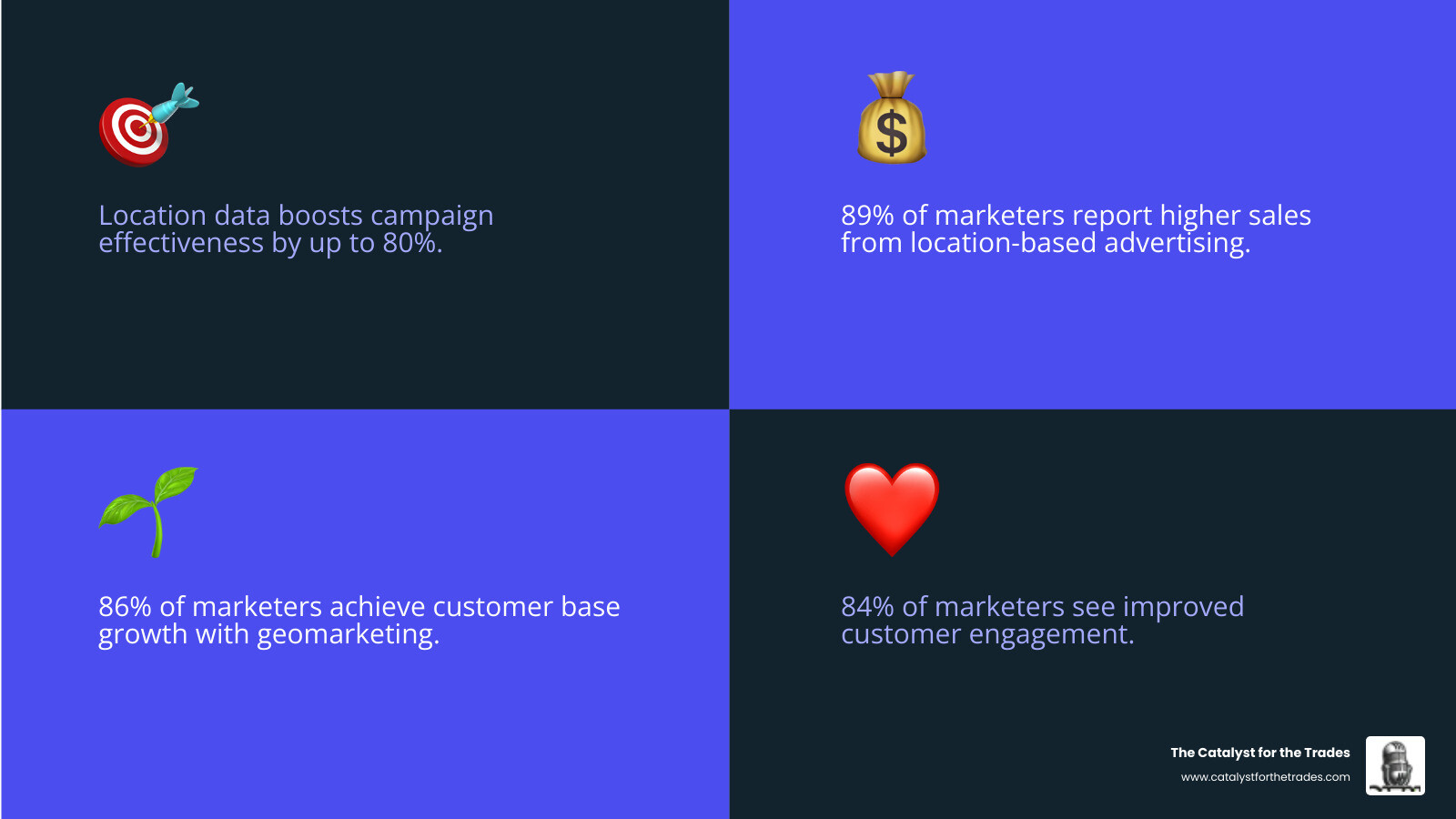
- Location data is proven to boost the effectiveness of marketing campaigns by up to 80%.
- Almost 9 in ten marketers said location-based advertising and marketing led to higher sales.
- 86% of marketers said location marketing helped grow their customer base.
- 84% of marketers said location marketing led to higher customer engagement.
Let’s look at how these benefits play out in real-world scenarios:
- Increased store visits: Even if we don’t have a traditional “store,” increased visits can mean more calls to our office, more website inquiries, or more booked appointments.
- Denny’s saw a 34% increase in in-store visits by targeting customers likely to visit based on in-store behavior and previous visits. This shows the power of combining location with behavioral data.
- Timberland increased store visits by 6% by targeting urban adventurers near their stores.
- Currys PC World increased store visits by 12% using audience and location targeting.
- Improved ad relevance: When we know where a homeowner is, we can show them ads that are genuinely useful to them. A homeowner in a cold climate will appreciate an ad for furnace repair, while someone in a warmer region might need AC maintenance. This hyper-relevance makes our marketing messages stand out.
- Improved customer experience: By delivering timely and relevant offers, we improve the customer experience. Imagine receiving a reminder for an annual HVAC check-up just as the seasons change, custom to your local weather patterns. It feels less like an ad and more like a helpful service. This focus on personalized, timely communication is a cornerstone of a strong customer service strategy.
One of the most famous examples of geo marketing in action is Burger King’s “Whopper Detour” campaign. They created a 600-foot geofence around McDonald’s restaurants. When customers entered this geofenced area, the Burger King app sent them a promotion for a 1-cent Whopper, navigating them to the nearest Burger King. This clever geo-conquesting tactic effectively diverted potential customers from a competitor, showcasing the power of precise location targeting.
The Future of Location: AI, Ethics, and Measurement
The landscape of geo marketing is constantly evolving, with artificial intelligence (AI) playing an increasingly pivotal role. As we look ahead, we must also address the critical ethical considerations surrounding location data.
- The role of AI: AI is changing geo marketing from a reactive strategy to a predictive one.
- Predictive analytics: AI can analyze vast amounts of historical and real-time location data to predict customer needs, optimal service times, and even potential equipment failures. For home services, this means we can anticipate when a homeowner might need a new water heater or an AC repair before they even realize it, allowing us to offer proactive solutions. This is a key component of our contractor AI strategy.
- Generative content: AI can help create highly localized and personalized marketing messages at scale. Imagine AI generating ad copy that speaks directly to the specific concerns of a particular neighborhood, referencing local landmarks or common issues.
- Ethical considerations: With great power comes great responsibility. The use of location data raises significant ethical questions regarding privacy. Consumers are increasingly concerned about how their personal information is collected and used. In fact, data privacy and security rank as one of Americans’ biggest concerns. While 64% of consumers prefer personalized experiences, only about 18% trust brands to use their location for targeting.
- Data privacy: We must prioritize data privacy. This means implementing robust security measures, anonymizing data where possible, and always respecting customer preferences.
- GDPR and CCPA compliance: Regulations like the General Data Protection Regulation (GDPR) in Europe and the California Consumer Privacy Act (CCPA) have reshaped how businesses can collect and use location data. These laws require explicit opt-in consent and provide individuals with greater control over their data. We must ensure our geo marketing practices are fully compliant with all applicable privacy laws.
- Building customer trust: Transparency is key. We need to clearly communicate what data we collect, how we use it, and the value we provide in return for that information. Offering clear benefits, like personalized discounts or timely service reminders, can incentivize homeowners to share their location data.
As AI continues to disrupt the marketing landscape, including how search engines operate, understanding these dynamics is crucial. Learn more about how AI is disrupting SEO and why contractors can’t ignore it.
Getting Started with Your Geo Marketing Strategy
Starting on a geo marketing journey doesn’t have to be overwhelming. By following a structured approach, we can effectively integrate location intelligence into our overall marketing efforts.
- Define campaign goals: Before we do anything, we need to know what we want to achieve. Are we aiming to increase emergency service calls by 15% in a specific area? Boost seasonal tune-up bookings by 20%? Clear, measurable goals will guide our strategy and help us track success.
- Identify target audience: Who are the homeowners we want to reach? What are their demographics, needs, and behaviors? Combining this with location data creates powerful audience segments.
- Choose the right geographic boundaries: This could be a specific radius around our office, a set of zip codes, or even individual neighborhoods. The key is precision.
- Best practices for implementation:
- Start small: Begin with pilot programs in a limited area to test effectiveness before scaling up.
- Prioritize privacy compliance: Always ensure our practices meet data protection regulations and build transparent opt-in processes.
- Invest in integration capabilities: Connect geo marketing tools with our existing CRM, marketing automation, and analytics platforms for a holistic view.
- Focus on value: Ensure every location-based message offers genuine value to the homeowner.
- Continuously review and update location data: Sales trends and demographics can change rapidly, so our data needs to be current.
This strategic approach aligns with our broader innovation strategy, ensuring we’re always leveraging cutting-edge techniques to serve our customers better.
Essential Tools for Geo Marketing
To successfully implement a geo marketing strategy, we need the right tools in our arsenal. These technologies help us collect, analyze, and act on location data.
- GIS platforms: Geographic Information Systems (GIS) software are foundational. They allow us to visualize customer data, service areas, and demographic information on digital maps, providing a powerful analytical lens.
- Mobile advertising platforms: Major platforms like Google Ads and social media advertising tools (Facebook, Instagram, Snapchat, LinkedIn) offer robust location targeting capabilities. They allow us to define specific geographic areas for our campaigns.
- Social media location features: These platforms allow users to check in, tag locations, and share their whereabouts. We can leverage these features for localized content and engagement.
- Analytics and measurement tools: Beyond the advertising platforms themselves, dedicated analytics tools help us track campaign performance, attribute conversions, and measure ROI. Examples include Google Analytics, and specialized foot traffic attribution platforms.
Investing in these tools is a crucial part of our technology implementation strategy, ensuring we have the infrastructure to support our geo marketing efforts.
Best Practices for Effective Geo Marketing
To truly excel at geo marketing, we need to adhere to a set of best practices that prioritize both effectiveness and customer trust.
- Offer value exchange: Homeowners are more willing to share their location data if they receive a clear benefit in return. This could be a personalized discount, a timely service reminder, or valuable local information.
- Ensure transparency: Be upfront about data collection and usage. Provide clear opt-in and opt-out options, and make your privacy policy easily accessible. Trust is built on transparency.
- Maintain data accuracy: Outdated or inaccurate location data leads to wasted efforts and frustrated customers. Regularly update and refine your data sources to ensure precision.
- Test and optimize campaigns: What works in one neighborhood might not work in another. A/B test different messages, offers, and geographic boundaries to find what resonates best with each segment. Continuously analyze performance and make adjustments.
- Integrate with overall marketing strategy: Geo marketing shouldn’t be a standalone effort. Integrate it seamlessly with our broader marketing activities, including our content marketing, email campaigns, and customer service initiatives. This creates a cohesive and powerful customer journey.
By following these best practices, we can refine our sales process optimization and ensure our geo marketing campaigns are not only effective but also build lasting customer relationships.
Conclusion
Geo marketing is more than just a trend; it’s a fundamental shift in how we connect with homeowners in the home service industry. By using location data intelligently, we can transform our marketing from a broad guessing game into a precise, highly effective strategy. For home service businesses, this means focusing our efforts where they matter most: on the homes and neighborhoods we serve.
We’ve seen how geo marketing allows us to understand our customers’ needs based on their location, optimize our service delivery, and measure the real-world impact of our campaigns. From targeting specific neighborhoods for seasonal promotions to quickly reaching homeowners in emergency situations, location intelligence gives us an unparalleled advantage.
As technology continues to advance, especially with the integration of AI, geo marketing will only become more sophisticated, offering even greater opportunities for hyper-personalization and proactive service. By embracing these advancements while upholding ethical data practices, we can future-proof our businesses and build deeper trust with our communities.
At The Catalyst for the Trades, we believe that combining cutting-edge tech insights with real-world industry experience is the key to success. Geo marketing is a prime example of how smart technology can empower us to serve our customers better and drive sustainable growth. By mapping our path to customers with precision, we ensure every marketing dollar works harder, bringing us closer to the homeowners who need our expertise most.
Ready to leverage location intelligence to transform your home service business? Find how tech-savvy contractors will win with e-commerce, AI, and the lean business revolution.
Learn more about our business growth strategies and let us help you chart your course to success.


