Learn · June 25, 2026
How Much Should a Trades Business Spend on Digital Marketing in 2026?
Learn how much should a trades business spend on digital marketing with proven 2026 budget frameworks, ROI tracking, and channel allocation strategies.
By The Catalyst Editorial Team Operator education · 12 min read · Updated July 24, 2026

The Real Answer to How Much a Trades Business Should Spend on Digital Marketing
Knowing how much should a trades business spend on digital marketing is one of the most common — and most poorly answered — questions in the home services industry. Most advice falls back on vague rules like “spend 5 to 10 percent of revenue,” which tells you almost nothing useful when you’re trying to decide whether to put another dollar into Google Ads or finally fix your website.
Here is a quick-reference answer based on 2026 industry benchmarks:
| Business Mode | % of Gross Revenue |
|---|---|
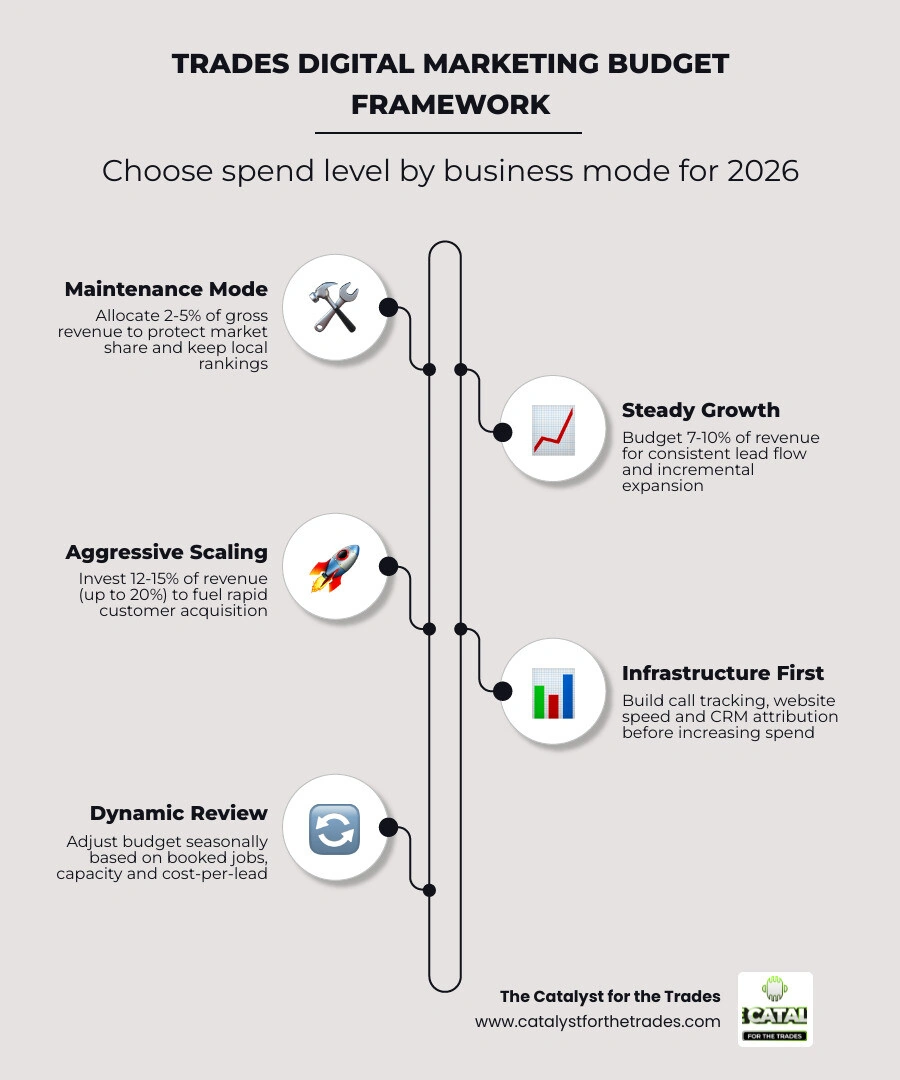
| Maintenance (holding steady) | 2% – 5% |
| Steady growth | 7% – 10% |
| Aggressive scaling | 12% – 15% (up to 20%) |
The U.S. Small Business Administration recommends 7 to 8 percent of gross revenue for businesses doing under $5 million in annual sales. Across all industries, the 2025 average sits at 7.7 percent of revenue, according to Gartner. For trades businesses competing in paid search and Local Services Ads, many land between 7 and 12 percent.
But the percentage is only part of the story. A trades business spending 10 percent of revenue with no call tracking, a slow website, and a weak follow-up process will get far worse results than one spending 7 percent with clean attribution and a tight sales process.
This guide breaks down the right numbers for your revenue level, the channels worth prioritizing, the infrastructure costs most owners forget to budget for, and how to know when your spend is actually working.
How Much Should a Trades Business Spend on Digital Marketing?
To determine exactly how much should a trades business spend on digital marketing, we have to look past the generic corporate advice and focus on the unique realities of the home services sector. In our work on The Catalyst for the Trades Podcast, we frequently discuss how trades businesses operate under different constraints than traditional retail or software companies. You deal with physical service areas, immediate dispatch needs, crew capacity limits, and seasonal weather changes.
Because of this, your digital marketing budget cannot be a static, set-it-and-forget-it expense. It must function as a dynamic system. If you are in maintenance mode—meaning your schedules are full, you have strong customer retention, and your goal is simply to protect your market share—a modest allocation of 2% to 5% of your gross revenue is usually sufficient. This keeps your brand visible and maintains your local search rankings.
However, if you are looking to expand your team, add new trucks, or enter a new service area, you need a steady growth budget of 7% to 10% of your gross revenue. For those looking to dominate a highly competitive metropolitan market or scale rapidly, an aggressive scaling budget of 12% to 15% (and sometimes up to 20% for brand-new operations) is required. To build a comprehensive roadmap for this type of expansion, check out our guide on Contractor Marketing Strategy Best 2026.
Determining How Much Should a Trades Business Spend on Digital Marketing Based on Revenue Tiers
As your business grows, your marketing needs and operational capabilities shift. A solo operator running one truck has vastly different cash flow constraints and lead requirements than a multi-location enterprise.
Here is how we recommend structuring your digital marketing allocation across different revenue tiers:
| Annual Revenue Tier | Recommended Budget Range (% of Revenue) | Primary Focus Areas |
|---|---|---|
| Under $250k | 3% – 8% | Google Business Profile optimization, gathering reviews, basic localized organic reach. |
| $250k – $500k | 5% – 10% | High-intent local search ads, professional website optimization, basic lead tracking. |
| $500k – $1M | 7% – 12% | Local SEO, Google Local Services Ads (LSAs), automated review generation, email reactivation. |
| $1M – $3M | 7% – 10% (Steady) / 12% – 15% (Aggressive) | Multi-channel search campaigns, CRM integration, advanced call tracking, local brand building. |
| $3M – $10M | 6% – 10% | Database monetization, advanced automation, localized social proof, team dispatcher training. |
| $10M+ | 4% – 8% | Brand authority, market-wide display ads, community sponsorships, advanced AI-driven retention. |
For a deeper dive into scaling your operations and matching your team’s capacity to your lead flow as you move through these tiers, explore our resource on Business Growth Strategies.
Choosing Your Budgeting Method: Revenue vs. Gross Profit vs. Goals
While using a flat percentage of gross revenue is the fastest and easiest way to establish a baseline, it is not the only method—nor is it always the safest for trades businesses with fluctuating material costs. We recommend exploring three distinct budgeting approaches to see which fits your operational model:
- The Revenue-Based Method: This is the standard approach where you take a fixed percentage (e.g., 8%) of your gross revenue and allocate it to marketing. It is simple to calculate, but its main flaw is that it does not account for changes in your profit margins.
- The Gross Profit-Based Method: This is a much safer approach for trades businesses with highly variable job mixes (such as a plumbing company that does both cheap drain cleanouts and high-margin sewer line replacements). By basing your marketing budget on a percentage of your gross profit rather than gross revenue, you protect your margins and ensure you aren’t overspending on marketing during months when expensive equipment or material costs eat into your cash flow.
- The Goal-Based Method (The “Unit Economics” Method): Here, you reverse-engineer your budget based on your growth targets. You calculate how many new customers you need to hit your revenue goals, determine your average customer acquisition cost (CAC) and customer lifetime value (LTV), and multiply the two. A healthy rule of thumb for trades businesses is maintaining an LTV-to-CAC ratio of at least 3:1.
To master these financial metrics and ensure your marketing expenses align with your operational cash flow, read through our guide on Business Growth and Operations Keywords.
Allocating Your Budget Across High-ROI Digital Channels
Once you have established your total budget, the next challenge is deciding where to put the money. Spreading your budget too thin across ten different marketing channels is a recipe for mediocrity. Instead, we advocate for the 70-20-10 framework:
- 70% of your budget should go into proven, high-ROI search channels that capture active demand (such as local SEO and paid search).
- 20% of your budget should target emerging growth opportunities (such as targeted social media campaigns or database reactivation).
- 10% of your budget should be reserved for experimental tactics (such as localized influencer partnerships or brand awareness tests).

Choosing the right mix of channels depends heavily on whether your services are high-intent “emergency” jobs (like a broken AC in July) or longer-cycle “quote-based” projects (like a kitchen remodel). To understand how to align your channels with buyer intent, read our Search Marketing Complete Guide.
Prioritizing SEO and Organic Traffic Growth
If you want the lowest possible cost per lead over the long term, you must invest in search engine optimization. Unlike paid ads, which stop generating leads the moment you turn off the budget, SEO builds compounding equity. When you optimize your website and Google Business Profile properly, you earn free, highly qualified local traffic month after month.
An effective local SEO strategy for contractors involves creating helpful content that answers your customers’ actual questions, optimizing your local service pages, and generating a steady stream of positive reviews. To build a foundation that keeps your business ranking ahead of local competitors, consult our guides on SEO for Contractors and Organic Traffic Growth.
Paid Acquisition and Google Local Services Ads (LSAs)
While SEO is the long game, paid acquisition is your primary engine for immediate leads. For home service business owners, we recommend starting with Google Local Services Ads (LSAs) before scaling into traditional Google Search Ads. LSAs position your business at the very top of search results with a “Google Screened” or “Google Guaranteed” badge, and you only pay when a customer actually calls or messages you through the platform.
Once your LSAs are performing consistently, you can expand into Google Search Ads to target specific high-value keywords. However, paid search requires careful conversion optimization and negative keyword management to avoid wasting money on irrelevant clicks. To optimize your local ad spend, read about our approach to Cortex Local Marketing.
Foundational Marketing Infrastructure and Tracking Costs
One of the biggest mistakes we see trades business owners make is dedicating 100% of their marketing budget to ad spend while investing nothing in the infrastructure required to capture those leads. If your website is slow, hard to navigate on a mobile phone, or lacks clear calls to action, you are essentially throwing your ad budget away.
A healthy marketing budget must fund your foundational “tracking stack” before you scale up your ad spend. This includes:
- A conversion-focused website that loads quickly and makes it incredibly easy for a homeowner to call or book an appointment.
- Call tracking software (such as CallRail) to assign unique phone numbers to each marketing channel, letting you know exactly which ads are driving phone calls.
- CRM integration (such as ServiceTitan or Jobber) to tie those incoming calls back to booked jobs and actual revenue.
Without this infrastructure, you are simply guessing which marketing channels are profitable. To set up clean lead tracking and attribution, refer to our resource on Marketing Attribution.
Factoring AI and Automation into Your Budget
In 2026, smart trades businesses are using AI and automation to maximize their existing marketing budgets without hiring massive administrative teams. These tools act as a force multiplier for your marketing spend.
For example, implementing an automated missed-call text back system ensures that if your office misses an incoming call from an ad, the lead immediately receives a text message offering assistance. This single automation can prevent high-intent leads from immediately calling your closest competitor. Additionally, automated review generation and automated email/SMS estimate follow-up sequences help you monetize your existing database for a fraction of the cost of cold lead acquisition. To explore how these tools can lower your customer acquisition costs, read our guides on AI Customer Acquisition and Cortex AI SEO.
Measuring ROI and Adjusting Your Spend Seasonally
A report full of clicks, impressions, and likes is meaningless if it does not translate to booked jobs and healthy profit margins. To measure the true success of your digital marketing budget, you must track these core operational metrics:
- Cost Per Booked Job: How much marketing spend is required to get a technician dispatched to a home?
- Close Rate by Source: Are leads from Google Ads closing at a higher or lower rate than leads from local SEO?
- Missed-Call Rate: What percentage of your hard-earned marketing calls are going to voicemail? (If this is over 5%, fix your phones before spending another dollar on ads!)
Your marketing budget must also adapt to seasonality. During peak seasons (like extreme summer heat or winter freezes), organic demand naturally spikes. You can often scale back your paid ad spend slightly or shift those dollars toward capturing high-value replacement jobs. Conversely, during the “shoulder months,” you should increase your marketing focus on database reactivation, maintenance agreements, and targeted promotions to keep your crews busy. To establish a system for tracking these returns, check out our guide on Digital Marketing ROI.
Avoiding Common Budgeting Mistakes and the 3 Percent Trap
The most dangerous financial mistake a growing contractor can make is falling into the 3 percent trap. Many mature, multi-million dollar firms can maintain their volume by spending only 3% of their revenue on marketing because they have decades of repeat business and brand equity. However, if a growing business attempts to copy this strategy, they quickly become invisible. In 2026, private equity-backed competitors are aggressively spending 8% to 15% of their revenue to capture market share, meaning a low budget will prevent you from ever scaling past your current size.
Other common budgeting mistakes include:
- Spreading your money too thin across too many channels instead of mastering one or two.
- Paying for expensive ads before your website and tracking systems are fully optimized.
- Ignoring customer retention and failing to market to your existing customer database.
- Cutting your marketing budget entirely during slow seasons, which destroys your search momentum and guarantees a dry pipeline when the season turns.
To build a balanced, resilient strategy that avoids these pitfalls, read our Home Service Marketing Complete Guide.
Frequently Asked Questions About Trades Marketing Budgets
How much should a trades business spend on digital marketing in its first year?
In your first year, you do not have a database of past customers or organic search authority to rely on. Because of this, your startup marketing budget will need to be higher as a percentage of revenue—often between 12% and 20%.
Your focus in year one should be entirely on immediate lead generation channels like Google LSAs and paid search, combined with building a professional website and aggressively gathering reviews to establish local trust. For a step-by-step roadmap for new businesses, read our Contractor Marketing Strategy Guide 2026.
Should I pause my digital marketing campaigns during the slow season?
No, pausing your campaigns entirely is usually a major mistake. For channels like SEO, stopping your efforts will cause you to lose search rankings that can take months to rebuild. For paid search, completely pausing campaigns resets Google’s machine-learning data, leading to higher costs when you turn them back on.
Instead, reduce your paid ad budget by 30% to 50% during slow months, narrow your geographic targeting to your most profitable neighborhoods, and shift your focus to maintenance plans and database reactivation. To learn more about targeting specific neighborhoods during slower seasons, explore our guide on Geo Marketing.
How do I know if my digital marketing budget is actually working?
Your marketing budget is working if it generates a minimum 3:1 return on investment (ROI)—meaning every dollar spent on marketing yields at least three dollars in gross revenue—and if your cost per booked job remains profitable.
You must track your leads from the initial click all the way to the final invoice in your CRM. If you are seeing high traffic but no booked jobs, the issue is likely a breakdown in your website conversion or your office’s call-handling process. For more on tracking these metrics, see our article on Digital Marketing for Contractors.
Conclusion
Determining how much should a trades business spend on digital marketing is not about finding a magic, static percentage. It is about aligning your financial investment with your operational capacity, tracking every lead back to a booked job, and scaling your spend based on real-world performance.
When you treat your marketing budget as an investment in profitable growth rather than a business expense, you can stop relying on unpredictable word-of-mouth referrals and build a highly predictable lead generation engine.
At The Catalyst for the Trades, we specialize in helping home service businesses combine cutting-edge marketing technology with real-world operational scaling. If you are ready to stop guessing with your marketing dollars and build a custom, high-ROI budget strategy for your business, check out our guide on Digital Marketing for Contractors or listen to our latest podcast episodes for more actionable insights.


