Learn · June 26, 2026
How to Know If Your Trades Business Is Actually Profitable Not Just Busy in 2026
Discover how to know if your trades business is actually profitable not just busy with key metrics and profit strategies.
By The Catalyst Editorial Team Operator education · 12 min read · Updated July 24, 2026

Is Your Trades Business Actually Making Money — or Just Staying Busy?
How to know if your trades business is actually profitable not just busy comes down to one simple check: are you tracking what stays in your pocket after all expenses, not just what comes in the door?
Here is a quick way to assess where you stand right now:
- Check your net profit margin. Subtract all expenses — labour, materials, overheads, your own pay — from total revenue. Divide by revenue. If it is below 15%, your business may be under-billing or leaking money.
- Review your last 10 jobs. Did you track actual expenses against what you billed? If not, you do not know which jobs made money.
- Look at your bank account after a busy month. If it does not reflect the activity you put in, there is a gap between turnover and true profit.
- Ask yourself: do I know my break-even point? If you cannot answer that quickly, financial clarity is missing.
- Check how long customers take to pay. Long debtor days drain cash even when jobs are technically profitable.
Many trades business owners are genuinely working hard. The trucks are out. The phone is ringing. The calendar is full. And yet, at the end of the month, the bank account tells a very different story.
This is one of the most common and expensive traps in the trades: mistaking activity for profitability. A business with £500,000 in turnover can easily be less profitable than one turning over £200,000 — if expenses are poorly managed and margins are never tracked. High revenue feels like success, but revenue is not profit. Turnover pays your suppliers. Net profit pays you.
The uncomfortable truth is that most trades business owners have never calculated their fully loaded expense per hour, do not track profit by job, and are making billing decisions based on gut feel rather than real numbers. That is not a criticism — it is simply how the industry has operated for a long time. But in 2026, with rising expenses, late payment pressures, and tighter competition across UK trades, flying blind on your numbers is an increasingly expensive habit.
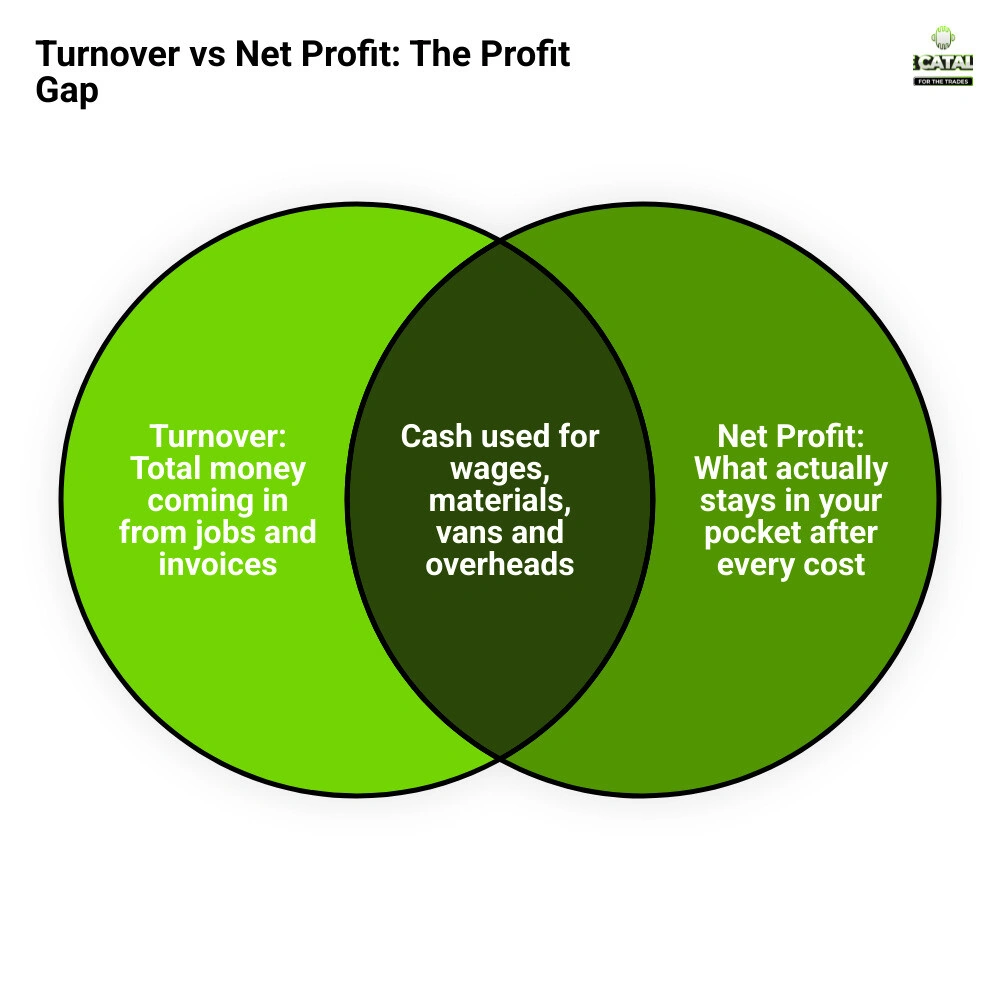
The Illusion of Activity: Busy vs. Truly Profitable
It is incredibly easy to fall into the “Effort Trap.” We often mistake motion for momentum. When you and your team are working 14-hour days, managing packed schedules, and constantly ordering parts, it feels like the business is thriving. But a packed calendar can create a false sense of security.
The market does not reward sheer effort; it rewards managed value. Many business owners confuse three fundamental financial concepts:
- Turnover (Revenue): The total amount of money that flows into your business. This is a vanity metric. You can generate hundreds of thousands of pounds, but if it required just as much outlay to deliver the work, your business is effectively a highly stressful, non-profit organisation.
- Net Profit: The money left over after every single expense has been paid. This includes materials, direct labour, subcontractor fees, insurance, fuel, software subscriptions, taxes, and your own salary. This is your sanity metric.
- Cash Flow: The physical movement of cash in and out of your bank account. You can be highly profitable on paper, but if your cash flow is poorly managed—perhaps because your clients take 45 days to pay while you must pay your merchants and team immediately—your business can still collapse.
When we look at Financial Management for Contractors, the distinction between these three elements is the foundation of long-term survival. If you do not separate turnover from net profit and cash flow, you run the risk of bankrolling your clients’ projects out of your own pocket while waiting for payments to land.
How to Know If Your Trades Business Is Actually Profitable Not Just Busy
To achieve true financial clarity, you must transition from looking at your annual accounts once a year to reviewing monthly management accounts. Annual accounts are like looking in the rearview mirror after a crash; management accounts are your real-time dashboard while driving.
If you want to escape the contractor’s trap, you need to understand where the leaks are occurring. We recommend starting with a deep dive into Know Your Numbers Grow Your Business Financial Strategies for Trades to map out your true overhead structure. When you have regular management reports, you can answer the critical questions: Which services are actually making money? Which clients are draining our resources? Are we structuring our rates to survive unexpected economic shifts?
How to Know If Your Trades Business Is Actually Profitable Not Just Busy
To calculate whether your business is genuinely profitable, we need to move past “gut feel” and look at the exact formulas that determine financial health.

True job profitability requires that we look at each project under a microscope. Here is how to calculate it step-by-step:
1. Gross Profit Margin
Gross profit is what is left after subtracting the direct outgoings of delivering a job (materials, subcontractors, and direct labour) from the project’s revenue.
- Formula:
Gross Profit = Job Revenue - Direct Outgoings - Gross Profit Margin Percentage:
(Gross Profit / Job Revenue) * 100
If you quote a job and fail to track the actual materials used or the exact hours your team spent on-site, your projected gross margin will drift. Improving this metric is the fastest way to build a sustainable business, which we discuss in detail in our guide on Increasing Service Margins.
2. Net Profit Margin
Net profit is your true bottom line. It is what remains after subtracting both your direct job outgoings and your indirect operating overheads (rent, software, administrative staff, vehicle leases, and marketing).
- Formula:
Net Profit = Revenue - (Direct Outgoings + Overhead Allocation) - Net Profit Margin Percentage:
(Net Profit / Revenue) * 100
3. Understanding Labor Burden
One of the most common errors trades owners make is using raw hourly wages to calculate job outlays. If you pay an engineer £20 per hour, that is not what they expense to the business.
Your labor burden reflects the full operational impact of an employee. It includes:
- National Insurance contributions
- Pension contributions
- Paid holiday and sick leave
- Vehicle running expenses and fuel
- Uniforms, safety gear, and specialist tools
- Non-billable training time
When you calculate your fully loaded hourly expense per technician, you will often find that an employee earning £20 per hour actually expenses the business £35 to £45 per hour to keep on the road. If you do not use this fully loaded rate in your job expense tracking, your margins are built on a fantasy.
4. Overhead Allocation
To know if a specific job is profitable, you must allocate a portion of your general and administrative (G&A) overhead to it. If your monthly overheads (office rent, admin salaries, software, insurance) total £10,000, and your team works 500 billable hours a month, every single billable hour must carry £20 of overhead just to break even.
5. Markup vs. Margin
Do not confuse markup with margin. Quoters often think in terms of markup (adding a percentage to the outlay), while business owners and accountants must think in terms of margin (the percentage of the final billing amount that is profit).
If you want a 30% gross profit margin on a job with £100 in outlays, you cannot simply mark it up by 30% (£130). A £130 sale with £100 in outlays only yields a 23% margin. To get a true 30% margin, you must divide your outlay by 0.70, resulting in a billing of £142.86.
Key Financial Metrics Every Trades Business Owner Must Track
Operating a business without tracking key performance indicators (KPIs) is like flying a plane in thick fog without instruments. To keep your business healthy, we recommend monitoring these four critical metrics monthly:
- Break-Even Point: This is the exact amount of gross profit your business needs to generate each month to cover your fixed overheads. Knowing this number tells you exactly how many days of the month your team is working just to pay the bills, and on which day you actually start making money.
- Debtor Days: This measures the average number of days it takes for your business to collect payment after an invoice is issued. In the UK construction and trades sector, late payments are a major bottleneck. Keeping this number as low as possible is essential, and we share practical ways to do this in our Cash Flow Management Tips for Contractors.
- Cash Flow Forecast: A rolling 13-week view of cash coming in and going out. This allows you to spot upcoming tax liabilities, VAT quarters, or quiet periods before they become emergencies.
- Utilization Rate: The percentage of your team’s paid hours that are actually billed to a client. If your technicians are paid for 40 hours a week but only spend 24 hours on-site doing billable work (due to travel, administrative tasks, or picking up parts), your utilization rate is 60%. Unbilled time quietly destroys profitability because it never shows up as a direct expense on a job sheet.
To help you visualize how markup affects your margins, use the comparison table below:
| Target Gross Margin | Required Markup Multiplier | Impact on Billing |
|---|---|---|
| 10% | 1.11 | Barely covers basic overheads; highly risky. |
| 20% | 1.25 | Standard for heavy commercial subcontracting. |
| 30% | 1.43 | Minimum target for standard installation work. |
| 40% | 1.67 | Healthy target for specialized residential service. |
| 50% | 2.00 | Excellent margin; allows for reinvestment and growth. |
Identifying and Plugging Common Profit Leaks
If you are working constantly but your bank account is empty, you do not have a sales problem—you have a leak problem.
In our experience working with growing businesses, profit leaks are rarely large, obvious losses. Instead, they are small, daily drips that slowly drain your cash. Here are the five most common profit leaks in trades businesses:
- Under-billed Labor: Failing to account for travel time, merchant visits, and diagnostics. If your team spends two hours driving and fetching parts for a three-hour job, but you only bill for three hours, you have given away 40% of your billable time.
- Unbilled Change Orders (Scope Creep): Technicians often want to do a great job, so they perform “quick favors” or extra tasks on-site without documenting them. If you do not bill for these extra parts and hours, your gross margin on that project collapses.
- Slow Invoicing: Waiting until the weekend or the end of the month to send invoices. The longer you wait to invoice, the longer the client takes to pay. We recommend invoicing on the same day the job is completed.
- Warranty Callbacks: Having to send a technician back to a job site to fix an issue for free. Callbacks consume double the resources: you lose the labour hours on the callback, and you lose the revenue those hours could have generated on a new job.
- Administrative Overhead: Spending 15 to 20 hours a week on manual scheduling, typing up quotes, and chasing payments. Implementing modern job management software can automate these workflows, saving hours of administrative time.
To systematically identify and stop these leaks in your business, review our comprehensive Expense Control Strategies Contractors Guide.
Benchmarking Your Performance Against UK Trades Industry Standards
How do your numbers stack up against the rest of the market? In 2026, UK trades businesses are navigating a shifting economic landscape. Benchmarking your performance helps you understand if your struggles are unique to you or part of wider industry trends.
According to recent UK industry data, the average pre-tax net income for construction and trade firms sits around 6% to 8%, while top-performing specialty contractors consistently achieve 15% to 20%. If you are fully booked and running below a 15% net margin, your billing structure is likely too low.
To benchmark your business effectively, we suggest focusing on these key metrics:
- Quote-to-Job Conversion Rate: The median conversion rate for trades is around 74%. However, the top 10% of contractors convert over 87% of their quotes by following up within 24 hours. If your conversion rate is 100%, your rates are too low. If it is below 40%, your sales process or rate presentation needs adjustment.
- Lead Response Time: The average UK contractor takes over 42 hours to respond to a new enquiry, and 23% never respond at all. Responding within an hour significantly increases your chances of winning the work at a profitable rate.
- Aged Debtors and Payment Delays: Construction and trades face some of the longest payment delays in the UK, averaging 38.2 days. Implementing card payments on-site for domestic work or requiring deposits for larger projects can help reduce this delay.
To build a long-term plan that aligns with these benchmarks, check out our guide on Financial Planning for Trade Businesses.
Here is a simple routine to start benchmarking your business next week:
- Analyze your last 30 quotes: Calculate your exact conversion rate and see how long it took to send them.
- Calculate your true hourly overhead: Divide your monthly fixed expenses by your team’s actual billable hours.
- Review your aged debtors: Identify any outstanding invoices past 30 days and set up an automated follow-up process.
Frequently Asked Questions about Trades Profitability
How to Know If Your Trades Business Is Actually Profitable Not Just Busy?
True profitability is revealed when you subtract your fully loaded expenses (including labour burden and overhead allocation) from your revenue on a job-by-job basis. If you rely solely on your bank balance or annual tax returns, you are flying blind. We recommend generating monthly management accounts to gain real-time visibility. For a deeper look at the terminology and methods, explore Financial Management and Profitability Keywords.
What is a healthy net profit margin for a home service contractor?
A healthy trades business should aim for a consistent 15% to 20% net profit margin. While the industry average often hovers around 6% to 8%, top-performing specialty contractors consistently hit double digits by managing their job expense tracking and keeping overheads lean. Maintaining healthy margins is also essential if you ever plan to exit or sell, as explained in our guide on Business Valuation for Contractors.
Why is my business fully booked but my bank account is empty?
This is usually caused by the “timing gap.” You pay for labour, fuel, and materials immediately, but your clients may take 30 to 45 days to pay their invoices. Other common causes include underestimating your fully loaded labour expenses, ignoring travel time, absorbing scope creep without change orders, and experiencing high callback rates that drain your team’s billable hours.
Conclusion
Transitioning your business from “busy” to “profitable” requires a shift in mindset. You must stop viewing your business as a collection of trade jobs and start viewing it as a financial system. Busy is a choice; profitable is a system.
At The Catalyst for the Trades, we focus on helping trade and home service business owners bridge the gap between hard work and financial reward. Through our podcast, hosted by Jennifer Bagley and Chuck Staszkiewicz, we share strategies for operational scaling, modern technology integration, and leadership development. We believe you deserve to be paid in proportion to the value you bring to the table.
If you are ready to stop guessing and start running a highly profitable trade business, take the first step today. Read our flagship guide, Know Your Numbers Grow Your Business Financial Strategies for Trades, and start building the systems your business needs to thrive.


