Learn · January 22, 2026
Engagement Strategies: Top 8 to Win & Thrive
Boost your home service team's motivation. Discover top engagement strategies to build a thriving culture and drive business growth.
By The Catalyst Editorial Team Operator education · 18 min read · Updated July 24, 2026

Why Employee Engagement Is the Secret Weapon for Home Service Businesses
Engagement strategies are the intentional actions and systems that help employees feel connected, motivated, and committed to their work. When your technicians, CSRs, and field teams show up with purpose and passion—not just to clock in—your business sees better performance, higher retention, and stronger profitability. But when engagement drops, so does everything else: productivity, customer satisfaction, and your bottom line.
Core engagement strategies include:
- Building trust through open communication – Create feedback channels and act on what you hear
- Empowering autonomy and ownership – Give team members choices and trust them to deliver
- Investing in development – Provide clear career paths and continuous learning opportunities
- Recognizing contributions meaningfully – Offer timely, specific praise and peer recognition
- Connecting work to purpose – Help employees see how their daily tasks impact customers and the company mission
- Leveraging technology wisely – Use AI and digital tools to improve collaboration and efficiency
- Creating healthy competition – Implement gamification and performance-based rewards
For home service business owners and managers, engagement isn’t just an HR buzzword—it’s a serious business driver. Research shows that roughly 8 in 10 elementary students feel engaged in school, but by high school, that number drops to just 4 in 10. The same pattern happens in the workplace. Your newest hires start excited, but without intentional engagement strategies, that energy fades fast. The good news? Engagement is malleable. You can influence it through your leadership, your systems, and your culture.
If you’re looking to scale your home service business while building a team that actually wants to stay, you need a deliberate engagement plan. Learn more about building company culture or discover how to develop lasting employee loyalty. Ready to transform your workforce? Explore The Catalyst for the Trades’ proven strategies.
Easy engagement strategies glossary:
The Three Pillars of Engagement: Understanding What Drives Your Team
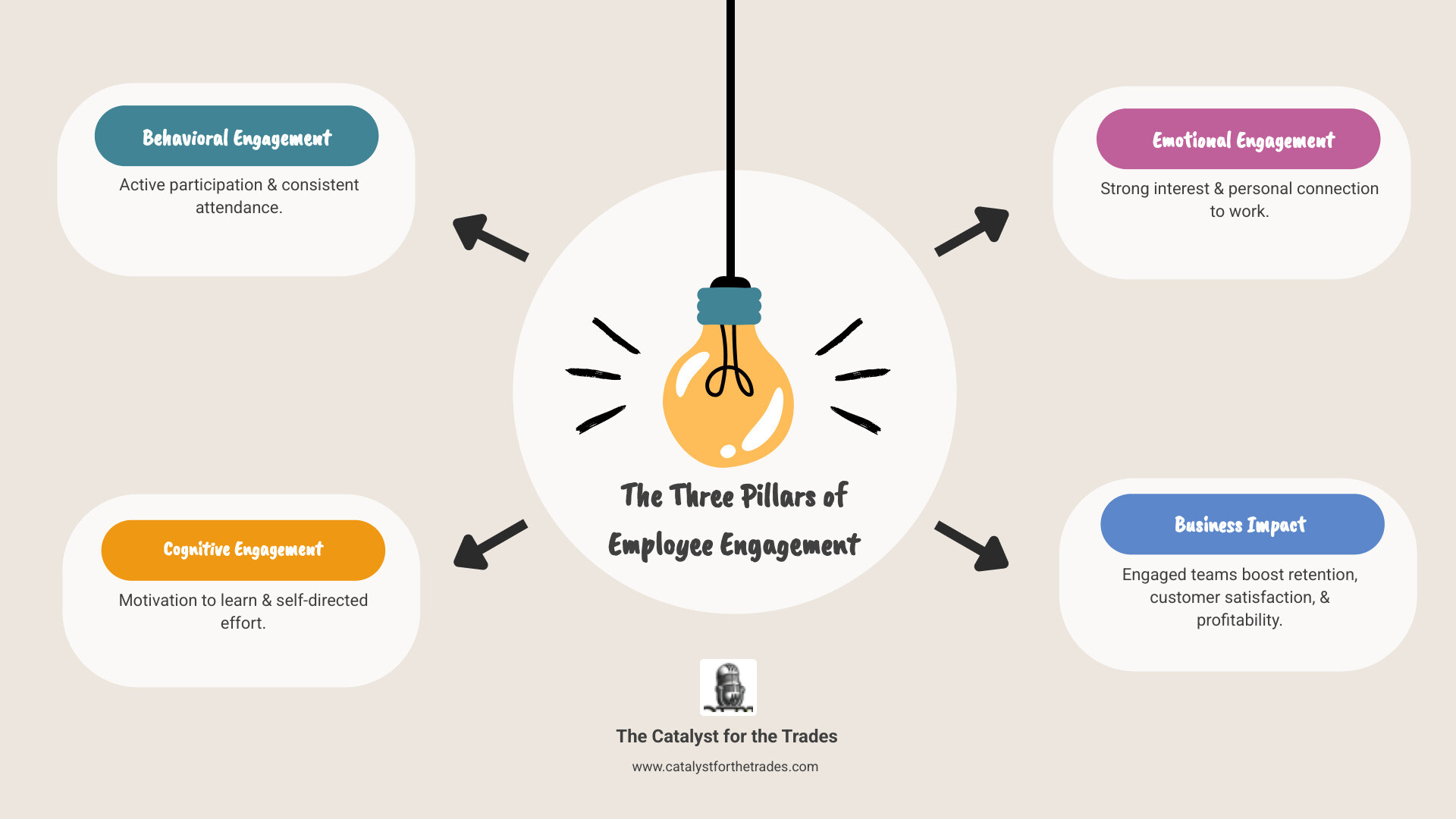
To truly engage your home service team, we need to understand the different dimensions of engagement. Studies identify three key dimensions: behavioral, cognitive, and emotional. Think of them as the three legs of a sturdy stool – if one is wobbly, the whole thing can fall over.
- Behavioral Engagement: This is what you can see. It’s about your team members actively participating, showing up on time, completing tasks, and following company procedures. In the trades, this means technicians adhering to safety protocols, CSRs diligently answering calls, and everyone contributing to team meetings. When employees are behaviorally engaged, they’re physically present and performing their duties.
- Cognitive Engagement: This refers to the mental effort and investment your employees put into their work. It’s about problem-solving, critical thinking, and a willingness to tackle challenges. A cognitively engaged technician isn’t just fixing a furnace; they’re diagnosing the root cause, considering multiple solutions, and thinking about preventative measures. They’re willing to learn new techniques and understand the ‘why’ behind their actions. This level of engagement is crucial for complex problem-solving and innovation in the field.
- Emotional Engagement: This is the ‘heart’ of engagement – how your employees feel about their work, their team, and your company. It encompasses their enthusiasm, interest, and sense of belonging. An emotionally engaged employee feels valued, respected, and connected to their colleagues and the company’s mission. They experience feelings of pride and satisfaction in a job well done. When emotions are positive, people bring their best selves to work.
A critical component underpinning all three pillars is psychological safety. This means creating an environment where people feel safe to speak up, ask questions, admit mistakes, and offer new ideas without fear of embarrassment or punishment. When employees feel respected, safe, and truly included, they bring their best ideas forward. This fosters a workplace where innovation can flourish, mistakes become learning opportunities, and team members genuinely support each other.
For a deeper dive into the importance of a thriving work environment, explore our insights on Company Culture Development and strategies for building Employee Loyalty. After all, an engaged team is a loyal team.
Foundational Engagement Strategies for a Thriving Culture
Building a highly engaged team in the home services industry isn’t about quick fixes; it’s about establishing foundational practices that foster a culture where everyone feels valued and motivated.
Foster a Culture of Trust and Open Communication
Trust is the bedrock of any successful team. When your employees trust you, and you trust them, amazing things happen. One of the most powerful engagement strategies is to cultivate a culture of open communication and ensure every voice is heard.
Employee voice isn’t just about suggestion boxes; it’s about actively seeking input from your team members, from your newest apprentice to your most seasoned technician. This means creating clear feedback channels – whether through regular one-on-ones, team meetings, or anonymous surveys – where employees feel comfortable sharing their ideas, concerns, and insights.
But listening is only half the battle. The real magic happens when you act on that feedback. As the research shows, “When employees see their voice leading to real change, trust grows. And when trust grows, so does engagement.” This demonstrates genuine transparency and shows your team that their opinions truly matter. For instance, if technicians consistently suggest a new tool or an improvement to a dispatch process, implementing that change (and crediting their input) builds immense goodwill and engagement.
Regularly communicating company goals, challenges, and successes also builds trust. When employees know where things stand, they’re more likely to stand with you. This transparent approach fosters a sense of shared purpose and collective responsibility.
For more insights into how to foster this kind of environment, check out this guide on How to Develop and Sustain Employee Engagement. And remember, your CSRs are often the frontline of your business; understanding their needs and feedback can open up untapped potential, as discussed in Your CSRs Are Sitting on Untapped Revenue. Here’s How to Fix It.
Empower Through Autonomy and Ownership
No one likes to be micromanaged, especially skilled professionals in the trades. Empowering your team through autonomy and ownership is a potent engagement strategy that fuels motivation and innovation.
Just as students thrive with autonomy, so do your skilled tradespeople. Research highlights that “Teacher-provided autonomy and structure both make important contributions to supporting students’ classroom engagement.” We can apply this to the workplace: providing a clear framework (structure) while allowing employees the freedom to determine how they achieve their goals (autonomy).
This means giving choice where possible. Can your technicians choose their preferred route for a job, or manage their breaks within a set window? Can your CSRs handle certain customer issues independently without immediate manager approval? When you trust your team to make decisions, you signal confidence in their abilities.
Trusting your team is about stepping back and letting them take the reins. It encourages them to take ownership of their work, leading to higher quality results and a greater sense of accomplishment. When a technician owns a repair from start to finish, they’re more invested in its success and the customer’s satisfaction.
Encouraging initiative means creating space for employees to suggest improvements, experiment with new methods (within safe boundaries), and even lead small projects. This not only engages them but also taps into their valuable on-the-ground experience and expertise. When people feel good and do great work, it’s a win-win.
Empowering your team is a hallmark of strong leadership. Learn more about The Future of Leadership: How to Build a Team That Drives Growth.
Build Strong Connections with People-First Leadership
At its heart, engagement is deeply human. The quality of manager-employee relationships and the overall sense of belonging are crucial. We believe in people-first leadership, where the focus is on fostering genuine connections, empathy, and a supportive environment.
Your leaders are the front lines of engagement. An empathetic leader understands the challenges their team faces, listens actively, and offers support. This builds strong bonds and a sense of loyalty. When employees know their teammates, they’re more likely to share ideas, lend a hand, and stick around. This applies just as much to the relationship between a manager and their direct reports.
Team building activities, both formal and informal, play a vital role. This could be anything from a shared meal after a particularly tough week, celebrating team successes, or even just encouraging casual conversations before a shift. These moments build camaraderie and make the workplace feel like a community. When your culture thrives, so do your people. And when your people thrive? That’s when the magic happens.
Genuine empathy from leadership creates a ripple effect. When leaders genuinely care about their team’s well-being and professional growth, employees feel valued and are more likely to be engaged. It’s about seeing each team member not just as a cog in the machine, but as an individual with unique strengths and needs.
For inspiration on how real leadership drives change, read Jazmin Ramirez: How Real Leadership Powers Change in the Trades. Further insights into effective leadership can be found in our resources on Organizational Leadership.
Actionable Growth and Recognition Strategies
Beyond the foundational elements, there are specific, actionable engagement strategies that directly contribute to individual and company growth. These strategies empower employees, acknowledge their contributions, and reinforce their connection to the broader mission.
Invest in Continuous Learning as a Core Engagement Strategy
In the fast-evolving home services industry, standing still means falling behind. Investing in continuous learning for your team is not just a perk; it’s a strategic engagement strategy that drives both individual and business growth.
When employees know you’re investing in their development, they bring more energy, creativity, and loyalty to the table. This investment can take many forms:
- Skill-building: Offering workshops, certifications, or online courses for new technologies or advanced techniques keeps your technicians sharp and confident. For example, training on new smart home systems or advanced HVAC diagnostics.
- Career paths: Clearly outlining opportunities for advancement, such as becoming a lead technician, trainer, or moving into management, provides a powerful motivator. When people start strong, they stay longer — and they’re more likely to hit the ground running.
- Mentorship programs: Pairing experienced team members with newer hires fosters knowledge transfer, builds relationships, and supports professional growth for both parties. This helps develop future leaders from within your organization.
This commitment to growth demonstrates that you value your employees’ long-term success, not just their immediate output. It transforms a job into a career.
Explore our resources on Professional Development and Trades Leadership Development to see how you can nurture your team’s potential. And for an ongoing commitment to improvement, dig into the concept of Continuous Learning.
Implement Meaningful Recognition and Feedback Systems
Imagine a job where your hard work goes unnoticed. Not very engaging, right? That’s why implementing meaningful recognition and feedback systems is one of the most impactful engagement strategies you can deploy.
Recognition is most effective when it’s timely, specific, and authentic. A vague “good job” six months after a big project doesn’t cut it. Instead, celebrate a technician who went above and beyond to solve a complex customer issue immediately after you hear about it. Highlight a CSR who received glowing customer feedback during your next team meeting. This specific praise reinforces desired behaviors and makes employees feel truly seen and appreciated.
Consider incorporating peer-to-peer recognition where team members can acknowledge each other’s contributions. This fosters a supportive team environment and amplifies the positive impact of recognition. A simple “shout-out” board or a digital platform for peer praise can work wonders.
Beyond praise, constructive feedback loops are equally important. Employees want to know how they can improve and grow. Providing regular, balanced feedback – focusing on strengths while also identifying areas for development – helps employees feel invested in their performance. This continuous dialogue is vital for growth and maintaining motivation.
Meaningful recognition is a cornerstone of strong Employer Branding and contributes significantly to a positive Candidate Experience, helping you attract and retain top talent.
Connect Daily Work to a Bigger Purpose
For many in the home services industry, the work isn’t just about fixing things; it’s about making homes safe, comfortable, and functional. Connecting your team’s daily work to a bigger purpose is a powerful engagement strategy that transcends routine tasks.
Help your employees understand and embody your company’s mission. If your mission is to provide unparalleled comfort and peace of mind, then every service call, every repair, and every interaction contributes to that larger goal. This gives their work meaning beyond just a paycheck.
Crucially, emphasize the real-world customer impact. Share stories of grateful customers whose lives were made better by your team’s efforts. Did a technician restore heat to an elderly couple’s home in winter? Did a plumber prevent significant water damage? These narratives bring the impact of their work to life. When youth have a meaningful role and feel connected to their school community, they feel a sense of responsibility to their peers and learning environment and are motivated to show up consistently. The same applies to your team: feeling their work makes a tangible difference fosters a deep sense of responsibility and dedication.
Sharing customer stories regularly, whether in team meetings, newsletters, or even on a dedicated internal channel, reinforces this connection. It reminds everyone that their efforts directly contribute to the well-being of their community. This sense of contribution can be a profound motivator and a key driver of Business Growth Strategies, as employees are more invested in the success of a purpose-driven company. Learn more about How to Protect Profit and Lead With Purpose in Home Services.
Innovative Tools and Techniques to Boost Motivation
In today’s rapidly advancing world, technology offers exciting new avenues to improve employee engagement. By thoughtfully integrating modern tools and approaches, home service businesses can create dynamic, motivating environments.
Leverage Technology and AI to Improve Collaboration
Technology, especially AI, isn’t just for automating tasks; it’s a potent force for improving communication, efficiency, and ultimately, engagement within your team. Leveraging technology and AI to improve collaboration is a forward-thinking engagement strategy.
Collaboration tools, such as shared digital platforms for scheduling, job notes, and communication, streamline workflows and reduce friction. Imagine a technician in the field needing a quick answer from a colleague or the office team; instant messaging or a shared project board makes this seamless. This efficiency reduces frustration and allows your team to focus on their core skills.
AI for efficiency can take many forms. AI-powered scheduling can optimize routes, reducing drive time and technician burnout. Predictive maintenance tools can help technicians arrive at jobs better prepared, increasing success rates and job satisfaction. As we’ve seen, AI and digital tools are changing the way home services sell, and they’re just as impactful internally. By automating repetitive administrative tasks, AI frees up your skilled employees to do what they do best: solve problems and serve customers.
The data-driven insights that technology provides can also be invaluable for engagement. Understanding team performance, customer feedback trends, and even individual development needs through analytics can help you tailor your engagement strategies and support more effectively. This is where AI Business Intelligence comes into play, offering a clearer picture of your operations.
For a deeper dive into how these advancements are changing our industry, explore How AI and Digital Tools Are Changing the Way Home Services Sell and stay ahead of the curve with insights on Home Service Innovation.
Use Gamification and Friendly Competition as Engagement Strategies
Who doesn’t love a little friendly competition? By applying elements of game design to work activities, gamification and friendly competition can be highly effective engagement strategies for your home service team.
Think about what makes games engaging: clear goals, instant feedback, rewards, and the thrill of achievement. We can bring these elements into the workplace:
- Sales leaderboards: For your sales or CSR teams, a transparent leaderboard tracking conversion rates, customer satisfaction scores, or new service contracts can motivate healthy competition.
- Performance-based rewards: Beyond traditional bonuses, consider symbolic rewards or recognition for reaching specific milestones. For instance, in educational settings, students earn points and open up new levels (like in Mathletics’ Meritopia). Your team could earn badges, special privileges, or even choose charitable donations in their name for outstanding performance.
- Team challenges: Pit teams against each other in challenges related to efficiency, customer reviews, or even safety compliance. The emphasis should always be on learning and improvement, not just winning. A well-designed challenge fosters collaboration within teams while sparking motivation across the company.
The key is to keep it fun, transparent, and aligned with your company’s values. The goal isn’t to create cutthroat competition but to harness the innate human drive for achievement and recognition. This approach can be a powerful component of your overall Competitive Strategy and helps you How to Win in the Trades: Recruitment, AI, and Trust with Mike Disney.
Frequently Asked Questions about Employee Engagement
We often get asked about the nuances of employee engagement. Here are some common questions and our expert insights.
What’s the difference between employee engagement and employee satisfaction?
While often used interchangeably, employee engagement and employee satisfaction are distinct.
- Employee Satisfaction refers to how content employees are with their job and work environment. It’s about whether their basic needs are met: fair pay, good benefits, a comfortable workspace, and reasonable workload. A satisfied employee might show up, do their job, and go home, but they might not be invested in the company’s success.
- Employee Engagement goes much deeper. It describes an employee’s emotional commitment to the organization and its goals. An engaged employee is not just happy; they are enthusiastic about their work, committed to their team, and motivated to contribute to the company’s success. They show up with purpose, passion, and a desire to make a difference. They’re more likely to go the extra mile and advocate for the company.
You can have a satisfied employee who isn’t engaged, but it’s rare to have an engaged employee who isn’t also satisfied to some degree. Engagement is the outcome we’re truly aiming for, as it directly impacts performance, retention, and innovation.
How do you measure the effectiveness of your engagement strategies?
Measuring the effectiveness of your engagement strategies is crucial for continuous improvement. It’s not a one-time check but an ongoing process.
- Employee Surveys: Regular pulse surveys (short, frequent checks) and comprehensive annual surveys can gauge employee sentiment, identify areas of strength, and pinpoint concerns. Look for trends in questions related to belonging, purpose, recognition, and growth opportunities.
- Key Performance Indicators (KPIs): Track metrics that correlate with engagement. These include:
- Retention Rates: Engaged employees are less likely to leave.
- Absenteeism Rates: Lower absenteeism often indicates higher engagement.
- Productivity: Engaged teams tend to be more productive.
- Customer Satisfaction (CSAT/NPS): Engaged employees deliver better customer experiences.
- Safety Incidents: Engaged teams are often more mindful of safety protocols.
- Exit Interviews: Gather feedback from departing employees to understand why they’re leaving. This can provide critical insights into gaps in your engagement strategies.
- Informal Feedback: Pay attention to anecdotal evidence, comments in team meetings, and one-on-one conversations. These qualitative insights can paint a rich picture of your team’s engagement levels.
- Leadership Check-ins: Leaders should regularly check in with their teams, not just on tasks, but on their well-being, challenges, and aspirations. These conversations are invaluable for understanding and nurturing engagement.
By combining quantitative data with qualitative feedback, you can gain a holistic view of your engagement efforts and make informed adjustments.
How can I re-engage an employee who seems disinterested?
Re-engaging an employee who shows signs of disinterest or disengagement requires a proactive, empathetic, and often personalized approach. It’s crucial to address the issue early before it impacts team morale or customer service.
- Open a Dialogue: The first step is to have a private, non-judgmental conversation. Express your observations and concern, and genuinely listen to their perspective. Ask open-ended questions like, “I’ve noticed a change in your usual energy; is everything alright?” or “What challenges are you facing right now?”
- Identify the Root Cause: Disengagement often stems from underlying issues such as:
- Lack of Purpose: Do they understand how their work contributes to the bigger picture?
- Feeling Undervalued: Do they feel their contributions are recognized?
- Burnout: Are they overwhelmed or overworked?
- Lack of Growth: Do they feel stagnant in their role or career path?
- Poor Relationship with Manager/Team: Are there interpersonal conflicts or a lack of support?
- Personal Issues: Are there external factors impacting their performance?
- Collaborate on Solutions: Work with the employee to find solutions. This could involve:
- Reconnecting to Purpose: Remind them of the impact of their work and share positive customer feedback.
- Providing New Challenges: Offer opportunities for new projects, skill development, or mentorship.
- Adjusting Workload: If burnout is an issue, look for ways to redistribute tasks or provide support.
- Offering Support: Connect them with resources (e.g., EAP if available) or offer coaching.
- Revisiting Autonomy: Can you give them more control over certain aspects of their work?
- Set Clear Expectations and Follow Up: Agree on actionable steps and schedule regular check-ins to monitor progress. Show consistent support and celebrate small wins.
Re-engagement is a process, not an event. It requires patience, empathy, and a genuine commitment from leadership to understand and address the employee’s needs.
Conclusion
Effective engagement strategies are not just a nice-to-have; they are a strategic imperative for any home service business looking to thrive. From fostering trust and empowering autonomy to investing in continuous learning and leveraging innovative tools like AI and gamification, each strategy plays a vital role in building a motivated, high-performing team.
The journey toward a fully engaged workforce is one of continuous improvement. It demands consistent leadership commitment and a willingness to adapt. By prioritizing the well-being and professional growth of your employees, you’re not just improving morale—you’re building a resilient, profitable business with a strong long-term strategy.
At The Catalyst for the Trades, we understand the unique challenges and opportunities within the home services industry. We’re here to help you implement these engagement strategies and open up the full potential of your team. Explore more growth strategies and leadership insights to continue your journey toward excellence.


