Episode
November 27, 2025

Beyond the Wrench: How Innovation is Reshaping Home Service Businesses

Why Home Service Innovation Matters More Than Ever

Home service innovation is no longer optional. For any HVAC, plumbing, or electrical business, the landscape is shifting rapidly. Customers demand instant responses and transparent pricing, skilled labor is scarce, and competitors are leveraging technology to become faster and more profitable. But innovation isn't just about expensive overhauls; it can be as simple as digitizing paperwork or using remote diagnostics to solve problems without rolling a truck.

Key drivers reshaping home service businesses today:

  • Technology adoption: AI, IoT, and digital platforms enable faster, more predictive service.
  • Customer expectations: Homeowners want the convenience of on-demand apps for everything.
  • Workforce challenges: Labor shortages necessitate automation and smarter workflows.
  • Aging infrastructure: Over half of U.S. homes are over 40, driving demand for proactive maintenance.
  • Sustainability pressure: Customers and regulations favor energy-efficient solutions.

The industry has moved from the Yellow Pages to AI systems that predict failures before they happen. For example, Bayada cut patient falls by 40% with predictive tech, and Help at Home boosted caregiver retention to 94.6% by simplifying administrative tasks. These innovations are happening now.

To scale your business and stay ahead, learn proven strategies on The Catalyst for the Trades podcast, and find how to adapt your sales process to modern customer expectations.
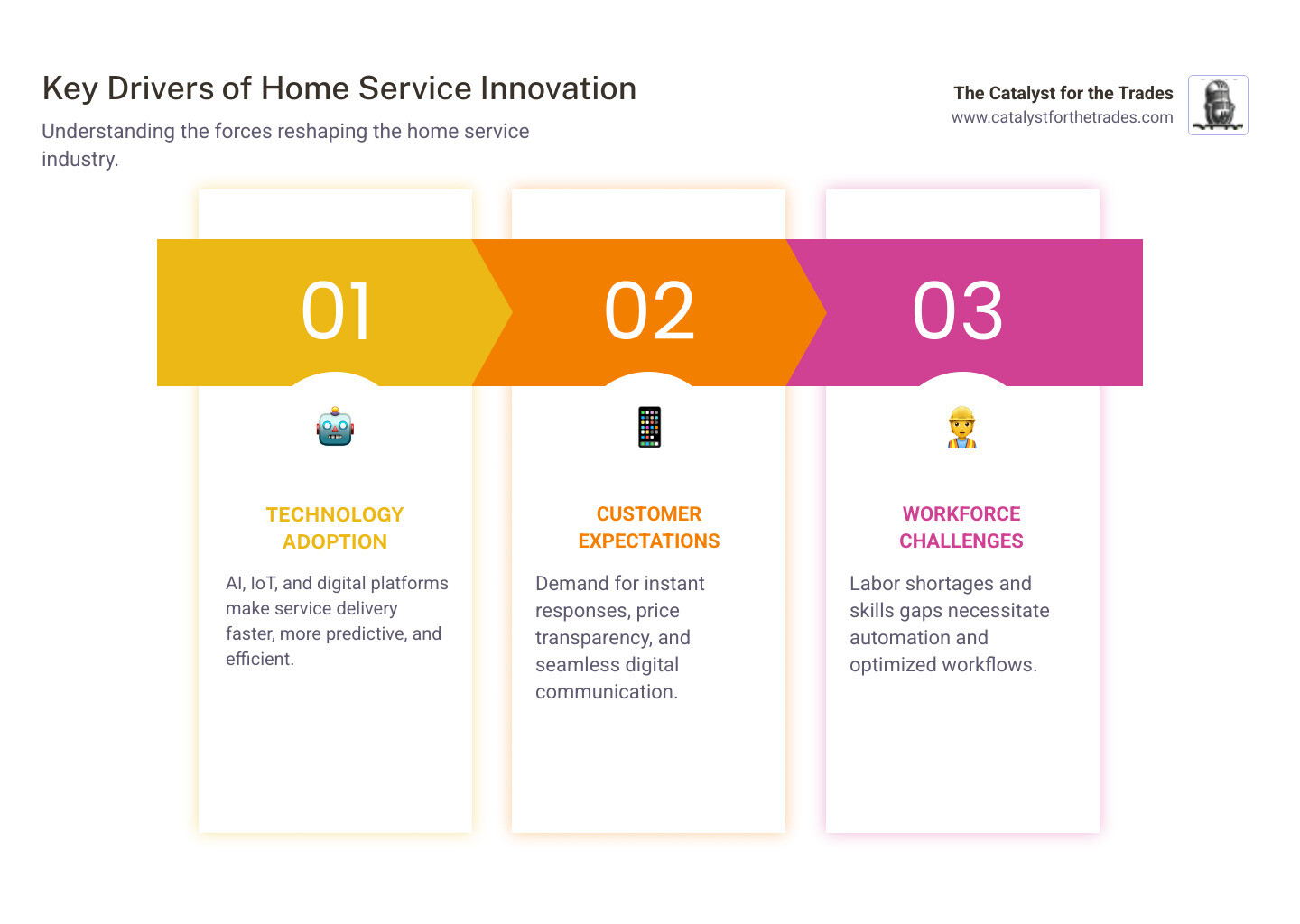
infographic showing three circular pillars: Technology (AI, IoT, automation tools), Customer Demand (instant service, transparency, convenience), and Workforce Challenges (labor shortages, skills gaps, retention issues) with arrows connecting them to a central hub labeled Home Service Innovation - home service innovation infographic pillar-3-steps

Home service innovation vocab explained:

The Core Drivers: Why the Home Service Industry is Evolving

The gap between how you ran your business ten years ago—with paper invoices and phone tag—and what customers expect today is what drives home service innovation.

Your customers have changed. They've grown up with on-demand apps and real-time tracking. They expect the same from you, whether it's instant text updates, online booking at midnight, or upfront pricing. This shift to on-demand service and digital communication is about respecting their time. Companies embracing price transparency and modern communication are winning jobs before competitors even call back. Adapting to consumer behavior and leveraging AI and digital tools in the trades is now table stakes.

The population is aging. By 2030, 1.4 billion people worldwide will be over 60, and most want to age in place. This aging population demographic shift creates demand for accessible remodels, better HVAC for health, and reliable maintenance—a major opportunity for trades that adapt their services.

Finding good people has never been harder. The workforce shortages are not going away, as experienced technicians retire without enough new talent to replace them. Technology is essential here. Using AI for routine calls, automating schedules, or using remote diagnostics allows you to do more with your existing team. Smart tools multiply your workforce's effectiveness.

Sustainability is now a core customer concern. Homeowners ask about energy bills, solar options, and water-saving fixtures, while regulations demand higher efficiency. Businesses that position themselves as partners in sustainability are thriving. When you show a customer how an upgrade saves money and helps the environment, you're solving multiple problems.

These forces all push toward one conclusion: innovate or be left behind. We dive deep into how to stay competitive as AI and consumer behavior reshape home services on the podcast, because this directly impacts your bottom line.

The Tech Revolution: AI, IoT, and the Future of Home Service Innovation

Today's smart homes are fundamentally changing homeowner expectations and opening new avenues for service providers. Home service innovation is being propelled by Artificial Intelligence (AI) and the Internet of Things (IoT), reshaping everything from diagnostics to proactive maintenance.
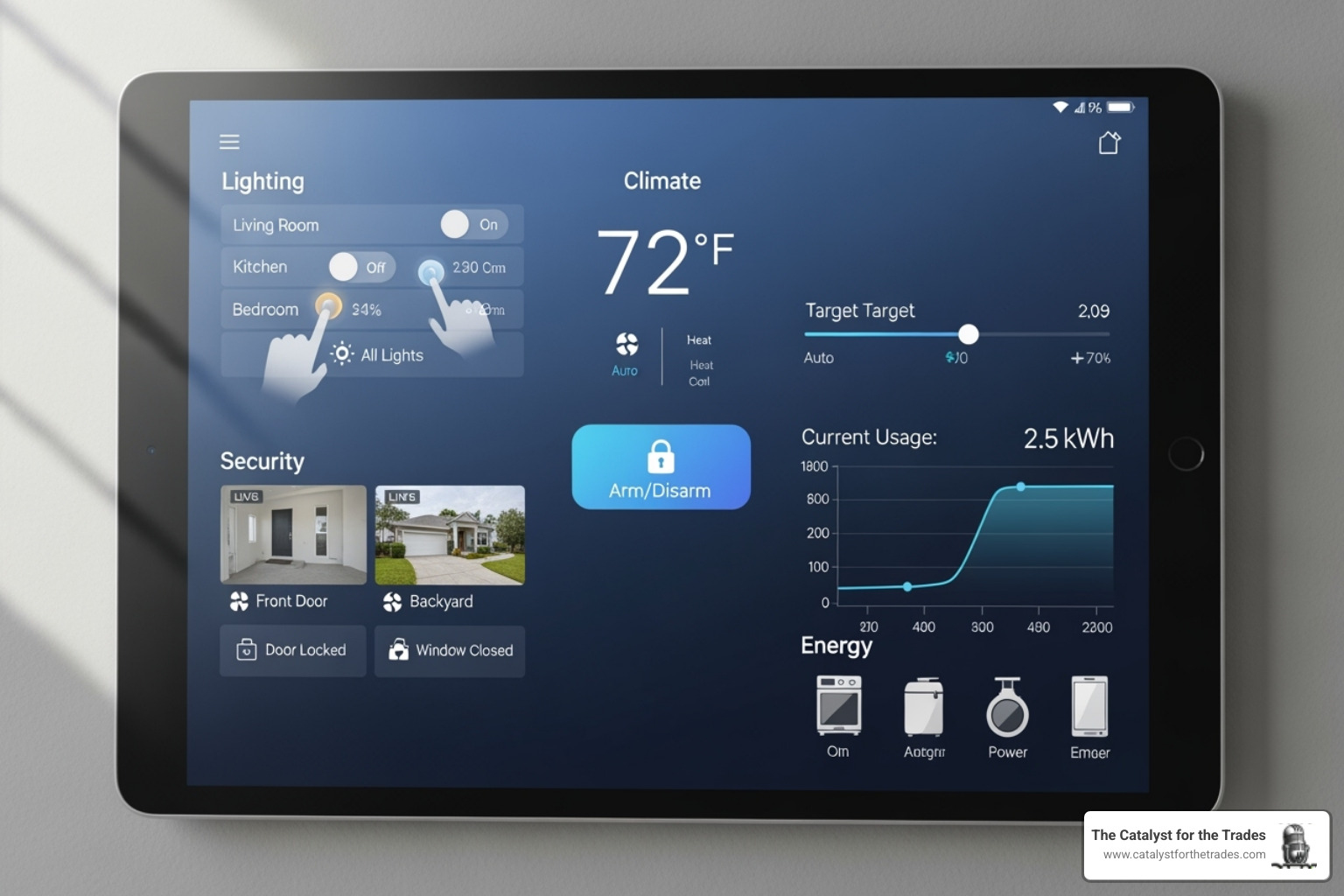
smart home dashboard - home service innovation

What if a water heater could alert you before it fails? Or you could diagnose an HVAC issue from your office? This is happening now. IoT devices turn homes into sensor networks, generating data that AI analyzes for patterns. Remote monitoring is a reality, with smart thermostats and appliances signaling their condition. Using predictive analytics, AI can flag potential failures, shifting contractors from reactive emergencies to proactive maintenance. This digital change is also seen in retail, with Lowe's Digital Home Platform offering personalized maintenance support and aiming to create a "digital twin" for each home.

Augmented Reality (AR) is also becoming essential. Tools like Lowe's Style Studio and Measure Your Space use AR for visualization and precise measurements. For contractors, AR means overlaying repair instructions, visualizing installations, and training new technicians interactively, reducing errors and improving accuracy. These are key topics we cover in the AI revolution in home services: how to future-proof your trades business.

Streamlining Operations with AI and Automation

The real power of AI is in eliminating operational friction. AI-powered dispatch optimizes schedules by matching the right technician to the job based on skills, location, and traffic, cutting drive time. On the sales side, automated lead management instantly qualifies and routes leads, ensuring high-value opportunities get immediate attention.

AI is also changing phone systems to handle routine inquiries and scheduling, freeing up staff for complex issues. As Brad Scruggs discussed in how AI is transforming call handling, this dramatically improves response times. All this data feeds into your CRM, enabling true data-driven decision making. With AI business intelligence, you can turn questions about profitability and marketing ROI from guesswork into actionable answers. This continuous process improvement is why we stress that how to get your CRM right and why it matters more than you think is critical for growth.

Enhancing the Customer and Technician Experience

Great technology improves life for both customers and technicians. For homeowners, smart home integration means their HVAC could automatically schedule its own maintenance. Personalized maintenance alerts remind them to change filters based on actual usage. Self-service portals and digital payment options put customers in control, allowing them to schedule appointments, track technicians, and pay invoices from their phones.

Technicians benefit from remote diagnostics, arriving on-site with the right parts and information, which boosts first-time fix rates. AR-assisted repairs provide real-time visual guidance, serving as a powerful training tool for new hires. This creates a virtuous cycle: customers get faster, more transparent service, and technicians are more effective and satisfied. It's about future-proofing contracting with tech and AI for a new customer experience and understanding how AI and digital tools are changing the way home services sell.

Sector Spotlights: How Different Trades Are Innovating

While home service innovation is a broad concept, the real change is happening within individual trades as they solve unique challenges. Each sector is developing sector-specific technology, but there's also tremendous cross-industry learning and service diversification as companies expand to meet new customer needs.
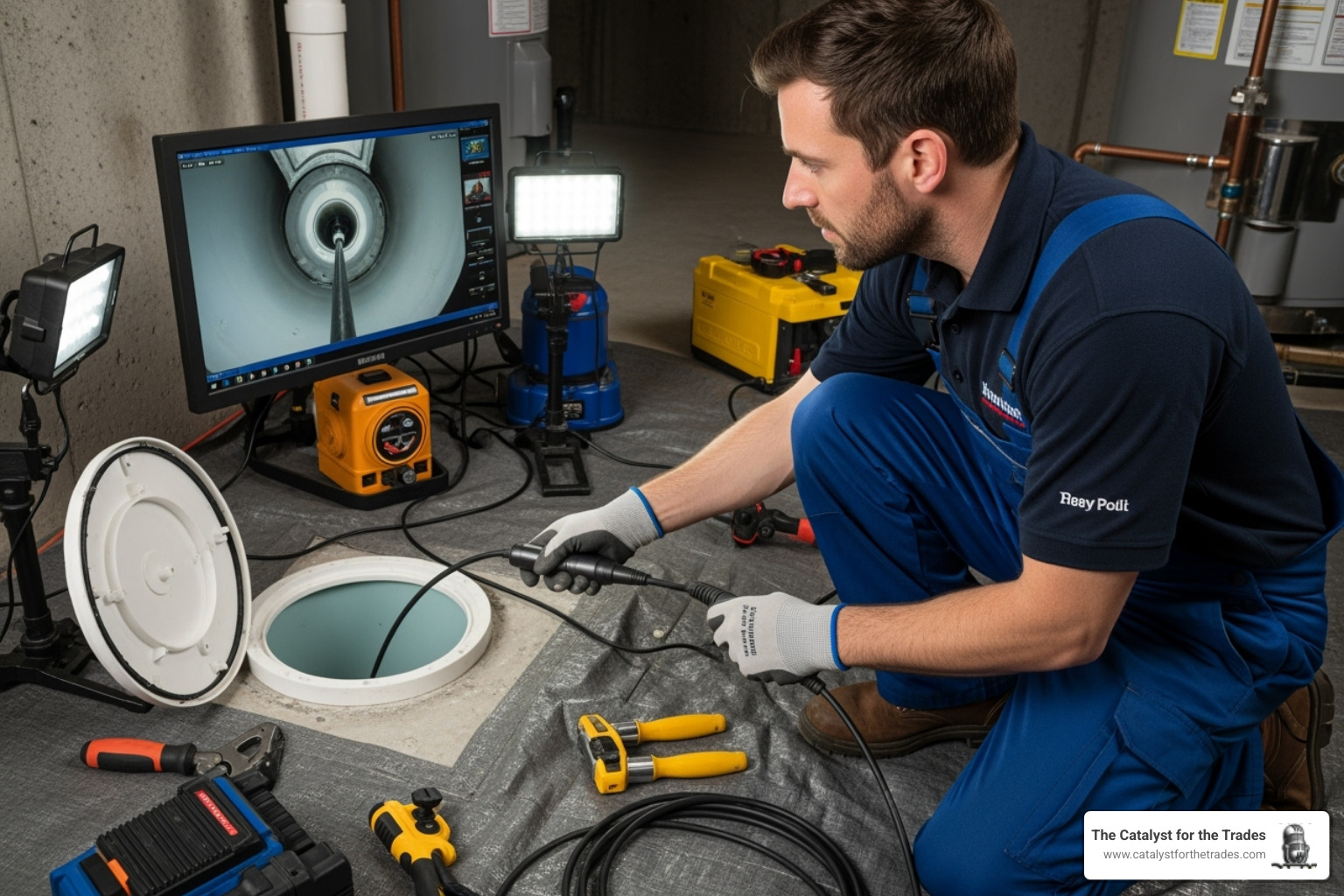
plumber using video inspection camera - home service innovation

HVAC

HVAC innovations are making comfort smarter and more predictable.

  • Predictive maintenance sensors monitor system performance to detect issues before they cause a breakdown, shifting service from reactive to proactive.
  • Smart thermostats learn household patterns, adjust to weather, and can even run self-diagnostics, sending reports to service providers.
  • Energy efficiency audits, using tools like thermal imaging, position technicians as trusted advisors who help homeowners save money.
  • Geothermal technology offers highly efficient heating and cooling by tapping into the earth's stable underground temperatures.
  • Indoor Air Quality (IAQ) monitoring has become crucial, with smart sensors detecting pollutants and allergens, allowing you to keep homes not just comfortable, but healthy.These are the kinds of technologies we explore when discussing how HVAC contractors can thrive in challenging times at HVAC Summit 2025.

Plumbing and Electrical

These traditional trades are being revolutionized by technology that makes homes safer and more efficient.

  • Smart water leak detectors alert homeowners to moisture and can automatically shut off the main water supply, preventing costly damage.
  • Tankless water heaters provide endless hot water on demand while saving space and energy.
  • Virtual consultations allow plumbers to perform initial assessments via video chat, saving time for everyone and ensuring technicians arrive prepared. The journey of how a Navy veteran created one of New Jersey's trusted plumbing brands often involves such innovations.
  • IoT-enabled circuit breakers offer unprecedented intelligence, monitoring energy use at the circuit level and detecting faults before they become dangerous.
  • EV charger installation has become a standard service, placing electricians at the forefront of the transportation revolution.

Home Health and Senior Care

In this sector, home service innovation is improving and saving lives, enabling people to age in place safely.

  • Remote patient monitoring devices track vital signs, allowing healthcare providers to intervene before a crisis occurs.
  • AI for fall prevention is having a huge impact. Bayada, for example, used predictive technology to reduce injurious falls by 40%.
  • Telehealth services have become essential, connecting patients with specialists from home, a key topic in a scoping review on home health nursing innovation.
  • Caregiver management platforms reduce administrative burdens, improving job satisfaction and retention. Help at Home saw 94.6% caregiver retention by implementing such technologies.
  • Medication management apps help prevent missed doses, a simple but life-changing tool for seniors managing multiple prescriptions.

Building, Roofing, and Remodeling

Even construction, traditionally slow to adopt tech, is changing fast.

  • Digital twins for project management create virtual replicas of projects that update in real-time, allowing managers to spot conflicts and prevent delays.
  • AR visualization tools, like Lowe's Style Studio™, let clients see a finished project in their actual space, reducing miscommunication.
  • Drone inspections have revolutionized roofing by providing fast, safe, and detailed assessments of roof conditions. As we've discussed, roofing contractors can't afford to ignore change: lessons from the Western States Roofing Expo.
  • Sustainable building materials are in high demand, offering better performance while reducing environmental impact.
  • 3D printing for components, while still emerging, promises to reduce waste, cost, and construction time by producing custom elements on-site.

Overcoming Problems: Challenges and Strategies for Implementation

Implementing home service innovation is challenging. Business owners are energized by the possibilities but often hit roadblocks. Understanding these challenges is the first step to overcoming them.

The initial problems include implementation costs for new software and equipment, which can feel overwhelming for smaller businesses. Then there are data privacy concerns; as you collect more customer data, robust cybersecurity becomes non-negotiable to maintain trust. In sectors like home health, regulatory problems and complex reimbursement models can stifle investment in new technology, a key issue in innovation diffusion in service organizations.

Key Barriers to Implementing Home Service Innovation

Several specific barriers can trip up businesses trying to innovate:

  • High initial investment: The significant upfront cost for new platforms and tools is often a deal-breaker. A phased approach, implementing one system at a time, can make this more manageable.
  • Employee resistance: Veteran technicians may be wary of new technology, fearing job insecurity or the hassle of learning new skills. Overcoming this requires empathy and clear communication about the benefits.
  • Technical skills gap: Even willing employees may lack the digital literacy to use new tools effectively. This necessitates comprehensive training and ongoing support.
  • Customer adoption rates: Not all customers will accept new self-service portals or smart devices. You must meet customers where they are while encouraging them toward more efficient channels.
  • Integrating new and old systems: Getting a new platform to communicate with legacy software can be a technical nightmare, requiring careful planning and a commitment to strategic adaptation.

Fostering a Culture of Home Service Innovation

The most innovative companies aren't always the ones with the biggest budgets; they're the ones with the right culture.

  • Leadership buy-in: Leaders must actively champion innovation and model the desired behaviors. As we discuss in the future of leadership: how to build a team that drives growth, this means working alongside technology, not competing with it.
  • Encouraging experimentation: Create a safe environment where the team can try new things and learn from failures. The goal is to innovate faster, start failing smarter through calculated experiments.
  • Investing in training: Continuous learning is the foundation of innovation. Regular education on new tools and methodologies must be part of your business model.
  • Celebrating small wins: Recognize and celebrate successes to build momentum. When you empower employees by implementing their suggestions and giving them autonomy, innovation becomes a shared effort, not a top-down mandate.

Building this culture takes time, but when you get it right, home service innovation becomes part of your company's DNA.

electric service van - home service innovation

The future of home service innovation is about a complete reimagining of how services integrate into daily life.

A key shift is hyper-personalization. Soon, AI systems will understand your home's unique needs and your family's habits, predicting maintenance needs before they arise. Lowe's vision of a "digital twin" for every home—a central hub for all maintenance data—is a step in this direction. Service will be custom specifically to your home and lifestyle.

Subscription-based models, or Home-as-a-Service (HaaS), are also gaining traction. Instead of facing unexpected repair bills, homeowners will pay a monthly fee for comprehensive maintenance and emergency fixes. This provides predictable costs for customers and recurring revenue for businesses.

Deeper AI integration will automate dispatch, predict failures with greater accuracy, and optimize schedules in real-time. This will free up technicians for complex problem-solving. We may even see robotics in service delivery for repetitive tasks, though the human touch will remain vital. We often explore what smart companies are doing now for the future of home services on our podcast.

Finally, green technology adoption will surge, driven by customer demand and environmental concerns. This includes everything from solar installations to ultra-efficient HVAC systems. We'll also see a move toward circular economy principles, with a focus on repairable, long-lasting equipment. This isn't just about sustainability; it's about building a resilient business model for the future.

Conclusion

The journey through home service innovation reveals an industry at a pivotal moment. What began as a reaction to market pressures has become a profound reimagining of the trades.

Innovation exists on a spectrum. It can be a simple change, like digitizing paperwork that boosted Help at Home's caregiver retention to 94.6%, or a sophisticated AI system that cut patient falls by 40% at Bayada. Both are home service innovation, and both prove the goal is finding solutions that deliver real value to your customers and your team.

Technologies like predictive AI, IoT sensors, and AR tools are not fantasies; they are being used now to make homes safer and more efficient while empowering technicians. Companies that accept these tools are fundamentally enhancing the value they deliver.

We believe the future of the trades is bright and tech-driven. But technology alone is not enough. It requires leadership willing to experiment, a culture that invests in training, and the courage to ask, "Is there a better way?"

This is why we created The Catalyst for the Trades podcast. Jennifer Bagley offers insights on AI and marketing, while Chuck Staszkiewicz provides wisdom on operational scaling. We are committed to bringing you the strategies and real-world experiences to steer this evolving landscape.

The pace of change is accelerating. The question isn't whether you'll adapt, but how. Listen to the latest strategies on The Catalyst for the Trades podcast and let's shape the future of home service excellence together.

Why Home Service Innovation Matters More Than Ever

Home service innovation is no longer optional. For any HVAC, plumbing, or electrical business, the landscape is shifting rapidly. Customers demand instant responses and transparent pricing, skilled labor is scarce, and competitors are leveraging technology to become faster and more profitable. But innovation isn't just about expensive overhauls; it can be as simple as digitizing paperwork or using remote diagnostics to solve problems without rolling a truck.

Key drivers reshaping home service businesses today:

  • Technology adoption: AI, IoT, and digital platforms enable faster, more predictive service.
  • Customer expectations: Homeowners want the convenience of on-demand apps for everything.
  • Workforce challenges: Labor shortages necessitate automation and smarter workflows.
  • Aging infrastructure: Over half of U.S. homes are over 40, driving demand for proactive maintenance.
  • Sustainability pressure: Customers and regulations favor energy-efficient solutions.

The industry has moved from the Yellow Pages to AI systems that predict failures before they happen. For example, Bayada cut patient falls by 40% with predictive tech, and Help at Home boosted caregiver retention to 94.6% by simplifying administrative tasks. These innovations are happening now.

To scale your business and stay ahead, learn proven strategies on The Catalyst for the Trades podcast, and find how to adapt your sales process to modern customer expectations.

infographic showing three circular pillars: Technology (AI, IoT, automation tools), Customer Demand (instant service, transparency, convenience), and Workforce Challenges (labor shortages, skills gaps, retention issues) with arrows connecting them to a central hub labeled Home Service Innovation - home service innovation infographic pillar-3-steps

Home service innovation vocab explained:

The Core Drivers: Why the Home Service Industry is Evolving

The gap between how you ran your business ten years ago—with paper invoices and phone tag—and what customers expect today is what drives home service innovation.

Your customers have changed. They've grown up with on-demand apps and real-time tracking. They expect the same from you, whether it's instant text updates, online booking at midnight, or upfront pricing. This shift to on-demand service and digital communication is about respecting their time. Companies embracing price transparency and modern communication are winning jobs before competitors even call back. Adapting to consumer behavior and leveraging AI and digital tools in the trades is now table stakes.

The population is aging. By 2030, 1.4 billion people worldwide will be over 60, and most want to age in place. This aging population demographic shift creates demand for accessible remodels, better HVAC for health, and reliable maintenance—a major opportunity for trades that adapt their services.

Finding good people has never been harder. The workforce shortages are not going away, as experienced technicians retire without enough new talent to replace them. Technology is essential here. Using AI for routine calls, automating schedules, or using remote diagnostics allows you to do more with your existing team. Smart tools multiply your workforce's effectiveness.

Sustainability is now a core customer concern. Homeowners ask about energy bills, solar options, and water-saving fixtures, while regulations demand higher efficiency. Businesses that position themselves as partners in sustainability are thriving. When you show a customer how an upgrade saves money and helps the environment, you're solving multiple problems.

These forces all push toward one conclusion: innovate or be left behind. We dive deep into how to stay competitive as AI and consumer behavior reshape home services on the podcast, because this directly impacts your bottom line.

The Tech Revolution: AI, IoT, and the Future of Home Service Innovation

Today's smart homes are fundamentally changing homeowner expectations and opening new avenues for service providers. Home service innovation is being propelled by Artificial Intelligence (AI) and the Internet of Things (IoT), reshaping everything from diagnostics to proactive maintenance.

smart home dashboard - home service innovation

What if a water heater could alert you before it fails? Or you could diagnose an HVAC issue from your office? This is happening now. IoT devices turn homes into sensor networks, generating data that AI analyzes for patterns. Remote monitoring is a reality, with smart thermostats and appliances signaling their condition. Using predictive analytics, AI can flag potential failures, shifting contractors from reactive emergencies to proactive maintenance. This digital change is also seen in retail, with Lowe's Digital Home Platform offering personalized maintenance support and aiming to create a "digital twin" for each home.

Augmented Reality (AR) is also becoming essential. Tools like Lowe's Style Studio and Measure Your Space use AR for visualization and precise measurements. For contractors, AR means overlaying repair instructions, visualizing installations, and training new technicians interactively, reducing errors and improving accuracy. These are key topics we cover in the AI revolution in home services: how to future-proof your trades business.

Streamlining Operations with AI and Automation

The real power of AI is in eliminating operational friction. AI-powered dispatch optimizes schedules by matching the right technician to the job based on skills, location, and traffic, cutting drive time. On the sales side, automated lead management instantly qualifies and routes leads, ensuring high-value opportunities get immediate attention.

AI is also changing phone systems to handle routine inquiries and scheduling, freeing up staff for complex issues. As Brad Scruggs discussed in how AI is transforming call handling, this dramatically improves response times. All this data feeds into your CRM, enabling true data-driven decision making. With AI business intelligence, you can turn questions about profitability and marketing ROI from guesswork into actionable answers. This continuous process improvement is why we stress that how to get your CRM right and why it matters more than you think is critical for growth.

Enhancing the Customer and Technician Experience

Great technology improves life for both customers and technicians. For homeowners, smart home integration means their HVAC could automatically schedule its own maintenance. Personalized maintenance alerts remind them to change filters based on actual usage. Self-service portals and digital payment options put customers in control, allowing them to schedule appointments, track technicians, and pay invoices from their phones.

Technicians benefit from remote diagnostics, arriving on-site with the right parts and information, which boosts first-time fix rates. AR-assisted repairs provide real-time visual guidance, serving as a powerful training tool for new hires. This creates a virtuous cycle: customers get faster, more transparent service, and technicians are more effective and satisfied. It's about future-proofing contracting with tech and AI for a new customer experience and understanding how AI and digital tools are changing the way home services sell.

Sector Spotlights: How Different Trades Are Innovating

While home service innovation is a broad concept, the real change is happening within individual trades as they solve unique challenges. Each sector is developing sector-specific technology, but there's also tremendous cross-industry learning and service diversification as companies expand to meet new customer needs.

plumber using video inspection camera - home service innovation

HVAC

HVAC innovations are making comfort smarter and more predictable.

  • Predictive maintenance sensors monitor system performance to detect issues before they cause a breakdown, shifting service from reactive to proactive.
  • Smart thermostats learn household patterns, adjust to weather, and can even run self-diagnostics, sending reports to service providers.
  • Energy efficiency audits, using tools like thermal imaging, position technicians as trusted advisors who help homeowners save money.
  • Geothermal technology offers highly efficient heating and cooling by tapping into the earth's stable underground temperatures.
  • Indoor Air Quality (IAQ) monitoring has become crucial, with smart sensors detecting pollutants and allergens, allowing you to keep homes not just comfortable, but healthy.These are the kinds of technologies we explore when discussing how HVAC contractors can thrive in challenging times at HVAC Summit 2025.

Plumbing and Electrical

These traditional trades are being revolutionized by technology that makes homes safer and more efficient.

  • Smart water leak detectors alert homeowners to moisture and can automatically shut off the main water supply, preventing costly damage.
  • Tankless water heaters provide endless hot water on demand while saving space and energy.
  • Virtual consultations allow plumbers to perform initial assessments via video chat, saving time for everyone and ensuring technicians arrive prepared. The journey of how a Navy veteran created one of New Jersey's trusted plumbing brands often involves such innovations.
  • IoT-enabled circuit breakers offer unprecedented intelligence, monitoring energy use at the circuit level and detecting faults before they become dangerous.
  • EV charger installation has become a standard service, placing electricians at the forefront of the transportation revolution.

Home Health and Senior Care

In this sector, home service innovation is improving and saving lives, enabling people to age in place safely.

  • Remote patient monitoring devices track vital signs, allowing healthcare providers to intervene before a crisis occurs.
  • AI for fall prevention is having a huge impact. Bayada, for example, used predictive technology to reduce injurious falls by 40%.
  • Telehealth services have become essential, connecting patients with specialists from home, a key topic in a scoping review on home health nursing innovation.
  • Caregiver management platforms reduce administrative burdens, improving job satisfaction and retention. Help at Home saw 94.6% caregiver retention by implementing such technologies.
  • Medication management apps help prevent missed doses, a simple but life-changing tool for seniors managing multiple prescriptions.

Building, Roofing, and Remodeling

Even construction, traditionally slow to adopt tech, is changing fast.

  • Digital twins for project management create virtual replicas of projects that update in real-time, allowing managers to spot conflicts and prevent delays.
  • AR visualization tools, like Lowe's Style Studio™, let clients see a finished project in their actual space, reducing miscommunication.
  • Drone inspections have revolutionized roofing by providing fast, safe, and detailed assessments of roof conditions. As we've discussed, roofing contractors can't afford to ignore change: lessons from the Western States Roofing Expo.
  • Sustainable building materials are in high demand, offering better performance while reducing environmental impact.
  • 3D printing for components, while still emerging, promises to reduce waste, cost, and construction time by producing custom elements on-site.

Overcoming Problems: Challenges and Strategies for Implementation

Implementing home service innovation is challenging. Business owners are energized by the possibilities but often hit roadblocks. Understanding these challenges is the first step to overcoming them.

The initial problems include implementation costs for new software and equipment, which can feel overwhelming for smaller businesses. Then there are data privacy concerns; as you collect more customer data, robust cybersecurity becomes non-negotiable to maintain trust. In sectors like home health, regulatory problems and complex reimbursement models can stifle investment in new technology, a key issue in innovation diffusion in service organizations.

Key Barriers to Implementing Home Service Innovation

Several specific barriers can trip up businesses trying to innovate:

  • High initial investment: The significant upfront cost for new platforms and tools is often a deal-breaker. A phased approach, implementing one system at a time, can make this more manageable.
  • Employee resistance: Veteran technicians may be wary of new technology, fearing job insecurity or the hassle of learning new skills. Overcoming this requires empathy and clear communication about the benefits.
  • Technical skills gap: Even willing employees may lack the digital literacy to use new tools effectively. This necessitates comprehensive training and ongoing support.
  • Customer adoption rates: Not all customers will accept new self-service portals or smart devices. You must meet customers where they are while encouraging them toward more efficient channels.
  • Integrating new and old systems: Getting a new platform to communicate with legacy software can be a technical nightmare, requiring careful planning and a commitment to strategic adaptation.

Fostering a Culture of Home Service Innovation

The most innovative companies aren't always the ones with the biggest budgets; they're the ones with the right culture.

  • Leadership buy-in: Leaders must actively champion innovation and model the desired behaviors. As we discuss in the future of leadership: how to build a team that drives growth, this means working alongside technology, not competing with it.
  • Encouraging experimentation: Create a safe environment where the team can try new things and learn from failures. The goal is to innovate faster, start failing smarter through calculated experiments.
  • Investing in training: Continuous learning is the foundation of innovation. Regular education on new tools and methodologies must be part of your business model.
  • Celebrating small wins: Recognize and celebrate successes to build momentum. When you empower employees by implementing their suggestions and giving them autonomy, innovation becomes a shared effort, not a top-down mandate.

Building this culture takes time, but when you get it right, home service innovation becomes part of your company's DNA.

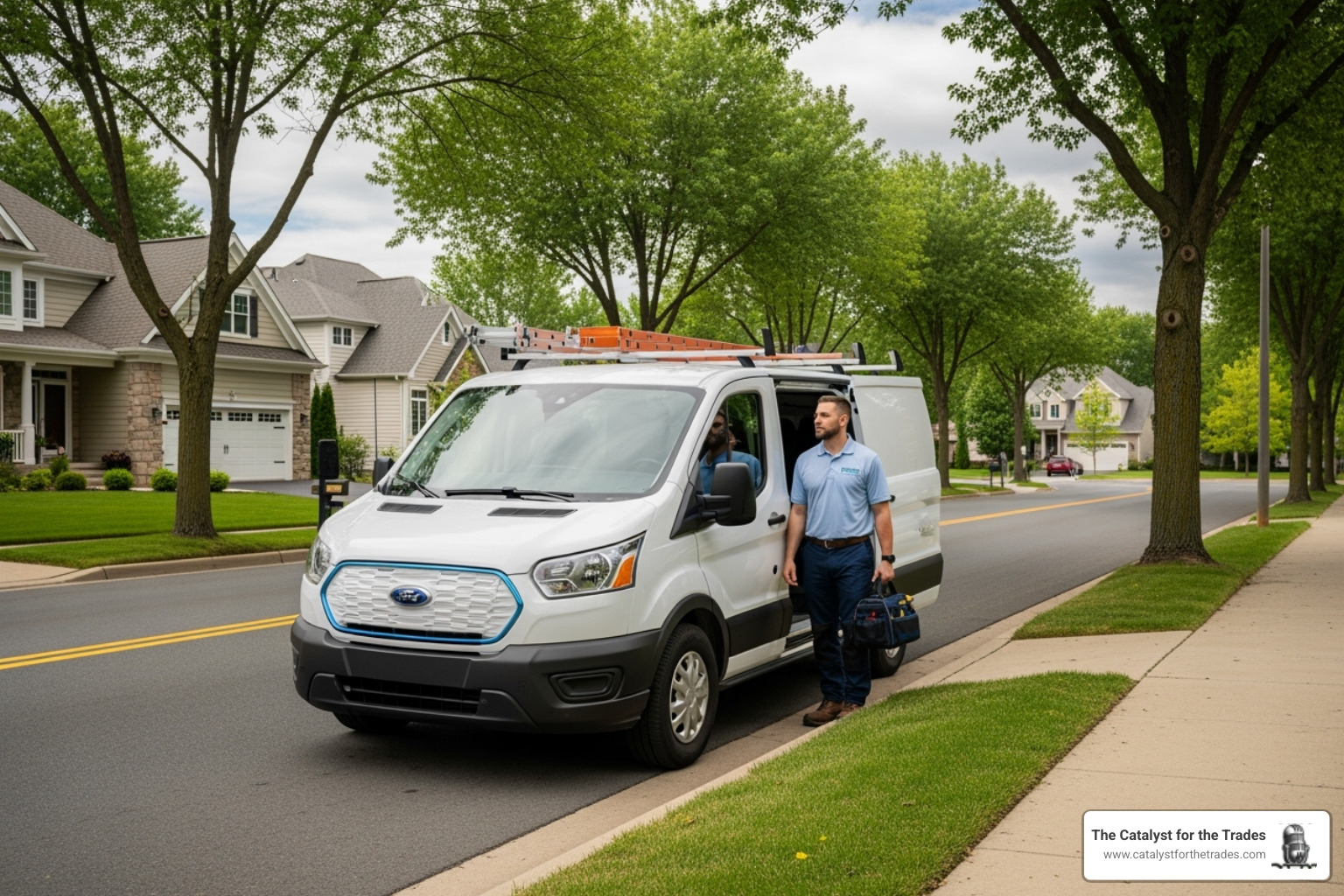
electric service van - home service innovation

The future of home service innovation is about a complete reimagining of how services integrate into daily life.

A key shift is hyper-personalization. Soon, AI systems will understand your home's unique needs and your family's habits, predicting maintenance needs before they arise. Lowe's vision of a "digital twin" for every home—a central hub for all maintenance data—is a step in this direction. Service will be custom specifically to your home and lifestyle.

Subscription-based models, or Home-as-a-Service (HaaS), are also gaining traction. Instead of facing unexpected repair bills, homeowners will pay a monthly fee for comprehensive maintenance and emergency fixes. This provides predictable costs for customers and recurring revenue for businesses.

Deeper AI integration will automate dispatch, predict failures with greater accuracy, and optimize schedules in real-time. This will free up technicians for complex problem-solving. We may even see robotics in service delivery for repetitive tasks, though the human touch will remain vital. We often explore what smart companies are doing now for the future of home services on our podcast.

Finally, green technology adoption will surge, driven by customer demand and environmental concerns. This includes everything from solar installations to ultra-efficient HVAC systems. We'll also see a move toward circular economy principles, with a focus on repairable, long-lasting equipment. This isn't just about sustainability; it's about building a resilient business model for the future.

Conclusion

The journey through home service innovation reveals an industry at a pivotal moment. What began as a reaction to market pressures has become a profound reimagining of the trades.

Innovation exists on a spectrum. It can be a simple change, like digitizing paperwork that boosted Help at Home's caregiver retention to 94.6%, or a sophisticated AI system that cut patient falls by 40% at Bayada. Both are home service innovation, and both prove the goal is finding solutions that deliver real value to your customers and your team.

Technologies like predictive AI, IoT sensors, and AR tools are not fantasies; they are being used now to make homes safer and more efficient while empowering technicians. Companies that accept these tools are fundamentally enhancing the value they deliver.

We believe the future of the trades is bright and tech-driven. But technology alone is not enough. It requires leadership willing to experiment, a culture that invests in training, and the courage to ask, "Is there a better way?"

This is why we created The Catalyst for the Trades podcast. Jennifer Bagley offers insights on AI and marketing, while Chuck Staszkiewicz provides wisdom on operational scaling. We are committed to bringing you the strategies and real-world experiences to steer this evolving landscape.

The pace of change is accelerating. The question isn't whether you'll adapt, but how. Listen to the latest strategies on The Catalyst for the Trades podcast and let's shape the future of home service excellence together.

Why Home Service Innovation Matters More Than Ever

Home service innovation is no longer optional. For any HVAC, plumbing, or electrical business, the landscape is shifting rapidly. Customers demand instant responses and transparent pricing, skilled labor is scarce, and competitors are leveraging technology to become faster and more profitable. But innovation isn't just about expensive overhauls; it can be as simple as digitizing paperwork or using remote diagnostics to solve problems without rolling a truck.

Key drivers reshaping home service businesses today:

  • Technology adoption: AI, IoT, and digital platforms enable faster, more predictive service.
  • Customer expectations: Homeowners want the convenience of on-demand apps for everything.
  • Workforce challenges: Labor shortages necessitate automation and smarter workflows.
  • Aging infrastructure: Over half of U.S. homes are over 40, driving demand for proactive maintenance.
  • Sustainability pressure: Customers and regulations favor energy-efficient solutions.

The industry has moved from the Yellow Pages to AI systems that predict failures before they happen. For example, Bayada cut patient falls by 40% with predictive tech, and Help at Home boosted caregiver retention to 94.6% by simplifying administrative tasks. These innovations are happening now.

To scale your business and stay ahead, learn proven strategies on The Catalyst for the Trades podcast, and find how to adapt your sales process to modern customer expectations.

infographic showing three circular pillars: Technology (AI, IoT, automation tools), Customer Demand (instant service, transparency, convenience), and Workforce Challenges (labor shortages, skills gaps, retention issues) with arrows connecting them to a central hub labeled Home Service Innovation - home service innovation infographic pillar-3-steps

Home service innovation vocab explained:

The Core Drivers: Why the Home Service Industry is Evolving

The gap between how you ran your business ten years ago—with paper invoices and phone tag—and what customers expect today is what drives home service innovation.

Your customers have changed. They've grown up with on-demand apps and real-time tracking. They expect the same from you, whether it's instant text updates, online booking at midnight, or upfront pricing. This shift to on-demand service and digital communication is about respecting their time. Companies embracing price transparency and modern communication are winning jobs before competitors even call back. Adapting to consumer behavior and leveraging AI and digital tools in the trades is now table stakes.

The population is aging. By 2030, 1.4 billion people worldwide will be over 60, and most want to age in place. This aging population demographic shift creates demand for accessible remodels, better HVAC for health, and reliable maintenance—a major opportunity for trades that adapt their services.

Finding good people has never been harder. The workforce shortages are not going away, as experienced technicians retire without enough new talent to replace them. Technology is essential here. Using AI for routine calls, automating schedules, or using remote diagnostics allows you to do more with your existing team. Smart tools multiply your workforce's effectiveness.

Sustainability is now a core customer concern. Homeowners ask about energy bills, solar options, and water-saving fixtures, while regulations demand higher efficiency. Businesses that position themselves as partners in sustainability are thriving. When you show a customer how an upgrade saves money and helps the environment, you're solving multiple problems.

These forces all push toward one conclusion: innovate or be left behind. We dive deep into how to stay competitive as AI and consumer behavior reshape home services on the podcast, because this directly impacts your bottom line.

The Tech Revolution: AI, IoT, and the Future of Home Service Innovation

Today's smart homes are fundamentally changing homeowner expectations and opening new avenues for service providers. Home service innovation is being propelled by Artificial Intelligence (AI) and the Internet of Things (IoT), reshaping everything from diagnostics to proactive maintenance.

smart home dashboard - home service innovation

What if a water heater could alert you before it fails? Or you could diagnose an HVAC issue from your office? This is happening now. IoT devices turn homes into sensor networks, generating data that AI analyzes for patterns. Remote monitoring is a reality, with smart thermostats and appliances signaling their condition. Using predictive analytics, AI can flag potential failures, shifting contractors from reactive emergencies to proactive maintenance. This digital change is also seen in retail, with Lowe's Digital Home Platform offering personalized maintenance support and aiming to create a "digital twin" for each home.

Augmented Reality (AR) is also becoming essential. Tools like Lowe's Style Studio and Measure Your Space use AR for visualization and precise measurements. For contractors, AR means overlaying repair instructions, visualizing installations, and training new technicians interactively, reducing errors and improving accuracy. These are key topics we cover in the AI revolution in home services: how to future-proof your trades business.

Streamlining Operations with AI and Automation

The real power of AI is in eliminating operational friction. AI-powered dispatch optimizes schedules by matching the right technician to the job based on skills, location, and traffic, cutting drive time. On the sales side, automated lead management instantly qualifies and routes leads, ensuring high-value opportunities get immediate attention.

AI is also changing phone systems to handle routine inquiries and scheduling, freeing up staff for complex issues. As Brad Scruggs discussed in how AI is transforming call handling, this dramatically improves response times. All this data feeds into your CRM, enabling true data-driven decision making. With AI business intelligence, you can turn questions about profitability and marketing ROI from guesswork into actionable answers. This continuous process improvement is why we stress that how to get your CRM right and why it matters more than you think is critical for growth.

Enhancing the Customer and Technician Experience

Great technology improves life for both customers and technicians. For homeowners, smart home integration means their HVAC could automatically schedule its own maintenance. Personalized maintenance alerts remind them to change filters based on actual usage. Self-service portals and digital payment options put customers in control, allowing them to schedule appointments, track technicians, and pay invoices from their phones.

Technicians benefit from remote diagnostics, arriving on-site with the right parts and information, which boosts first-time fix rates. AR-assisted repairs provide real-time visual guidance, serving as a powerful training tool for new hires. This creates a virtuous cycle: customers get faster, more transparent service, and technicians are more effective and satisfied. It's about future-proofing contracting with tech and AI for a new customer experience and understanding how AI and digital tools are changing the way home services sell.

Sector Spotlights: How Different Trades Are Innovating

While home service innovation is a broad concept, the real change is happening within individual trades as they solve unique challenges. Each sector is developing sector-specific technology, but there's also tremendous cross-industry learning and service diversification as companies expand to meet new customer needs.

plumber using video inspection camera - home service innovation

HVAC

HVAC innovations are making comfort smarter and more predictable.

  • Predictive maintenance sensors monitor system performance to detect issues before they cause a breakdown, shifting service from reactive to proactive.
  • Smart thermostats learn household patterns, adjust to weather, and can even run self-diagnostics, sending reports to service providers.
  • Energy efficiency audits, using tools like thermal imaging, position technicians as trusted advisors who help homeowners save money.
  • Geothermal technology offers highly efficient heating and cooling by tapping into the earth's stable underground temperatures.
  • Indoor Air Quality (IAQ) monitoring has become crucial, with smart sensors detecting pollutants and allergens, allowing you to keep homes not just comfortable, but healthy.These are the kinds of technologies we explore when discussing how HVAC contractors can thrive in challenging times at HVAC Summit 2025.

Plumbing and Electrical

These traditional trades are being revolutionized by technology that makes homes safer and more efficient.

  • Smart water leak detectors alert homeowners to moisture and can automatically shut off the main water supply, preventing costly damage.
  • Tankless water heaters provide endless hot water on demand while saving space and energy.
  • Virtual consultations allow plumbers to perform initial assessments via video chat, saving time for everyone and ensuring technicians arrive prepared. The journey of how a Navy veteran created one of New Jersey's trusted plumbing brands often involves such innovations.
  • IoT-enabled circuit breakers offer unprecedented intelligence, monitoring energy use at the circuit level and detecting faults before they become dangerous.
  • EV charger installation has become a standard service, placing electricians at the forefront of the transportation revolution.

Home Health and Senior Care

In this sector, home service innovation is improving and saving lives, enabling people to age in place safely.

  • Remote patient monitoring devices track vital signs, allowing healthcare providers to intervene before a crisis occurs.
  • AI for fall prevention is having a huge impact. Bayada, for example, used predictive technology to reduce injurious falls by 40%.
  • Telehealth services have become essential, connecting patients with specialists from home, a key topic in a scoping review on home health nursing innovation.
  • Caregiver management platforms reduce administrative burdens, improving job satisfaction and retention. Help at Home saw 94.6% caregiver retention by implementing such technologies.
  • Medication management apps help prevent missed doses, a simple but life-changing tool for seniors managing multiple prescriptions.

Building, Roofing, and Remodeling

Even construction, traditionally slow to adopt tech, is changing fast.

  • Digital twins for project management create virtual replicas of projects that update in real-time, allowing managers to spot conflicts and prevent delays.
  • AR visualization tools, like Lowe's Style Studio™, let clients see a finished project in their actual space, reducing miscommunication.
  • Drone inspections have revolutionized roofing by providing fast, safe, and detailed assessments of roof conditions. As we've discussed, roofing contractors can't afford to ignore change: lessons from the Western States Roofing Expo.
  • Sustainable building materials are in high demand, offering better performance while reducing environmental impact.
  • 3D printing for components, while still emerging, promises to reduce waste, cost, and construction time by producing custom elements on-site.

Overcoming Problems: Challenges and Strategies for Implementation

Implementing home service innovation is challenging. Business owners are energized by the possibilities but often hit roadblocks. Understanding these challenges is the first step to overcoming them.

The initial problems include implementation costs for new software and equipment, which can feel overwhelming for smaller businesses. Then there are data privacy concerns; as you collect more customer data, robust cybersecurity becomes non-negotiable to maintain trust. In sectors like home health, regulatory problems and complex reimbursement models can stifle investment in new technology, a key issue in innovation diffusion in service organizations.

Key Barriers to Implementing Home Service Innovation

Several specific barriers can trip up businesses trying to innovate:

  • High initial investment: The significant upfront cost for new platforms and tools is often a deal-breaker. A phased approach, implementing one system at a time, can make this more manageable.
  • Employee resistance: Veteran technicians may be wary of new technology, fearing job insecurity or the hassle of learning new skills. Overcoming this requires empathy and clear communication about the benefits.
  • Technical skills gap: Even willing employees may lack the digital literacy to use new tools effectively. This necessitates comprehensive training and ongoing support.
  • Customer adoption rates: Not all customers will accept new self-service portals or smart devices. You must meet customers where they are while encouraging them toward more efficient channels.
  • Integrating new and old systems: Getting a new platform to communicate with legacy software can be a technical nightmare, requiring careful planning and a commitment to strategic adaptation.

Fostering a Culture of Home Service Innovation

The most innovative companies aren't always the ones with the biggest budgets; they're the ones with the right culture.

  • Leadership buy-in: Leaders must actively champion innovation and model the desired behaviors. As we discuss in the future of leadership: how to build a team that drives growth, this means working alongside technology, not competing with it.
  • Encouraging experimentation: Create a safe environment where the team can try new things and learn from failures. The goal is to innovate faster, start failing smarter through calculated experiments.
  • Investing in training: Continuous learning is the foundation of innovation. Regular education on new tools and methodologies must be part of your business model.
  • Celebrating small wins: Recognize and celebrate successes to build momentum. When you empower employees by implementing their suggestions and giving them autonomy, innovation becomes a shared effort, not a top-down mandate.

Building this culture takes time, but when you get it right, home service innovation becomes part of your company's DNA.

electric service van - home service innovation

The future of home service innovation is about a complete reimagining of how services integrate into daily life.

A key shift is hyper-personalization. Soon, AI systems will understand your home's unique needs and your family's habits, predicting maintenance needs before they arise. Lowe's vision of a "digital twin" for every home—a central hub for all maintenance data—is a step in this direction. Service will be custom specifically to your home and lifestyle.

Subscription-based models, or Home-as-a-Service (HaaS), are also gaining traction. Instead of facing unexpected repair bills, homeowners will pay a monthly fee for comprehensive maintenance and emergency fixes. This provides predictable costs for customers and recurring revenue for businesses.

Deeper AI integration will automate dispatch, predict failures with greater accuracy, and optimize schedules in real-time. This will free up technicians for complex problem-solving. We may even see robotics in service delivery for repetitive tasks, though the human touch will remain vital. We often explore what smart companies are doing now for the future of home services on our podcast.

Finally, green technology adoption will surge, driven by customer demand and environmental concerns. This includes everything from solar installations to ultra-efficient HVAC systems. We'll also see a move toward circular economy principles, with a focus on repairable, long-lasting equipment. This isn't just about sustainability; it's about building a resilient business model for the future.

Conclusion

The journey through home service innovation reveals an industry at a pivotal moment. What began as a reaction to market pressures has become a profound reimagining of the trades.

Innovation exists on a spectrum. It can be a simple change, like digitizing paperwork that boosted Help at Home's caregiver retention to 94.6%, or a sophisticated AI system that cut patient falls by 40% at Bayada. Both are home service innovation, and both prove the goal is finding solutions that deliver real value to your customers and your team.

Technologies like predictive AI, IoT sensors, and AR tools are not fantasies; they are being used now to make homes safer and more efficient while empowering technicians. Companies that accept these tools are fundamentally enhancing the value they deliver.

We believe the future of the trades is bright and tech-driven. But technology alone is not enough. It requires leadership willing to experiment, a culture that invests in training, and the courage to ask, "Is there a better way?"

This is why we created The Catalyst for the Trades podcast. Jennifer Bagley offers insights on AI and marketing, while Chuck Staszkiewicz provides wisdom on operational scaling. We are committed to bringing you the strategies and real-world experiences to steer this evolving landscape.

The pace of change is accelerating. The question isn't whether you'll adapt, but how. Listen to the latest strategies on The Catalyst for the Trades podcast and let's shape the future of home service excellence together.

Episodes you may like

Future-Proof Your Business: A Guide to Developing Your Technology Strategy

Develop a winning technology strategy to future-proof your business. Align tech with goals, implement effectively, and leverage AI for growth.

Read more
Published
December 8, 2025
Future-Proofing Your Business with AI: A Conversation with Remy Skerjanz

If you're a home service business owner trying to make sense of the changing tech landscape, this is a must-watch episode. Discover some of the highlights below.

Read more
Published
December 8, 2025
Connect and Conquer: Understanding CRM

Conquer growth! Learn how customer relationship management empowers home services with data, boosts efficiency, and delights customers.

Read more
Published
December 5, 2025