Learn · June 23, 2026
How Company Culture Affects Customer Reviews and Referrals in Home Services: 5 Proven Strategies
Discover how company culture affects customer reviews and referrals in home services with actionable strategies for better ratings and growth.
By The Catalyst Editorial Team Operator education · 10 min read · Updated July 24, 2026

Why Company Culture Is the Hidden Engine Behind Your Reviews and Referrals
How company culture affects customer reviews and referrals in home services comes down to one simple idea: the way your team treats people on the inside shows up in what customers say about you on the outside.
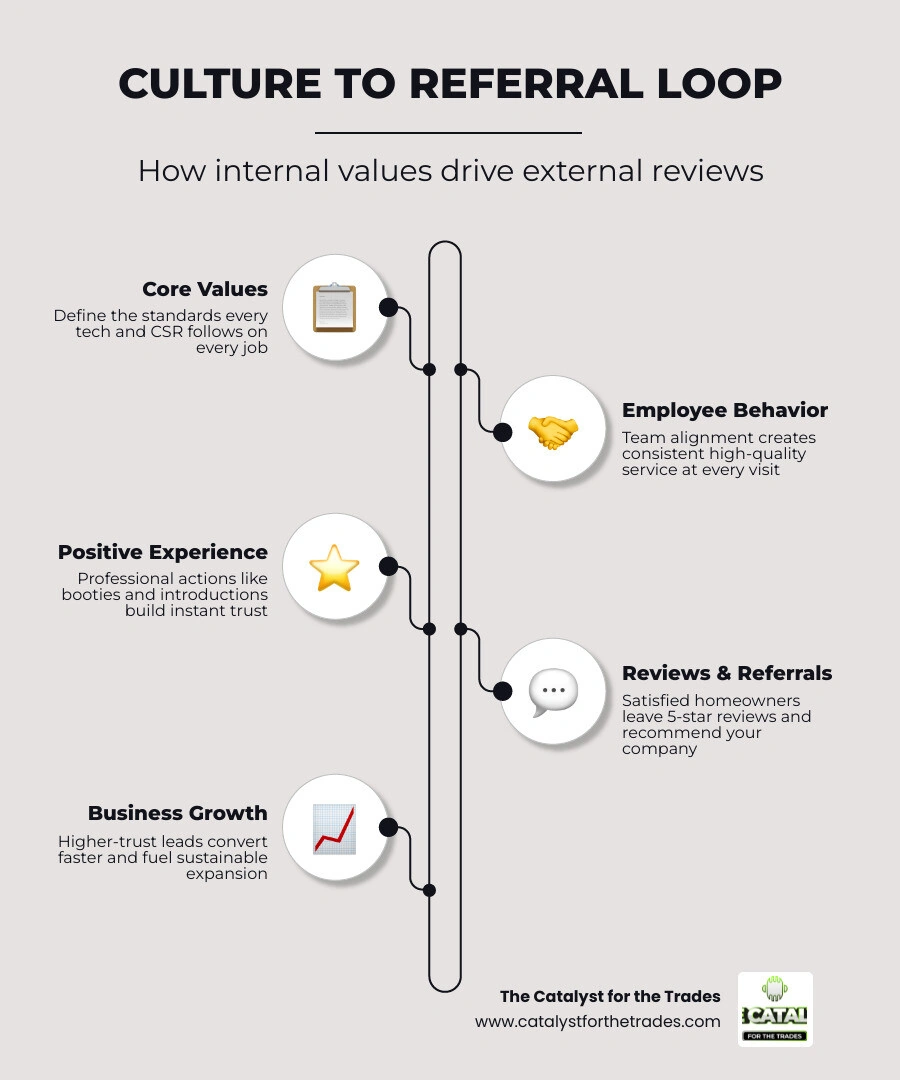
Here is a quick breakdown of how it works:
- Core values shape how technicians and CSRs behave on every job
- Employee alignment with those values creates consistent, high-quality service
- Consistent service leads to positive customer experiences
- Positive experiences generate 5-star reviews and word-of-mouth referrals
- Referrals bring in higher-trust leads who are more likely to convert and refer others
Most home service business owners think reviews are a marketing problem. They are not. They are a culture problem — or more accurately, a culture opportunity.
When a technician wipes down the truck, introduces himself by name, and puts on booties before stepping inside, that is not just professionalism. That is company culture in action. And according to research, most 1-star reviews are earned in the first 90 seconds of a visit — before any actual work even begins.
The businesses generating the most reviews and the steadiest stream of referrals are not necessarily the ones with the biggest ad budgets. They are the ones where every person on the team, from the CSR answering the phone to the tech closing out a job, understands exactly what the company stands for and acts on it daily.
How Company Culture Affects Customer Reviews and Referrals in Home Services
In the home services sector—whether you run an HVAC, plumbing, electrical, or roofing business—your product isn’t just the physical equipment you install or repair. Your real product is the relationship you build with the homeowner. Every single interaction is an opportunity to build trust, earn a lifelong customer, and secure a glowing recommendation.
At the heart of this relationship lies your core values. When a company’s values are clearly defined and lived by every employee, they act as an operational compass. Instead of relying on rigid rulebooks, technicians and customer service representatives (CSRs) make decisions based on shared principles.
This internal alignment is the bedrock of Online Reputation Management. When your team behaves consistently, your service quality stabilizes, resulting in predictable customer experiences that naturally encourage reviews and organic referrals.
The Direct Link: How Company Culture Affects Customer Reviews and Referrals in Home Services
Let’s look at the numbers. Research shows that 89% of customers are more likely to complete an additional purchase following a good customer service experience. In the home services industry, where repeat business and customer lifetime value (LTV) determine profitability, this is a massive growth lever.
When your company culture prioritizes the homeowner’s peace of mind, your team stops treating visits as transactional tasks and starts treating them as relationship-building opportunities. This mindset shift is the definition of Service Excellence.
A customer who experiences a seamless, respectful, and highly professional service call doesn’t just feel satisfied; they feel compelled to share their experience. This is how a strong culture directly feeds your digital marketing efforts, driving up your star ratings on Google and generating high-trust referrals.
Employee Happiness as a Driver of Customer Referrals
It is impossible to deliver a 5-star customer experience with a 1-star employee culture. The way your office staff and field technicians feel about their jobs directly translates to how they treat your customers. When employees feel valued, respected, and supported, their enthusiasm and pride show in their work.
Happy employees naturally provide better service, which translates into powerful word-of-mouth marketing. If a technician feels appreciated by leadership, they are far more likely to go the extra mile for a homeowner—whether that means taking the time to explain a complex system or ensuring the workspace is cleaner than they found it. By practicing People First Leadership in Construction and the trades, you build an internal culture of advocacy that effortlessly turns into external customer referrals.

Embedding Core Values into Daily Home Service Operations
Many contracting businesses make the mistake of treating core values as mere wall decorations. To truly influence your reputation, those values must be baked into your daily operations. This is the core of active Company Culture Development.
To make your values real for your team, you must create daily rituals that reinforce them. Consider implementing:
- Daily Morning Huddles: Spend 10 minutes celebrating team members who lived your core values the day before.
- A Simple Service Mantra: Distill your customer philosophy into a single, memorable phrase (e.g., “Leave every home better than we found it”).
- Leadership Modeling: Leaders must walk the walk. If your core value is “Honesty,” leadership must be transparent with employees about business updates and challenges.
Operationalizing the Connection: How Company Culture Affects Customer Reviews and Referrals in Home Services
To bridge the gap between internal culture and external reviews, you must give your team the authority to act on your values. This is known as empowering on-site decision-making.
If a technician is at a customer’s house and notices a minor, unrelated issue—like a loose hose bib while servicing an AC unit—are they empowered to fix it on the spot without charging the client or waiting for manager approval?
When your culture encourages this level of proactive care, it transforms a standard service call into an unforgettable experience. Following a Customer Experience Best Practices Guide means structuring your operations so that technicians have the resources and permission to make homeowners feel truly cared for.
Value-Driven Training and Ongoing Development
Embedding culture is not a one-time onboarding task; it is an ongoing process. Training programs should focus equally on technical skills and soft skills like active listening, empathy phrasing, and conflict resolution.
Using role-playing exercises during weekly meetings helps technicians practice how to handle difficult conversations, present options clearly, and ask for reviews naturally. When your team is highly engaged and possesses the tools to handle any customer scenario with grace, your Customer Retention Strategies become far more effective.
Proactive Customer Service and Measurable Cultural Metrics
A reactive home service business waits for the phone to ring with a complaint before taking action. A proactive business, rooted in a healthy culture, anticipates customer needs and reaches out before issues escalate.
By building a systematic Customer Service Strategy, you can turn potential friction points into opportunities for positive feedback.
Let’s look at how proactive cultures compare to reactive ones in real-world scenarios:
| Operational Area | Reactive Service Culture | Proactive Service Culture |
|---|---|---|
| Communication | Only contact the homeowner when something goes wrong or to send the bill. | Send text updates with tech bios, photos, and live tracking links. |
| Problem Resolution | Wait for a negative online review, then call to argue or offer a refund. | Address issues on-site immediately; follow up within 24 hours of every job. |
| Feedback Collection | Send automated, generic emails 48 hours later (low conversion). | Ask verbally at the “happy moment” and send a direct text link within 1 hour. |
| Technology Use | Avoid tech upgrades; rely on manual scheduling and paper invoices. | Leverage AI and modern CRMs to provide instant answers and seamless bookings. |
Proactive Problem Solving to Reduce Complaints
No business is perfect, and mistakes will happen. However, a customer-centric culture views complaints not as nuisances, but as valuable feedback.
According to industry data, 43% of consumers said that a poor customer service experience is why they stopped buying from a company. If a homeowner has a bad experience, there is a 91% chance they will never return—and they will likely tell up to 20 people about it.
By addressing issues quickly and empathetically, you can actually increase customer loyalty. When a technician or manager takes immediate ownership of a mistake and resolves it transparently, it demonstrates integrity. This level of proactive care frequently turns potential 1-star situations into 5-star reviews praising your professionalism.
Measuring Culture Through Response Time and Personalization
Homeowners value speed and convenience. In fact, 72% of consumers say they’ll give their loyalty to companies providing faster service.
Your company’s response time is a direct reflection of your internal culture. If your team is slow to return calls or show up for appointments, it signals a lack of respect for the customer’s time.
Modern home service businesses are increasingly turning to technology to maintain speed and personalization at scale:
- 90% of service leaders say that AI helps them make faster, better-informed decisions.
- 96% of field service leaders currently use or plan to use AI to access product and service information instantly.
Integrating tools like automated SMS updates, CRM platforms, and AI-driven diagnostic assistants allows your team to spend less time on paperwork and more time delivering personalized, high-quality human interactions.
The High Cost of a Weak or Misaligned Culture
When company culture is weak or misaligned, the consequences show up directly on your bottom line. Without shared values, employees operate in silos, leading to inconsistent service, internal friction, and a drop in overall standards.
In the digital era, a poor internal culture cannot remain hidden. It quickly translates into negative online reviews, damaging your local search rankings and halting your business growth. Effective Online Reputation Management is impossible without a healthy cultural foundation.
The Risk of Negative Reviews and Damaged Reputation
A single “culture misfit” or a toxic employee who is tolerated because they are a high technical performer can quietly destroy your business. If a technician treats a homeowner rudely or cuts corners on a job, the resulting negative review will be seen by thousands of local prospects.
Furthermore, 73% of consumers only trust reviews written in the last 30 days. This means you cannot rely on past successes; your team must deliver exceptional service every single day. If your culture fails to support consistent quality, your review pipeline will dry up, and your search visibility will plunge.
Frequently Asked Questions about Culture and Reviews
How does internal employee treatment affect external customer service?
The way you treat your team sets the standard for how they treat your customers. When employees feel respected, supported, and valued by leadership, they take pride in their work.
In fact, research shows that employees who feel respected are 27% more likely to find their jobs meaningful and take personal ownership of customer happiness. Prioritizing employee satisfaction naturally reduces turnover and improves service consistency.
Can we incentivize technicians to get more Google reviews?
You must be extremely careful here. The Federal Trade Commission (FTC) enforces strict rules regarding online reviews.
While you can run internal contests to reward technicians for the number of reviews they generate, you cannot offer discounts, gift cards, or incentives to customers in exchange for positive reviews, nor can you pay technicians based on the sentiment (star rating) of the reviews. Keep your internal programs focused on rewarding team members for delivering great service and asking for honest feedback.
What is the difference between customer service and customer experience?
While these terms are often used interchangeably, they are quite different:
- Customer Service refers to a specific, single interaction—such as a CSR answering a question on the phone or a technician repairing a leaky pipe.
- Customer Experience (CX) is the sum of all interactions a customer has with your brand, from the first time they see your ad, to the booking process, the on-site visit, the invoice, and the follow-up communications.
Company culture shapes your entire customer experience, ensuring every touchpoint is seamless and positive.
Conclusion
Your company culture is not an abstract concept; it is the most practical growth tool your home service business possesses. By building an internal environment of respect, continuous learning, and clear core values, you empower your team to deliver the kind of outstanding experiences that naturally earn 5-star reviews and steady referrals.
At The Catalyst for the Trades, we are dedicated to helping business owners scale their operations, master modern marketing technology, and build high-performing teams. If you are ready to turn your company culture into your greatest competitive advantage, explore our resources on Company Culture Development and start building a reputation-first business today.


