Learn · June 30, 2026
How to Attract and Hire Good Technicians for an HVAC or Plumbing Business: 7 Proven Tactics
Learn how to attract and hire good technicians for an HVAC or plumbing business with proven sourcing, interview, and retention strategies.
By The Catalyst Editorial Team Operator education · 13 min read · Updated July 24, 2026

The Technician Shortage Is Real — Here’s How to Fix Your Hiring
How to attract and hire good technicians for an HVAC or plumbing business is one of the most pressing challenges in the trades right now. If you’re a home services business owner, you already feel it: the pool of qualified candidates is shrinking, competition is fierce, and the cost of leaving a truck parked is very real.
Here’s a quick overview of what actually works:
- Build multiple sourcing channels — employee referrals, trade school partnerships, social media, and job boards
- Make your company worth choosing — strong employer brand, Google reviews, and a reputation for treating people well
- Write job postings that sell the opportunity — lead with benefits, culture, and growth, not just a list of requirements
- Simplify the application process — keep it mobile-friendly and completable in under three minutes
- Use a structured interview process — combine a phone screen with a practical skills assessment
- Offer competitive, transparent compensation — including pay ranges, benefits, and advancement opportunities
- Invest in onboarding and retention — the first 90 days determine whether someone stays two months or two years
The numbers paint a clear picture of why this matters. Over 50% of the current HVAC workforce is over age 45 and nearing retirement. More than 25,000 skilled technicians leave the industry every year, while fewer are entering to replace them. One report from the Better Business Bureau projects as many as 225,000 vacant service technician positions within five years. At the same time, 87% of service companies report difficulty finding qualified technicians, and 8 in 10 contractors say they’re struggling to find skilled workers right now.
The challenge isn’t just finding warm bodies. As one industry consultant puts it, it’s not about getting people who can “fog a mirror” — it’s about finding people who are the right technical and cultural fit, and then giving them a reason to stay.
The good news? Many businesses hire reactively, posting a job only when they are desperate and hoping for the best. Building a proactive, systematic approach to recruiting — one that runs year-round, not just when there’s an open seat — consistently positions your business for success in this tight labor market.
This guide walks you through exactly how to do that.
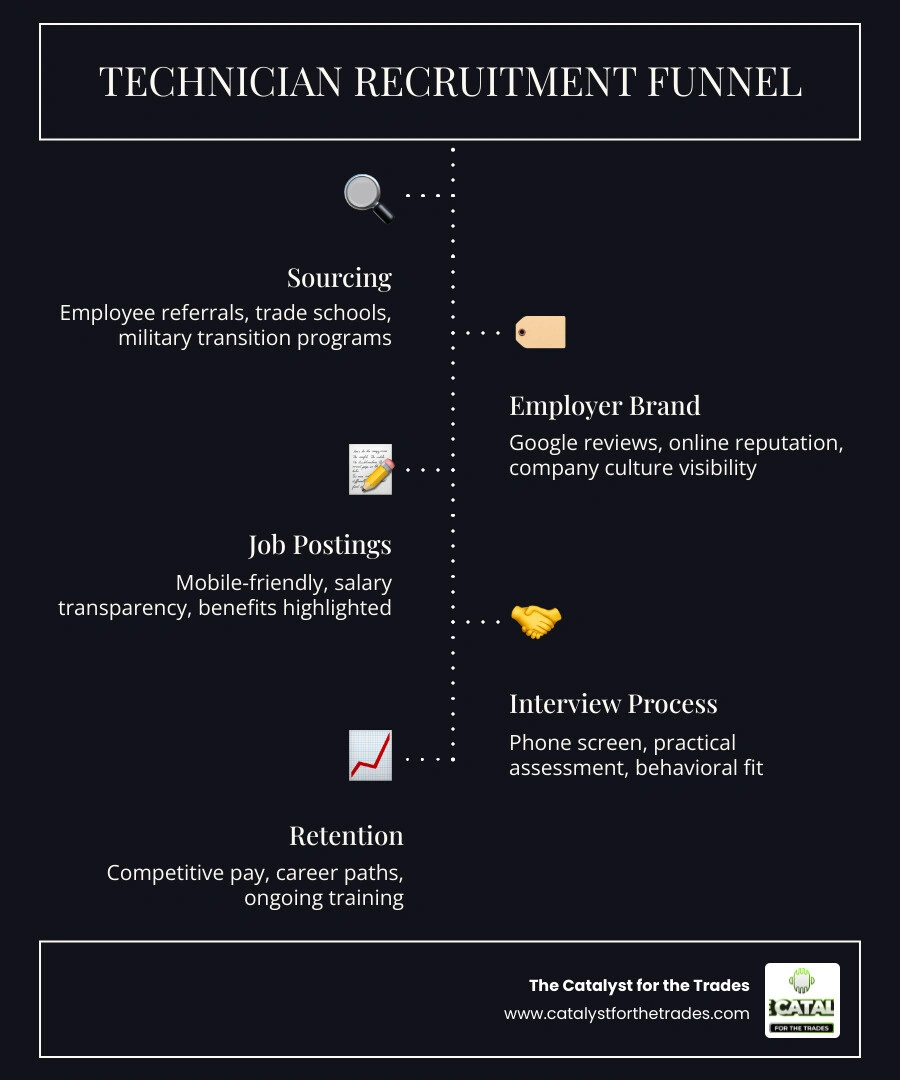
Sourcing Channels: Where to Find Qualified Candidates

Relying solely on general job boards when you need a technician is a recipe for frustration. The most skilled professionals in your area are rarely scrolling through online boards on a Tuesday afternoon; they are already employed. In fact, research shows that up to 70% of the global workforce consists of passive candidates who aren’t actively looking for a job but would move for the right opportunity.
To reach these top-tier tradespeople, we must diversify our sourcing channels. This means building a proactive machine that targets active job seekers, passive talent, and the next generation of tradespeople entering the market. By establishing a robust candidate sourcing strategy, you can turn a reactive “panic hire” into a predictable, year-round talent pipeline.
Leveraging Employee Referrals for Better Cultural Fit
Your current team members are your best recruiters. They understand your company culture, they know what the day-to-day work actually looks like, and they likely have a network of former coworkers, trade school classmates, and industry peers.
Statistically, employee referrals have a 3x higher probability of success than cold applicants. Referred hires ramp up faster, fit into the team culture more smoothly, and stay with the company longer.
To make this work, you need a structured, highly visible referral program. Simply telling your team, “Let me know if you know anyone,” won’t cut it. Instead, establish clear incentives and milestone rewards:
- The Initial Hire Bonus: Offer a substantial financial reward when a referred candidate is hired and completes their first 90 days.
- The Retention Milestone: Keep the excitement alive by offering an additional bonus on the referred employee’s one-year anniversary.
- Public Recognition: Celebrate referral successes during team meetings. When technicians see their peers receiving real bonus checks for helping build the team, they will actively look for talent on your behalf.
For a deeper dive into building these internal networks, explore our guide on Contractor Recruiting Strategies.
How to Attract and Hire Good Technicians for an HVAC or Plumbing Business via Trade Schools
If you want to solve your long-term talent needs, you must build relationships with local trade schools, vocational programs, and community colleges. Too many home service businesses only reach out to trade schools when they have an immediate opening. To win the best graduating talent, you need to be a familiar face on campus long before graduation day.
Partnering with trade schools allows you to build structured pathways and offer hands-on internships. This creates a win-win scenario: students get real-world experience, and you get to evaluate their work ethic, attitude, and aptitude before making a full-time offer.
Here is how to build a highly effective trade school outreach program:
- Engage the Instructors: Get to know the program directors and instructors within a 50-mile radius. They know which students are the hardest workers and the fastest learners.
- Offer Guest Lectures: Volunteer to speak to classes about the reality of running a service business, the future of smart home technology, or advanced troubleshooting techniques.
- Provide Equipment: Donate older, functional equipment or tools to the school’s workshop. Having your company name associated with their learning environment builds immediate brand familiarity.
By systematically engaging with these local institutions, you can dramatically reduce your average time-to-hire. For practical steps on setting up these pipelines, read our insights on Recruiting Skilled Hvac Technicians.
How to Attract and Hire Good Technicians for an HVAC or Plumbing Business
In today’s hyper-competitive market, technicians are interviewing you just as much as you are interviewing them. Before they ever submit an application, they will look up your business online. If your digital footprint is messy, outdated, or non-existent, passive candidates will quickly move on to the next option.
This is where Employer Branding becomes your secret weapon. Your employer brand is the reputation you have as a place to work. It is built on your company culture, your online presence, and how your current employees speak about you.
One of the most overlooked recruitment tools is your Google reviews. Technicians want to work for a winner. They would much rather represent a highly respected, 5-star company than a struggling, 3.2-star business where they have to constantly apologize to angry homeowners. A stellar online reputation doesn’t just attract customers; it acts as a talent magnet for high-performing professionals who take pride in their work.
Crafting Compelling Job Postings That Convert
Most trades job postings look like a dry, uninspiring laundry list of demands: “Must have 5 years experience, EPA 608 license, clean driving record, own tools, and be willing to work weekends.”
To stand out, your job postings must be treated as marketing tools. Their job is to sell the opportunity of working for your business. Lead with what the candidate gains by joining your team, not just what you expect from them.
When writing your job descriptions, keep these best practices in mind:
- Lead with the “Why”: Start with your company culture, your values, and what makes your team unique.
- Provide Complete Transparency: Include clear salary ranges, benefits, tool allowances, and licensing reimbursements. Transparency builds immediate trust.
- Highlight Professional Growth: Show that this isn’t just a temporary position; it offers clear opportunities for long-term advancement.
- Use Inclusive Language: Avoid aggressive, masculine-coded language that might discourage qualified, diverse candidates from applying.
To learn how to structure your ads for maximum conversions, check out our guide on Strategic Recruiting.
Designing an Effective Interview and Assessment Process
Too many home service business owners hire based on a “gut feeling” during a quick, unstructured 30-minute chat. This often leads to poor hires, which can cost your business thousands of dollars in lost productivity, damaged customer relationships, and repeating the recruitment cycle all over again.
To build a high-performing team, you need a structured approach to Talent Acquisition that objectively evaluates both technical skills and cultural alignment.
| Evaluation Area | Technical Skills Assessment | Behavioral Fit Interview |
|---|---|---|
| Focus | Diagnostic accuracy, safety protocols, tool proficiency | Work ethic, coachability, customer service, team chemistry |
| Method | Hands-on shop exercises, troubleshooting scenarios | Structured behavioral questions, past work history deep dive |
| Goal | Verify actual field competence and licensing | Ensure alignment with company values and long-term retention |
Structuring the Multi-Stage Interview
A structured, multi-stage interview process allows you to thoroughly vet candidates without dragging out the timeline. Here is a highly effective four-stage framework:
- The 15-Minute Phone Screen: A quick, friendly conversation to verify basic requirements, license status, availability, and alignment on compensation expectations.
- The Hands-On Shop Visit: Bring the candidate into your facility for a practical assessment. Have them diagnose a staged equipment fault or explain their troubleshooting process. This filters out candidates who talk a good game but struggle with practical application.
- The Work History Deep Dive: Sit down for a 30-minute conversation to explore their past work experiences, why they left previous roles, and how they handle challenges in the field.
- The Expectations Setting Conversation: End the process with absolute clarity. Lay out your company standards, performance metrics, on-call expectations, and professional development opportunities so there are no surprises on day one.
Key Interview Questions for Assessing Character and Competency
To truly understand how a technician will perform in the field, ask behavioral questions that require them to share specific examples from their past. Here are some highly revealing questions to include in your interviews:
- “Can you tell me about a time when a customer was extremely unhappy with your work, and how you turned the situation around?” (Assesses customer service and emotional intelligence)
- “Describe a complex technical issue you encountered recently that you couldn’t solve right away. What steps did you take to figure it out?” (Assesses problem-solving and resourcefulness)
- “How do you prefer to be managed, and what does a supportive company culture look like to you?” (Assesses cultural fit and communication style)
- “What does going ‘above and beyond’ for a homeowner look like in your daily routine?” (Assesses work ethic and attention to detail)
Retention Strategies: Keeping the Talent You Hire
Hiring a great technician is only half the battle; keeping them is where the real work begins. With the current skills shortage, top talent is always in high demand. If your technicians feel undervalued, overworked, or stagnant, they will look for other opportunities.
In fact, research shows that 64% of technicians cite inadequate compensation as their primary reason for leaving a business within the first two years. However, money is rarely the only factor. Technicians also leave due to poor management, a lack of professional progression, and exhausting on-call schedules that destroy their work-life balance.
To keep your fleet fully staffed, you must implement proactive Employee Retention Strategies For Contractors.
Designing Competitive Compensation and Benefits Packages
To attract and retain A-players, your compensation package must be competitive and comprehensive. This means moving beyond just an hourly rate and designing a holistic package that supports your team both on and off the clock:
- Comprehensive Health Insurance: Provide robust medical, dental, and vision coverage for your technicians and their families.
- Predictable Time Off: Offer at least three weeks of paid time off (PTO) within the first year to prevent seasonal burnout.
- Tool and Uniform Allowances: Cover the costs of high-quality uniforms and provide a yearly tool allowance so your team always has the right gear for the job.
- Employee Assistance Programs (EAP): Provide access to mental health support, financial counseling, and wellness resources to help your team manage life’s stresses.
By building a comprehensive package, you show your team that you are invested in their long-term well-being. To discover how to structure these packages effectively, read our guide on Talent Retention.
How to Attract and Hire Good Technicians for an HVAC or Plumbing Business by Offering Professional Development
Top-tier technicians are rarely content with staying in the exact same position forever. They want to know that their hard work leads to professional growth, new skills, and increased earning potential. If they feel like they’ve hit a ceiling at your company, they will find another organization that offers a clear path forward.
By incorporating structured development into your Workforce Planning, you create a clear roadmap for advancement:
- Clear Advancement Paths: Map out exactly what is required to move from an entry-level role to a lead technician or a service manager.
- Ongoing Skill Development: Provide paid time off for manufacturer workshops, advanced skill-building, and technical seminars.
- Regular Professional Check-Ins: Don’t wait for annual reviews. Conduct brief, monthly check-ins focused purely on their professional goals, skills development, and long-term aspirations.
Investing in your team’s growth builds deep loyalty and ensures your business always has the leadership talent it needs to scale. For more strategies on building these internal pathways, explore our approach to Talent Pipeline Development.
Frequently Asked Questions about Hiring Trades Technicians
How long does the hiring process typically take for an HVAC or plumbing technician?
In today’s highly competitive market, a typical hiring process can take anywhere from 2 to 6 weeks from the initial job posting to the candidate’s first day on the job.
However, the fastest-moving companies always win the best talent. If you take two weeks just to schedule a phone screen, the top candidates will already have multiple offers in hand. To stay competitive, aim to review applications daily, conduct phone screens within 24 hours of submission, and keep your total interview process to under a week.
Should my business hire entry-level apprentices or experienced journeymen?
The ideal approach is a balanced mix of both:
- Experienced Journeymen: They can generate immediate revenue, work independently, and mentor younger team members. However, they command higher compensation and are much harder to find in a tight labor market.
- Entry-Level Apprentices: They require a significant educational investment and close supervision for the first 12 to 24 months. However, they allow you to develop them in your specific processes, build deep company loyalty, and scale your workforce more cost-effectively over time.
How do Google reviews and online reputation affect technician recruitment?
Your online reputation is your digital storefront for potential employees. Technicians do not want to work for companies with poor ratings, bad customer feedback, or a reputation for cutting corners.
When a technician sees that your company has hundreds of 5-star reviews, it tells them three things: you run a professional operation, your customers trust you, and their daily work will be respected. A strong online brand makes candidates feel proud to wear your uniform and significantly increases your application rates.
Conclusion
Building a world-class team of HVAC and plumbing technicians doesn’t happen by accident. It requires moving away from reactive, panic-driven hiring and embracing a year-round, proactive recruitment strategy. By building diverse sourcing channels, crafting compelling job ads, streamlining your application process, and investing heavily in technician retention, you can build a stable, high-performing workforce that drives consistent business growth.
At The Catalyst for the Trades, we are dedicated to helping home service business owners conquer their operational and recruiting challenges. Through our podcast, hosted by Jennifer Bagley and Chuck Staszkiewicz, we combine cutting-edge technology insights with real-world industry experience to help you scale your business, optimize your processes, and become the employer of choice in your market.
Ready to take your recruiting and team management to the next level? Explore our comprehensive resources and check out The Catalyst for the Trades Talent Management Guide to start building your ultimate workforce today!


