Learn · July 1, 2026
How to Scale an HVAC or Plumbing Business Past One Million Dollars: Proven 2026 Guide
Learn how to scale an HVAC or plumbing business past one million dollars with proven systems, leadership strategies, and marketing tactics for sustainable growth.
By The Catalyst Editorial Team Operator education · 12 min read · Updated July 24, 2026

Why Most HVAC and Plumbing Businesses Stall at $1 Million (and How to Break Through)
How to scale an HVAC or plumbing business past one million dollars comes down to one core shift: stopping doing the work yourself and starting building the systems, team, and strategy that let the business grow without you.
Here is a quick overview of what that looks like in practice:
- Stop working in the business – Get out of the truck and off the tools so you can work on the business
- Build operational systems – Implement a CRM, automate follow-ups, and document your processes
- Hire ahead of demand – Add technicians, a field supervisor, and admin support before you desperately need them
- Invest in digital marketing – Own your local SEO, Google reviews, and paid ads to drive consistent leads
- Create recurring revenue – Launch maintenance membership plans to stabilize cash flow year-round
- Track the right KPIs – Monitor metrics like revenue per truck, callback rate, close rate, and cost per acquisition
- Shift your pricing – Move to flat-rate pricing and revisit your rates regularly to reflect the value you deliver
Hitting one million dollars in revenue is a genuine achievement. Most trades businesses never get there. But here is the uncomfortable truth that many owners discover only after crossing that threshold: the habits, routines, and instincts that got you to $1 million are often the exact things holding you back from $3 million, $5 million, or beyond.
At $1 million, you are likely still the best technician on your team, the default decision-maker for every problem, and the person everyone calls when something goes wrong. That model works — until it does not. Growth stops being a matter of working harder and starts requiring something most skilled tradespeople were never trained to do: lead a business, delegate with confidence, and build systems that run without you in the middle of everything.
One business owner described the moment perfectly: “I was obsessed with hitting $10M. And when we finally got there… everything broke.” That experience is more common than most people admit. Scaling creates new pressure points at every stage, and the businesses that push through to $5 million, $10 million, and beyond do it by solving those problems deliberately — not by grinding harder.
This guide walks you through exactly how to make that transition, from the mindset shifts required on day one to the systems, marketing strategies, and financial controls that separate a $1 million business from a $10 million one.
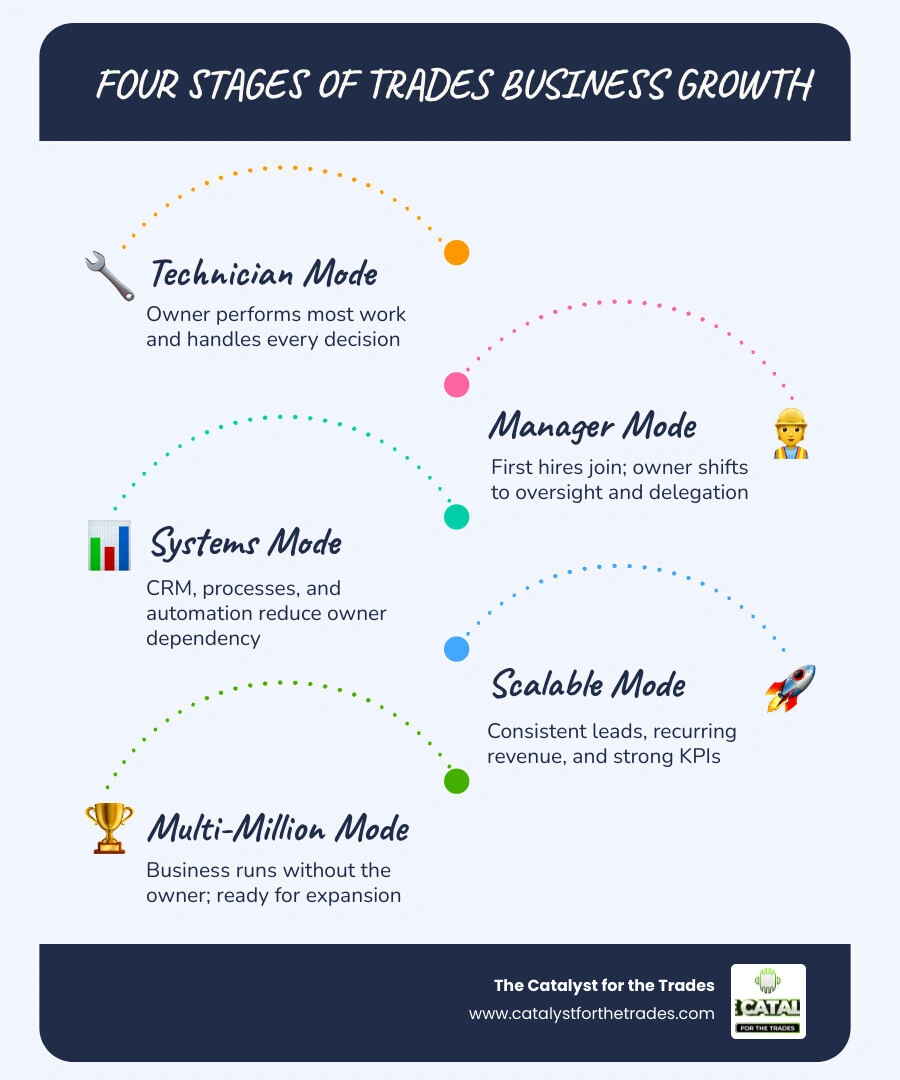
How to Scale an HVAC or Plumbing Business Past One Million Dollars
Reaching the seven-figure mark is a massive milestone. Statistically, only a small percentage of home service businesses ever cross this threshold—often estimated at fewer than 10% to 20% of all contracting firms. Most remain lifestyle businesses or solo operations where the owner is the primary producer.
To break out of this bracket, you must stop viewing your business as a job you own and start treating it as an asset you build. This requires a structured blueprint, much like our 5 Year Business Roadmap for Contractors, which helps map out the transition from a hands-on operator to an enterprise leader.
At the $1 million mark, you are at a critical tipping point. You cannot simply work more hours to double your revenue; there are only 24 hours in a day, and you are likely already using most of them. Scaling past $1 million requires a fundamental restructuring of how your business operates, how decisions are made, and where you invest your capital.
Shifting from Technician to Strategic CEO
The skills that make you an exceptional plumber or HVAC technician are completely different from the skills required to run a multi-million-dollar corporation. When you are under $1 million, your technical expertise is your greatest asset. Once you cross that line, your technical expertise can easily become your greatest bottleneck.
To scale, you have to transition from a “doer” to a “planner and delegator.” This shift is often uncomfortable because it requires letting go of direct control over the daily work. However, as we explore in How to Build a Profitable Scalable Trades Business: Lessons from Dana Staszkiewicz, true scaling only happens when the owner stops answering service calls and begins coaching managers, defining company culture, and managing cash flow.
As a strategic CEO, your primary responsibilities become:
- Vision and Strategy: Setting the long-term direction and expansion goals for the company.
- Leadership Development: Recruiting, onboarding, and mentoring key managers who can run operations without your daily supervision.
- Financial Stewardship: Monitoring cash flow, analyzing margins, and ensuring capital is allocated to high-growth areas.
Overcoming the Owner-Dependency Trap
The “owner-dependency trap” is the single most common reason trades businesses plateau around the $1 million mark. If every customer escalation, inventory discrepancy, and scheduling conflict has to pass through you, you are not running a scalable business—you are running a highly stressful job.
To break this bottleneck, you must build robust operational frameworks. We dive deep into this concept in our guide on Building Scalable Service Operations. Eliminating owner-dependency involves three core actions:
- Documenting Standard Operating Procedures (SOPs): Every routine task—from how a technician greets a homeowner to how inventory is tracked in the warehouse—must be documented. This ensures consistency and makes onboarding new hires seamless.
- Creating Clean Decision-Making Boundaries: Give your office managers and field supervisors the authority to resolve problems within specific limits. If a technician needs a part or a customer requests a minor adjustment, your team should have a clear protocol to handle it without calling you.
- Establishing Peer Accountability: Use simple, visual scorecards so technicians and dispatchers can see their own performance metrics. When the team knows what success looks like, they begin self-managing.
Building the Operational Infrastructure for Multi-Million Dollar Growth
You cannot build a skyscraper on a residential foundation. Similarly, you cannot scale a trades business to $5 million or $10 million using spreadsheets, paper invoices, and whiteboard schedules. You need a modern, integrated software stack that acts as the central nervous system of your business.
When scaling, we must look at how we transition from manual, error-prone tasks to automated, streamlined workflows. Understanding this journey is key to breaking through, as discussed in How to Break Through Growth Plateaus in the Trades: Lessons from Vince Heuser’s Journey.
| Manual Process (The $1M Ceiling) | Automated Workflow (The Multi-Million Dollar Engine) |
|---|---|
| Hand-written or basic digital invoices that require manual entry | Integrated CRM invoicing that syncs directly with accounting software |
| Calling customers individually to confirm scheduled service bookings | Automated text and email sequences with technician tracking links |
| Following up on open estimates manually when the owner has free time | Automated 4-touch estimate follow-up sequences via SMS and email |
| Tracking stock on paper, leading to lost parts and missed billing | Digital inventory management with barcode scanning and automated reordering |
| Answering service calls only during standard business hours | AI-powered web chat and 24/7 automated phone backup systems |
Implementing Automation and Speed-to-Lead Systems
In the modern home services market, speed is your ultimate competitive advantage. If a homeowner has a leaking pipe or a broken air conditioner, they will rarely wait hours for a callback. They will simply call the next company on Google.
By implementing speed-to-lead automation, you ensure that every incoming lead is engaged within seconds. As highlighted in From Zero to 22 Million: Vince Heuser’s Blueprint for Explosive Home Service Growth, leveraging advanced CRM workflows and instant communication tools allows you to capture opportunities that your competitors miss.
Key automation workflows to implement immediately include:
- Missed-Call Text-Back: If a customer calls and your office cannot answer, an automated text is sent instantly: “We missed your call! How can we help you today?” This simple tool can recover massive amounts of otherwise lost revenue each year.
- Multi-Touch Estimate Follow-Up: When an estimate is sent but not accepted, an automated sequence follows up with the customer over several days. This consistent, professional touch can improve close rates by 10 to 15 percentage points.
- Automated Review Requests: As soon as a technician marks a job as complete in the CRM, a personalized text is sent to the customer asking for a review. This keeps your Google Business Profile active and growing with fresh, positive feedback.
Key Performance Indicators to Track While Scaling
To scale safely, you must manage by the numbers, not by your gut feeling. This is a lesson shared by the industry’s most successful operators; for instance, in How George Donaldson Scaled a Home Services Company to 100 Million, tracking precise, non-negotiable metrics is highlighted as the foundation of sustainable expansion.
The most critical KPIs for a scaling HVAC or plumbing business include:
- Revenue Per Truck: This measures the efficiency of your fleet. At scaling stages, you should target high efficiency per vehicle, optimizing schedules and routing to maximize active wrench time.
- Gross Margin and Net Margin: Ensure you maintain healthy margins. Tracking these separately for service versus installation helps you identify which departments are driving profit and which are dragging it down.
- Callback Rate: The percentage of jobs that require a technician to return to fix an issue. High callback rates destroy profitability and harm your reputation. Keep this metric below 2% to 3%.
- Customer Acquisition Cost (CAC) vs. Lifetime Value (LTV): Know exactly how much you spend to acquire a customer compared to the total revenue they generate over their relationship with your business.
Marketing and Customer Retention Strategies for Sustainable Expansion
To feed a growing fleet of trucks, you need a predictable, scalable lead generation machine. Ad-hoc marketing and relying solely on word-of-mouth will not support a multi-million-dollar operation. You need a multi-channel digital strategy that positions your brand as the dominant authority in your local market.
When expanding into new territories or scaling up your local footprint, having a cohesive marketing plan is vital. You can find detailed frameworks on how to structure this in our guide on Business Expansion Strategies for Trades.
Dominating Local SEO and Digital Lead Generation
The vast majority of homeowners search online when they need emergency plumbing or HVAC services. In fact, 70% of homeowners won’t hire an HVAC pro without reviews. This means your online reputation and local search visibility are directly tied to your revenue growth.
Building a sellable, highly valued business requires establishing incredible brand equity and digital dominance. As discussed in How to Build a Sellable Trades Business: Insights from a 3.7 Billion Advisor, a company with a strong digital footprint and automated lead generation is worth a much higher valuation multiple.
To dominate local search, focus on these three pillars:
- Google Business Profile Optimization: Keep your profile updated with real photos of your team, list all your specific services, and respond to every single review—both positive and negative.
- Service-Specific Landing Pages: Create high-quality, conversion-optimized pages on your website for every service you offer and every city you serve. Ensure your site loads quickly and features clear, easy-to-use scheduling options.
- Strategic Paid Advertising: Combine Google Local Services Ads (LSAs) with targeted Google search ads to capture high-intent searchers at the exact moment they need your help.
We have seen this digital-first approach transform businesses. For example, some plumbing companies have grown from a single truck to large, multi-truck operations, or nearly tripled their monthly call volumes, simply by executing a dedicated local SEO and conversion strategy.
Maximizing Lifetime Value with Recurring Revenue and Memberships
Acquiring a new customer is always more expensive than keeping an existing one—in fact, it’s roughly ten times more expensive to earn a new customer than it is to keep an existing one. This is why building a robust maintenance membership program is the ultimate cheat code for scaling a home service business.
A successful membership program provides several massive benefits:
- Predictable Cash Flow: Monthly or annual membership dues provide a reliable baseline of recurring revenue, helping cover overhead during shoulder seasons.
- High-Value Replacement Pipelines: Regular maintenance visits allow your technicians to find aging systems and offer replacement solutions before an emergency occurs.
- Increased Business Valuation: Recurring revenue streams make your business far more attractive to potential buyers, investors, or private equity firms.
Balancing rapid growth with customer and employee satisfaction is a art form. In How Trey McWilliams Balances Big Growth with People First Leadership, we learn that putting your people and your loyal customers first creates a self-sustaining growth loop that naturally boosts retention and referrals.
Furthermore, integrating modern technology into your retention efforts pays massive dividends. Businesses using AI and retention systems see a 30–40% increase in repeat bookings and up to 25% more referrals. These systems can automatically text members when it is time to schedule their seasonal tune-up, keeping your schedules full without manual office labor.
Frequently Asked Questions about Scaling a Trades Business
What is the hardest part of how to scale an hvac or plumbing business past one million dollars?
The hardest part is almost always the psychological shift required of the owner. Moving from a hands-on technician who controls every detail to a strategic CEO who delegates authority is incredibly challenging. Many owners struggle with “founder’s anxiety”—the fear that if they are not personally overseeing every job, quality will slip. Overcoming this bottleneck requires building trust in your team, documenting clear processes, and accepting that mistakes will happen as part of the learning curve.
How do systems help you learn how to scale an hvac or plumbing business past one million dollars?
Systems remove human error and owner-dependency from your daily operations. A modern CRM and automated workflow engine ensure that leads are followed up on instantly, customers receive consistent communication, and technicians have all the information they need in the field. This structure allows you to replicate your high standards across multiple trucks and crews, turning your business into a predictable machine rather than a chaotic daily scramble.
What metrics are most critical when expanding a home service company?
When scaling, the most critical metrics to track are:
- Revenue Per Truck: To ensure your fleet is operating efficiently.
- Gross Margin (Service vs. Install): To protect your profitability as volume increases.
- Customer Acquisition Cost (CAC) vs. Customer Lifetime Value (LTV): To guarantee your marketing spend is generating a profitable return.
- Callback Rate: To monitor quality control and customer satisfaction across all field teams.
Conclusion
Scaling an HVAC or plumbing business past the $1 million mark is not about working harder; it is about working smarter. It requires a complete evolution of your leadership style, a deep commitment to operational systems, and a data-driven approach to marketing and customer retention.
By stepping out of the truck, investing in modern automation, and building a team that is empowered to succeed, you can transform your business from a demanding job into a highly profitable, scalable asset.
At The Catalyst for the Trades, we are dedicated to helping home service owners navigate this transition with practical, real-world strategies. Ready to map out your growth plan and build a business that runs smoothly with or without you?
Take the next step with our Contractor Business Strategy Ultimate Guide


