Learn · May 19, 2026
Predictive Maintenance Technology: 15% Downtime Slash
Discover predictive maintenance technology: Cut downtime 15%, boost productivity 20%, and extend asset life with AI sensors and real-time monitoring.
By The Catalyst Editorial Team Operator education · 9 min read · Updated July 24, 2026

Why Predictive Maintenance Technology Is Changing How Smart Businesses Operate
Predictive maintenance technology is a data-driven approach that monitors equipment health in real time and alerts you before a breakdown happens — so you can fix problems on your schedule, not your equipment’s.
Here’s a quick breakdown of what it means:
- What it is: A maintenance strategy that uses sensors, AI, and data analytics to predict when equipment is likely to fail
- How it works: Sensors collect data (vibration, temperature, sound), AI analyzes patterns, and you get an alert before failure occurs
- Who it’s for: Any business that relies on equipment — from large manufacturers to home service operations like HVAC and plumbing
- Why it matters: Unplanned downtime costs Fortune Global 500 companies around 11% of their annual turnover — and that pain scales all the way down to small businesses too
If you run a home services business, you already know the feeling: a critical piece of equipment fails at the worst possible time, a job gets delayed, a customer gets frustrated, and your team scrambles to fix a problem that could have been prevented. That’s reactive maintenance — and it’s expensive.
Traditional preventive maintenance is better, but it’s still based on guesswork. You service equipment on a fixed schedule whether it needs it or not. That wastes time, labor, and parts.
Predictive maintenance technology takes a smarter approach. Instead of reacting to failures or following a calendar, you use real-time data to make decisions based on actual equipment condition. The result? Fewer surprises, lower costs, and a business that runs more smoothly.
In fact, research shows predictive maintenance can reduce unplanned downtime by up to 15%, boost labor productivity by 20%, and cut inventory costs by as much as 30%. For a growing home services business, those numbers add up fast.
This guide breaks down exactly how predictive maintenance technology works, what tools power it, and how you can start applying it to your operations — even if you’re not running a factory floor.
Essential predictive maintenance technology terms:
Understanding Predictive Maintenance Technology vs. Traditional Methods
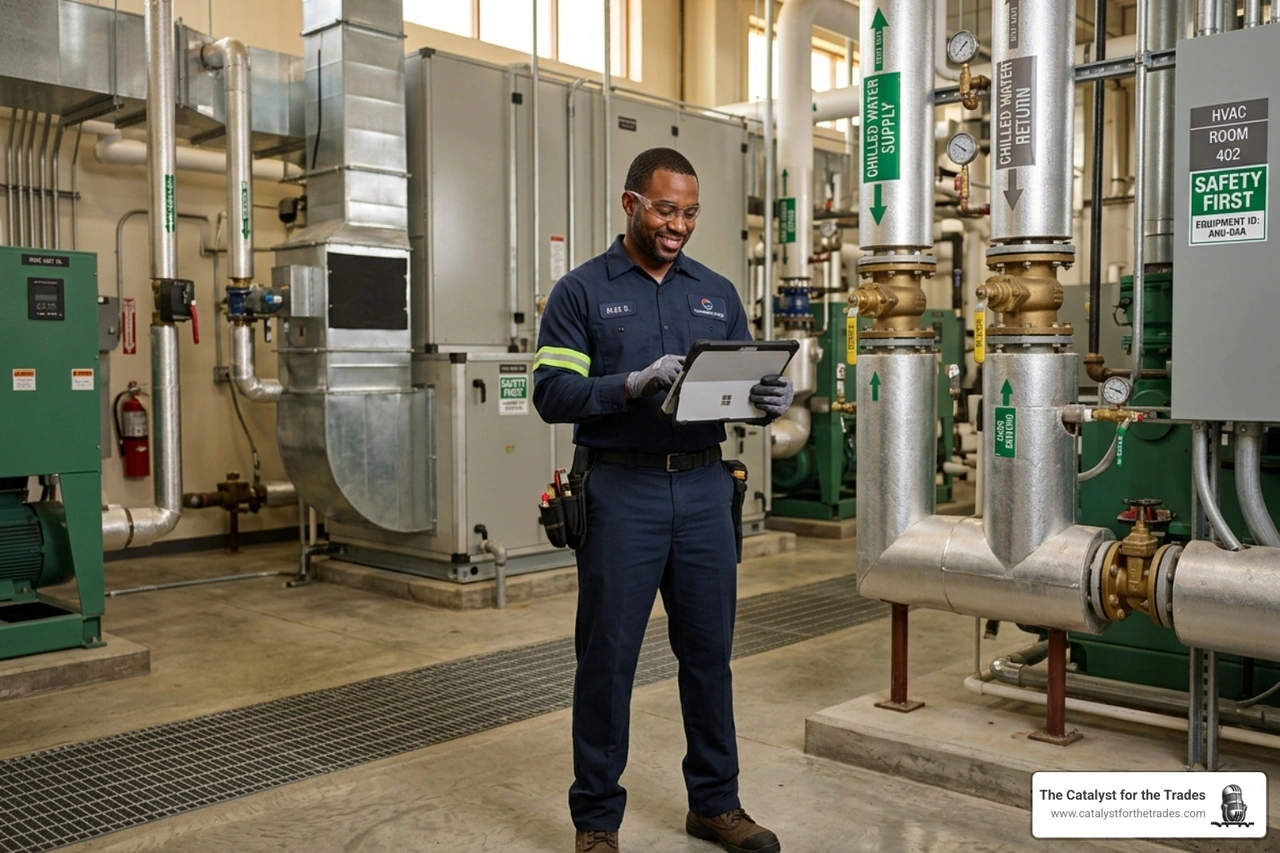
To understand why predictive maintenance technology is such a game-changer in April 2026, we have to look at where we started. For decades, the trades have operated on two main speeds: “fix it when it breaks” or “fix it because the calendar says so.”
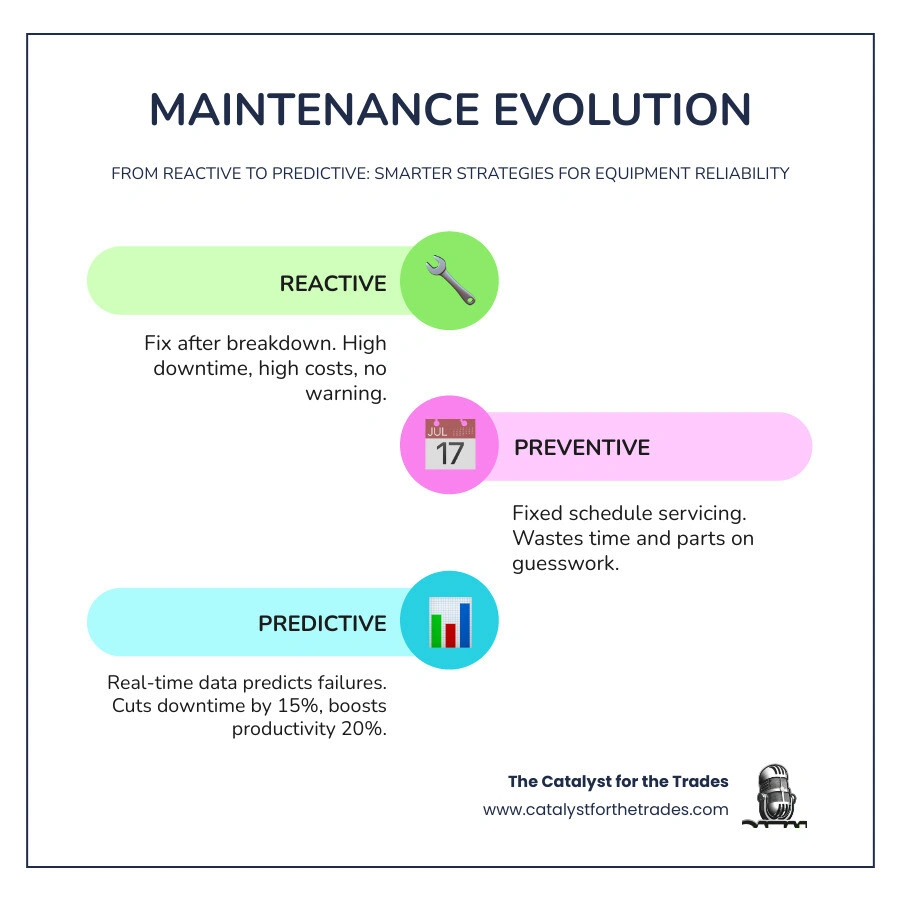
Reactive Maintenance is the old-school “run-to-failure” method. You wait for the HVAC compressor to seize or the pump to stop. While this requires the least amount of planning, it is by far the most expensive. You’re hit with emergency repair costs, lost revenue from downtime, and unhappy customers.
Preventive Maintenance was the first big step forward. This is the scheduled tune-up. You change the filters every three months or grease the bearings once a year. It’s better than waiting for a disaster, but it’s inefficient. Research suggests that preventive maintenance can actually cause failures if equipment is taken apart unnecessarily. Plus, you often replace parts that still had months of life left in them.
Predictive Maintenance (PdM) is the “Goldilocks” zone. It uses Operational Efficiency strategies to monitor the actual condition of the asset. By using statistical process control and real-time data, we only perform maintenance when the data shows a deviation from the norm. This ensures a “just-in-time” maintenance approach that maximizes the asset lifespan without risking a catastrophic failure mode.
| Feature | Reactive (Run-to-Failure) | Preventive (Calendar-Based) | Predictive (Condition-Based) |
|---|---|---|---|
| Timing | After failure occurs | Fixed schedule/intervals | Based on actual equipment health |
| Cost | High (emergency repairs) | Medium (waste of good parts) | Low (optimized spending) |
| Downtime | Unplanned and long | Planned but frequent | Planned and minimized |
| Data Use | None | Historical averages | Real-time sensor data & AI |
How Predictive Maintenance Works: From Sensors to Action
Implementing predictive maintenance technology isn’t just about sticking a sensor on a motor and calling it a day. It’s a multi-step workflow that turns raw physical signals into business decisions.
- Data Collection via IoT Sensors: The process starts with Internet of Things (IoT) sensors. These tiny devices are the “eyes and ears” of your equipment. They measure vibrations, heat, sound, and electrical current.
- Data Preprocessing and Edge Computing: In modern setups, we don’t send every single bit of data to the cloud. Edge computing allows the sensor or a local gateway to filter out the “noise” and only send relevant anomalies.
- Cloud Computing and Analysis: The filtered data is sent to the cloud where massive processing power lives. This is where the Technology Implementation really shines, as the data is compared against “digital twins”—virtual models of your equipment that know exactly how a healthy machine should behave.
- Automated Alerts and Action: When the system detects a trend toward failure, it doesn’t just send a vague email. It integrates with AI Scheduling Software to automatically create a work order, assign the right technician, and ensure the necessary parts are in the truck.
The Role of AI in Predictive Maintenance Technology
Artificial Intelligence is the “brain” of the operation. While a human might miss a slight increase in motor vibration over three weeks, Machine Learning (ML) algorithms are designed for pattern recognition.
These neural networks analyze historical failure data to build predictive models. They look for “fingerprints” of trouble—specific anomalies that happened right before a breakdown three years ago. By detecting these patterns early, AI can provide a precise “time-to-failure” estimate. This level of automation is similar to what we see in the AI Customer Service Automation Complete Guide, where technology handles the heavy lifting of data so humans can focus on the high-level tasks.
Core Technologies Powering Modern Maintenance
What are these sensors actually looking for? Depending on your trade—be it HVAC, plumbing, or electrical—different nondestructive testing methods are used to “see” inside the machine without tearing it apart.
- Vibration Analysis: This is the most common tool for rotating equipment like fans, pumps, and motors. By recording a baseline of “normal” vibration, the system can detect misalignments, unbalance, or bearing wear long before a human could hear or feel it.
- Acoustic Monitoring (Ultrasonic): Think of this like an EKG for your machines. It uses sensors to listen for high-frequency sounds. It’s incredibly effective for detecting leaks in pressurized systems or friction in bearings that are just starting to fail.
- Infrared Thermography: Heat is a universal sign of trouble. Infrared sensors identify “hot spots” in electrical panels, overloaded fuses, or friction-filled gearboxes.
- Oil and Fluid Analysis: For heavy machinery, analyzing the particles in the lubricating oil can tell you exactly which internal component is wearing down.
- Motor Circuit Analysis: This evaluates the health of the stator and rotor, checking for contamination or ground faults. It’s a vital part of the Tech Stack for Home Service Businesses that manage large-scale commercial contracts.
Key Benefits and Quantifiable Impact
Why should a business owner invest in predictive maintenance technology? The numbers from recent industry studies (updated for 2026) tell a compelling story.
When you stop “firefighting” and start predicting, you see a direct impact on Building Scalable Service Operations. Here are the primary wins:
- Reduced Downtime: Predictive strategies can lead to a 5-15% reduction in facility downtime. In the oil and gas sector, this has been shown to reduce maintenance costs by up to 38%.
- Increased Labor Productivity: When your techs aren’t chasing “ghost” problems or responding to 2:00 AM emergencies, their productivity can increase by 20%. They arrive with the right parts and a clear plan.
- Inventory Optimization: You don’t need to stock every possible spare part “just in case.” Predictive data allows for a 30% reduction in inventory levels because you know exactly when a part will be needed.
- Extended Asset Lifespan: In the steel industry, PdM has improved equipment lifetime by a staggering 60%. For a home services business, this means getting more years out of your fleet and shop equipment.
- Improved Safety: By catching failures like helicopter rotor issues or electrical fires before they happen, you protect your most valuable asset: your people.
Measuring the ROI of Predictive Maintenance Technology
Return on Investment (ROI) isn’t just a buzzword; it’s the difference between a struggling shop and a market leader. According to the Improving Operational Efficiency Guide, poor maintenance strategies can reduce a plant’s overall capacity by 5% to 20%.
For Fortune Global 500 companies, unplanned downtime costs roughly 11% of their turnover. While your business might not be a multi-billion dollar conglomerate, that percentage still applies. If your turnover is $1 million, you could be losing $110,000 a year to avoidable downtime. Predictive maintenance can save 5-10% in material costs and reduce maintenance planning time by 20-50%. These savings go straight to your bottom line, fueling Building Scalable Service Operations.
Frequently Asked Questions about Predictive Maintenance
Transitioning to new technology always raises questions. Whether you are integrating this with Field Service Management Software or starting from scratch, here is what most pros want to know.
What is the main difference between preventive and predictive maintenance?
Preventive maintenance is like changing your car’s oil every 5,000 miles because the manual says so. Predictive maintenance is like having a smart sensor in the oil that tells you the viscosity is breaking down and you need to change it now—whether that’s at 3,000 miles or 8,000 miles. One is based on time; the other is based on the actual condition.
Which industries benefit most from predictive maintenance technology?
While it started in heavy industries like oil and gas, mining, and railways, it has moved rapidly into:
- Manufacturing: Reducing unit costs and supply chain disruptions.
- Energy and Utilities: Preventing power outages and customer loss.
- Home Services: HVAC and plumbing companies use it to monitor commercial boilers and cooling towers for their clients.
- Healthcare: Monitoring life-critical laboratory and refrigeration equipment.
How do IoT sensors improve maintenance accuracy?
IoT sensors remove human error. Instead of a technician “feeling” if a motor is too hot, a sensor provides a constant stream of precise data. This allows for “anomaly detection”—comparing real-time data to a predicted “normal” behavior rather than just waiting for a fixed threshold to be crossed. This provides much earlier warnings than traditional inspections.
Conclusion
At The Catalyst for the Trades, we believe that the future of the home services industry isn’t just about who has the best tools in their belt, but who has the best data in their pocket. Predictive maintenance technology is no longer a luxury for giant factories; it is a strategic necessity for any business looking for growth, innovation, and leadership in April 2026.
By moving away from the chaos of reactive fixes and the waste of rigid preventive schedules, you can build a more resilient, profitable operation. This shift requires a solid Technology Strategy and a commitment to operational excellence.
Ready to stop firefighting and start growing? Whether you’re scaling your HVAC business or modernizing your plumbing fleet, the data is already there—you just need the right technology to listen to it.
For more insights on how to lead your trade into the digital age, visit us at www.catalystforthetrades.com.


