Learn · May 20, 2026
7 Managerial Skills for Trade Pros in 2026
Master managerial skills for trade professionals: cultural intelligence, communication, resilience & tech mastery for 2026 global success.
By The Catalyst Editorial Team Operator education · 9 min read · Updated July 24, 2026

Why Managerial Skills for Trade Professionals Determine Who Scales and Who Stalls
Managerial skills for trade professionals are the difference between a business that stays stuck at the same revenue year after year and one that grows, scales, and runs without the owner doing everything themselves.
Here are the 7 essential managerial skills every trades leader needs to master:
- Cultural Intelligence and Global Networking – Build trust across borders and unlock new business relationships
- Strategic Communication – Set clear expectations with customers and teams to prevent costly mistakes
- Negotiation and Interpersonal Influence – Close better deals and resolve conflict before it derails projects
- Trade Finance and Regulatory Compliance – Understand the financial and legal landscape your business operates in
- Adaptive Thinking and Problem-Solving – Respond to disruptions fast without losing momentum
- Resilience and Stress Management – Lead with composure when projects, people, or markets throw curveballs
- Technology Proficiency – Use digital tools to automate, analyze, and scale what works
You can be the best technician in your market. But if you can’t lead a team, communicate expectations, or make smart decisions under pressure, growth will always have a ceiling.
That’s the reality most trade business owners hit somewhere between their first hire and their tenth. The technical skills that got you here won’t get you to the next level. Research consistently shows that companies struggle to find people with the right mix of communication, leadership, negotiation, legal knowledge, and business acumen for trade management roles. That gap doesn’t just hurt large corporations — it stalls small and mid-size trade businesses every day.
The good news? These skills are learnable. Every single one of them.
This guide breaks down the 7 managerial skills that separate reactive trade business owners from proactive leaders who build teams, win deals, and scale with confidence in 2026.
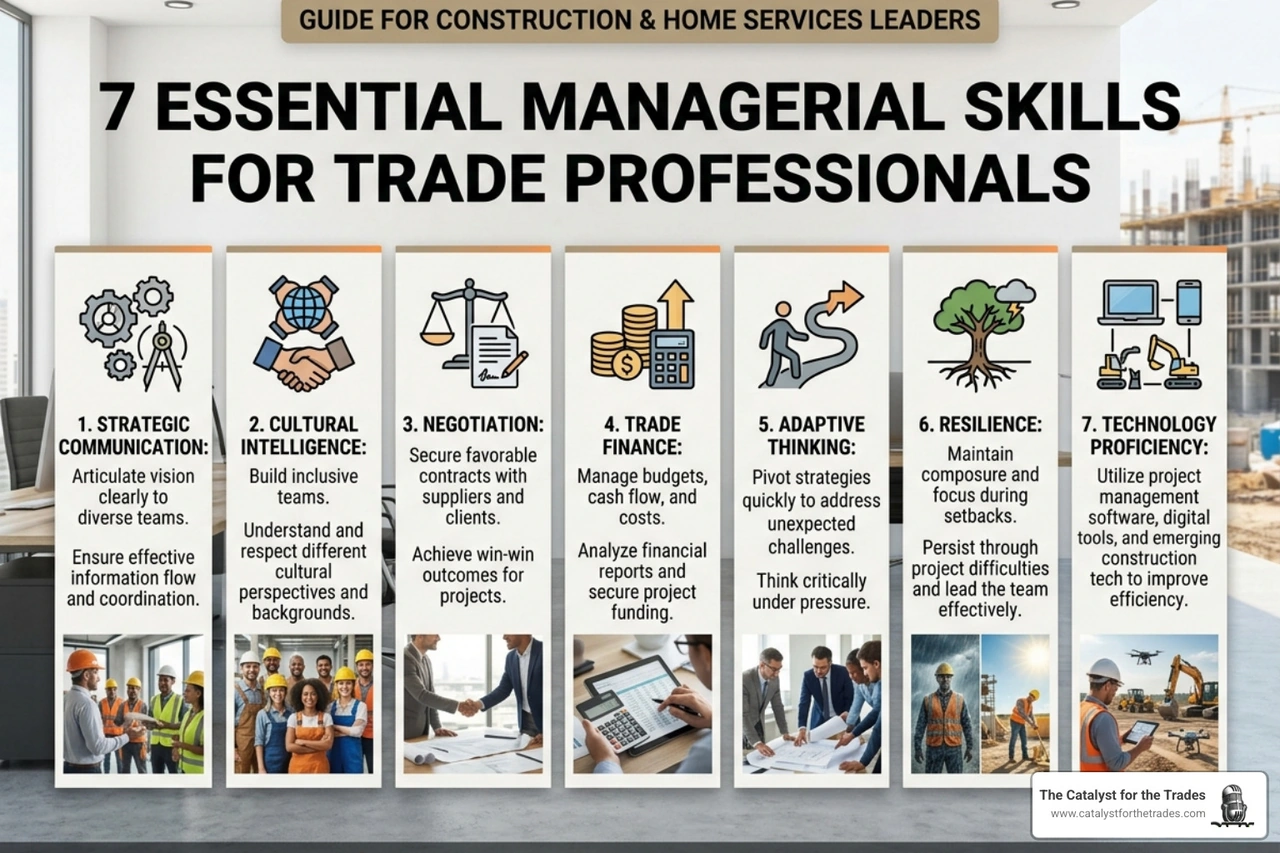
Common managerial skills for trade professionals vocab:
Cultural Intelligence and Global Networking
In the modern trade landscape of April 2026, your “local” business is more connected to the global economy than ever before. Whether you are sourcing specialized HVAC components from overseas or managing a diverse crew from different backgrounds, cultural intelligence (CQ) is no longer a “nice-to-have” soft skill. It is a fundamental component of managerial skills for trade professionals.
Cultural intelligence is the ability to function and manage effectively in culturally diverse situations. It’s about recognizing that while a direct “no” might be standard in one culture, it could be seen as a relationship-ending insult in another. By developing CQ, we move beyond mere tolerance to a place of strategic advantage.
We often see trade leaders struggle when they assume their way of doing business is the only way. Real growth happens when we lean into Leadership Circles Guide concepts, where peer learning helps us understand different perspectives. Building trust is the currency of the trades, and that trust is built through the lens of culture.
Building Trust Across Borders
Trust isn’t a universal constant; it’s a cultural variable. In many cultures, business doesn’t even begin until a personal relationship is established. This requires trade managers to lead with humility and a willingness to empower local expertise.
If you’re expanding your service area or working with international suppliers, don’t just charge in with a “my way or the highway” attitude. Practice active listening and research cultural norms before high-stakes meetings. For instance, in some regions, maintaining direct eye contact is a sign of confidence, while in others, it can be perceived as aggression. Mastering these nuances is a key part of Trades Leadership Development.
Networking for International Opportunity
Global networking isn’t just about collecting business cards at a convention; it’s about building stakeholder loyalty. By attending industry conferences and engaging on professional social media platforms, trade managers can unlock opportunities that their competitors don’t even know exist.
Successful networking requires adaptability. You might need to adjust your pitch or your communication style depending on who is across the table. When we focus on Sales Team Development, we teach our teams that the best “sales” often come from the strongest relationships, not the loudest pitches.
Strategic Communication and Technical Mastery
Communication is the “make or break” skill in the trades. Whether it’s explaining a complex boiler installation to a homeowner or coordinating a massive logistics chain, how you relay information determines your profit margin.
Strategic communication involves more than just talking; it’s about active listening and ensuring the message was received as intended. In 2026, this also means bridging the gap between technical jargon and everyday language. If your customers don’t understand what they’re paying for, they won’t pay for it. Using a Customer Service Training Guide can help your team translate “tech-speak” into value-speak.
Negotiation and Interpersonal Influence
Negotiation in the trades isn’t about “winning” at the expense of someone else. It’s about creating win-win deals that ensure long-term partnerships. Influence, especially in a global context, extends beyond verbal persuasion. It’s about building a reputation for reliability and integrity.
When we look at Sales Team Development Complete Guide, we emphasize that the best negotiators are those who understand the other party’s “why.” Why are they pushing for this deadline? Why is this specific compliance issue a deal-breaker for them? By answering these questions, you move from being a vendor to a strategic partner.
Mastering Trade Finance and Compliance
You cannot manage what you do not understand. Technical mastery for a trade manager includes a deep dive into trade finance and regulatory compliance. This includes understanding:
- Letters of Credit and Documentary Collections: Ensuring payment in international transactions.
- Risk Mitigation: Hedging against currency fluctuations and political instability.
- Regulatory Compliance: Navigating the maze of import/export laws, tariffs, and trade agreements.
Ignoring these “hard skills” can lead to audits, heavy penalties, and shipments being held at borders—all of which kill your cash flow. Developing your Organizational Leadership means ensuring your business is legally and financially sound before you try to scale.
Adaptive Thinking and Resilience
If the last few years have taught us anything, it’s that the “plan” rarely survives first contact with reality. This is where your Adaptability Quotient (AQ) comes into play. AQ is the X-factor for career success in 2026. It’s the ability to pivot when a product launch faces regulatory delays or when a critical material shortage threatens a project timeline.
Trade professionals who lack resilience often burn out when disruptions occur. However, those who master Contractor Leadership view these challenges as puzzles to be solved rather than catastrophes.
Handling Dynamic Trade Disruptions
Managing geopolitical risks and market volatility requires proactive contingency planning. Don’t wait for the disruption to happen. Prepare “Plan B” and “Plan C” for your most critical projects. This could mean diversifying your supplier base or investing in Leadership Development Programs that train your mid-level managers to think on their feet.
Productivity and the Art of Staging
In the construction and home service world, time is literally money. Experienced pros will tell you that at least 70% of construction is “staging”—the act of managing, moving, and organizing materials, crews, and waste.
If your team is spending half their day looking for tools or waiting for materials to arrive, your management has failed. Effective staging requires top-tier time management and resource allocation. Using a Leadership Training Contractors Guide can help you implement routines that ensure your “staging” is as efficient as your “doing.”
Leveraging Technology to Bridge Managerial Skills for Trade Professionals
We are living in the age of the digital trade. In 2026, leveraging technology is no longer optional—it is the only way to bridge the skills gap. Modern Global Trade Management (GTM) systems and automated tools allow small and medium enterprises (SMEs) to compete with global giants.
The “skills gap” often cited by companies is really a “tech-human synergy gap.” We need people who can use The Future of Leadership How to Build a Team That Drives Growth strategies to pair skilled labor with high-tech automation.
| Feature | Manual Trade Management | Automated GTM Systems (2026) |
|---|---|---|
| Compliance | Prone to human error; slow updates | Real-time regulatory updates; auto-checks |
| Data Analysis | Reactive; based on old reports | Proactive; uses AI for predictive insights |
| Efficiency | High administrative overhead | Streamlined workflows; auto-documentation |
| Visibility | Siloed information; “black holes” | End-to-end supply chain transparency |
Digital Proficiency in 2026
Trade managers today must be proficient in ERP (Enterprise Resource Planning) systems and CRM (Customer Relationship Management) software. These tools aren’t just for “office people.” They are for the leaders who need to track inventory, manage remote teams across time zones, and analyze customer behavior to drive sales.
AI integration is the newest frontier. Whether it’s using AI to optimize routes for service vans or to predict when a piece of equipment is likely to fail, digital proficiency is what allows a manager to do more with less.
Training for Long-Term Success
How do we develop these managerial skills for trade professionals? It starts with a commitment to continuous learning.
- Mentorship: Pairing seasoned veterans with tech-savvy newcomers.
- Online Instruction: Utilizing platforms that offer expert-led training in trade-specific leadership.
- Role-Playing: Practicing high-stress scenarios, like a customer dispute or a failed inspection, in a safe environment.
The goal is a blend of soft skills (like empathy and leadership) and hard skills (like trade finance and data analytics). This combination is the “secret sauce” for long-term success in global management.
Conclusion
The trades are changing. The days of the “accidental manager”—the technician who got promoted simply because they were the best with a wrench—are fading. To succeed in April 2026 and beyond, you must be a student of leadership, a master of communication, and a champion of technology.
At The Catalyst for the Trades, we are dedicated to helping you bridge this gap. By combining operational scaling with cutting-edge innovation, we empower you to build a business that doesn’t just survive but thrives in a global market. Learn more about our mission and how we can help you master the skills that matter.
What are the top managerial skills for trade professionals in 2026?
The top skills include cultural intelligence, strategic communication, negotiation, financial acumen (specifically trade finance), adaptive thinking, resilience, and technological proficiency. Success requires a balance of “soft” leadership abilities and “hard” technical knowledge of regulations and digital tools.
How do managerial skills for trade professionals impact global deal-making?
Strong managerial skills allow professionals to build trust across borders, which is the foundation of any international deal. Emotional intelligence helps managers navigate the nuances of different cultures, while negotiation skills ensure that deals are both profitable and sustainable.
Why is emotional intelligence vital for trade leadership?
Emotional intelligence (EQ) is critical for managing high-stakes negotiations and maintaining team morale during disruptions. In the trades, conflict is inevitable—whether it’s a project delay or a budget overrun. A leader with high EQ can resolve these conflicts calmly, ensuring that the team stays focused and the customer stays satisfied. EQ also allows leaders to recognize cultural differences in emotional expression, preventing misunderstandings in a global business environment.


