Learn · July 2, 2026
How Emotional Intelligence Makes Better Leaders in the Trades: 7 Powerful Strategies
Discover how emotional intelligence makes better leaders in the trades industry by boosting retention, teamwork, and project success.
By The Catalyst Editorial Team Operator education · 11 min read · Updated July 24, 2026

Why Emotional Intelligence Makes Better Leaders in the Trades Industry
How emotional intelligence makes better leaders in the trades industry comes down to one simple truth: technical skill gets the work done, but emotional skill determines whether your team shows up, stays, and performs at their best. Here is a quick breakdown of the impact:
- Self-awareness helps leaders recognize how their own stress and reactions affect the crew
- Empathy builds trust with both team members and clients
- Self-regulation keeps leaders steady when job sites get chaotic
- Social skills improve communication, reduce conflict, and strengthen team cohesion
- Motivation drives engagement and reduces costly turnover
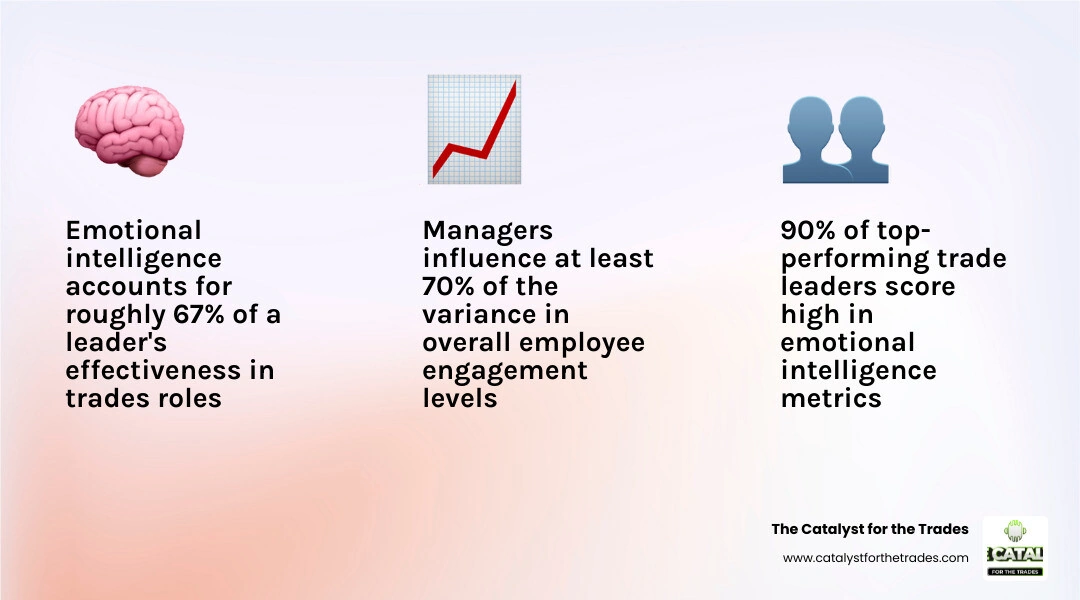
Research backs this up clearly. Emotional intelligence accounts for roughly 67% of a leader’s effectiveness, and 90% of top performers score high in EQ. Meanwhile, managers alone are responsible for at least 70% of the variance in employee engagement — meaning your foremen and supervisors have an enormous influence on whether your people stay fired up or quietly check out.
For decades, trades leadership ran on grit, hustle, and a “figure it out” mentality. That approach built a lot of great companies. But the workforce has changed. Retaining talent is harder. Clients expect more. And the pressure to perform keeps climbing. The leaders who are pulling ahead in 2026 are not just the most technically skilled — they are the ones who know how to read a room, handle conflict without blowing up a crew, and build the kind of trust that keeps good people around.
This guide is built for home services business owners and managers who want to lead better, scale smarter, and build teams that last.
What is Emotional Intelligence and Why It Matters in the Trades
When we talk about intelligence in the trades, we usually think of technical expertise—the master plumber who can diagnose a complex piping issue in minutes, or the HVAC technician who knows modern heat pumps inside and out. That is cognitive intelligence, or IQ.
However, there is another form of intelligence that dictates how successfully we navigate the human side of the job: Emotional Intelligence (EI), often referred to as Emotional Quotient (EQ). Originally popularized by psychologists in the 1990s, EQ represents our ability to recognize, understand, manage, and effectively use our own emotions, while also perceiving, interpreting, and responding to the emotions of those around us.
For trade leaders, EQ is broken down into five core pillars:
- Self-Awareness: Recognizing your own emotional states, triggers, and biases, and understanding how your mood impacts the crew.
- Self-Regulation: The ability to control impulsive reactions, stay calm under pressure, and choose constructive responses over explosive outbursts.
- Empathy: Understanding the perspectives, challenges, and feelings of your team members and customers.
- Social Skills: Building strong relationships, managing conflict, and guiding teams toward collaborative goals.
- Motivation: Possessing an inner drive to achieve excellence that goes beyond just collecting a paycheck.
While technical training gets your foot in the door, developing Managerial Skills for Trade Professionals requires a deep commitment to mastering these five pillars. In high-stakes home services and construction environments, EQ is what prevents a minor field mistake from turning into a shouting match that ruins crew morale for the week. By practicing Authentic Leadership in Home Services, leaders can transition from simply being “bosses” to becoming true mentors who inspire loyalty.
Understanding How Emotional Intelligence Makes Better Leaders in the Trades Industry
To understand how emotional intelligence makes better leaders in the trades industry, we have to look at the metrics that keep business owners awake at night: employee retention, safety, and project performance.
The data is clear: emotional intelligence has a massive 58% influence on the success and productivity of workers across various industries. When a supervisor possesses high EQ, they do not just manage tasks; they manage the emotional climate of the job site. This is crucial because construction and home service environments are inherently high-pressure. Material delays, unexpected weather, and demanding clients can create a powder keg of stress.
An emotionally intelligent leader acts as a shock absorber. Instead of reacting to a setback with anger—which shuts down communication and increases the likelihood of safety mistakes—they regulate their emotions, pause, and guide the team toward a solution. This approach directly drives employee retention. People do not quit their trades; they quit supervisors who make them feel undervalued, ignored, or constantly criticized. Embracing People-First Leadership in Construction ensures that field crews feel respected, which keeps turnover low and productivity high.
The Shift from Tough-Guy Mentality to Modern Leadership
Historically, the skilled trades have been dominated by a “tough-guy” culture. Under this old-school model, feelings were left in the truck, and leadership was synonymous with yelling, demanding, and driving crews to the point of burnout. The prevailing attitude was often, “The beatings will continue until morale improves.”
But in 2026, that style of management is a fast track to business failure. Today’s workforce is incredibly diverse, spanning multiple generations—from baby boomers to Gen Z—each with different motivations, expectations, and communication preferences. Younger workers, in particular, expect psychological safety at work. They want to know the why behind a task, not just the what, and they expect to be treated with respect.
This shift does not mean we lose our edge or stop working hard. Instead, as we learn from Unfiltered Leadership Lessons from Kathryn Elizabeth and Laura Kelly, modern leadership requires balancing high standards with genuine human connection. When leaders replace screaming with constructive coaching, they create an environment where team members feel safe to admit mistakes early—before those mistakes get buried under concrete or drywall, costing thousands of dollars to fix.
How Emotional Intelligence Makes Better Leaders in the Trades Industry
A leader’s emotional intelligence directly impacts the bottom line of every project. When things go wrong on a job site, a low-EQ leader seeks someone to blame. A high-EQ leader seeks to understand the breakdown and find a solution.

To see how this plays out in day-to-day operations, let us compare traditional command-and-control leadership with EQ-driven leadership:
| Leadership Area | Traditional Command-and-Control | EQ-Driven Leadership |
|---|---|---|
| Handling Mistakes | Immediate yelling, public blame, treating errors as personal failures. | Asking open questions, analyzing context, treating mistakes as “lessons paid for.” |
| Dealing with Conflict | Avoiding the issue or using authority to force compliance. | Active listening, finding root causes, guiding teams to collaborative solutions. |
| Client Relations | Defensive posture, focusing strictly on contract terms. | Empathetic listening, validating concerns, building long-term trust. |
| Stress Management | Projecting anxiety onto the crew, raising the pressure. | Modeling calm, acting as an “emotional spotter” for the team. |
Improving Teamwork, Communication, and Conflict Resolution
On any trade crew, teamwork is not a luxury—it is a safety requirement. Whether you are running a commercial HVAC install or a residential plumbing repipe, the team must operate as a cohesive unit.
When conflicts arise—as they inevitably do when crews work long hours in tight spaces—an emotionally intelligent leader does not ignore the tension. They address it early and constructively. They teach their team the power of taking radical ownership. Instead of pointing fingers, team members are encouraged to ask: “What could I have done differently to prevent this, and how can we fix it together?”
This collaborative environment is exactly what powers real change. In the story of Jazmin Ramirez: How Real Leadership Powers Change in the Trades, we see how leading with empathy and open communication can break down traditional barriers, align diverse crews, and elevate the performance of an entire organization.
Managing Client Relationships and Building Trust
In the home services industry, your technicians are not just working with pipes and wires; they are working with people. Customers are often stressed, dealing with flooded basements, broken air conditioners, or major financial decisions.
An emotionally intelligent leader models the behavior they want to see in their field technicians. When a customer is angry or anxious, a high-EQ technician does not get defensive. They practice active listening, validate the customer’s frustration, and explain the solution clearly. This builds immediate trust and turns a stressful service call into a lifelong customer relationship.
As we scale our operations, maintaining this high level of customer trust requires intentional leadership. Understanding How Trey McWilliams Balances Big Growth with People-First Leadership shows us that even during rapid expansion, keeping human empathy at the center of your client interactions is what protects your brand’s reputation and fuels sustainable growth.
Decision-Making and Stress Management Under Pressure
When an emergency call comes in at 2:00 AM, or a critical piece of equipment fails on a tight deadline, a leader’s emotional state dictates the team’s response. Under high stress, our brains naturally trigger a fight-or-flight response.
Leaders with high self-regulation can pause, recognize this physiological spike, and make rational, data-driven decisions rather than emotional ones. This ability to maintain psychological resilience under pressure is a core trait of Executive Leadership in Service Businesses.
Furthermore, academic research shows that emotional intelligence builds self-efficacy—a person’s belief in their ability to succeed. When a leader models this resilience, it ripples through the crew, giving them the confidence to tackle complex, high-pressure challenges without losing their focus or compromising safety.
The Core Components of EQ on the Job Site
To make emotional intelligence highly practical for your daily operations, it helps to focus on how these skills present themselves in the field.
When we look closely at successful trade crews, we see several distinct EQ traits in action:
- Active Listening: Hearing what your crew and clients are saying without immediately formulating your rebuttal.
- Radical Ownership: Admitting when you made a bad call and focusing on the path forward.
- Predictive Empathy: Noticing when a crew member’s body language or tone changes, indicating they might be distracted, stressed, or dealing with personal issues that could compromise job site safety.
- Constructive Feedback: Framing critiques around specific behaviors and growth, rather than attacking a person’s character or intelligence.
Applying EQ to Team Dynamics: How Emotional Intelligence Makes Better Leaders in the Trades Industry
Academic studies in project management consistently demonstrate that a leader’s emotional intelligence does not just directly improve project outcomes—it does so by enhancing team cohesiveness.
When a foreman or project manager has high EQ, they establish clear group norms that promote cooperation and eliminate toxic, negative emotional environments. This team cohesiveness acts as a bridge. No matter how complex or difficult a project is, a highly cohesive team can adapt and solve problems together because they trust one another and their leader.
For business owners, investing in these social dynamics is a primary lever for growth. Our work in Leadership Development for Business Owners focuses on helping owners step back from daily micro-management and instead focus on building a strong, self-sustaining organizational culture where emotional intelligence is valued and modeled at every level.
Practical Ways to Develop and Measure EQ Skills
One of the greatest myths about emotional intelligence is that you are either born with it or you aren’t. In reality, EQ is a set of skills that can be trained, practiced, and measured over time.
Here are some practical strategies we use to build EQ in trade organizations:
- Implement 360-Degree Feedback: Allow field crews, peers, and upper management to anonymously rate supervisors on communication, stress management, and empathy. This helps identify blind spots that a leader might not see.
- Deliver Micro-Learning Lessons: Introduce short, 3-to-5-minute lessons on active listening, conflict resolution, or self-regulation during morning huddles.
- Establish “Emotional Spotters”: Just like you have a spotter when backing up a heavy service truck, encourage leaders to have a trusted peer or manager point out when they seem highly stressed or reactive on a tough day.
- Utilize Structured Programs: Enroll your management team in dedicated Leadership Development Programs that focus specifically on soft skills, accountability, and modern people management.
For a step-by-step roadmap on how to build these training structures within your contracting business, check out our comprehensive Leadership Training Contractors Guide.
Frequently Asked Questions About EQ in the Trades
Why is emotional intelligence especially important for leaders in the trades?
The trades industry is unique because of its high-pressure, physical, and collaborative nature. Almost every job is completed as a crew. In these tight-knit, high-stress environments, a single toxic attitude can ruin crew morale, lead to safety shortcuts, and drive away top talent. Leaders with high emotional intelligence keep crews focused, safe, and aligned, directly reducing costly turnover.
How does team cohesiveness mediate the relationship between a leader’s EQ and project success?
A leader’s EQ is the fuel, but team cohesiveness is the engine. When a leader practices empathy, self-regulation, and clear communication, they build a culture of mutual trust. This trust allows the team to work as a unified force (cohesiveness). Academic research confirms that this team cohesiveness is the primary pathway through which a leader’s EQ translates into on-time, on-budget project success.
What role does organizational culture play in amplifying the benefits of EQ?
Organizational culture acts as a multiplier. If a company’s culture rewards ego, blame, and silent compliance, even an emotionally intelligent foreman will struggle to make a difference. However, when the company culture actively supports open communication, continuous learning, and psychological safety, the benefits of EQ are amplified, creating a positive ripple effect from the front office to the field.
Conclusion
At The Catalyst for the Trades, we believe that the future of the home services and construction industries belongs to leaders who pair technical excellence with high emotional intelligence. When you invest in developing the EQ of your foremen, supervisors, and project managers, you are not just making your workplace more pleasant—you are building a highly productive, incredibly resilient business that top talent fights to work for.
If you are ready to transform your supervisors into true leaders who can drive retention, scale your operations, and secure your company’s legacy, explore our resources on Trades Leadership Development today. Let us build a stronger, more profitable future for your business together.


